The digital economy favors aerial metaphors. Data circulates through the “cloud,” companies deploy “dematerialized” services, markets operate in real time, and communications appear to travel instantaneously through a borderless space. Yet this representation conceals a far more material reality.
Beneath the oceans lies the physical infrastructure of digital globalization.
Fiber-optic cables connect continents, cross the Atlantic and Pacific, run along African coastlines, traverse the Mediterranean, and converge toward the Red Sea and the Indian Ocean. According to the International Telecommunication Union, more than 99% of international data traffic is carried by submarine cables. The ITU estimates that around 500 systems span more than 1.7 million kilometers.
Through them pass private communications, financial transactions, cloud services, part of government communications, the flows required by businesses, and an increasing volume of data associated with artificial intelligence.
The Internet, therefore, is not merely a computer network.
It is also a maritime network.
And as data becomes a strategic resource, the geography of these cables is becoming a geography of power.
The Forgotten Infrastructure of the Internet
The idea of a world connected by submarine cables predates the Internet by more than a century. In the nineteenth century, the first transoceanic telegraph links had already profoundly altered the relationship between distance and power. Empires could communicate with distant territories much more rapidly; financial centers received commercial information at previously unimaginable speeds; governments could transmit instructions across oceans.
The cable was already a geopolitical infrastructure.
Modern fiber optics are its technological successor.
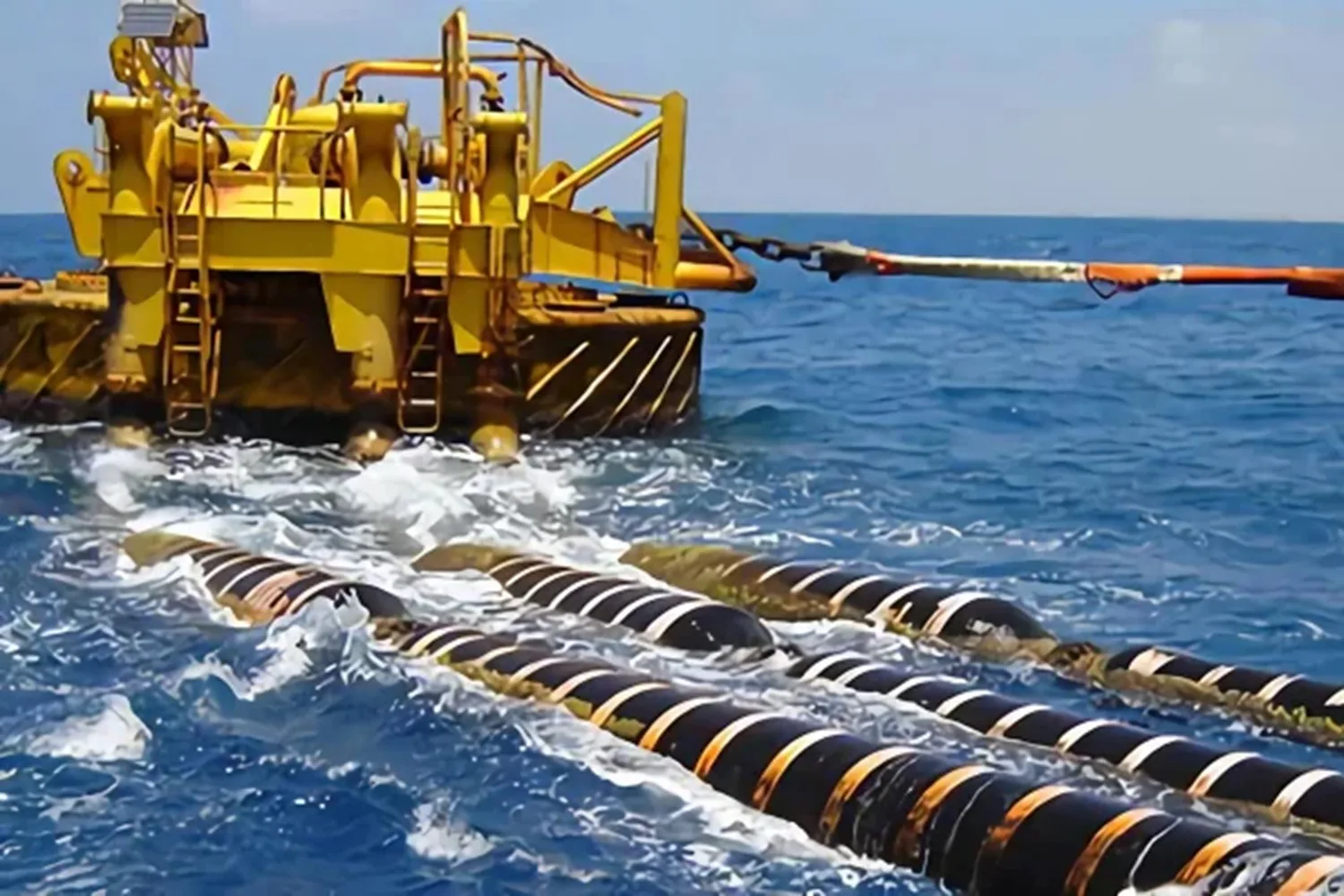
The principle remains relatively simple: beams of light carry information through extremely thin fibers bundled together and protected by several layers of material. Repeaters positioned at regular intervals amplify the signal across thousands of kilometers. Near coastlines, where the risks posed by anchors and fishing activity are greater, cables generally receive additional protection and can be buried beneath the seabed.
This infrastructure is remarkably efficient. It is also discreet enough to have remained largely absent from public debate for decades.
Satellites occupy a spectacular place in the technological imagination, but they do not form the primary backbone of international communications. For transporting immense volumes of data between continents with low latency, submarine fiber remains critical.
The global Internet therefore rests on a paradox: one of the most important infrastructures of the contemporary economy remains almost entirely invisible.
A New Strategic Geography
Submarine cables are not distributed evenly across the planet.
They follow the geography of populations, economies, data centers, and major commercial routes. They converge on particular coastlines and at specific passage points where physical geography imposes its constraints.
The North Atlantic naturally concentrates numerous connections between North America and Europe. The Pacific links American digital centers with the major Asian economies. Africa has progressively benefited from new infrastructure running along its Atlantic and eastern coastlines. The Mediterranean forms an interface between Europe, Africa, and Asia.
Yet one of the most sensitive corridors lies between the Mediterranean, Egypt, the Red Sea, and the Indian Ocean.
Geography suddenly reasserts itself in a universe often imagined to have transcended distance.
A cable connecting Europe and Asia must either circumvent Africa or use corridors linking the Red Sea to the Mediterranean. Physical constraints therefore create concentrations of digital routes, just as they have long created concentrations of commercial and energy routes.
Data has its own straits.
This reality transforms certain territories into strategic crossroads. Cable landing stations — the points where submarine cables leave the ocean and connect to terrestrial networks — become critical infrastructure in their own right. A global map of submarine cables therefore reveals another representation of globalization: not one defined by political borders, but by the corridors through which information flows.
When Technology Giants Go to Sea
For decades, international cables were primarily built by consortia of telecommunications operators. The explosion of cloud computing and digital platforms has gradually transformed this structure.
Major technology companies have become directly involved in financing and deploying submarine infrastructure.
Google, Meta, Microsoft, and Amazon Web Services have participated in different cable systems, sometimes through consortia and sometimes with much more direct involvement.
The economic rationale is clear.
Global platforms generate enormous volumes of traffic between their data centers. Owning or directly reserving international capacity reduces dependence on traditional operators, optimizes the routes taken by data, and supports the worldwide expansion of cloud infrastructure.
But the phenomenon also has a strategic dimension.
A company that controls data centers, digital platforms, cloud infrastructure, and part of the capacity connecting these systems is no longer simply operating services on the Internet. It is participating in the construction of the Internet’s physical architecture.
The boundary between technology company and infrastructure operator becomes increasingly blurred.
The Cloud Has a Territory
This development challenges one of the most persistent representations of the digital economy: the idea of infrastructure detached from geography.
A data center exists somewhere.
It depends on an electricity grid.
The semiconductors inside it originate from specific factories.
The information it processes must enter and leave.
And when that information crosses an ocean, it generally travels through physical infrastructure whose route can be mapped.
The cloud therefore has a geography.
This geography explains why contemporary technological competition extends far beyond software. Digital power simultaneously depends on semiconductors, data centers, energy, terrestrial networks, satellites, and submarine cables.
A weakness in any one of these links can affect the whole.
The rise of artificial intelligence further reinforces this material dependence. AI models require enormous computing capacity, but the concentration of computing power in large data centers also increases the importance of networks capable of moving immense volumes of information rapidly between regions.
The more digital the economy becomes, the more strategic its physical foundations become.
A Resilient but Vulnerable Infrastructure
Cable breaks are not exceptional events.
Most do not result from hostile action. Ship anchors, fishing activity, submarine landslides, earthquakes, and other natural or human events can damage infrastructure. The ITU reported more than 200 cable repairs worldwide in 2023, equivalent to more than three failures per week on average.
The global network has been designed precisely to absorb some of these incidents. When one connection is interrupted, traffic can often be rerouted through alternative paths.
Resilience, however, depends on available redundancy.
A major digital hub connected through numerous cables has several alternatives. An island state or a country connected through only a handful of systems may find itself in a far more fragile position. The report adopted in July 2026 by the international body dedicated to submarine cable resilience specifically highlighted the geographic concentration of infrastructure and the dependence of many countries on a limited number of systems.
The vulnerability therefore lies not only in the cable itself.
It lies in the structure of the network.
From Accidental Risk to Strategic Risk
This vulnerability takes on another dimension when the possibility of intentional action enters the equation.
Events observed in the Baltic Sea in recent years have drawn European governments’ attention to submarine infrastructure. Several telecommunications or energy cables have been damaged in the region, prompting investigations whose conclusions and levels of attribution have varied from one incident to another.
That distinction is essential: a damaged cable does not automatically constitute sabotage.
But repeated incidents are sufficient to alter security doctrines.
In February 2025, the European Union adopted an action plan dedicated to cable security. It covers prevention, detection, response, repair, and deterrence. Following mapping and risk-assessment work published in 2025, the EU presented a “Cable Security Toolbox” in February 2026, together with a list of projects considered strategically important.
The shift in perception is significant.
What once belonged primarily to the technical management of telecommunications has entered the realm of national security.
The Seabed as a New Arena of Confrontation
This evolution is part of a broader transformation in contemporary conflict.
Between peace and open warfare lies a wide spectrum of ambiguous actions: cyberattacks, jamming, influence operations, espionage, economic pressure, maritime incidents, and attacks on infrastructure.
Submarine cables fit this environment remarkably well.
They extend across enormous distances. Much of their route lies far from shore. Permanent surveillance is difficult. Damage can result from entirely ordinary events. And attributing an intentional act can be complex.
That ambiguity is itself a strategic vulnerability.
Damaging infrastructure is one thing. Demonstrating who did it, under what circumstances, and with what intention is another.
Protecting submarine cables therefore cannot be limited to physical surveillance. It also requires maritime intelligence, vessel monitoring, cooperation between states, repair capacity, route diversification, and contingency planning to maintain communications if several links are disrupted simultaneously.
Digital security can therefore begin far from any screen, thousands of meters beneath the ocean’s surface.
The United States, China, and the Battle for Infrastructure
The Sino-American rivalry gives the issue an additional dimension.
Washington and Beijing are competing not only over semiconductors, artificial intelligence, telecommunications, and digital platforms. They are also seeking to shape the infrastructure upon which the global economy of the coming decades will depend.
The choice of a cable supplier, operator, route, or landing point can now be examined through the lens of national security.
The logic resembles the controversies surrounding 5G networks, but it applies to an even more fundamental layer of infrastructure.
The party that builds part of the network does not necessarily control the information flowing through it. Cable systems are complex, traffic can be encrypted, and networks incorporate multiple layers of protection. It would therefore be simplistic to equate infrastructure ownership automatically with control over data.
Governments, however, increasingly think in terms of dependencies.
Who manufactures the equipment?
Who lays the cables?
Who maintains them?
Who controls the landing stations?
Who can intervene when a system is damaged?
Which routes would remain available during a crisis?
Digital sovereignty is no longer simply about protecting data. It increasingly requires understanding the entire material chain that allows data to move.
Repair Is Also a Strategic Capability
Cable ships illustrate this transformation particularly well.
Laying or repairing a submarine cable requires specialized vessels, trained crews, specific equipment, and a logistical organization capable of operating thousands of kilometers from home ports.
A global infrastructure can therefore possess redundancy while remaining vulnerable if its repair capacity is insufficient.
Time becomes a strategic factor.
A single disruption may be absorbed by the network. Several simultaneous breaks within the same region can generate congestion. If suitable vessels are scarce or far away, complete restoration may take considerably longer.
This is precisely why repair capabilities are increasingly incorporated into public policy. The ITU has identified potential delays in cable repairs as a resilience challenge, while the European Union is working to strengthen its response and recovery capabilities.
Possessing infrastructure is not enough.
It must also be possible to restore it.
The New Routes of Digital Power
Faced with these risks, the most obvious response is to multiply routes.
New cables can directly connect regions that previously depended on intermediate hubs. African coastlines are benefiting from additional connections. Island states are seeking to reduce their dependence on a single link. Major platforms are constructing systems capable of directly connecting their principal digital centers.
Other routes may also become increasingly important.
The High North is one area to watch. Retreating sea ice, changing maritime activity, and competition over Arctic infrastructure are gradually opening new possibilities for connectivity between Europe, North America, and Asia.
The logic is similar to that of maritime transport: diversifying routes can reduce certain dependencies while simultaneously creating new strategic spaces that must be protected.
The global network could therefore become denser while becoming politically more fragmented.
Digital Sovereignty Goes Underwater
For years, the debate over digital sovereignty focused on software, personal data, platforms, and cloud computing.
It is now expanding to physical infrastructure.
Governments are rediscovering that a sovereign digital economy requires not only technology companies and data centers, but also sufficiently diversified and resilient connectivity.
This does not mean that states will replace private actors. The economics of submarine cables depend precisely on massive investments by telecommunications operators, consortia, and increasingly global technology companies.
The central question is therefore how private ownership and collective security can coexist.
An infrastructure can belong to a company while remaining indispensable to the functioning of an entire country.
The same is already true of electricity networks, ports, cloud infrastructure, and many telecommunications systems. Submarine cables make this interdependence particularly visible because they cross jurisdictions and directly connect multiple continents.
The global digital network is largely private in its construction, transnational in its operation, and strategic in its consequences.
That combination forces governments to develop new forms of cooperation with the companies that own and operate it.
Geography Never Disappeared
The digital age was supposed to abolish distance.
It mostly made distance less visible.
A message sent from Casablanca to New York can cross the Atlantic in a fraction of a second. A European company can use a service hosted on another continent without knowing precisely which route its data follows. Billions of users can simultaneously access the same platforms and experience what appears to be a single global space.
But behind that abstraction lies an infrastructure profoundly shaped by geography.
It has routes.
It has crossroads.
It has points of concentration.
It has vulnerable zones.
And it now has its own strategic rivalries.
Previous centuries had their trade routes, railways, pipelines, straits, and canals. The twenty-first century has not replaced them. It has added another layer of infrastructure.
At the bottom of the oceans, strands of glass carry an essential share of contemporary human activity.
Digital power therefore belongs not only to those who manufacture the most advanced semiconductors, train the most capable artificial intelligence models, or build the largest data centers.
It also belongs to those who can connect these infrastructures, diversify their routes, protect their connections, and restore them when they are disrupted.
The cloud floats in our vocabulary.
Its arteries lie on the ocean floor.
Main Sources
- International Telecommunication Union (ITU), Submarine Cable Resilience and the work of the International Advisory Body on Submarine Cable Resilience, 2024–2026.
- International Telecommunication Union, data on the global submarine cable network and international data traffic.
- European Commission, EU Action Plan on Cable Security, mapping and risk-assessment methodology, 2025.
- European Commission, Report on Security and Resilience of EU Submarine Cable Infrastructures, October 2025.
- European Commission, Submarine Cable Security Toolbox and Cable Projects of European Interest, February 2026.
Atlas Limits Research Desk
Atlas Limits’ editorial and analytical desk.