Sometimes, all it takes is buying nothing.
No demonstration, no strike, no vote, not even necessarily a formal organization. A consumer switches brands. A university withdraws an investment. A retailer stops carrying a product. An artist refuses to perform in a country. A bank closes a financing line. A few million individual decisions, insignificant when taken separately, can become an economic force.
The boycott rests on an almost elementary idea: in an economy built on exchange, the refusal to exchange has value too.
Its history, however, shows that this instrument extends far beyond consumption. It belongs to a much broader family of strategies that use economic, commercial, financial, cultural or institutional exclusion to influence the behavior of another actor. Between a consumer refusing a bottle, a fund selling a stake, a university divesting and a state imposing an embargo, the means and legal frameworks differ profoundly. Yet the underlying logic remains the same: turning an economic relationship into an instrument of power.
In the age of social media, this old mechanism has changed scale. A local controversy can now become global within hours. But this apparent power conceals a more complicated reality. Many boycotts generate noise without materially changing sales. Some damage reputation more than revenue. Others genuinely force companies to change policy. And a few produce precisely the opposite effect: they mobilize opponents of the boycott, who begin buying more.
Understanding the boycott therefore means less measuring outrage than examining how power circulates through the economy.
A Man Who Became a Verb
The word itself comes from a man.
In 1880, in County Mayo, Ireland, Charles Cunningham Boycott managed land on behalf of a landowner. Against the backdrop of the Irish Land War, disputes over rents and evictions pitted landlords against tenant farmers. Activists associated with the Irish National Land League developed an unusual method: rather than attack Boycott directly, the community would progressively cease cooperating with him.
Workers refused to harvest his fields. Merchants stopped serving him. Domestic staff left their jobs. Economic isolation became social isolation as well.
The affair attracted enough attention for Charles Boycott's surname to escape its owner and enter the international political vocabulary. To “boycott” would henceforth mean an organized refusal to maintain economic or social relations with a person, organization or country in order to exert pressure.
The word was Irish. The practice, of course, was not.
Long before 1880, communities had understood that consumption could become political. Refusals of imported goods, campaigns against particular merchants and forms of economic ostracism had accompanied social, religious, colonial and national conflicts for centuries. With industrialization and the emergence of large brands, however, the method acquired a new reach: consumers became a dispersed but potentially coordinated force.
The market ceased to be merely the place where economic preferences were expressed. It also became a place where political preferences could be expressed.
When Consumers Discover Their Power
The boycott has a remarkable characteristic: it allows individuals who control neither the company nor the state to attempt to influence both.
Consumers do not normally vote on the strategy of a multinational corporation. They do not sit on its board of directors or determine its investment policy. Yet they possess a small power exercised hundreds of times every year: to buy or not to buy.
A boycott politicizes that decision.
The act appears weak because the loss of one customer is almost invisible to a large corporation. Its potential power comes from coordination. When enough individuals adopt the same behavior simultaneously, the cost changes in nature. It can affect sales, then distributors, then margins, then reputation and ultimately investors.
But this chain is never automatic.
That is precisely what makes the economics of boycotts more interesting than their public manifestation. The number of posts on a social network is not the number of consumers who have actually changed their purchasing behavior. Declared intention is not necessarily action. And a highly indignant consumer may discover, when the moment comes to act, that there is no acceptable substitute for the product being avoided.
The cost of a boycott is therefore shared between the target and the person doing the boycotting.
The more numerous and comparable the alternatives, the easier refusal becomes. Replacing a beverage, a restaurant or a clothing brand is relatively simple. Exiting a technological ecosystem, a payment infrastructure, professional software or an industrial supply chain overnight is considerably harder.
Market structure therefore becomes decisive.
A boycott against a company surrounded by close competitors can quickly transform moral preference into commercial substitution. A boycott targeting a near-monopoly can generate enormous amounts of discourse and remarkably little change in actual behavior.
Moral power then encounters an old economic reality: elasticity.
Boycotts Do Not Always Strike Where We Think
A study published in the Southern Economic Journal in 2019 examined 125 boycotts targeting American companies between 1978 and 2017. It identified, on average, a statistically significant negative effect on the shareholder wealth of targeted firms. Effects appeared in campaigns involving social relations, animal rights, wages in developing countries, discrimination and ideological, political or religious issues.
That does not mean every campaign causes sales to collapse.
Research on social movements suggests instead that the principal transmission mechanism may lie elsewhere. A boycott creates a reputational threat. Media coverage amplifies that threat. Investors begin incorporating the risk. Business partners start asking questions. Executives must devote time and political capital to the crisis. The original question — will some consumers buy less? — becomes a much broader one: how much will maintaining this controversy cost the company?
The real objective is therefore not necessarily to deprive a company of revenue immediately.
It may be to change its calculation.
A campaign succeeds when the economic, reputational, institutional or political cost of maintaining a decision becomes greater than the cost of changing it. Under these conditions, even a modest decline in sales can matter if it triggers extensive media coverage, worries investors or threatens essential commercial relationships.
Conversely, a campaign generating millions of posts can fail if the company concludes that public attention will disappear before producing structural damage.
Time becomes a strategic variable.
From Montgomery to Pretoria
Some boycotts have nevertheless extended far beyond the relationship between a brand and its customers.
In the major political movements of the twentieth century, economic refusal sometimes served as an extension of social mobilization. It made material a conflict that might otherwise have remained symbolic.
The Montgomery bus boycott, which began in December 1955 after the arrest of Rosa Parks, remains one of the best-known examples. For more than a year, a substantial part of the city's Black population refused to use municipal buses. The everyday act of not boarding a vehicle became a mechanism of collective mobilization and one of the formative episodes of the American civil rights movement.
South Africa provides an even broader example of the gradual expansion of the boycott.
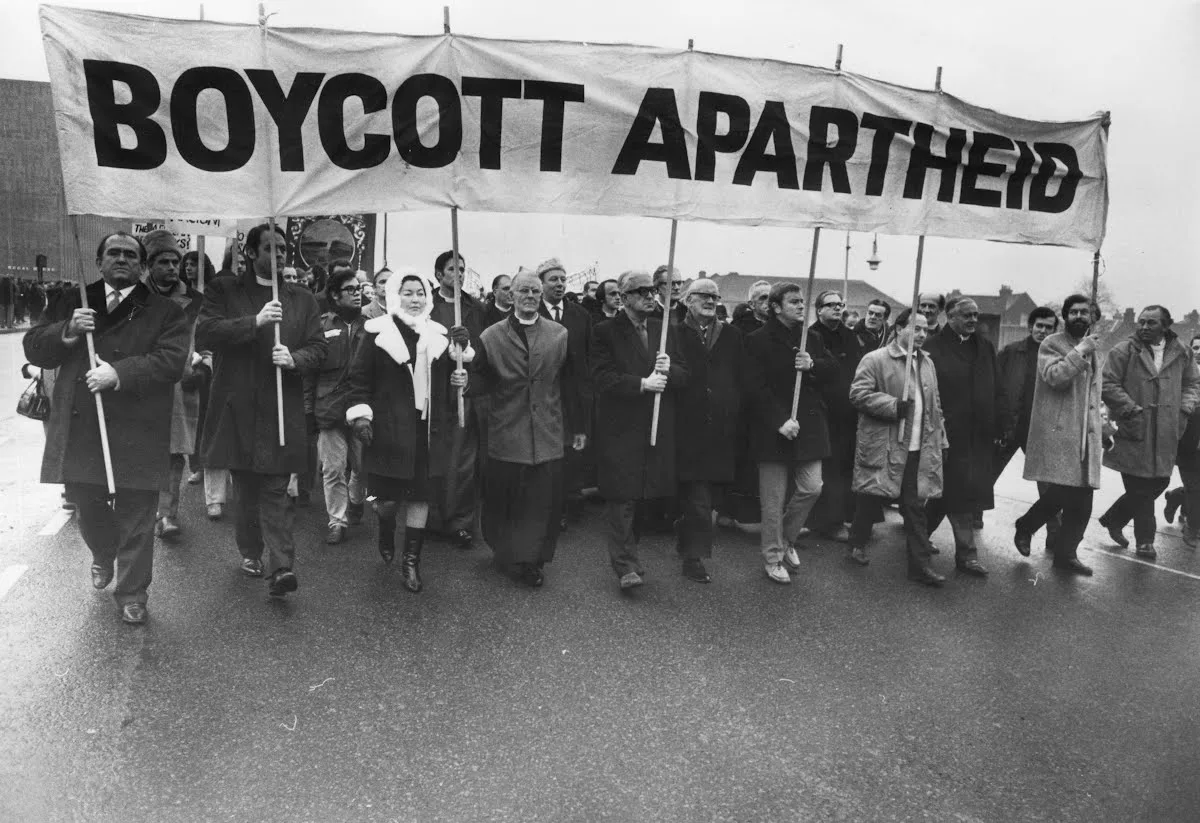
The international struggle against apartheid was not confined to consumers. Over time, it combined diplomatic pressure, divestment campaigns, cultural and sporting boycotts, trade restrictions and government sanctions.
The United Nations progressively became part of this architecture. The Security Council called on states in 1963 to halt arms sales to South Africa; the arms embargo became mandatory in 1977. The General Assembly also encouraged the suspension of cultural, educational and sporting exchanges and, during the 1980s, called for much broader economic measures. By 1988, a General Assembly resolution was encouraging restrictions involving petroleum, certain minerals and agricultural products, alongside the withdrawal of investments, credits and loans by international banks and corporations.
At this point, the word “boycott” is almost insufficient.
A voluntary consumer boycott, institutional divestment and sanctions imposed by a public authority must be distinguished from one another. Their political logic may converge, but their legal nature and coercive capacity are fundamentally different.
A consumer chooses not to buy.
A fund chooses to sell.
A government can prohibit.
That distinction is fundamental.
Boycott, Divestment, Embargo, Sanction
In public debate, these instruments are often conflated. Yet they represent several different degrees of constraint.
The classic boycott generally originates in civil society: individuals, associations, trade unions, religious organizations or other groups voluntarily coordinate their refusal.
Divestment moves the action from consumption to capital. A university, pension fund, foundation or asset manager may decide to sell securities issued by a company or companies belonging to particular sectors. The immediate target is no longer revenue but access to capital, valuation, investor reputation and, potentially, financing costs.
Embargoes and economic sanctions belong to another category. They result from public decisions and can legally prohibit particular transactions. The state turns what was an individual choice into a regulatory constraint.
The distinction becomes even more important because boycotts themselves can become subject to regulation.
The United States, for example, maintains an antiboycott regime administered by the Department of Commerce's Bureau of Industry and Security. Certain provisions discourage or prohibit U.S. persons and businesses from participating in foreign boycotts that are not sanctioned by the United States and impose reporting requirements in certain circumstances. The Bureau identifies the Arab League boycott of Israel as the principal unsanctioned foreign boycott currently addressed by these rules.
The paradox is striking: a state can itself use economic exclusion as an instrument of foreign policy while prohibiting its companies from participating in certain exclusions organized by other states.
A boycott is therefore never purely economic. Once it reaches sufficient scale, it encounters law, sovereignty and geopolitics.
The Brand as Political Territory
For a long time, a large corporation could hope to sell the same product to consumers whose political convictions it knew almost nothing about.
That neutrality has become harder to maintain.
Contemporary companies communicate about the environment, diversity, social rights, international conflicts or the values of their executives. Consumers, meanwhile, possess tools that allow them to document political donations, supply chains, investors, executive statements and corporate activities across different countries.
A brand is no longer merely a commercial sign.
It can become an identity.
And when commercial identity encounters a polarized society, the boycott itself can change function. It does not always seek a specific concession from a company. It can instead signal political belonging: “I do not buy this brand because what it represents is not what I am.”
Research published in 2025 on politically motivated boycotts highlights precisely this evolution: in highly polarized environments, some campaigns function less as attempts to secure an immediate change in corporate behavior than as mechanisms for expressing disagreement, displaying collective identity and discouraging other companies from adopting similar positions.
The product becomes a miniature ballot paper.
Unlike an election, however, everyone can vote every day.
The Counter-Boycott
This politicization produces a particularly revealing phenomenon: the buycott.
If one group decides to punish a company by refusing to purchase its products, the opposing camp can decide to reward it by purchasing more.
The economics of refusal then encounters the economics of support.
The episode involving Goya Foods in the United States in 2020 provides a particularly well-documented case. Following comments supportive of Donald Trump by the company's chief executive, calls for a boycott emerged on social media. They were rapidly accompanied by an opposing campaign encouraging supporters of the president to purchase Goya products.
Subsequent analysis of consumer data produced a counterintuitive result. Pro-boycott messages dominated the public conversation, yet Goya sales temporarily increased by approximately 22%. In heavily Republican counties, the increase reached 56.4%. The aggregate effect, however, disappeared after roughly three weeks.
The case reveals two things.
First, social networks measure conversation extraordinarily well and economic behavior much less reliably.
Second, in a polarized society, a boycott can inadvertently mobilize the commercial support of its opponents.
A targeted company can lose some customers while gaining others. The outcome then depends on the original composition of its customer base, the political intensity of each camp, the ease of substitution and the duration of the controversy.
The boycott becomes a battle between commercial coalitions.
The Visibility Trap
Social media has radically reduced the cost of organizing a boycott.
In the past, coordinating thousands of people required associations, trade unions, meetings, posters, newspapers and sometimes years of mobilization. Today, a hashtag can create the impression that a coalition exists before one has actually been built.
That is considerable power.
It is also a weakness.
Virality accelerates mobilization but often shortens its horizon. An outrage can reach millions of people within twenty-four hours and be replaced a few days later by another controversy. The corporation, meanwhile, possesses precisely what social media often lacks: time.
Executives can wait.
If the campaign changes neither sales nor distributor behavior, investor decisions, employee attitudes nor regulatory pressure, digital intensity can evaporate without leaving a major economic trace.
Success therefore depends less on initial volume than on the ability to convert attention into institutions.
The most powerful campaigns are generally those that cross several boundaries: consumers, media, employees, investors, professional organizations, universities, trade unions, religious institutions and governments. Pressure then ceases to be merely a communications phenomenon and becomes a change in the environment within which the targeted organization must operate.
An effective boycott builds a system.
An ephemeral boycott builds a trend.
Multinationals and the Risk of Fragmentation
For global companies, the problem becomes more complicated still.
A brand can now be boycotted simultaneously for contradictory reasons in different markets. A decision considered virtuous in one country can provoke hostility in another. An advertising campaign designed to appeal to one group of consumers can alienate another. A geopolitical position may protect the company in its domestic market while damaging its commercial position abroad.
There may no longer be a neutral position.
Silence can be interpreted as a position. Speaking becomes another.
This is gradually changing the management of brand risk. Companies must no longer simply assess the probability that a campaign will emerge; they must understand the political geography of their customer base.
Who buys the product?
In which countries?
With what convictions?
Which categories of consumers can realistically switch to another brand?
Which distributors might withdraw?
Which investors might regard the controversy as a material risk?
The answer no longer belongs solely to public relations.
It belongs to strategy.
Can a Globalized Economy Be Boycotted?
Another difficulty emerges when the target is no longer a brand but a country.
In an economy organized around global value chains, the origin of a product is rarely as simple as its logo. A car can be designed in one country, assembled in another and contain semiconductors manufactured in a third using machines produced in a fourth. A smartphone combines components, patents, software, minerals, logistics services and capital originating from multiple jurisdictions.
Boycotting an economic nationality therefore becomes considerably more complicated than avoiding a product.
Globalization made economies interdependent precisely by fragmenting production.
That fragmentation can reduce the legibility of a boycott. It can also multiply collateral damage. A campaign targeting an international company may affect local franchisees, employees, suppliers or investors who had no responsibility for the contested decision.
Here, the economics of the boycott encounters its moral and strategic limit.
Applying pressure to an organization requires understanding who will actually bear the cost.
Consumption as Imperfect Citizenship
Boycotts are attractive because they offer an immediately accessible form of power.
They require neither elected office nor wealth. Anyone can decide to participate. This simplicity helps explain why the boycott repeatedly returns in modern societies.
But the market is not a democracy.
Economic power is not distributed according to the principle of one person, one vote. Someone who consumes heavily mechanically possesses more capacity to withdraw spending than someone who consumes little. Someone with numerous alternatives can boycott more easily than someone dependent on a particular product or service. A fund managing billions possesses a capacity for divestment that bears little resemblance to that of an individual investor.
Political consumption is therefore a profoundly unequal form of citizenship.
It can complement political action.
It cannot replace it.
This is probably one reason why the great historical boycotts that genuinely transformed systems almost never remained mere boycotts. They became connected to social movements, institutions, investors, political parties, governments or legal transformations.
Economic refusal opened a door.
Change then passed through other institutions.
The Price of Refusal
Nearly a century and a half after Charles Boycott found himself isolated in the Irish countryside, his name now describes a behavior practiced on every continent.
The world, however, has changed radically.
Markets have globalized. Companies have become transnational. Investors can move billions in seconds. Social networks can coordinate a global campaign before a board of directors has had time to meet. Brands possess communities that can become almost as identity-driven as political organizations. And states themselves use access to markets, technologies, capital and financial systems as instruments of power.
In this world, the boycott is no longer an anomaly of the market.
It reveals one of its fundamental properties.
Every transaction requires two forms of consent. Whoever owns something can decide not to sell it. Whoever wants it can decide not to buy it. Between them lies a space that economics describes as exchange, but that politics can transform into a relationship of power.
The boycott begins precisely there.
Its power does not lie in outrage, or even necessarily in the number of people who proclaim their refusal. It lies in the ability to make that refusal sufficiently durable, coordinated and costly to alter the calculation of the actor at whom it is directed.
Everything else is noise.
And in an economy saturated with noise, distinguishing the refusal that passes from the refusal that costs has probably become the true measure of power.
Main Sources
United Nations — archives and documentation concerning the international campaign against apartheid and sanctions against South Africa.
United Nations Digital Library — General Assembly resolutions concerning apartheid policies and economic sanctions.
U.S. Department of Commerce, Bureau of Industry and Security — Office of Antiboycott Compliance and U.S. antiboycott regulations.
Southern Economic Journal — Kasaundra M. Tomlin, Assessing the Efficacy of Consumer Boycotts of U.S. Target Firms: A Shareholder Wealth Analysis, 2019.
Marketing Science — Jūra Liaukonytė, Anna Tuchman and Xinrong Zhu, Spilling the Beans on Political Consumerism: Do Social Media Boycotts and Buycotts Translate to Real Sales Impact?, 2022.
The Journal of Politics — Cindy D. Kam and Maggie Deichert, Boycotting, Buycotting, and the Psychology of Political Consumerism, 2020.
Journal of the Association for Consumer Research — research on strategic interactions between social movements, consumers and corporations.
International Review of Retail, Distribution and Consumer Research — recent research on politically motivated boycotts and brand polarization.
The Land League — historical documentation on Charles Cunningham Boycott and the Irish Land War.
Atlas Limits Research Desk
Atlas Limits’ editorial and analytical desk.