Madrid was supposed to celebrate a restored relationship. Instead, it revealed how a crisis unfolding along a few kilometres of North African border is changing scale.
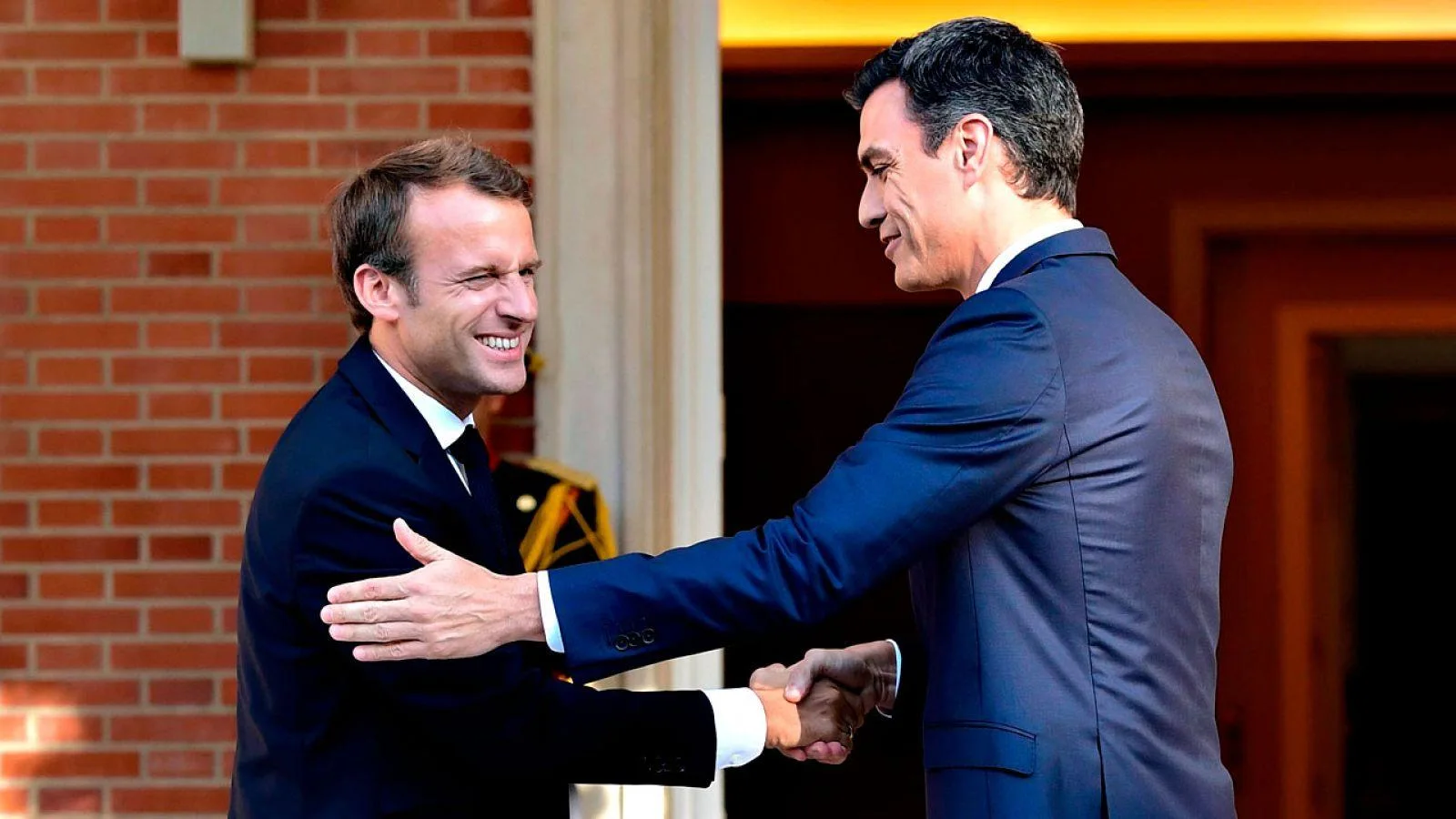
On 29 and 30 September 2026, Emmanuel Macron travelled to Spain for the first state visit by a French president since 2009. Received by King Felipe VI and then by Pedro Sánchez, the French president came to discuss economic cooperation, European industry, energy, Ukraine and the future of the European Union. But two months after the events in Ceuta, the Spanish enclave on the Moroccan coast moved to the centre of the visit.
And Emmanuel Macron’s choice of words was significant.
Asked in Madrid about the mass arrivals of 30 and 31 July, he said that Spain — and, beyond it, Europe — had been the victim of what was “rather an attack”. He described it as an attack that was “probably multiple” in nature, notably involving information operations that helped convince thousands of people that crossing into Ceuta was possible.
But he stopped there.
The French president did not identify Morocco as responsible. A few sentences later, he instead stressed the need to continue returns “in close coordination” with the Moroccan authorities, adding that this cooperation was working well.
Between those two statements lies the entire difficulty of Europe’s relationship with Rabat.
Two Days That Changed the Scale of Ceuta
The figures illustrate the magnitude of the event.
According to the Spanish government, more than 70,000 people entered Ceuta on 30 and 31 July. Madrid estimates that between 90 and 95% of them subsequently returned to Morocco within the first 24 to 48 hours. The Spanish government recorded 141 deaths during the crisis.
Ceuta, a city of around 80,000 inhabitants before the crisis, therefore faced within a matter of hours an influx almost equivalent to its permanent population.
The existing reception system was incapable of absorbing such numbers. Ceuta’s temporary migrant reception centre had only around 500 to 600 places. Madrid was forced to create more than 3,400 additional places and mobilise €309 million to reinforce reception capacity, public services, security and the local economy.
Yet the crisis did not emerge from a political vacuum.
On 8 July, Spain’s Supreme Court had ruled that certain immediate border-return procedures could not be applied to people arriving by swimming when no physical barrier prevented them from reaching Spanish territory. Madrid subsequently began installing a pneumatic barrier and buoys near Tarajal.
In the following weeks, social media spread the idea that a window had opened.
The Spanish government says human-trafficking networks exploited the court decision. Pedro Sánchez has also acknowledged that Moroccan authorities had warned Spain about population movements before the mass arrivals. According to his own account, Moroccan intervention became significantly more extensive roughly ten hours after the crisis began.
That detail matters.
It makes it impossible to reduce the events in Ceuta to a single interpretation.
Paris Chooses Its Words
It is precisely within this grey zone that Emmanuel Macron positioned himself in Madrid.
By speaking of an “attack”, he adopted part of Spain’s security vocabulary. By refusing to identify its author, he simultaneously avoided opening a confrontation with Rabat.
The distinction matters.
Macron did not say that Morocco attacked Spain. He said that Spain had suffered an attack and explicitly referred to an information component. He then stressed that returns needed to be organised with Morocco and that cooperation with the Moroccan authorities was working.
This diplomatic construction allows Paris to support Madrid without directly challenging the Franco-Moroccan rapprochement developed in recent years.
It also shifts the centre of the issue.
Ceuta is gradually ceasing to be presented merely as a bilateral matter between Spain and Morocco. It is becoming a question of Europe’s border.
Felipe VI had prepared the ground the previous day.
Speaking in Macron’s presence, the Spanish king argued that states located on the European Union’s external borders could not be expected to absorb this kind of shock alone. In this interpretation, the Ceuta border is no longer merely a Spanish border. It is one of Europe’s southern frontiers.
Macron adopted the same logic the following day.
European solidarity, European responsibility, protection of common borders, coordinated return policies and implementation of the European Pact on Migration and Asylum: the French response is less about publicly determining who was responsible for July than about turning Ceuta into a European issue.
Morocco Becomes Indispensable Without Being Blamed
This Europeanisation nevertheless places Rabat in a paradoxical position.
Morocco remains indispensable to any Spanish migration policy around Ceuta.
At the height of the crisis, Madrid publicly thanked Moroccan forces for their cooperation. As early as 31 July, Emmanuel Macron himself welcomed that cooperation, which had by then enabled tens of thousands of people to return. Spain’s Interior Ministry also highlighted the role played by Moroccan forces in preventing further attempted crossings.
Two months later, that operational dependence remains.
Madrid can reinforce its infrastructure. Brussels can expand Frontex. Paris can call for better coordination within Schengen. None of these measures changes the geographical reality: in some places, only a few metres separate Moroccan territory from the European Union’s external border.
Ceuta’s stability therefore depends partly on decisions made on the other side of that border.
This is where the Morocco-Spain relationship reveals its singular character.
Over recent years, Madrid and Rabat have rebuilt extensive cooperation on migration, security, trade and the economy. That architecture produces results when it functions. It also reveals its vulnerability whenever human movements become an instrument of pressure — whether real, perceived or simply beyond control.
The events of July demonstrated that an apparently stabilised border could change within hours.
An Increasingly European Border
The most lasting consequence may therefore not lie in the relationship between Rabat and Madrid.
It may lie in Brussels.
The Ceuta crisis comes precisely as the European Union is attempting to transform its migration policy: stronger external controls, accelerated asylum procedures, solidarity mechanisms between member states, faster returns and an expanded role for Frontex.
Ceuta is almost a textbook case for this emerging doctrine.
An extremely rapid migration surge hits a geographically isolated European territory. Local capacity becomes overwhelmed. The affected state asks its partners for solidarity. Neighbouring countries fear secondary movements within Schengen. And restoring normality ultimately depends on cooperation with a third country.
The equation extends far beyond the enclave’s 18.5 square kilometres.
It raises a much broader question: where does Europe’s border actually begin?
Legally, it begins in Ceuta.
Operationally, it begins partly in Morocco.
Politically, it now stretches back to Madrid, Paris and Brussels.
Another Paradox in Madrid
The French visit also produced an almost contradictory scene.
At the very moment Macron and Sánchez were displaying their political proximity, the Spanish Senate rejected the Franco-Spanish Treaty of Friendship and Cooperation signed in Barcelona in January 2023.
The text was defeated by 142 votes to 106, with one abstention. The Partido Popular and Vox voted against it, while the Socialists and several nationalist parties supported it.
France had already ratified the treaty.
Sánchez publicly apologised to Macron and insisted that the agreement would eventually be adopted. The French president played down the incident.
The episode nevertheless remains revealing.
Paris and Madrid are seeking to deepen their cooperation at the same time as Spain’s domestic politics make the formalisation of that relationship more difficult.
On Ceuta, however, the convergence is considerably clearer.
France has now adopted part of Spain’s interpretation of the crisis: what happened at the gates of Ceuta does not concern Spain alone.
Ceuta Is No Longer Just Ceuta
For decades, the Spanish enclaves of Ceuta and Melilla could be viewed as geographical anomalies inherited from history: two pieces of Europe on the African coast, administered by Madrid and claimed by Rabat.
The July crisis gives them another function.
They are becoming laboratories of the European border.
What happens there now touches asylum policy, movement within Schengen, relations with transit countries, information security and the European Union’s ability to absorb extremely large human movements within a matter of hours.
Macron did not resolve Ceuta’s fundamental ambiguity.
He exposed it.
Spain can consider itself to have suffered an attack without France publicly identifying its author. Morocco can remain the indispensable partner in restoring control of the border without disappearing from the strategic equation. And the European Union can expand its presence without being able to change geography.
In Ceuta, Europe is therefore discovering a reality it is likely to encounter elsewhere: a border can never be controlled solely from the side on which it is drawn.
Main Sources
— Presidency of the French Republic, Élysée, “State Visit to Spain”, Emmanuel Macron’s press conference in Madrid, 30 September 2026. — Presidency of the Government of Spain, La Moncloa, Pedro Sánchez statement on the Ceuta crisis, 3 September 2026. — Presidency of the Government of Spain, La Moncloa, institutional reports and communications on the Ceuta events, published 9 September 2026. — Spanish Ministry of the Interior, communications concerning the Ceuta crisis and cooperation with Morocco, July 2026. — Government of Spain, Council of Ministers, €309 million plan for Ceuta, 1 September 2026. — Reuters, data on arrivals in Ceuta and statements by Felipe VI, 29 September 2026. — RTVE / EFE, French state visit and Franco-Spanish relations, 29–30 September 2026.
Atlas Limits Research Desk
Atlas Limits’ editorial and analytical desk.