For four decades, one of China’s great strengths was its willingness not to control everything. Deng Xiaoping understood that an economy could remain politically communist while allowing prices, private enterprise, competition and individual initiative to transmit information that no central administration could gather on its own. That concession to the market became one of the engines of the most spectacular economic transformation of the modern era.
Xi Jinping is now exploring another possibility. Not abolishing the market, nor simply returning to Maoist planning, but constructing a system in which the state possesses technological capabilities powerful enough to reclaim part of the economic coordination relinquished since Deng’s reforms.
Artificial intelligence could become one of its instruments.
That is one of the questions emerging from Kevin Rudd’s August 2026 lecture at the Australian National University on the evolution of Chinese economic strategy under Xi Jinping. The former Australian prime minister describes a gradual transformation of Chinese economic doctrine: the market, which Beijing still acknowledged in 2013 as playing a “decisive” role in allocating resources, now operates within a system increasingly shaped by national self-sufficiency, strategic planning, economic security and industrial policy.
The change extends far beyond economic policy. It reaches into the way Beijing understands power itself.
China is no longer seeking merely to become richer. It is seeking to become technologically difficult to constrain.
THE RETURN OF THE CENTRE
When Xi Jinping came to power, China was emerging from three decades during which economic opening had progressively multiplied the centres of decision-making. Private companies, provincial governments, foreign investors, financial markets and international value chains had acquired considerable influence over the allocation of capital.
The Communist Party had, of course, never disappeared. But part of China’s prosperity came precisely from its ability to allow mechanisms it did not entirely control to develop.
Under Xi, that relationship has changed.
National security has progressively entered the economic vocabulary. Supply chains have become strategic questions. Critical technologies have ceased to be merely industrial sectors. Semiconductors, artificial intelligence, quantum technologies, biotechnology, robotics and new energy technologies have become components of sovereignty.
This evolution is not merely ideological. It is also a response to the external environment.
American restrictions on advanced semiconductors and certain manufacturing equipment demonstrated to Beijing how technological dependence could become a geopolitical vulnerability. From that perspective, technological autonomy is no longer simply an industrial objective. It becomes a form of strategic insurance.
Chinese industrial policy has consequently changed scale.
Xi Jinping has given it a concept: “new quality productive forces.”
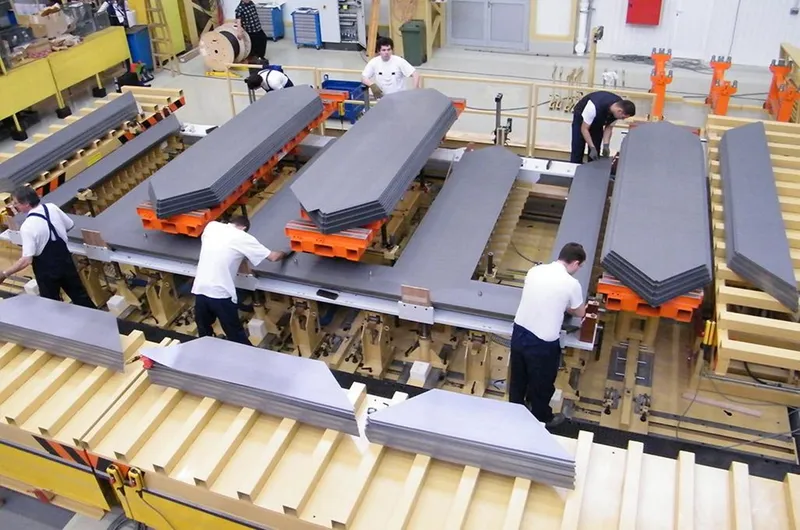
The expression may sound like the abstract vocabulary of the Party. Yet it describes a very concrete direction: progressively shifting the engines of Chinese growth away from property, traditional infrastructure and low-value-added industry towards technology, automation and advanced manufacturing.
The figures available in 2026 already illustrate the scale of this mobilisation. During the first eight months of the year, revenues in China’s high-tech industries rose by 15.7% year on year, while high-tech manufacturing revenues increased by 18.9%. Sales associated with the production of artificial-intelligence-related integrated circuits increased by 67.7%.
These remain sectoral indicators. But they reveal the direction of travel.
AI AS INDUSTRIAL POLICY
In many countries, artificial intelligence is primarily conceived as an industry.
In China, it is increasingly becoming an infrastructure.
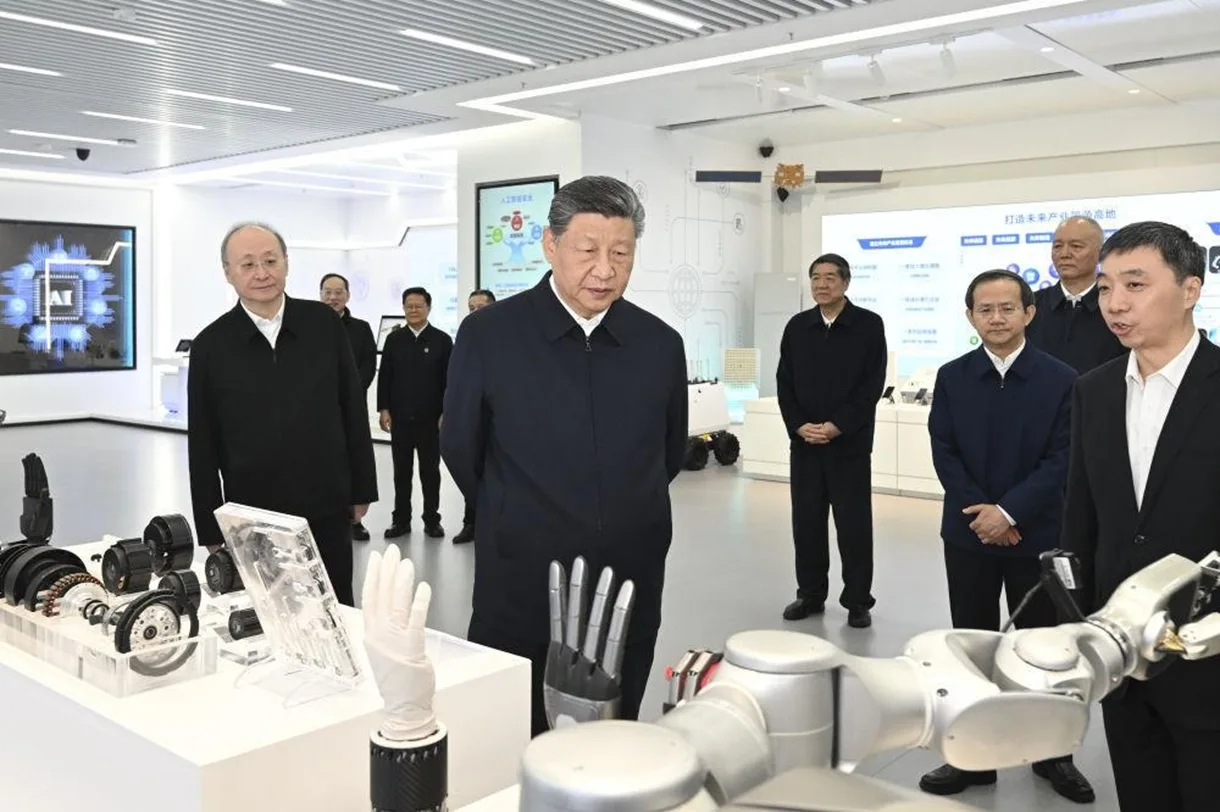
The government is pursuing its “AI Plus” programme, intended to diffuse artificial intelligence throughout industry, scientific research, services, consumption and, progressively, public administration. Beijing now presents 2035 as a horizon by which the economy and society should be profoundly transformed by AI.
This ambition benefits from a particular combination of advantages: China simultaneously possesses an enormous industrial base, vast quantities of data, a continental domestic market and a state capable of directing considerable resources towards a limited number of strategic priorities.
AI can therefore be deployed not only in laboratories or digital platforms, but across factories, power grids, ports, logistics networks, industrial design and supply chains.
This is where the project becomes more interesting.
Because a technology capable of improving forecasting, optimisation and coordination does not transform companies alone. It could also alter the economic capabilities of the state.
THE OLD PROBLEM OF PLANNING
The debate between markets and planning has long revolved around a problem of information.
A modern economy produces billions of signals every second: prices, shortages, orders, inventories, consumer preferences, industrial capacity, logistics costs and the availability of labour or capital. No ministry can efficiently know and process all of this information.
The market possesses precisely this property: it distributes the calculation.
Millions of actors make decisions independently. Prices imperfectly aggregate their information. Companies that make the wrong decisions can disappear. Those that identify demand can prosper. The system remains chaotic, sometimes brutal and frequently inefficient in the short term, but it possesses an extraordinary capacity for adaptation.
The planned economies of the twentieth century encountered the opposite difficulty. They could concentrate resources with considerable force, but they often understood poorly the reality they were attempting to organise.
A factory could meet its administrative target while producing something nobody needed. A local shortage could remain invisible to the centre. Officials had incentives to embellish statistics. The more complex the economy became, the more the information required to coordinate it exceeded the administrative capacity available.
Artificial intelligence does not eliminate this problem.
But it potentially changes its parameters.
An economy now covered by sensors, digital payments, logistics platforms, connected industrial systems and enormous databases generates quantities of information that twentieth-century planners could scarcely have imagined possessing. AI models can analyse part of these flows, detect tensions, optimise networks and simulate certain scenarios.
The question then becomes considerably larger: what happens when a centralised state finally possesses tools capable of processing a meaningful fraction of the complexity that once made central planning impossible?
THE PARTY AND THE MACHINE
There is no indication that Beijing intends to replace the market with an enormous central computer.
China’s reality is considerably more hybrid.
Private companies remain indispensable. Markets continue to allocate a substantial share of resources. Competition among Chinese companies can be ferocious. Beijing itself seeks to preserve the innovation and entrepreneurship on which its technological ascent depends.
But above this economy remains a higher level of strategic direction.
The state identifies priority sectors, finances infrastructure, directs part of the credit system, organises scientific policy, protects certain supply chains and seeks to reduce dependencies it considers dangerous.
Artificial intelligence can reinforce this architecture.
It can help coordinate the electricity required by data centres, anticipate industrial requirements, accelerate scientific research, optimise infrastructure or identify bottlenecks within a value chain. Used in this way, AI does not replace the market. It increases the centre’s capacity to intervene around it.
This may be where the Chinese experiment becomes most significant.
Beijing is not necessarily choosing between planning and markets. It is attempting to determine how far digital technologies can allow it to combine the two.
THE CONTRADICTION REMAINS
Technology does not, however, solve the political problem of information.
A model can analyse the data it receives. It cannot guarantee that those data are true.
Within a strongly hierarchical system, a local official still has an incentive to present favourable results to a superior. A state-owned company can defend its funding. A bureaucracy can protect its jurisdiction. A provincial government can seek to preserve an industry that has already developed excess capacity.
Artificial intelligence can optimise a decision based on imperfect information. It can even make that decision faster and more systematic.
It can therefore amplify an error just as efficiently as it improves a sound policy.
China already displays some manifestations of this tension. Massive investment in sectors considered strategic has produced global industrial champions, but also excess capacity, price wars and redundant investment. China’s extraordinary ability to mobilise capital is simultaneously a strength and a risk.
There is an even deeper contradiction.
Innovation often requires precisely what planning finds difficult to tolerate: uncertainty.
Nobody knew exactly which companies would dominate the Chinese internet, which technologies would become essential or which products would find a market. Innovation involves useless experiments, failed companies, wasted capital and entrepreneurs pursuing ideas that an administration would probably never have selected.
Yet Beijing is simultaneously seeking more innovation and more direction.
Perhaps the entire economic experiment of Xi Jinping lies within that tension.
POWER RATHER THAN EFFICIENCY
This strategy becomes easier to understand once it is no longer measured exclusively according to traditional criteria of economic efficiency.
Beijing’s objective is not necessarily to construct the theoretically most efficient economy. It is also to build an economy productive enough to continue enriching the country, innovative enough to remain competitive and autonomous enough to withstand a prolonged confrontation with the United States or a fragmentation of the global system.
Inefficiency can then become acceptable if it purchases resilience.
A semiconductor factory less profitable than a foreign competitor may retain strategic value if it reduces a critical dependency. A redundant supply chain may appear economically suboptimal while becoming rational from the perspective of national security.
This is precisely the convergence between economics, technology and security that Kevin Rudd identifies under Xi.
The Sino-American competition therefore no longer concerns only the size of GDP or the volume of exports. It increasingly places two different ways of organising innovation and industrial power alongside one another.
The United States possesses a system extraordinarily effective at producing disruptive technology companies, attracting capital and transforming research into global businesses. China possesses an exceptional capacity to turn national priorities into infrastructure, manufacturing capacity and complete industrial ecosystems.
Artificial intelligence is arriving at precisely the moment when both models are testing their limits.
THE CHINESE EXPERIMENT
It will probably take years to determine whether Xi’s wager works.
China may succeed in creating a hybrid system in which markets continue to generate innovation and information while a technologically augmented state coordinates infrastructure, protects strategic dependencies and accelerates the development of industries considered essential.
It may also discover that technology cannot resolve the fundamental contradictions of centralisation: poor information, institutional conformity, politically directed capital and the difficulty of predicting innovation.
The two outcomes are not mutually exclusive. China may achieve spectacular successes in certain industries while simultaneously accumulating profound inefficiencies elsewhere.
But the experiment deserves to be observed beyond China itself.
For much of the twentieth century, the economic debate opposed two architectures: allowing a multitude of actors to coordinate economic activity through markets, or attempting to organise that coordination from the centre.
The collapse of the Soviet bloc appeared largely to have settled the question.
Artificial intelligence does not resurrect the Soviet economy. It introduces something different: a capacity for computation, observation and coordination that no planning state has ever possessed.
Xi Jinping appears determined to discover how far that capacity can go.
Deng transformed China by giving more space to the market.
Xi may be seeking to transform China again by giving more intelligence to the centre.
The real question, then, may not be whether artificial intelligence will replace human labour. In China, another experiment is beginning to take shape: determining whether it can alter the boundary between the market and the state. And this time, the laboratory accounts for nearly one-fifth of the global economy.
Main Sources
- Kevin Rudd — The Evolution of Chinese Economic Strategy Under Xi Jinping: On Becoming a Techno-Industrial Superpower by 2035 — Asia Society / Substack, August 2026.
- Australian National University, China in the World — The Evolution of Chinese Economic Strategy Under Xi Jinping — Annual Lecture, 26 August 2026.
- State Council of the People’s Republic of China — policy documents and official guidance on the “AI Plus” initiative and artificial intelligence development, 2025–2026.
- State Council of the People’s Republic of China — policy orientations for the 15th Five-Year Plan (2026–2030), industrial modernisation, and scientific and technological self-reliance.
- National Bureau of Statistics of China — data on industrial production, high-tech industries, and the transformation of China’s productive structure, 2026.
- State Taxation Administration of China — tax data covering high-tech industries, high-tech manufacturing, and AI-related integrated circuits, January–August 2026.
- Xi Jinping / Xinhua — speeches and official documents on “new quality productive forces” and their role in China’s economic modernisation.
- U.S. Department of Commerce, Bureau of Industry and Security — U.S. export controls concerning advanced semiconductors, semiconductor manufacturing equipment, and AI-related technologies destined for China.
- International Monetary Fund — People’s Republic of China: Article IV Consultation — analysis of Chinese growth, investment, productivity, and structural imbalances.
- World Bank — China Economic Update — analysis of China’s growth-model transition, investment, and productivity.
Atlas Limits Research Desk
Atlas Limits’ editorial and analytical desk.