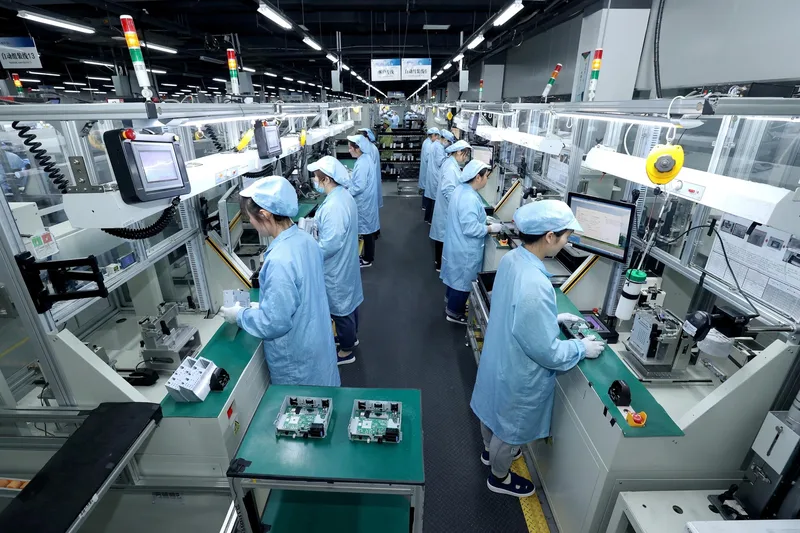
China's October data expose an imbalance that industrial performance can obscure. In its release of 16 November 2026, the National Bureau of Statistics reported a 4.8% year-on-year increase in value added at industrial enterprises above the designated size. Strength in technology-related manufacturing does not, however, establish a broad recovery in domestic demand. [1] Producing more, selling abroad and raising household purchasing power are connected but different processes.
The indicators first need to be kept in their proper categories. Industrial production measures supply within a defined set of enterprises. Retail sales do not capture all household consumption, including the full range of services. Investment accumulated over several months is not a monthly change. Weakness across several series can support an assessment, but their growth rates cannot be added together or translated directly into contributions to GDP without further data.
The structural mechanism matters more than any single month. Property has connected household wealth, local revenue and activity across many industries. When homes lose value or completion becomes uncertain, households may prefer precautionary saving. Developers' difficulties and weaker land sales can simultaneously constrain local investment. Increasing manufacturing output does not necessarily remove these limits on spending.
The IMF had already placed a shift towards consumption at the centre of its February 2026 analysis. It linked subdued demand to the property slump and insufficient social protection, recommending a composition of public spending more supportive of households. [2] This earlier diagnosis does not prove that every October movement has the same cause. It does help explain how an economy can retain advanced manufacturing capabilities while struggling to expand domestic markets.
External demand has political limits
Exports help firms sustain production when domestic orders are insufficient. They support employment and cash flow but do not provide an unlimited pool of demand. Foreign buyers may benefit from cheaper equipment while competing producers lose market share. The same price advantage becomes a gain for users and a concern for rival industries.
That divergence creates a political constraint. Trading partners can raise barriers, impose investment conditions or seek local production. Chinese companies can respond by entering different markets or building factories abroad. These adjustments require capital and do not eliminate regulatory exposure. A strategy relying on foreign demand consequently makes part of China's growth more sensitive to decisions beyond its borders.
Technological upgrading does not automatically solve the problem. Automation can improve costs and quality without increasing household disposable income proportionately. Its effect on demand depends on how gains are distributed between profits, wages, prices and public revenue. Policies focused exclusively on supply can therefore widen an imbalance even as individual businesses become more productive.
Rebalancing requires fiscal and institutional choices. Supporting incomes and reducing social uncertainty can encourage spending, but means allocating resources differently. Stabilising property requires addressing unfinished homes and financial losses rather than indiscriminately restarting construction. These choices affect actors that benefit from existing industrial finance and public investment arrangements.
Future releases need to be read together: incomes, employment, house prices, services consumption, private investment and financing conditions. A production rebound alone will not demonstrate a new growth model. That shift becomes more credible if domestic spending strengthens without another accumulation of underused capacity. For trading partners, the issue is also whether China can provide sustained demand for their products, rather than requiring repeated adjustments to absorb Chinese supply.
Sources
[1] National Bureau of Statistics of China, October activity release, 16 November 2026.
[2] IMF, How China's Economy Can Pivot to Consumption-led Growth, 18 February 2026. Unattributed mechanisms and prospects are Atlas Limits analysis.
Atlas Limits Research Desk
Atlas Limits’ editorial and analytical desk.