It takes only a few seconds to eat a square of chocolate. It takes years to grow the cocoa tree that made it possible, months to harvest, ferment and dry its beans, an international logistics chain to transport them, considerable industrial infrastructure to process them, and finally the full power of marketing and distribution to make consumers forget the journey altogether.
Chocolate is one of those products whose familiarity conceals extraordinary complexity. Behind a bar sold in a European, American or Asian supermarket lies a global industry connecting millions of small tropical farmers with some of the world's largest food companies. Between them stand traders, grinders, manufacturers, commodity exchanges, banks, logistics companies and retailers. An agricultural bean becomes, successively, a commodity, a semi-processed product, an industrial ingredient, a brand and finally a consumer good.
For decades, this chain has operated according to a peculiar geography: cocoa is largely grown where relatively little of the world's chocolate is manufactured and consumed, while much of its commercial value is created in places where cocoa trees could scarcely grow at all.
The spectacular cocoa crisis that began in 2023 abruptly exposed this dependence. After decades in which a relatively abundant supply of inexpensive beans had allowed the industry to treat sourcing almost as a given, a succession of poor harvests was enough to destabilise the global balance. Prices soared, manufacturers raised their own prices, consumption volumes began to fall, and a question long confined to commodity specialists reached supermarket aisles: how much should chocolate actually cost?
The answer begins far from those aisles.
An American plant becomes a European industry
Cocoa is not originally African. Theobroma cacao is a tropical plant native to the Americas, where its use stretches back several millennia. Mesoamerican civilisations, particularly the Maya and later the Aztecs, consumed cacao as a beverage, incorporated it into ceremonial life and, in some contexts, treated cocoa beans as valuable enough to serve as a medium of exchange.
The arrival of Europeans in the Americas gradually transformed these uses. Introduced into Spain during the sixteenth century, cocoa was adapted to European tastes, notably through the addition of sugar. It subsequently spread through aristocratic courts before industrialisation turned chocolate into a product accessible to much larger populations.
The nineteenth century proved decisive. Innovations in cocoa pressing made it possible to separate part of the cocoa butter from the cocoa solids. Improvements in grinding and refining produced smoother textures. Combining cocoa, sugar and milk opened the way to milk chocolate. Conching further transformed texture and flavour.
An industry had been born.
Switzerland, Belgium, Britain, France, Germany, the Netherlands and later the United States developed industrial and commercial traditions that remain visible in the geography of chocolate brands today. Nestlé, Lindt & Sprüngli, Cadbury, Hershey and numerous European chocolate houses descend directly from this transformation of chocolate from an artisanal speciality into an industrial consumer product.
Yet as the industry expanded, the geography of its raw material shifted.
Cocoa crossed the Atlantic. Colonial powers developed its cultivation across tropical Africa. During the twentieth century, West Africa progressively became the centre of gravity of global cocoa production.
It remains so today.
The geographical paradox of chocolate
Africa now accounts for roughly 70% of global cocoa supply according to estimates commonly used by international organisations. Côte d'Ivoire and Ghana alone occupy a decisive position and, depending on the crop year and statistical source, have accounted for around 60% of recent global production. Cameroon and Nigeria complete the major West African production belt.
Africa's dominance, however, is not absolute. Ecuador has emerged as an increasingly important Latin American cocoa power. Brazil, Peru, the Dominican Republic, Colombia and other producers across the Americas also participate in the global market, while Indonesia remains an important Asian producer.
This diversification matters. It marginally reduces the industry's dependence on West Africa and enables some producing countries to develop differentiated positions around origin and flavour characteristics. Ecuador's expansion, in particular, has gradually begun to alter the global balance.
Yet the heart of the system remains extraordinarily concentrated.
Such geographical concentration would already be remarkable for almost any commodity. It becomes strategically significant when the structure of cocoa farming itself is considered. Cocoa is not predominantly produced by a handful of multinational agricultural corporations operating enormous mechanised plantations. UNCTAD estimates that roughly five to six million farmers participate in cocoa production worldwide, predominantly through smallholdings in developing economies.
In other words, a global food industry that is highly concentrated downstream rests upon an extraordinarily fragmented agricultural base upstream.
That is one of the keys to its economics.
From pod to bean
Chocolate begins with a biological constraint that financial markets cannot remove: the cocoa tree.
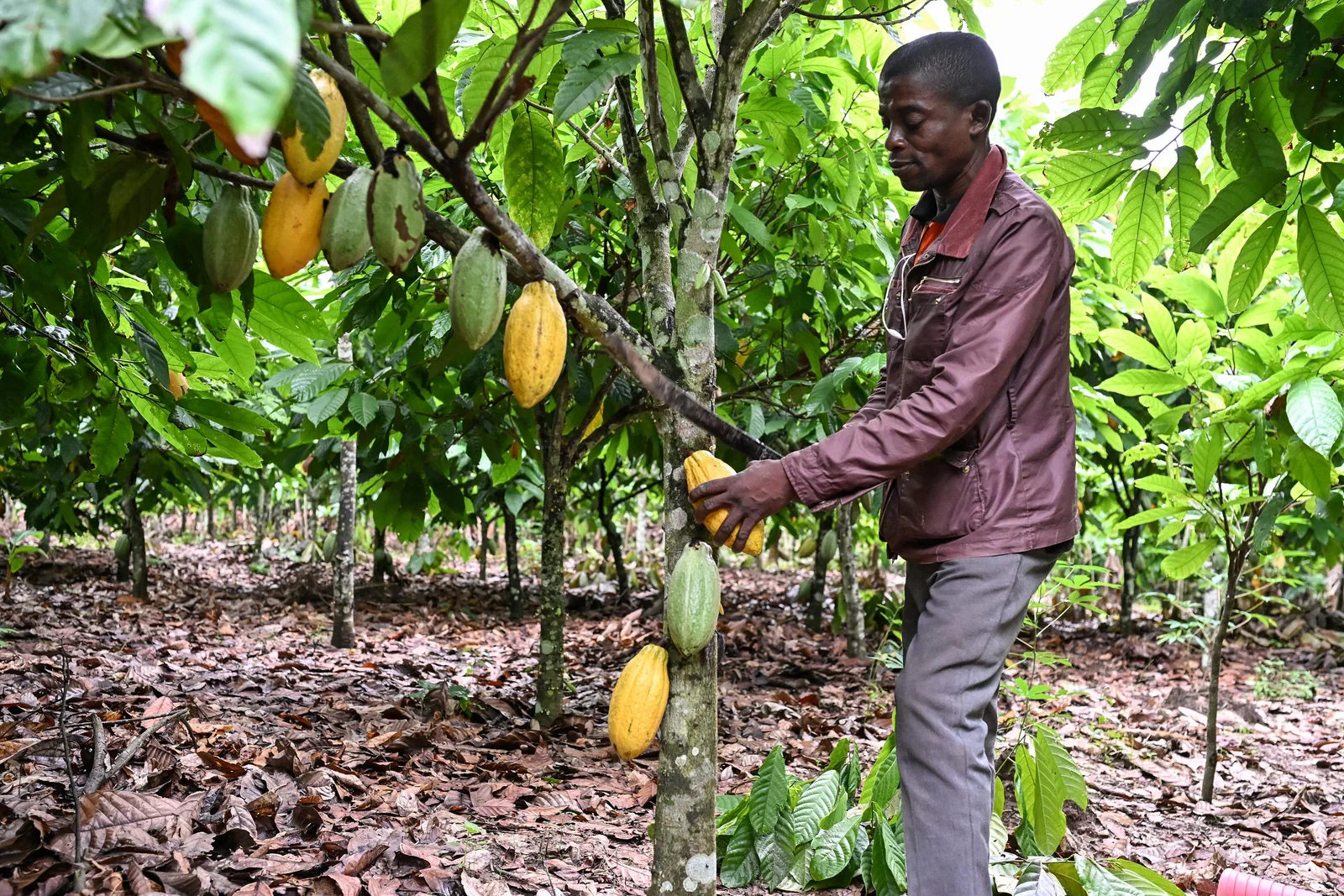
The tropical tree requires heat, humidity and sufficient rainfall. It is vulnerable to climatic variation, disease and soil conditions. Its fruits, cocoa pods, contain the seeds that eventually become cocoa beans.
Harvesting is only the beginning. The beans must be extracted, fermented and then dried. These stages are essential: much of the future chocolate's aromatic potential develops during fermentation. Poorly fermented or improperly dried cocoa cannot easily be rescued later by industrial sophistication.
The beans are subsequently collected, aggregated, inspected and exported. They reach processing facilities where they are cleaned, roasted and ground into cocoa mass, or cocoa liquor. This can then be pressed to separate cocoa butter from the solids used, among other things, to produce cocoa powder.
At this point, a second industry begins.
Chocolate manufacturers recombine cocoa mass, cocoa butter, sugar and, for milk chocolate, dairy ingredients according to their recipes. Refining, conching and tempering then create the desired texture, shine, snap and flavour profile.
A relatively standardised bean can therefore become an extraordinary variety of products: dark chocolate bars, milk chocolate, pralines, spreads, biscuits, ice cream, professional couverture, drinking powder and cocoa butter used by other industries.
Every transformation adds value.
But that value is not distributed evenly.
Where agricultural value disappears
This is perhaps the central economic paradox of chocolate.
The farmer produces the ingredient without which the entire industry disappears. Historically, however, the farmer has captured only a small portion of the final value.
Precise estimates vary according to methodology, period, country and product. But the structural diagnosis is longstanding. UNCTAD has previously highlighted the substantial decline in producers' share of the value of a chocolate bar over previous decades and, in earlier work, estimated that farmers' share could fall below 6-7% in some decompositions of the value chain.
Such figures require caution. A three-euro chocolate bar obviously does not contain three euros' worth of cocoa. Its price incorporates sugar and milk, industrial processing, energy, packaging, transport, inventory financing, marketing, labour, factory depreciation, taxation, manufacturers' margins and retailers' margins.
But that is precisely where the structural issue lies.
Raw cocoa provides the biological foundation of the product; the stages capable of generating the greatest margins generally lie further downstream.
A tonne of cocoa beans is a commodity. A Lindt, Cadbury, Milka, Ferrero or Hershey bar, or a box of branded pralines, is a differentiated product. Between the two appears one of the most valuable assets in the consumer economy: a brand.
And a brand can command a price that a bean cannot.
The giants consumers rarely see
Between an African or Latin American farmer and the world's familiar chocolate brands sits an industrial layer largely invisible to consumers.
Barry Callebaut provides perhaps the clearest example. The Swiss group describes itself as the world's leading manufacturer of high-quality chocolate and cocoa solutions. It supplies food manufacturers, professional users, pastry chefs and chocolatiers, operates more than 60 production facilities and employed more than 13,000 people at the end of its 2024/2025 financial year.
Its business illustrates a crucial feature of the industry: the company whose name appears on the packaging is not necessarily the company that performed every stage of upstream processing.
Around Barry Callebaut operate other major trading and processing groups, including Cargill, ofi — originating from Olam — and ECOM. They buy, transport, grind or process cocoa and supply ingredients to manufacturers.
This intermediate layer is essential because chocolate is also an industry of volumes, inventories and risk management. Manufacturers must secure supplies long before a chocolate bar reaches a consumer. London and New York cocoa futures therefore become part of the industrial machinery: they allow companies to hedge part of their price exposure while simultaneously providing global benchmarks for cocoa valuation.
When the price of the underlying commodity becomes extraordinarily volatile, the entire mechanism comes under strain.
That is precisely what happened.
2023-2025: when cocoa became scarce
For a long time, consumers in developed economies had become accustomed to a curious certainty: chocolate would remain relatively inexpensive.
The 2023/2024 crop year shattered that assumption.
Harvests were severely disrupted across West Africa. Adverse weather, cocoa tree diseases, ageing plantations, weak yields and accumulated structural constraints converged. According to data cited by the World Bank, global production fell to around 4.2 million tonnes during the 2023/2024 season, approximately 14% below the previous crop year.
For a market whose inventories had already been strained, the shock was considerable.
International prices exploded. In December 2024, the World Bank was still recording cocoa prices above $10 per kilogram on average after an extraordinary annual increase. Futures markets had previously crossed levels that the industry would have regarded as exceptional only a few years earlier.
This was no longer merely another episode of commodity inflation. It exposed a physical shortage and vulnerabilities accumulated over decades.
A cocoa tree is not a factory that can simply be operated around the clock when prices rise. New plantations require several years before producing significant quantities. Rehabilitating ageing orchards requires capital. Diseases do not disappear because the market suddenly pays more per tonne. And when farmers have spent years earning modest incomes, their capacity to invest preventively in their trees remains limited.
The market was therefore discovering a contradiction it had partly helped to create: keeping agricultural prices low for long periods can ultimately weaken the supply on which the industry itself depends.
The great retreat of 2026
Commodity markets rarely produce linear stories.
After the surge came the retreat.
The latest publicly available estimates from the International Cocoa Organization put global 2024/2025 production at approximately 4.733 million tonnes, an increase of 8.5% year on year. Global grindings, meanwhile, were estimated to have declined by 3.3% to 4.649 million tonnes. The ICCO consequently estimated a surplus of approximately 37,000 tonnes for the season and end-of-season stocks of 1.309 million tonnes.
For 2025/2026, the organisation temporarily suspended publication of some production and grinding estimates in its August 2026 bulletin. It would therefore be imprudent to present a definitive ICCO figure for the current crop year.
Other indicators nevertheless demonstrate a spectacular easing of the market. In June 2026, the World Bank recorded an average cocoa price of approximately $4.35 per kilogram, more than 50% below its level a year earlier. It attributed the correction to improving supply, notably following better conditions in Côte d'Ivoire and Ghana, but also to demand weakened by the high prices of previous years.
This is where the crisis becomes particularly revealing.
Expensive cocoa began to destroy part of the demand for chocolate.
When the chocolate bar transmits the shock
A manufacturer can temporarily absorb an increase in raw-material costs. It cannot indefinitely absorb a multiplication of those costs.
Transmission to consumers was therefore inevitable, although neither immediate nor uniform. Large groups hold inventories, procurement contracts and financial hedges that delay the impact of commodity prices. As these protections expire, new costs gradually enter corporate accounts.
Companies then have several options: raise prices, reduce promotions, alter package sizes, rationalise product ranges, reformulate products where regulation and commercial positioning permit, or accept margin compression.
Eventually, higher prices encountered consumer resistance.
Barry Callebaut provides a striking illustration. During its 2024/2025 financial year, sales volumes fell by 6.8%, including declines of 5.3% in Global Chocolate and 12.8% in Global Cocoa. Yet revenue jumped 49% in local currencies to approximately CHF14.8 billion, largely because higher cocoa prices were passed through under its pricing model.
That is the paradox of the period in a single set of accounts: far more revenue, considerably less chocolate.
At Lindt & Sprüngli, operating in a different part of the market and under a different business model, 2025 told a comparable story in another form. The group generated CHF5.92 billion in sales and organic growth of 12.4%, while recording a negative volume/mix contribution of 6.6%. Premium positioning and the ability to raise prices protected value much more effectively than volumes.
Consumers eventually began to adjust their behaviour.
That response is now contributing to the easing of the underlying commodity market.
Mars, Ferrero, Mondelēz, Nestlé, Hershey: the power of brands
The finished-chocolate industry is dominated by a relatively small number of groups controlling portfolios of globally recognised brands.
Mars owns M&M's, Snickers, Twix and Galaxy/Dove. Mondelēz controls Cadbury, Milka and Toblerone. Ferrero has built an empire around Ferrero Rocher, Kinder and Nutella. Nestlé retains a major confectionery presence, including KitKat across many markets. Hershey remains an institution in North American chocolate. Lindt & Sprüngli occupies an especially powerful position in the premium segment.
These companies are not simply selling processed cocoa.
They sell habits, formats, memories, gifts, impulse purchases, availability and trust. Chocolate therefore illustrates one of the fundamental laws of consumer industries: the closer a company gets to the final consumer, the greater the potential for differentiation.
Cocoa is traded by the tonne.
Chocolate is sold by the gram.
That change of unit captures a significant part of the industry's value creation.
It also explains why producing countries have long sought to move beyond the export of raw beans.
The battle to process cocoa at home
For Côte d'Ivoire, Ghana and other producing economies, the challenge is therefore not simply to produce more cocoa. It is to retain a greater share of the value added.
Domestic processing is an obvious response. Instead of exporting beans alone, a country can develop grinding capacity, produce cocoa mass, butter and powder, and potentially move further downstream into finished chocolate.
Yet every step increases complexity.
Grinding cocoa requires industrial facilities, energy, port and logistics infrastructure, financing and international customers. Manufacturing competitive chocolate bars requires still more: technology, quality control, packaging, distribution networks and, above all, brands capable of securing shelf space.
Growing cocoa and selling chocolate are two different businesses.
This is why the question of value cannot be solved merely by constructing factories. The real economic leap occurs when producing countries control more processing, intellectual property, distribution and ultimately the relationship with consumers.
Industrial history demonstrates just how difficult that climb can be.
Côte d'Ivoire and Ghana: trying to reclaim the price
Given their combined weight, Abidjan and Accra have attempted to use a weapon rarely available to commodity producers: coordination.
In 2019, Côte d'Ivoire and Ghana introduced the Living Income Differential, a mechanism intended to improve farmers' remuneration through a premium applied to cocoa sales.
The logic extends beyond the price itself. Two countries representing such a large proportion of global supply theoretically possess considerable leverage if their policies are coordinated.
But cocoa is not oil.
Production is fragmented among millions of farmers; harvests are perishable at different stages; governments must protect both rural incomes and export revenues; buyers can modify procurement strategies; and the expansion of competing producers such as Ecuador gradually reduces concentration.
The balance of power therefore exists, but it is subtler than that of a conventional commodity cartel.
The 2024 price surge nevertheless demonstrated something fundamental: when Côte d'Ivoire and Ghana produce less cocoa, the entire world feels it.
Climate enters the chocolate bar
The next constraint may prove more difficult to arbitrate than price.
Cocoa trees grow within a relatively narrow climatic zone. Changes in temperature, rainfall and humidity can affect yields, increase disease pressure and alter the areas suitable for cultivation.
The vulnerability is compounded by the condition of parts of the West African cocoa estate. Ageing trees produce less. Disease can force their replacement. Yet renewing a plantation means accepting several transitional years before new trees reach full production.
Agroforestry has therefore emerged as one potential path forward. Growing cocoa alongside other trees can provide shade, improve certain soil characteristics, diversify income and increase resilience to heat. In Côte d'Ivoire, the FAO was still documenting programmes in 2026 designed to convert full-sun cocoa plantations towards agroforestry systems.
But climate adaptation costs money.
And this returns the industry to its starting point: who pays?
The farmer whose income remains fragile? The producing state? The trader? The manufacturer? The consumer? Or the entire value chain?
Sustainable chocolate is not merely an agricultural problem. It is a problem of economic distribution.
Deforestation becomes a commercial issue
Climate pressure is now being joined by regulation.
The European Union Deforestation Regulation, or EUDR, covers cocoa alongside several other commodities and a range of derived products. Following several revisions to its implementation timetable, application is scheduled to begin on 30 December 2026 for large and medium-sized operators, followed by 30 June 2027 for most micro and small enterprises.
For the cocoa industry, the change is profound.
It will no longer be sufficient to know that a shipment originated in Côte d'Ivoire, Ghana or Ecuador. Operators concerned by the regulation will have to demonstrate that products placed on the European market comply with its requirements, notably regarding deforestation and legality in the country of production.
Traceability is therefore becoming an economic infrastructure.
Farm mapping, geolocation, information systems, segregation or tracking of flows and supplier documentation: practices that could once be presented as voluntary sustainability initiatives are progressively becoming conditions for access to one of the world's largest consumer markets.
This could contribute to a positive transformation of the industry.
But it also creates a risk: producers and cooperatives with stronger administrative capacity may find it easier to participate in regulated supply chains, while smaller or less documented farmers become harder to integrate.
A regulation designed to protect forests will therefore have to solve a delicate equation: making cocoa traceable without making some of its farmers invisible.
The social problem chocolate has never fully solved
Behind prices, tonnages and futures markets remains the industry's oldest question: the living standards of cocoa farmers.
Millions of families depend directly or indirectly on cocoa. Yet poverty remains present across several producing regions. It contributes to other problems: underinvestment in farms, difficulty renewing plantations, vulnerability to shocks, child labour and declining interest among younger generations in agricultural livelihoods.
There is a fundamental contradiction here.
The industry wants cocoa that is sustainable, traceable, deforestation-free, compliant with rising social standards and sufficiently abundant to meet global demand.
Every one of those requirements implies greater investment at farm level.
Yet the farm has historically been one of the points in the value chain with the weakest financial capacity.
Sustainability therefore cannot probably be achieved simply by accumulating standards. It will also depend on whether the system can make economically possible what it requires farmers to do.
An industry entering a new era
The spectacular correction in cocoa prices during 2026 could create the impression that the crisis is over.
That would probably be too simple a reading.
The market has rebalanced because supply improved and because high prices weakened demand. Yet the structural causes exposed by the crisis have not disappeared: geographical concentration, ageing plantations, disease, climatic vulnerability, weak agricultural incomes, investment requirements, increasing traceability demands and the biological slowness of any supply response.
The question, therefore, is no longer simply whether cocoa will return to its former prices.
It is whether the old model itself can return.
For decades, the global chocolate industry expanded under a remarkably favourable combination of circumstances: relatively accessible raw materials, rising consumption, mass industrialisation, powerful brands and logistics chains capable of moving millions of tonnes from tropical farms to the world's major consumer markets.
The crisis of 2023-2025 exposed the limits of that architecture.
It also recalled something that the sophistication of the finished product had gradually obscured. Behind the advertising campaigns, premium packaging, century-old recipes and billions invested in brands, the entire industry still depends on a tropical tree, sufficiently regular rainfall and millions of farmers willing and able to continue growing it.
Chocolate became a global industry.
The cocoa tree never stopped being a tree.
Main sources
International Cocoa Organization (ICCO), Quarterly Bulletin of Cocoa Statistics, data and estimates available as of August 2026; global production, grindings, stocks and market-balance statistics.
World Bank, Commodity Markets / Beverage Prices, 2025-2026 analyses of cocoa prices, recovering supply and conditions in Côte d'Ivoire and Ghana.
UN Trade and Development (UNCTAD), research on the global cocoa value chain, industrial concentration, smallholder farmers and the International Cocoa Agreement.
Food and Agriculture Organization of the United Nations (FAO), research and programmes concerning sustainable cocoa, agroforestry, agricultural incomes and the cocoa sectors of Côte d'Ivoire and Ghana.
European Commission, European Union Deforestation Regulation (EUDR), provisions and implementation timetable updated in 2026.
Barry Callebaut, 2024/2025 annual results and corporate information.
Lindt & Sprüngli, Integrated Annual Report 2025.
Public reports and institutional information from major companies operating across the cocoa and chocolate industry.
Atlas Limits Research Desk
Atlas Limits’ editorial and analytical desk.