For years, European strategic autonomy was measured in fighter jets, tanks, missiles and satellites. A different dependency is now emerging, less visible but potentially more consequential: dependence on the software systems able to gather battlefield data, interpret it and support military command decisions.
On September 17, 2026, Thales unveiled HexaForce, a new AI-enabled multi-domain command-and-control system. The French group describes it as an architecture designed for high-intensity operations, capable of supporting command structures involving more than 100,000 personnel and connecting land, maritime, air, cyber, space and information domains. The system has already been tested during NATO’s CWIX 2026 interoperability exercise. (thalesgroup.com)
Taken in isolation, HexaForce might look like another product in the accelerating digitization of armed forces. In reality, it points to a much broader transformation. As militaries become saturated with sensors, drones, satellites, radars, electronic-warfare systems and autonomous platforms, their effectiveness increasingly depends on the software layer capable of connecting all of them.
The strategic question is therefore no longer only who will build Europe’s weapons. It is also becoming who will control the system that allows those weapons to see, understand and act together.
War Is Becoming an Orchestration Problem
A modern battlefield generates more information than any headquarters can process manually at the speed required by high-intensity warfare. A satellite image detects movement. A drone transmits video. A radar identifies a trajectory. A ground unit requests support. An electronic-intelligence source detects an emission.
Multiple systems must then determine which information matters, which signals corroborate one another, which threat has priority and which assets are available to respond.
Artificial intelligence increasingly operates in precisely this space.
HexaForce is designed to aggregate multiple sources, select relevant information and support decision-making from strategic headquarters down to tactical echelons. Thales presents the system as a response to both the growing volume of data and the accelerating tempo of operations. (thalesgroup.com)
This is gradually transforming military command itself. The technological center of gravity is not disappearing from physical platforms, but a growing share of value is moving toward the software layer that links those platforms together.
The comparison with civilian computing is imperfect but useful. A smartphone can contain components produced by dozens of manufacturers, yet the overall experience is structured by the operating system that organizes their interaction. In digitized armed forces, a comparable layer is beginning to emerge. It does not replace soldiers or weapons. It organizes the flow of information between them.
Whoever provides that layer therefore occupies an unusually sensitive position.
Palantir Is Already Inside NATO’s Architecture
This issue is not theoretical.
On March 25, 2025, the NATO Communications and Information Agency finalized the acquisition of Palantir’s Maven Smart System NATO for Allied Command Operations, the structure responsible for planning and executing NATO military operations. The procurement was completed in six months, one of the fastest acquisition cycles in NATO’s recent history. (ncia.nato.int)
Maven combines several forms of artificial intelligence, including machine learning, generative AI and large language models. According to NATO, the system is intended to improve intelligence fusion, targeting, situational awareness, planning and the speed of decision-making. (ncia.nato.int)
The system is no longer experimental.
By August 2025, NATO’s Joint Warfare Centre was preparing its integration into major Alliance exercises and described it as NATO’s first AI-enabled command system deployed at that scale. (jwc.nato.int)
A year later, Maven had become part of NATO’s operational digital environment. In July 2026, the Alliance said the system was being used by Allied Command Operations and was serving as a platform for integrating new analytical tools developed through NATO’s DIANA accelerator. (nato.int)
In other words, while Europe is still defining the contours of its military digital sovereignty, an American architecture is already participating in the transformation of allied command.
This does not mean NATO has outsourced military decision-making to a private company. Operational authority remains within NATO’s military chains of command. The more important question is different: how far can a military organization depend on foreign proprietary software to structure the information on which its decisions rely?
HexaForce Is a Direct Response to That Concern
This is where HexaForce becomes strategically significant.
Thales emphasizes three characteristics: sovereignty, open architecture and interoperability. The system is presented as compatible with NATO standards and designed to allow states to retain control over their data while integrating different suppliers into their own architectures. (thalesgroup.com)
That positioning is not incidental.
Technological sovereignty does not simply mean using a domestic supplier. It means being able to control data, understand the architecture being used, modify critical components and continue operating the system even if the political or industrial environment changes.
This distinction becomes especially important in command-and-control systems.
Dependence on a foreign aircraft can create constraints around maintenance, munitions or upgrades. Dependence on a digital command platform can go further: it may affect the way information is structured before a military decision is even made.
Reuters has reported that the rise of Maven is feeding European concerns over data sovereignty, while Germany is examining the use of certain American tools with caution. Thales, meanwhile, is presenting HexaForce as independent of US ITAR restrictions and as a European response to the growing need for AI-supported command systems. (reuters.com)
This is not yet a European replacement for Maven.
HexaForce has only just been unveiled. Maven already has access to NATO’s operational ecosystem. The gap in maturity, deployment and institutional penetration remains significant.
But the emergence of a European alternative already changes the nature of the debate.
Strategic Autonomy Is Moving Down the Technology Stack
For two decades, Europe’s defense debate has focused primarily on platforms.
Should Europe develop its own fighter aircraft rather than buy American? Its own air-defense systems? Its own satellites, drones or launchers?
Those debates remain unresolved. But artificial intelligence is pushing the sovereignty question deeper into the technology stack.
After platforms come data.
After data come models.
After models come the command systems capable of connecting everything together.
European industry is beginning to organize around these layers. Thales is building command systems. Mistral AI is developing European AI models. Comand AI is positioning itself in military decision-support and command systems. Other companies are working on cloud infrastructure, communications architectures and the tools required for data fusion.
That fragmentation is both a strength and a weakness.
It allows Europe to build a more open ecosystem in which several suppliers can be combined. But it also makes it harder to create integrated platforms capable of competing immediately with American systems.
In the United States, the concentration of capital, data, cloud infrastructure and defense contracts has allowed companies such as Palantir to develop platforms covering an increasingly large share of the operational chain.
Europe is still working out how to assemble its own pieces.
The Real Challenge Is Interoperability Without Dependency
Europe cannot simply detach itself from American military architectures.
Its armed forces remain integrated into NATO. Multinational operations require aircraft, radars, satellites, ground systems and command centers to exchange data in compatible formats.
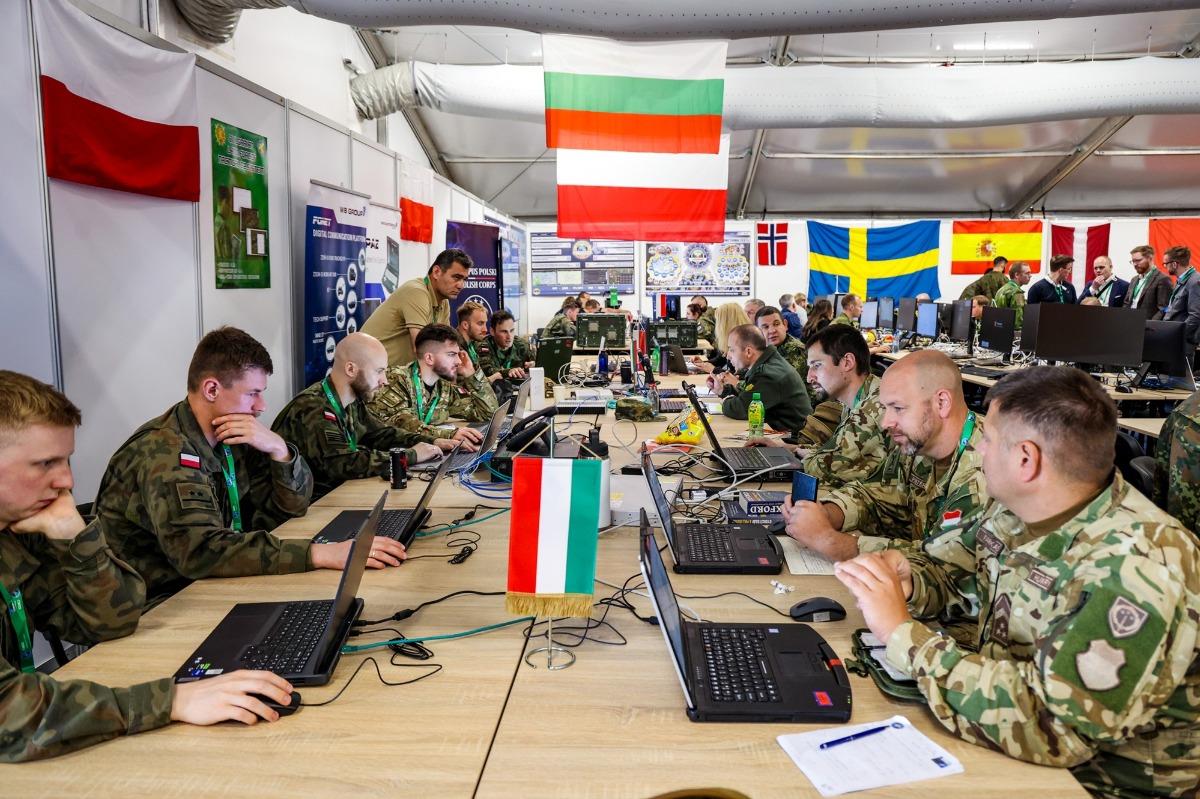
CWIX, the exercise in which HexaForce was tested, exists precisely to verify this digital interoperability across NATO members.
The European objective is therefore not to build a closed system.
It is to achieve something much harder: maximum interoperability without irreversible dependency.
A state must be able to participate fully in the Western military network while retaining the ability to control its data, choose its suppliers and evolve its systems without becoming dependent on a single company or country.
That federated model is more complex than a single-platform architecture. It may nevertheless become one of the foundations of European military sovereignty.
HexaForce matters precisely because Thales presents it as open and distributed.
That promise will have to be tested in real deployments. Operational performance, ease of integration, cost and resilience in degraded environments will matter far more than industrial messaging.
But the strategic direction is already clear.
AI Does Not Replace Command — It Changes Its Tempo
This shift also raises a harder question: what role should artificial intelligence play in military decision-making?
Systems such as Maven and HexaForce are not presented as machines that independently decide to strike a target. Their function is to accelerate situational understanding and provide recommendations to human operators.
Yet the boundary can become increasingly subtle.
When software analyzes thousands of data points at once, ranks threats, proposes priorities and recommends how assets should be used, the human may retain the formal decision while operating inside a cognitive environment largely structured by the machine.
Sovereignty therefore goes beyond the location of servers or the nationality of the supplier.
It also concerns the algorithms that determine which information appears first, which correlations are considered significant and which options are presented to a commander.
Thales itself is now calling for an international framework to govern the development of artificial intelligence. Its CEO, Patrice Caine, has argued that technical safeguards should be accompanied by governmental and international rules. (reuters.com)
That debate is arriving at the same moment AI is becoming operational inside military headquarters.
The Next Strategic Dependency
Europe already knows the cost of technological dependency.
It relies heavily on the United States for the most advanced processors, parts of its cloud infrastructure, multiple critical software systems and a significant share of its military capabilities.
Command AI could become one more layer of dependency — or one of the first areas in which European states choose to preserve a genuinely plural and sovereign architecture.
HexaForce does not prove that Europe already has a complete answer. It shows that Europe is beginning to identify the problem.
The strategic question of the coming years may therefore no longer be only how many tanks, aircraft or missiles Europe can produce.
It will also be this: who controls the software connecting all those systems when war begins?
On digitized battlefields, power will no longer reside only in weapons.
It will also reside in the architecture that tells them what they can see.
Main Sources
Thales, September 17, 2026, official release on the launch of HexaForce and the system’s technical architecture. (thalesgroup.com)
NATO Communications and Information Agency, acquisition of Maven Smart System NATO, April 14, 2025. (ncia.nato.int)
NATO Joint Warfare Centre, operational integration of Maven Smart System NATO, August 2025. (jwc.nato.int)
NATO / DIANA, use of Maven by Allied Command Operations and integration of new AI tools, July 2026. (nato.int)
Reuters, September 17, 2026, on HexaForce, Maven, European data-sovereignty concerns and Thales’ military AI strategy. (reuters.com)
Atlas Limits Research Desk
Atlas Limits’ editorial and analytical desk.