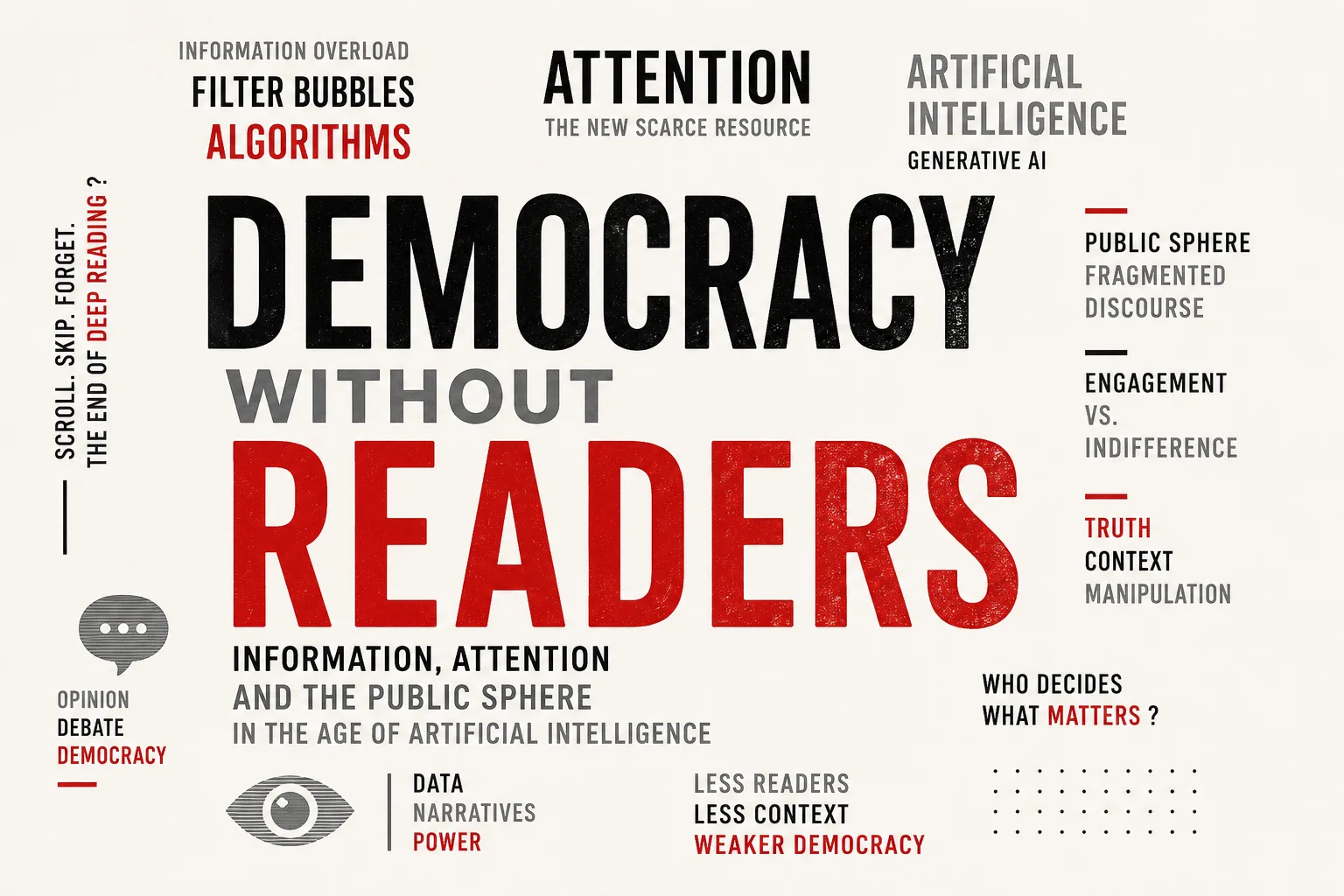
Never before has humanity had access to so much information. Never has it been so easy to learn the result of an election on the other side of the world, consult a company’s accounts, read the text of a law, follow a war almost in real time, or access the publications of an international institution.
And yet, information abundance does not appear to have mechanically produced better-informed societies.
The contemporary paradox may lie here: we are more exposed to information while becoming less available for it.
News arrives through notifications, videos, posts, excerpts, charts, comments and reactions. It mixes with entertainment, advertising, private conversations and algorithmic recommendations within the same stream. A connected individual can therefore encounter hundreds of fragments of current affairs in a single day without ever having actively sought to become informed.
Generative artificial intelligence is now introducing another transformation. It is no longer changing only the amount of information available or the way it is distributed: it allows us to delegate part of the act of reading itself.
Why read ten pages when a machine can summarize them in ten lines?
The question goes beyond the future of journalism. It concerns the formation of individual judgment, the understanding of public affairs and, ultimately, the cognitive conditions of democracy.
From Information Scarcity to Attention Scarcity
For much of modern history, access to information was a major constraint. Producing, printing, transporting and distributing a newspaper had a cost. Accessing archives, statistics or foreign documents required time and sometimes considerable resources.
The internet gradually reversed this economy.
Information became abundant, immediately accessible and reproducible at almost zero marginal cost. Human processing capacities, however, did not expand at the same pace.
A day still has twenty-four hours. Working memory remains limited. Attention must still be divided between professional activity, family, leisure, everyday obligations and rest.
The scarce resource is therefore increasingly no longer information itself. It is the cognitive time available to make sense of it.
Digital platforms have industrialized this competition for attention. Every piece of content now competes not only with other information, but with virtually every possible form of digital stimulation.
An analysis of public debt can appear in the same feed between a humorous video, an advertisement, a holiday photograph, a political controversy and a sports clip.
The editorial hierarchy that once separated political, economic or international news from entertainment is being displaced by an algorithmic hierarchy: the ability to retain the user’s attention.
Research into diffusion dynamics on social networks has long shown that the quality of information is not a prerequisite for virality and that limited individual attention can facilitate the circulation of low-quality content. More recent research also suggests that, on social media, the way a message is expressed plays a considerable role in the attention it receives.
Information therefore no longer competes merely to be true or useful.
It must be visible.
We Are Not Necessarily Stopping Consuming News — We Are Consuming It Differently
Simply describing this evolution as a “loss of interest in news” would nevertheless be misleading.
People are not necessarily turning away from public affairs. They are changing their points of entry.
The Reuters Institute’s Digital News Report 2026 describes a symbolic shift: for the first time in its international survey, platforms collectively surpass both television and news websites or apps as sources of news.
Video is simultaneously continuing its rise. In 2026, 77% of respondents across the 48 markets surveyed said they consumed online news video every week.
The trend was already clear the previous year. The Reuters Institute estimated that between 2020 and 2025, the proportion of respondents consuming news through social video had risen from 52% to 65%.
The shift matters because it changes more than the medium. It changes the relationship between the individual and information.
On a news website, readers generally choose to consult the news. On a social platform, news can come to them between two unrelated pieces of content.
The distinction between searching for information and encountering information becomes fundamental.
Data from the Pew Research Center illustrate this evolution in the United States. In 2024, 21% of American adults said they regularly received news from “news influencers” on social media; among 18-to-29-year-olds, the figure reached 37%. Among TikTok users who regularly consumed news there, 68% said they received news from influencers or celebrities, almost exactly the same proportion as the 67% receiving it from news organizations or journalists.
The intermediary function is shifting.
Journalists, television news programs and newspaper front pages are not necessarily disappearing, but they now share that function with creators, platforms, algorithms and, increasingly, artificial intelligence.
The Economy of the Fragment
This transformation favors a particular unit of consumption: the fragment.
A headline. A quotation. A thirty-second video. A chart. A screenshot. A sentence extracted from a speech. A reaction.
Taken individually, each may be accurate. But understanding a political or economic phenomenon often requires reconstructing the relationships between several facts.
An inflation rate of 4% means little without knowing its trajectory, composition, wage growth, monetary policy or the broader condition of the economy concerned.
A migration figure has a different meaning depending on whether it refers to gross arrivals, net migration, asylum applications, work permits or population change.
An increase in military expenditure carries different implications depending on whether it is expressed in absolute value, as a proportion of GDP or compared with the military capabilities actually available.
Yet the fragment travels better than the context.
It is faster to produce, faster to consume and easier to share.
The risk, therefore, is not necessarily a society in which citizens know nothing. It may be a society in which everyone knows an enormous number of isolated things while having less and less time to understand how they relate to one another.
Factual knowledge and systemic understanding are not synonymous.
News Avoidance: When Knowing Becomes a Burden
Fragmentation is accompanied by another phenomenon: the deliberate avoidance of news.
For several years, the Reuters Institute has observed, across countries it has tracked over the long term, declining stated interest in news and increasing levels of news avoidance.
This behavior may seem paradoxical in societies where information is free and omnipresent. It becomes easier to understand when considering the information environment individuals face.
Wars. Climate crises. Inflation. Terrorism. Political instability. Disasters. Permanent elections. Controversies.
Public information is structurally biased toward what changes, threatens, surprises or divides. At high doses, it can become psychologically costly.
Avoidance is therefore not necessarily civic indifference. It can constitute a strategy for protecting attention.
A contemporary citizen can consider politics important while refusing to devote several hours every day to its permanent flow.
This distinction is essential.
Disengaging from the stream does not necessarily mean disengaging from the world.
Then Artificial Intelligence Arrives
Search engines had already profoundly transformed access to knowledge. But they generally preserved an intermediate step: after asking a question, users received a list of sources they still had to open.
Generative artificial intelligence can remove that step.
The user asks a question and receives a synthesized answer directly.
“Why did interest rates rise?”
“Summarize the causes of the war.”
“What are the main institutions of the international monetary system?”
“Compare the economic programs of these two candidates.”
A few seconds later, a synthesis appears.
In 2026, according to the Reuters Institute, 10% of respondents in its international survey already said they used AI chatbots for news every week, up from 7% the previous year. Among people under 35, the proportion reached 16%. Among users, the ability to ask follow-up questions is one of the most valued features.
These levels remain a minority.
But the conceptual change is considerable.
AI is no longer merely another intermediary between a source and its audience.
It can become the place where information consumption begins and ends.
From Search Engine to Answer Engine
This evolution could profoundly alter the cognitive economy of the internet.
A search engine organized paths toward information.
An answer engine attempts to provide the result directly.
In the first model:
question → results → source → reading → interpretation
In the second:
question → synthesis
The efficiency gain is spectacular.
So is the potential loss.
Reading a source does not consist solely of retrieving the few pieces of information required to answer a question. Readers encounter nuances, methodological reservations, contradictory arguments, information they were not looking for and sometimes elements that challenge the premise of their original question.
A synthesis optimizes the route toward an answer. But that optimization can eliminate some of the detours through which understanding is actually constructed.
This is the paradox of cognitive efficiency: the better the tool becomes at sparing us from reading, the less exposed we are to what we never thought to ask.
The Gradual Disappearance of the Source
Another transformation then appears.
For decades, reputation was a central component of information consumption. Readers knew they were reading a particular newspaper, watching a particular broadcaster or consulting an identified institution.
Within a generative interface, multiple sources can be absorbed into a single response.
The content remains.
Its provenance becomes less visible.
This creates an obvious economic problem for information producers, but also an epistemological problem for users.
Information does not carry the same value when it comes from a central bank, a ministry, a scientific publication, a journalist, an interested company, an activist or an anonymous account.
Evaluating a claim normally requires evaluating its provenance, methodology and potential conflicts of interest.
When information is synthesized before reaching the reader, this hierarchy can become much less perceptible.
The interface provides a homogeneous answer from materials that are not necessarily homogeneous.
A Democracy of Citizens Informed by Proxy?
The issue becomes political when this transformation concerns public affairs.
Representative democracies have never assumed that every citizen reads hundreds of pages of public reports every day. They nevertheless depend on the idea that enough information circulates to allow opinions to form, decisions to be challenged and governments to be evaluated.
Journalism, political parties, trade unions, associations, universities and other institutions have historically participated in this mediation.
Digital platforms have already weakened some of these hierarchies.
Artificial intelligence could add another layer: the delegation of synthesis itself.
Tomorrow’s citizen may no longer ask:
“Where can I learn about this reform?”
but:
“What should I understand about this reform?”
The difference appears subtle.
It is enormous.
In the first case, the tool facilitates access to the materials from which judgment can be formed.
In the second, it participates directly in organizing them.
This does not necessarily mean that AI manipulates the user. A good synthesis may instead allow someone to understand in a few minutes a subject to which they would otherwise have devoted no time at all.
AI can therefore democratize access to complex knowledge.
But precisely because it facilitates understanding, the power of whoever performs the synthesis increases.
Choosing which facts matter, deciding what context is necessary, ranking causes, highlighting some uncertainties rather than others: every synthesis involves choices.
Whether those choices are made by a journalist, a professor or an artificial intelligence model does not make them disappear.
AI Could Also Bring Citizens Back to Complexity
It would nevertheless be too simplistic to portray artificial intelligence as merely another stage in intellectual impoverishment.
It can produce the opposite effect.
A 300-page report from an international organization was theoretically accessible before AI. In practice, very few citizens were going to read it.
An assistant capable of explaining it, extracting its important data, defining technical terminology and then answering the user’s questions can make that document genuinely accessible.
Someone who would never have opened an IMF report, a judicial decision or a scientific paper can now interrogate its contents.
Simplification is therefore not necessarily the enemy of knowledge.
It can be the gateway to it.
Everything depends on how the tool is used.
AI used systematically to avoid sources reduces exposure to complexity.
AI used to navigate complexity can increase it.
This distinction may become one of the major challenges of information literacy in the coming years.
Public Life Confronts the Logic of Personalization
Another tension emerges with personalization.
Traditional media partly imposed a common agenda. Millions of people saw the same headlines even when they were not initially interested in the subjects concerned.
Platforms fragmented this common space into individualized feeds.
AI can push this logic much further.
Not only can everyone receive different subjects, but the same information can be reformulated according to each user’s level of knowledge, available time, language, interests or preferred format.
This personalization has considerable potential.
The same public budget could be explained in thirty seconds to someone in a hurry, in ten minutes to an interested citizen and through detailed tables to a specialist.
But democracy also depends on a certain amount of shared informational experience.
If everyone receives a different representation of the world, optimized for their preferences, the question is no longer simply whether citizens possess accurate information.
We must also ask whether they still inhabit enough of the same informational space to debate the same reality.
The Return of the Trust Problem
There is nevertheless an important limit to disintermediation.
When people want to verify whether information is true, recognized news brands and official sources retain an important role. The Reuters Institute finds that these sources remain among the most frequently cited destinations for checking an online claim.
Overall trust in news remains low, but it has not disappeared.
This suggests a future more complex than the simple replacement of media by AI.
We may instead be entering a multilayered system:
platforms for discovery;
creators for explanation;
artificial intelligence for synthesis;
recognized institutions and news organizations for verification;
primary sources for deeper investigation.
The reader therefore does not necessarily disappear.
The reader becomes occasional.
People read when a subject crosses a certain threshold of importance, when trust becomes necessary or when the synthesis is no longer sufficient.
Producing Knowledge in a World That Prefers Answers
This transformation finally raises a question for knowledge producers themselves.
Why write an analysis several thousand words long if much of the public will consume only a summary?
The answer may appear discouraging.
It is not necessarily so.
A synthesis cannot sustainably exist without material to synthesize.
Artificial intelligence models, search engines, journalists, students, researchers and citizens still require original work, data, investigations, reasoning and sources.
The paradox of the generative era may therefore be this:
long-form reading becomes less frequent at the very moment when producing rigorous, verifiable long-form content becomes more important to the information ecosystem.
Knowledge producers may gradually lose part of their direct relationship with readers while becoming invisible components of systems that reuse, cite, synthesize or interpret their work.
Economically, this is difficult.
Intellectually, the function remains.
The Real Divide May Become Cognitive
For a long time, information divides were described in terms of access: access to newspapers, the internet, libraries, data or education.
Artificial intelligence reduces some of these barriers.
Another divide, however, may replace them.
On one side, those who will use digital tools to move faster toward knowledge.
On the other, those who will use them so they no longer have to go there.
Both individuals may use exactly the same technology.
The first will request a summary, identify a question, verify a source and investigate further.
The second will request a summary and stop there.
The divide will therefore no longer concern only access to information.
It will concern the effort people are willing to make to transform information into understanding.
A Society That Knows Everything Without Reading Anything?
It would be excessive to announce the disappearance of the reader.
Books are still read. Long-form articles still find audiences. Podcasts can last several hours. Millions of people continue to devote time to understanding complex subjects.
But the reader is no longer the implicit model around which the entire information environment is organized.
Reading is becoming one modality among others.
Reading, watching, listening, asking, summarizing, conversing with an AI: these practices now coexist.
The central question may therefore no longer be:
“Do people still read?”
It is more demanding:
how much understanding does a democratic society need in order to function?
Democracy does not require every citizen to become an expert in monetary policy, constitutional law or international relations.
But it probably requires a sufficient proportion of the population to retain the ability — and occasionally the willingness — to move beyond the fragment, verify a claim, tolerate uncertainty and devote time to a question whose answer cannot fit into fifteen seconds.
Artificial intelligence can facilitate that effort.
It can also make it possible to avoid it almost entirely.
Technology alone will not determine which of these possibilities prevails.
Conclusion — The Last Scarce Resource
The twentieth century largely democratized access to information.
The beginning of the twenty-first made information almost infinite.
Artificial intelligence is now beginning to democratize access to its synthesis.
At each stage, a constraint disappears.
Yet behind them remains a resource that neither social networks, search engines nor generative models can produce on behalf of the individual:
the attention they are willing to devote to understanding.
Perhaps it, more than information itself, is becoming a political resource.
A society can possess billions of documents, real-time data and artificial intelligence capable of explaining almost any subject.
None of this guarantees that it understands the world any better.
Between available information and judgment there remains a human operation: choosing to stop, compare, doubt and, sometimes, read.
In the age of artificial intelligence, the question is therefore no longer merely who controls information.
It may become:
who can still obtain a few minutes of our attention — and what do we do with them?
Main Sources
- Reuters Institute for the Study of Journalism — Digital News Report 2026: international changes in access to news, the rise of platforms, consumption of online news video and the use of AI chatbots for news.
- Reuters Institute for the Study of Journalism — Digital News Report 2025: growth of social video, fragmentation of the information environment, trust in news, payment for digital news and early international data on the use of AI for news.
- Reuters Institute — “Emerging uses of AI chatbots for news and what it means for journalism” (2026): emerging uses of generative assistants as interfaces for accessing news.
- Reuters Institute — research on news avoidance and disengagement (2025): changes in interest in news and deliberate news avoidance across markets tracked over time.
- Pew Research Center — America’s News Influencers (2024): use of news influencers in the United States, particularly among 18-to-29-year-olds.
- Pew Research Center — How Americans Get News on TikTok, X, Facebook and Instagram (2024): sources and patterns of news consumption across major social platforms.
- Ofcom — News Consumption in the UK 2025 / Online Nation 2025: growth of online news consumption, the role of digital intermediaries and time spent online.
- Nature Human Behaviour — Qiu et al., “Limited individual attention and online virality of low-quality information” (2017): relationship between limited attention, information overload and online diffusion.
- Nature Human Behaviour — Zhao et al., “Attention on social media depends more on how you express yourself than on who you are” (2026): contemporary mechanisms governing the allocation of attention on social media.
Atlas Limits Research Desk
Atlas Limits’ editorial and analytical desk.