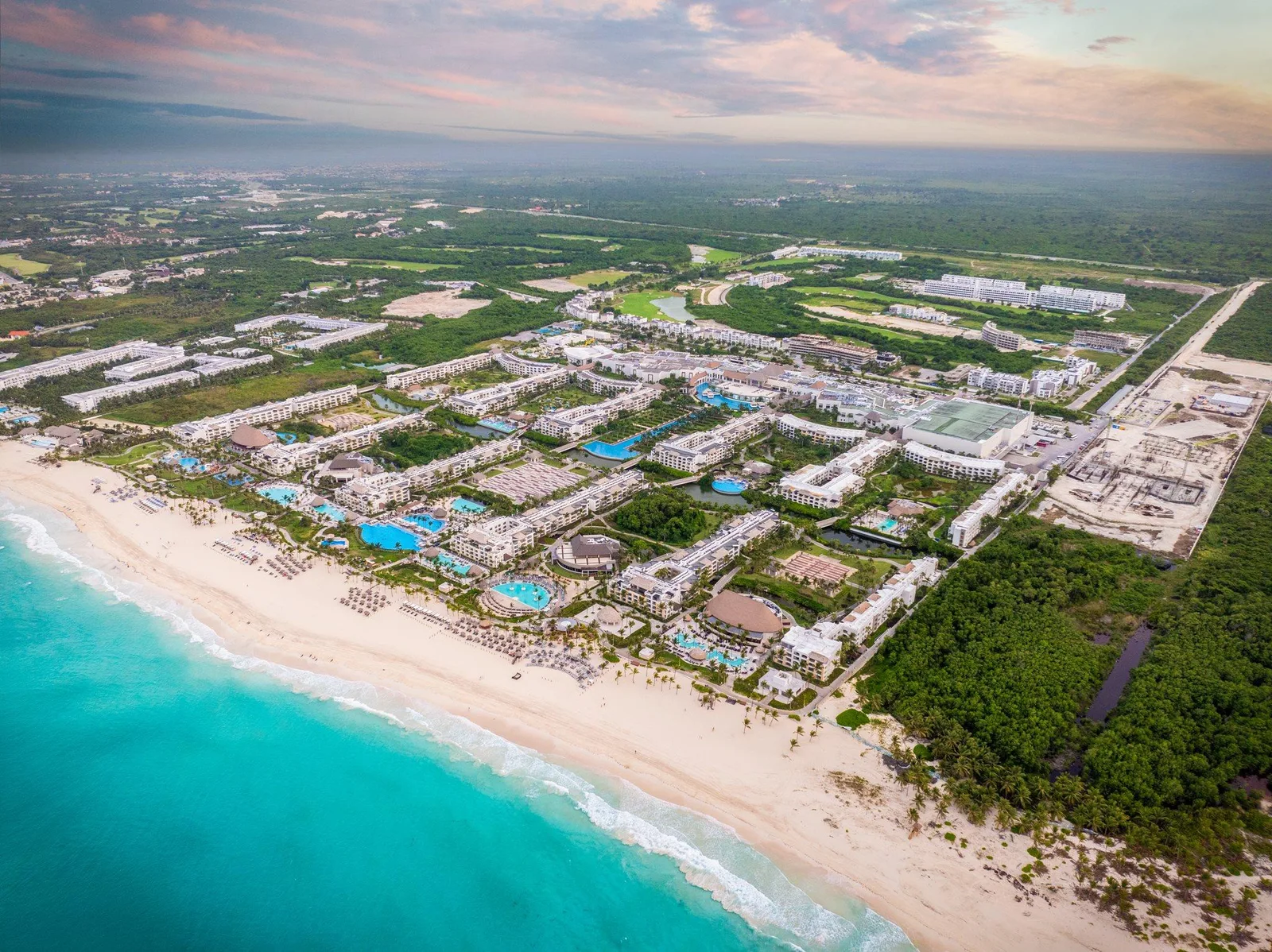
In Punta Cana, aircraft descend in steady succession over the hotel complexes lining the Atlantic coast. A few hundred kilometers away, in the industrial zones of Santiago and Santo Domingo, factories manufacture medical devices, electrical equipment, and components destined for international markets. Between these two worlds, mass tourism and industrial production, lies the transformation of the Dominican economy. Long regarded primarily as another Caribbean tourist destination, the nation of approximately 11 million people has become one of the region's principal centers of economic growth, manufacturing, and foreign investment.
This evolution extends far beyond the success of a single industry or the attractiveness of its coastline. It reflects the gradual emergence of a diversified economy supported by services, manufactured exports, international capital, and a particularly advantageous geographical position. Located close to the United States, at the intersection of the Atlantic Ocean and the Caribbean Sea, the Dominican Republic occupies a strategic position within the tourism, commercial, and industrial networks of the Americas.
By 2025, its gross domestic product had reached approximately $127.4 billion, according to the World Bank, compared with less than $25 billion in the early 2000s. This nominal increase reflects real economic growth, price developments, and exchange-rate effects. Nevertheless, it illustrates the profound change in the scale of the Dominican economy. Annual GDP per capita exceeded $11,000 in 2025, placing the country in a substantially different economic position from the one it occupied a generation earlier.
The trajectory, however, has not been uninterrupted. After expanding by 5% in 2024, economic activity slowed to 2.1% in 2025, reflecting tighter financial conditions and a more uncertain international environment. This slowdown highlights a fundamental distinction: economic power is measured not only by the speed of expansion but also by the ability to preserve its foundations when circumstances become less favorable.
The Dominican Republic now faces a different challenge from the one that defined its previous decades of development. Having successfully expanded the scale of its economy, it must determine how to convert that achievement into lasting productive strength.
From an Agricultural Economy to a Manufacturing and Services Platform
For much of its modern history, the Dominican economy was closely associated with sugar production. Throughout much of the twentieth century, plantations, agricultural exports, and large rural estates shaped the country's productive structure. Sugar, coffee, cocoa, and tobacco provided its principal sources of foreign earnings, leaving the economy exposed to fluctuations in international commodity prices and heavily dependent on external markets.
The transformation accelerated during the 1980s and 1990s, when tourism development and the expansion of free trade zones gradually altered the composition of economic activity. The Dominican Republic began building two complementary engines of growth. The first relied on the commercial development of its territory, climate, and natural attractions. The second sought to attract foreign manufacturers by offering competitive production conditions and preferential access to international markets.
This combination produced a degree of diversification that remains relatively unusual among smaller island economies. While several Caribbean territories depend heavily on tourism, financial services, or a limited range of export commodities, the Dominican Republic has developed a productive base encompassing manufacturing, commercial agriculture, construction, mining, trade, and services.
Integration into North American trade networks played a decisive role. The Dominican Republic–Central America–United States Free Trade Agreement, commonly known as CAFTA-DR, strengthened access to the American market and encouraged the establishment of companies seeking manufacturing facilities close to their principal customers.
Geographical proximity provides a tangible advantage. From the country's main ports, goods can reach the eastern United States relatively quickly. For American companies seeking to shorten delivery times, diversify production locations, or reduce exposure to trans-Pacific supply chains, the Dominican Republic offers an additional industrial option.
The country does not replace the major manufacturing centers of North America or Asia. Instead, it occupies an intermediate position: a regional platform capable of manufacturing, assembling, processing, and exporting products in industries where proximity to final markets represents a competitive advantage.
This role becomes increasingly significant as international companies reconsider the geographical organization of their supply chains.
Free Trade Zones and the Transformation of Manufacturing
Dominican manufacturing has a defining characteristic: a substantial part of its development has taken place within free trade zones operating under specific investment, taxation, and foreign trade arrangements.
Initially dominated by textiles and apparel, these industrial platforms have gradually attracted a broader range of activities. Medical devices, electrical equipment, pharmaceuticals, industrial components, and tobacco products now account for significant portions of the country's manufactured exports.
This transition is strategically important. It allows the Dominican Republic to move gradually beyond a production model based almost exclusively on competitive labor costs and participate in industries requiring more advanced qualifications, industrial controls, and regulatory compliance.
In 2025, exports recorded by the national investment and export promotion agency ProDominicana reached approximately $14.65 billion, an increase of 13.4% from the previous year. Free trade zones accounted for approximately $8.60 billion of that total, representing nearly 59%.
Differences in statistical coverage between customs-based export figures and balance-of-payments data mean that these amounts should not automatically be treated as interchangeable measures of total national exports.
The importance of the free trade zone system is also evident in employment. According to Dominican authorities, employment in these zones surpassed 200,000 workers in 2025, reaching 200,134 positions. During the same year, 82 new companies and ten industrial parks received approval, representing approximately $344 million in projected investment.
These figures demonstrate the existence of a substantial manufacturing sector for an economy of this size. They do not, however, imply that the entire value of exported products is generated domestically.
Assembly industries may import a considerable share of their intermediate inputs, while strategic management, research, product design, and certain technological functions often remain located abroad.
This distinction defines the next stage of Dominican industrial development.
The challenge is no longer simply to attract foreign factories. It is to increase domestic value added by developing local suppliers, training technicians and engineers, strengthening certification capabilities, and encouraging Dominican companies to participate directly in international industrial supply chains.
Industrial upgrading is therefore a credible development opportunity, but its success will depend less on the multiplication of free trade zones than on the concentration of skills, suppliers, and productive activities that emerge around them.
Tourism as a National Industry with Global Reach
Tourism remains the other major engine of Dominican economic growth. In this sector, the country benefits from a particularly favorable combination of extensive hotel capacity, international air connections, substantial real estate investment, and a tourism industry organized around several major destinations.
Punta Cana concentrates much of this activity, but Puerto Plata, La Romana, Samaná, and Santo Domingo also contribute to the diversification of the national tourism economy. The development of additional destinations, particularly in the southwest, reflects efforts to distribute economic benefits beyond the country's established tourism centers.
In 2025, air arrivals of nonresident visitors reached approximately 8.86 million, an increase of 3.8% compared with 2024. This figure excludes cruise passengers and should therefore not be confused with the broader total of international visitors reported by tourism authorities.
The scale of these flows is remarkable relative to the country's population. It helps explain the economic importance of airports, hotel investment, transportation infrastructure, and associated services.
Yet tourism's contribution extends far beyond visitor spending.
Every major resort mobilizes a network of economic activities involving construction, food production, transportation, energy, maintenance, telecommunications, distribution, and financial services. Some of this spending circulates through the domestic economy, while another portion corresponds to imported goods, foreign services, or profits transferred abroad.
Increasing the proportion of value retained within the country is therefore an essential measure of tourism's contribution to long-term development.
The Dominican Republic is gradually seeking to move beyond an exclusively beach-oriented model. Cultural tourism, urban destinations, sporting activities, and transportation investments could diversify revenue sources and reduce some of the industry's geographical concentration.
This strategy nevertheless faces significant constraints.
The rapid development of tourism complexes places pressure on water resources, coastal ecosystems, electricity networks, and public infrastructure. Exposure to hurricanes and extreme weather events adds another dimension to the management of economic and environmental risks.
Tourism remains a major source of foreign exchange and employment, but its future contribution to national development will increasingly depend on the country's ability to manage its environmental and territorial costs.
Foreign Capital and the Geography of an Open Economy
The Dominican Republic's economic expansion also rests on its capacity to attract international capital.
Foreign investment flows into tourism, real estate, infrastructure, telecommunications, energy, financial services, and manufacturing. These investments contribute to the financing of new productive capacity while deepening the country's integration into international economic cycles.
This openness is particularly visible in relations with the United States.
As the Dominican Republic's principal economic partner, the American market provides a crucial destination for manufactured exports, a major source of tourists, and the primary origin of remittances sent by the Dominican diaspora.
These financial transfers occupy a central position in the national economy. According to the World Bank, remittances represented approximately 9.7% of GDP in 2025.
For an economy exceeding $127 billion, this proportion illustrates the macroeconomic importance of income generated abroad. Remittances constitute a source of foreign exchange comparable in scale to several major export activities.
They support household consumption, contribute to housing investment, and help stabilize the country's external financial resources. They also maintain a permanent economic connection between the Dominican Republic and its expatriate communities.
This relationship nevertheless reveals a structural dependency.
A significant portion of household purchasing power depends on employment and income generated outside the national territory, particularly in the United States.
The Dominican Republic therefore operates as an open economy whose sectoral diversification does not eliminate the geographical concentration of its external relationships.
An American recession could simultaneously affect exports, tourism, investment, and remittances. Diversifying commercial partnerships is consequently not merely a question of expanding markets. It is also a matter of economic resilience.
Hispaniola: One Island, Two Economic Trajectories
The Dominican Republic occupies a distinctive geographical position: it shares the island of Hispaniola with Haiti.
Their approximately 390-kilometer land border separates two countries whose economic, institutional, and social trajectories have diverged profoundly.
The Dominican Republic has progressively strengthened its integration into international tourism, trade, and investment networks. Haiti, meanwhile, has experienced a prolonged crisis characterized by severe institutional disruption, insecurity, and a dramatic deterioration in living conditions.
This asymmetry represents one of the defining features of Caribbean political geography.
For Santo Domingo, relations with Haiti simultaneously involve trade, security, migration management, and labor market organization. Cross-border exchanges support certain local economies, while Haitian workers contribute to several Dominican industries, particularly agriculture and construction.
Migration tensions and border enforcement policies complicate this interdependence. They raise questions involving security, legal protections, and human rights while also affecting economic sectors that employ foreign labor.
Haiti's situation also represents a constraint on the economic integration of the island.
Under more stable conditions, cross-border cooperation could support infrastructure development, commercial networks, and productive complementarities. Persistent insecurity instead limits opportunities for coordination and long-term investment.
The Dominican Republic consequently occupies a paradoxical position.
Its economic success increases its regional importance, but it also intensifies the responsibilities and pressures associated with its proximity to a neighboring country experiencing a major crisis.
This reality distinguishes Dominican development from that of many other Caribbean economies. The country's emergence as an economic power cannot be understood independently of the political and humanitarian conditions prevailing on the island it shares.
The Vulnerabilities of Rapid Growth
Dominican economic expansion has generated considerable social transformation.
According to the World Bank, nearly three million people have escaped poverty over the past two decades. The expansion of the middle class, urbanization, and improvements in access to certain services reflect the scale of this change.
Nevertheless, GDP growth alone cannot measure the quality of development.
Territorial disparities remain substantial between major urban centers, tourism destinations, and certain rural regions. Informal employment continues to account for a significant share of the labor market, limiting access to social protection and constraining the government's ability to mobilize tax revenue.
Productivity represents another important challenge.
Export-oriented industries may benefit from advanced technologies and international production standards, while many smaller domestic companies operate with considerably more limited financial and technical resources.
This coexistence of modern industries and less capital-intensive domestic businesses is characteristic of economies undergoing structural transformation.
It can sustain rapid growth for extended periods, but eventually raises the question of whether productivity gains are spreading throughout the broader economy.
Electricity provides a particularly revealing example.
Despite investment in generation capacity and infrastructure, the Dominican electricity system continues to face distribution losses, collection difficulties, and persistent requirements for public subsidies.
According to the International Monetary Fund, the electricity sector deficit averaged approximately 1.5% of GDP between 2022 and 2024.
For a government whose tax revenues remain relatively limited, this burden reduces the resources available for other priorities.
The problem extends beyond public finances.
Expensive or unreliable electricity directly affects industrial competitiveness, business profitability, and household living standards.
Reforming the energy sector is therefore a necessary condition for further economic upgrading.
Investment requirements also extend to education, vocational training, healthcare, transportation, and climate adaptation.
Rising national income creates new opportunities, but it also generates higher expectations regarding infrastructure and public services.
The Dominican Republic must now convert part of its previous economic growth into the productive and institutional capabilities required for its future development.
Economic Power, but of What Kind?
The Dominican Republic's position within the Caribbean requires a distinction between economic size, income per capita, and regional influence.
With GDP exceeding $127 billion in 2025, the country possesses considerable economic weight within the Caribbean region. Its domestic market, tourism industry, and manufactured exports provide a degree of productive depth that many smaller island economies cannot match.
This does not mean that the Dominican Republic has the highest income per capita in the region.
Several Caribbean territories, particularly those benefiting from energy revenues, financial services, or distinctive institutional relationships with developed economies, report higher levels of individual income.
The Dominican Republic's particular strength lies elsewhere.
It combines a relatively substantial domestic market, a large labor force, diversified manufacturing exports, and the capacity to attract international tourism on a significant scale.
A comparison with Jamaica illustrates these structural differences.
Both economies are exposed to tourism and external markets, but the Dominican Republic possesses a more extensive export-oriented manufacturing sector and a considerably larger domestic market.
Puerto Rico provides another point of comparison, although its status as a United States territory, institutional framework, and fiscal relationship with Washington make direct comparisons potentially misleading.
The Dominican Republic should therefore be understood as a sovereign, medium-sized economy whose influence derives primarily from commercial weight, investment attractiveness, and productive capacity.
This influence remains predominantly economic.
It does not automatically translate into diplomatic, financial, or military power comparable to that of major continental states.
Nevertheless, the country could assume a more prominent role in regional discussions involving trade, investment, logistics, energy, and infrastructure.
In a Caribbean region characterized by geographical dispersion and fragmented markets, the concentration of economic capabilities constitutes an advantage in itself.
The Next Threshold of Development
The Dominican economy's prospects remain closely connected to developments in the international environment.
Following the slowdown of 2025, economic institutions anticipate a recovery in growth, although their projections differ according to the assumptions employed.
In its October 2026 update, the World Bank projected economic expansion of 4.7% for 2026 and 4.4% in 2027.
These forecasts are not guarantees.
They depend on continued investment, macroeconomic stability, and the country's ability to absorb external shocks.
More fundamentally, the future of the Dominican economy will depend on three interconnected transformations.
The first concerns manufacturing.
Free trade zones have demonstrated their ability to attract international companies. The next stage will involve strengthening the connections between these industrial platforms and the domestic economy, increasing local production of components and services, and developing a more sophisticated national workforce.
The second concerns infrastructure.
Electricity, ports, transportation networks, and digital systems must support the continued expansion of industrial and tourism activities.
An economy seeking to become a regional production and logistics platform cannot indefinitely depend on infrastructure that remains insufficient or excessively expensive.
The third transformation involves human capital.
Moving toward higher-value activities requires sustained improvements in education, technical training, and innovation capacity.
Without such progress, the country risks maintaining a competitive position based primarily on production costs, fiscal incentives, and geographical proximity.
These transformations also require sufficient fiscal capacity.
Broadening the tax base, improving public expenditure efficiency, and controlling structural deficits will be essential to financing the investments needed for the next stage of development.
The Dominican Republic now possesses several of the economic attributes necessary for further structural advancement.
It has a domestic market, an export-oriented manufacturing base, an internationally established tourism industry, and a privileged position within the North American economic space.
Yet these advantages will produce their most lasting effects only if they translate into higher productivity, broader income distribution, and stronger domestic capabilities.
The country's economic history demonstrates that an island economy can overcome some of the constraints of geography by transforming its location into an instrument of international integration.
It also illustrates how that integration creates new dependencies.
For several decades, the Dominican Republic sought to attract visitors, companies, and international capital. It succeeded on a scale that fundamentally altered its position within the Caribbean.
The challenge ahead is different.
It is no longer simply to attract wealth generated elsewhere, but to develop the capacity to create, control, and retain a greater share of that wealth within its own territory.
The Dominican Republic has successfully changed the scale of its economy. The question now is whether it can transform that ascent into a lasting capacity for autonomous development.
Main Sources
- World Bank — Dominican Republic: Country Overview, October 6, 2026 update; development indicators and 2025 economic data.
- International Monetary Fund — Dominican Republic: 2025 Article IV Consultation, Country Report No. 25/305, November 2025.
- Central Bank of the Dominican Republic — Macroeconomic statistics, national accounts, balance of payments, and external sector indicators, 2024–2026.
- ProDominicana — Dominican export performance in 2025, published January 2026.
- Ministry of Industry, Commerce and MSMEs — 2025 industrial performance, free trade zone employment, and investment data.
Atlas Limits Research Desk
Atlas Limits’ editorial and analytical desk.