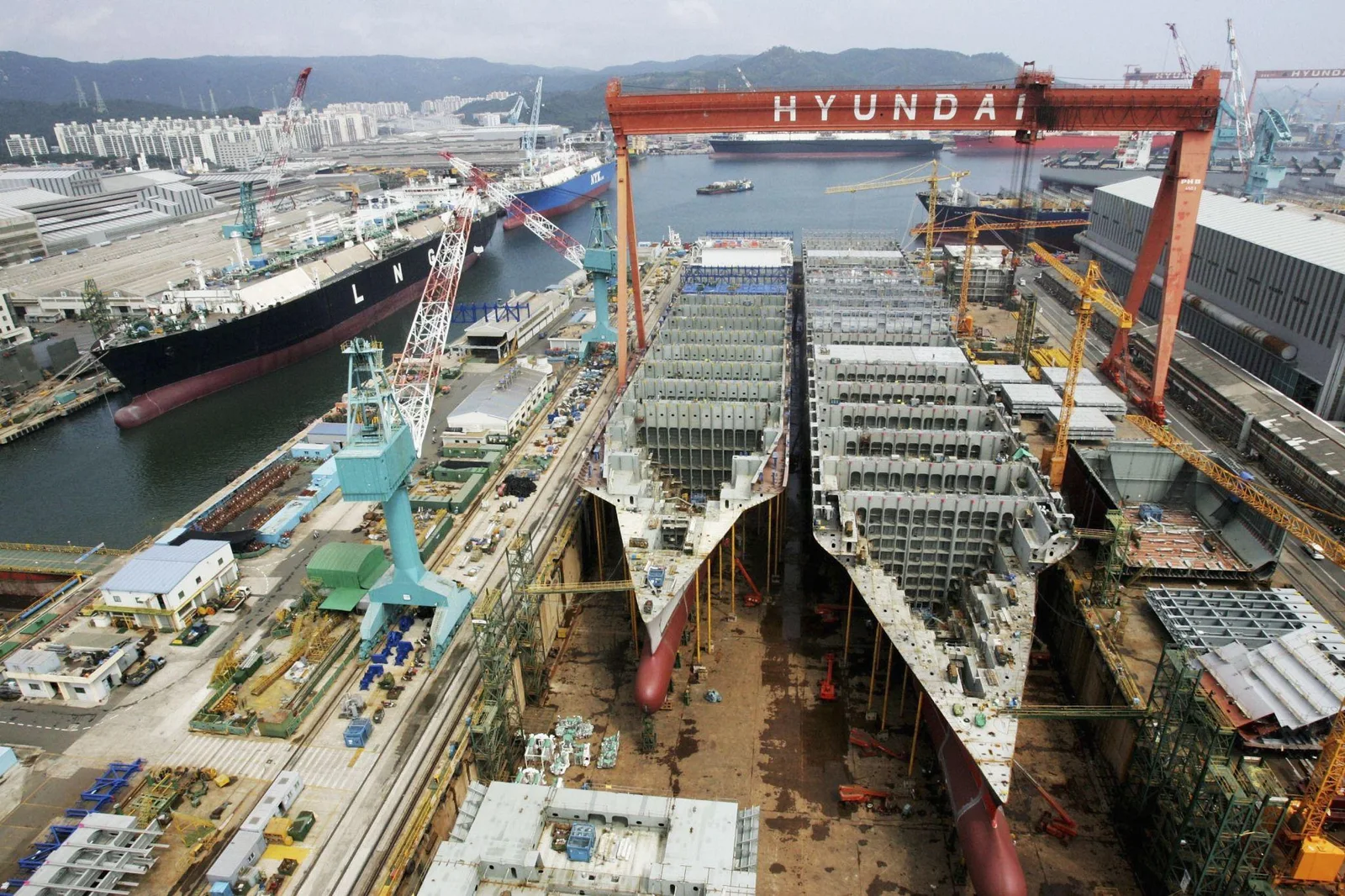
The reconstruction of America’s shipbuilding industry is entering a new phase. On October 22, 2026, in Houston, South Korean industrial group HD Hyundai and American engineering and construction company Kiewit signed an agreement to establish a joint venture and develop a new shipyard in the United States. The proposed company, HD Kiewit Shipbuilding, is expected to begin construction in 2027, with operations scheduled to start in 2029. Once fully operational, the project could support approximately 3,000 American jobs. Behind this industrial agreement lies a more profound transformation: rebuilding strategic manufacturing capacity in the United States increasingly requires the technologies, expertise and industrial experience of allied economies.
The agreement represents a further step in a partnership initiated several months earlier. In July 2026, HD Hyundai and Kiewit announced a strategic cooperation framework aimed at strengthening American shipbuilding capabilities, particularly in the production of ship blocks and modules. The establishment of a joint venture now gives that ambition a more concrete industrial dimension. The objective is no longer simply to exchange expertise or explore potential areas of cooperation, but to develop new production infrastructure on American soil.
The choice of partners reflects the complementary capabilities required for such an undertaking. HD Hyundai belongs to one of the world's leading shipbuilding groups, with extensive expertise in designing, manufacturing and integrating complex vessels. Its industrial capabilities extend beyond ship assembly to the coordination of thousands of components, suppliers and technical operations. Kiewit contributes its experience in American engineering, construction and major infrastructure development. Their partnership seeks to combine two distinct strengths: the ability to build ships at scale and the capacity to develop the facilities needed to manufacture them in the United States.
A Maritime Power Confronting Its Industrial Limits
The significance of this cooperation extends well beyond the construction of another shipyard. The United States remains the world's leading military naval power in terms of global force projection and possesses specialized manufacturers capable of producing some of the most sophisticated warships ever built. Yet its commercial shipbuilding industry accounts for only a marginal share of global production, a market overwhelmingly dominated by China, South Korea and Japan.
This imbalance is the result of several decades of industrial transformation. Having developed an extraordinary shipbuilding capacity during the Second World War, the United States gradually lost much of its commercial production base to Asian competitors capable of manufacturing vessels in greater numbers, more rapidly and frequently at lower costs. American shipyards retained critical expertise in military programs and certain protected domestic markets, but the broader industrial ecosystem contracted. Specialized suppliers disappeared or consolidated, infrastructure aged, recruitment became increasingly difficult and economies of scale diminished.
The distinction between naval power and shipbuilding power has consequently become more visible. Maintaining an advanced military fleet does not automatically guarantee the ability to replace vessels quickly, absorb additional production requirements or sustain a prolonged industrial expansion. Delays affecting several American naval programs have exposed constraints involving production infrastructure, supply chains and the availability of skilled labor.
Meanwhile, China has developed a shipbuilding industry whose commercial and strategic dimensions increasingly reinforce one another. The production of container ships, oil tankers, bulk carriers and other merchant vessels supports an extensive network of shipyards, suppliers and specialized workers. Some of these capabilities also contribute to military shipbuilding, creating an industrial depth that cannot be replicated simply by increasing defense expenditure.
This is precisely where cooperation with South Korea becomes strategically important. Seoul possesses a highly integrated shipbuilding industry organized around major industrial groups capable of designing and constructing complex vessels within competitive production schedules. For Washington, the objective is not merely to obtain additional ships, but to rebuild the industrial conditions necessary to manufacture them sustainably at home.
Korean Technology and the Reconstruction of American Manufacturing
The proposed HD Kiewit Shipbuilding facility is expected to incorporate advanced manufacturing technologies, including digital twins, automation, robotic welding and digitally integrated production management systems. These technologies are central to the modernization of contemporary shipbuilding.
A modern shipyard operates as a coordinated industrial system in which design, procurement, block fabrication, assembly and testing must follow precisely managed sequences. Digital twins can provide virtual representations of facilities and manufacturing processes, allowing engineers to anticipate production constraints, identify potential inefficiencies and reduce operational errors. Robotic welding can improve consistency in repetitive manufacturing tasks, while digital management systems facilitate the exchange of information between engineering departments, production workshops and suppliers.
The South Korean contribution therefore extends beyond machinery or technical equipment. It includes the organization of production itself. Building a shipyard does not automatically create a competitive shipbuilding industry. Manufacturers must also master assembly sequences, train workers, ensure component quality, coordinate subcontractors and maintain sufficient production volumes to justify the cost of their facilities.
The joint venture is expected to pursue three complementary markets: commercial shipbuilding, logistics support vessels for the United States Navy and the production of components for other shipyards. This potential diversification is significant. It could allow the new facility to avoid dependence on a single category of orders while contributing more broadly to the reconstruction of America's shipbuilding supply chain.
None of these markets, however, is guaranteed. No firm order from the United States Navy has been announced as part of the agreement. Military shipbuilding programs remain subject to procurement procedures, budgetary decisions and regulatory requirements. Commercial markets will present a different challenge: demonstrating that a newly established American facility can operate competitively against international manufacturers with extensive experience and established economies of scale.
The planned opening in 2029 is likewise an industrial target rather than an immediately available production capability. Between the agreement and the delivery of the first vessels, the partners will need to develop infrastructure, obtain regulatory approvals, recruit and train workers, qualify suppliers and progressively increase production. Experience across major industrial projects suggests that these stages can prove just as consequential as the initial investment decision.
An Industrial Alliance Within a Much Larger Investment Framework
The agreement comes amid a broader economic rapprochement between Washington and Seoul. Shipbuilding has emerged as one of the strategic sectors in bilateral discussions, with a $150 billion commitment framework associated with the development of the American maritime industry as part of a wider $350 billion investment package linked to trade negotiations.
These figures illustrate the scale of the political ambitions involved, but they must be distinguished from the HD Hyundai–Kiewit project itself. The $150 billion represents a broader national cooperation framework, not the announced financing of the proposed shipyard. Based on the information currently available, neither the project's specific investment amount nor the joint venture's valuation or final equity ownership structure has been publicly disclosed.
The absence of these financial parameters makes it premature to assess the transaction's precise economic structure. Potential borrowing arrangements, the respective capital contributions of the partners, possible public financing mechanisms and the allocation of financial risks remain to be clarified. Similarly, the signing of the agreement does not establish which company will ultimately exercise majority ownership or effective corporate control.
The underlying industrial logic is nevertheless identifiable. Unlike a conventional cross-border acquisition, in which a foreign company purchases an existing domestic manufacturer, HD Hyundai and Kiewit intend to establish new production capacity. The transaction therefore represents a form of industrial expansion and technology transfer rather than the acquisition of an established American shipbuilder.
For South Korea, this model offers an opportunity to expand its industrial influence beyond the export of vessels manufactured in Asia. Korean companies can commercialize their expertise, gain access to additional markets and strengthen their position in a sector of increasing strategic importance to Washington. For the United States, the intended benefit is different: attracting the technological capabilities and organizational expertise needed to accelerate a reconstruction process that could otherwise take many years.
This convergence does not eliminate the partners' distinct interests. South Korean companies will seek to preserve competitiveness, protect intellectual property and generate adequate returns on investment. American authorities will prioritize domestic employment, supply-chain security and the development of national manufacturing capabilities. The balance between these objectives will partly determine the partnership's long-term viability.
Industrial Sovereignty Is Changing Its Methods
The HD Hyundai–Kiewit project reveals an apparent contradiction at the center of American industrial policy. Washington seeks to reduce strategic dependencies, yet rebuilding certain domestic capabilities increasingly requires deeper international cooperation.
The contradiction becomes less pronounced when the origin of technology is distinguished from the location of production. A facility built in the United States, employing American workers and integrated into domestic supply chains can strengthen national manufacturing capabilities even when part of its expertise originates abroad. The decisive questions concern operational control, production continuity and the ability to preserve and develop industrial skills over time.
From this perspective, alliances are no longer confined to military agreements, diplomatic guarantees or commercial exchanges. They are becoming instruments of productive reconstruction. Allied economies do not merely supply finished equipment; they increasingly participate in developing the infrastructure, production methods and workforce capabilities required to manufacture that equipment locally.
Shipbuilding is particularly suited to this transformation because it connects commercial, military, energy and logistical interests. The same industrial regions can support component suppliers, maintenance facilities, automation specialists and technical skills applicable across multiple vessel categories. The development of a major shipyard can therefore generate economic effects extending beyond its own order book, provided that a sufficiently developed network of suppliers and training institutions emerges around it.
The strategic implications are substantial. The United States is seeking to reinforce its domestic industrial base while preserving access to the technological capabilities of countries whose security and economic interests are closely aligned with its own. South Korea, meanwhile, has an opportunity to transform its position from a major supplier of globally traded vessels into a direct participant in the reconstruction of American manufacturing infrastructure.
This approach also reflects the changing nature of international industrial competition. For decades, globalization encouraged companies to concentrate production wherever costs, infrastructure and scale offered the greatest advantages. Strategic considerations are now increasingly influencing those decisions. Governments are placing greater emphasis on the location of critical facilities, the resilience of supply chains and the political reliability of industrial partners.
The resulting model is not a simple reversal of globalization. Rather, it represents a reorganization of industrial interdependence around strategic partnerships. Production may be relocated or expanded domestically without requiring every technology, supplier or investor to originate within national borders.
The success of this approach will depend on its practical implementation. A new shipyard alone cannot reverse several decades of relative industrial decline. The United States must also address high production costs, workforce shortages, infrastructure requirements and the need for predictable long-term demand. Asian competitors retain considerable advantages in scale, while American regulatory requirements may constrain certain commercial or military activities.
The project's eventual performance will therefore be measured less by the announcement itself than by its ability to become a viable manufacturing operation. Actual employment, production volumes, domestic sourcing, customer orders, delivery schedules and operating costs will provide the most meaningful indicators of progress.
The year 2029 represents an initial milestone rather than a final outcome. Even if operations begin on schedule, the subsequent expansion of production will determine whether the facility can contribute materially to America's shipbuilding capacity.
Yet the geopolitical significance of the agreement is already clearer than its future financial returns. In a global environment where industrial depth is once again becoming a decisive component of national power, the United States is attempting to transform its alliances into productive capabilities. South Korea, traditionally recognized as one of the world's leading shipbuilding nations, may increasingly become a partner in rebuilding the American maritime industrial base.
The central question is no longer simply which country builds the ships, but where the production facilities are located, who controls the technologies and which economies retain the skills necessary to manufacture at scale. Through HD Hyundai and Kiewit, Washington is exploring a model in which industrial sovereignty is not achieved by eliminating international interdependence, but by reorganizing it.
Main Sources
- Reuters, October 23, 2026 — Report on the HD Hyundai–Kiewit agreement to develop a new shipyard in the United States.
- ChosunBiz, October 23, 2026 — Announcement of HD Kiewit Shipbuilding and the proposed industrial development schedule.
- Kiewit Corporation, July 17, 2026 — Official announcement of the initial strategic partnership with HD Hyundai.
- U.S. Government Accountability Office (GAO) — Reports examining American shipbuilding capacity, industrial constraints and delays affecting Navy procurement programs.
- UNCTAD, Review of Maritime Transport — Structural analysis of the global maritime industry and international shipbuilding markets.
Atlas Limits Research Desk
Atlas Limits’ editorial and analytical desk.