For the first time, British fighter aircraft have participated in a simulated French nuclear mission. Exercise Rummy, conducted on 20 and 21 October 2026, marks a significant step in the strategic rapprochement between Paris and London. Beyond this unprecedented military cooperation lies a much broader question: can Europe develop credible nuclear coordination without compromising the sovereignty of its two nuclear powers?
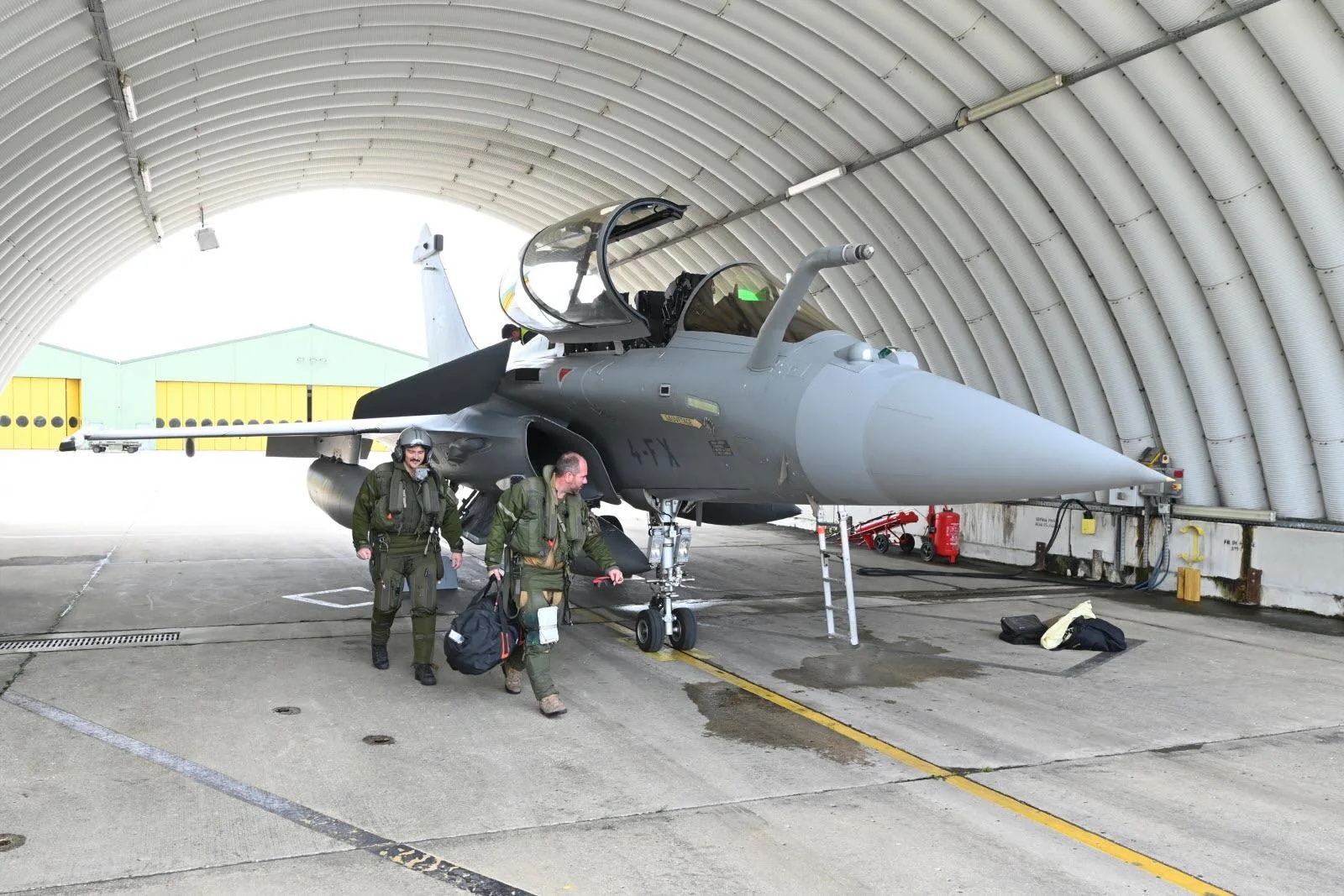
On 20 and 21 October 2026, French Rafale fighter aircraft departed from Saint-Dizier Air Base to conduct a simulated nuclear strike mission over the Mediterranean. Their escort included Typhoon fighters from the British Royal Air Force. No nuclear weapons were employed. Yet the significance of the exercise extends far beyond the aerial operations themselves.
Known as Rummy, the manoeuvre represents a first in Franco-British military relations. Until now, nuclear cooperation between the two countries had largely consisted of political consultations, strategic commitments, and scientific and technological programmes. It is now finding expression in the operational training of their armed forces.
The official announcement, made on 23 October, follows the Northwood Declaration adopted in July 2025. That agreement recognises that French and British nuclear forces, while remaining independent, can be coordinated. The wording is carefully constructed, preserving national prerogatives while opening a new area of military cooperation.
The distinction is fundamental. The United Kingdom did not participate in a French nuclear strike decision, nor did it assume any responsibility for French nuclear weapons. British aircraft performed a conventional escort function during a simulated mission. Nevertheless, their participation establishes a precedent: Europe's two nuclear powers can now train certain military capabilities together in support of an operation associated with national nuclear deterrence.
This development comes as Europe reassesses the foundations of its security. The war in Ukraine, the enduring confrontation with Russia, rising military expenditure, and uncertainty surrounding the continuity of American security commitments have gradually returned nuclear deterrence to the centre of the continent's strategic calculations. France and the United Kingdom, long attached to different conceptions of nuclear independence, are beginning to explore the operational consequences of their strategic interdependence.
Two Sovereign Powers Facing a Shared Geography
France and the United Kingdom are the only two European states possessing national nuclear arsenals. Their shared status as permanent members of the United Nations Security Council also gives them particular responsibilities within the international security system. This institutional proximity, however, should not obscure the profound differences between their doctrines and military capabilities.
French nuclear deterrence rests on two complementary components. The first is sea-based, relying on the ballistic missile submarines of the Strategic Oceanic Force. Their stealth and ability to remain on patrol ensure that France retains the capacity to retaliate even after a major attack against its territory. The second component is airborne, notably involving Rafale aircraft belonging to the Strategic Air Forces and their air-launched nuclear missiles.
This dual structure provides Paris with several instruments of strategic signalling. The submarine component emphasises permanence and discretion. The airborne component allows more visible demonstrations of political and military resolve. Increased readiness, deployments, and exercises can therefore communicate a message to a potential adversary without any nuclear weapon being employed.
The United Kingdom has followed a different path. Since abandoning its last airborne nuclear capability in the 1990s, its operational deterrent has relied on Vanguard-class submarines equipped with Trident ballistic missiles. London maintains continuous at-sea deterrence, designed to ensure that a retaliatory capability remains available at all times.
This arrangement is accompanied by a particularly close technological relationship with the United States. British Trident missiles form part of a system of cooperation with Washington, although the decision to employ British nuclear weapons remains the sovereign prerogative of the British Prime Minister. France, by contrast, maintains national autonomy in the design and operation of its nuclear systems.
The two countries therefore possess neither identical equipment nor identical industrial structures, and their relationships with NATO's nuclear arrangements are not the same. Yet their geography and strategic interests increasingly bring them together. A major crisis threatening Europe's security would be unlikely to affect one country without also concerning the other.
This reality underpins the Northwood Declaration.
The agreement does not establish a common nuclear doctrine. It nevertheless recognises that the vital interests of both states may be affected by converging threats and that their forces can, under certain circumstances, be coordinated.
This recognition represents an important development. It suggests that nuclear independence does not necessarily exclude cooperation, provided that the arrangements adopted do not compromise either government's freedom of decision.
From Lancaster House to Northwood
Franco-British strategic cooperation did not begin with Exercise Rummy. It belongs to a longer history of military cooperation, of which the Lancaster House agreements signed in November 2010 remain one of the principal foundations.
Those agreements enabled the two countries to deepen military cooperation, develop joint capabilities, and organise scientific and technological work associated with their nuclear arsenals. In this field, France and the United Kingdom established mechanisms intended to support the safety and reliability of their weapons without merging their national programmes.
The cooperation was primarily technical and institutional. It allowed certain expertise and infrastructure to be shared while preserving sensitive technologies, national responsibilities, and sovereign decision-making.
The Northwood Declaration introduces an additional dimension. It moves beyond cooperation on the scientific and technological foundations of nuclear deterrence and explicitly opens the possibility of coordination between the forces responsible for its implementation.
The establishment of a bilateral nuclear steering group, which first met in December 2025, forms part of this transformation. Its purpose is to provide institutional continuity to cooperation whose implications now extend beyond scientific programmes.
Exercise Rummy represents the first visible operational application of this approach.
Its importance does not lie in a spectacular technological innovation. French and British air forces have extensive experience of multinational operations. They regularly participate in air defence, escort, interception, and tactical coordination exercises.
The novelty concerns the nature of the mission being supported. British fighters were integrated into the operational environment of a simulated French nuclear deterrence mission.
This distinction changes the political significance of a manoeuvre that, considered in isolation, might appear relatively conventional.
In nuclear deterrence, military procedures matter as much as equipment. Credibility depends on the ability to execute a mission, the reliability of command structures, and the extent to which a potential adversary understands the capabilities actually available. Cooperation that remains theoretical does not have the same significance as coordination repeatedly tested by military forces.
Exercise Rummy does not demonstrate the existence of an integrated operational architecture. It nevertheless shows that both governments are now prepared to make visible a form of cooperation previously confined to more limited areas.
The Return of Europe's Nuclear Question
For several decades, Western European security was organised around a relatively stable arrangement. The United States provided the principal collective nuclear guarantee within NATO, while France and the United Kingdom retained their own deterrent forces.
This architecture never eliminated disagreements between allies. It nevertheless allowed European states to develop their defence policies without collectively resolving the ultimate question of nuclear employment.
The strategic environment has changed profoundly.
The war in Ukraine has returned the possibility of major conflict on the continent to the centre of military planning. Russia retains a substantial nuclear arsenal and continues to assign nuclear deterrence an essential place in its strategic doctrine. Tensions with European countries have renewed concerns about escalation, retaliatory capabilities, and the credibility of security guarantees.
At the same time, American debates over NATO financing, the distribution of military responsibilities, and Washington's geopolitical priorities have intensified European uncertainty.
These developments do not mean that the American nuclear guarantee has disappeared. They do, however, demonstrate that a security architecture dependent on external political commitments remains exposed to changes in the priorities of the power providing them.
Europe consequently faces a longstanding contradiction. It possesses considerable economic, industrial, and technological resources, yet its strategic security remains heavily dependent on a power outside the continent.
The existence of two national nuclear arsenals does not automatically resolve this contradiction. French and British nuclear weapons do not constitute a common European force. They serve national doctrines and remain under separate political authorities.
Cooperation between Paris and London could nevertheless gradually alter this situation.
It could not, by itself, replace American guarantees, whose scale and capabilities remain unmatched in Europe. It could, however, strengthen the contribution of Europe's two nuclear powers to continental security and increase their capacity for coordinated action.
The objective would be less to create a unified European deterrent than to give greater coherence to existing national capabilities.
This approach offers an obvious political advantage: it does not require an immediate solution to the extraordinarily difficult question of supranational nuclear authority.
It also has a fundamental limitation: coordination of military capabilities can never guarantee identical political decisions.
Why a Common Deterrent Is Not a Simple Solution
The concept of European nuclear deterrence regularly returns to strategic debates. At first glance, it appears to follow a straightforward logic. If Europe possesses two nuclear powers, why should it not organise a common nuclear protection system?
The difficulty becomes apparent as soon as the practical requirements of such an arrangement are examined.
Deterrence does not depend solely on possessing weapons. It depends on the credibility of a political decision. A potential adversary must believe that a state could actually employ its nuclear capabilities if its vital interests were threatened.
Yet vital interests cannot necessarily be defined identically by several sovereign governments.
A threat considered existential by Paris might not receive the same assessment in London. The two capitals could also disagree over the timing, form, and consequences of a potential response.
Creating a common European nuclear authority would therefore require answers to questions touching the foundations of sovereignty.
Who would decide whether nuclear weapons should be employed? Under what procedures? How extensively would other states be consulted? Could a government be required to participate in a decision it opposed? And how could the credibility of a nuclear response be preserved if its implementation depended on a complex multinational political process?
None of these difficulties is resolved by the Northwood Declaration.
The agreement nevertheless suggests another method.
Rather than attempting to merge decision-making authority, the two countries can develop mechanisms allowing certain military activities to be coordinated while retaining separate national command structures.
Cooperation could therefore concern conventional support capabilities, force protection, information exchanges, and operational preparation, within limits determined by both governments.
Such an architecture would not amount to shared nuclear decision-making. It could nevertheless improve the effectiveness of certain missions and deepen mutual understanding of operational procedures.
The precedent established by Rummy fits precisely within this logic.
A British aircraft can contribute to protecting a simulated French nuclear mission without the British government acquiring any authority over French nuclear weapons.
The separation between military support and sovereign decision-making therefore makes it possible to envisage cooperation that might previously have appeared incompatible with the principle of nuclear independence.
London Between Washington and Paris
The rapprochement with France comes as the United Kingdom is also seeking to strengthen its participation in NATO's nuclear arrangements.
London has announced plans to acquire twelve F-35A aircraft and expand its involvement in the Alliance's airborne nuclear mission. This represents an important development for a country whose national operational deterrent has relied exclusively on submarines for several decades.
The two initiatives must nevertheless be distinguished.
Participation in NATO's nuclear mission falls within specific multinational arrangements in which the United States occupies a central position.
Cooperation with France is based on a bilateral relationship between two sovereign nuclear powers.
Their legal frameworks, command procedures, and political responsibilities are different.
This dual approach could nevertheless strengthen Britain's strategic position.
London appears to be seeking to consolidate its role within the Atlantic Alliance while deepening its special relationship with France, without abandoning its military and technological ties with Washington.
The investments announced by the British government illustrate the importance attached to this direction. London has notably presented a commitment of £63 billion over four years to strengthen its nuclear deterrent and associated capabilities.
The modernisation of submarine forces, nuclear infrastructure, industrial expertise, and new airborne capabilities forms part of a broader strategic renewal.
For France, the rapprochement serves a different purpose.
It allows Paris to develop nuclear cooperation with a European power possessing significant military capabilities while preserving the national character of its deterrent.
It also provides a framework through which France can strengthen its European strategic role without placing its nuclear forces under integrated command.
The two countries therefore pursue objectives that are not identical but can converge.
London seeks to reinforce its relationships with Washington, NATO, and Paris simultaneously. France seeks to deepen European cooperation without compromising its independence of decision.
The Northwood Declaration allows these orientations to be brought closer together without requiring them to become identical.
A European Architecture Built on Several Levels
If Franco-British nuclear cooperation continues to deepen, it could contribute to the emergence of a European strategic architecture organised around several complementary levels.
The first would remain national. France and the United Kingdom would retain their arsenals, doctrines, and command structures.
The second would be bilateral. It would encompass strategic consultations, joint exercises, and certain coordination procedures between the two countries' forces.
A third level could eventually involve other European partners in precisely defined conventional activities.
Germany, Italy, Poland, the Netherlands, and several other states possess military capabilities that could contribute to air defence, intelligence, communications, and the protection of strategic infrastructure.
Some already participate in NATO's nuclear arrangements. Others are seeking to strengthen their role in continental security.
Their possible involvement in support activities would not, however, mean participation in French or British nuclear decision-making.
Maintaining this distinction would be essential to preserving the political coherence of the arrangement.
Broader military cooperation could strengthen the protection and support available to national nuclear forces. It would not, by itself, constitute an automatic nuclear security guarantee extended to every European state.
Crossing that threshold would require explicit political commitments and clarification of the circumstances under which French or British vital interests might be considered directly affected by the security of other countries.
At this stage, Exercise Rummy does not justify anticipating such a development.
It nevertheless opens a new field of strategic reflection: European nuclear security organised around coordinated national capabilities rather than a common political authority.
Such an arrangement might correspond more closely to the continent's institutional realities, where defence policy remains largely determined by national governments.
It could also allow gradual progress based on trust, exercises, and operational results rather than immediate institutional transformation.
Deterrence as Political Communication
The significance of a nuclear exercise cannot be measured solely by the military assets deployed.
Deterrence has an inherently political dimension. Its purpose is to influence a potential adversary's calculations by demonstrating that certain actions would carry unacceptable consequences.
Exercises perform several functions within this framework.
They verify military capabilities, train personnel, and test procedures. They also help make government resolve visible.
Exercise Rummy therefore communicates several messages.
First, it indicates that Paris and London intend to translate their nuclear cooperation declaration into practical military activity.
Second, it demonstrates that differences between their doctrines do not constitute an absolute obstacle to certain joint operations.
Finally, it suggests that European nuclear security could gradually rely on closer cooperation between the continent's two nuclear powers.
This communication must nevertheless be interpreted cautiously.
A demonstration of coordination does not mean that a permanent operational mechanism already exists. Nor does it prove that the two countries would necessarily adopt identical positions during a crisis.
Strategic credibility cannot simply be declared. It develops over time through consistent political commitments, available military capabilities, and reliable procedures.
For this reason, future exercises may ultimately prove more revealing than the October 2026 announcement itself.
Repeated manoeuvres, possible diversification of their scope, and deeper consultation mechanisms would help determine whether Rummy remains an isolated event or becomes the beginning of an enduring practice.
The precise nature of the procedures tested is also important. Publicly available information establishes British participation in a simulated French mission but does not demonstrate that joint nuclear decision-making mechanisms were exercised.
Air escort cooperation and coordination of strategic decisions belong to fundamentally different levels of responsibility.
The Limits of European Strategic Autonomy
Closer Franco-British nuclear cooperation could strengthen Europe's strategic capabilities, but it would not be sufficient to guarantee complete autonomy.
Nuclear deterrence represents only one component of military power. It cannot replace conventional forces, industrial capacity, intelligence systems, or surveillance capabilities.
A credible security architecture also requires air defence, ammunition stockpiles, logistics, resilient infrastructure, and an industrial base capable of sustaining prolonged military operations.
European states continue to face significant dependencies in several of these areas.
Nuclear cooperation therefore cannot be separated from conventional rearmament and the modernisation of European defence industries.
It also raises a question of political coherence.
Europe is not a federal state possessing a single military authority. Its governments do not always share the same threat perceptions or geographical priorities.
The United Kingdom belongs to NATO but has left the European Union. France belongs to both organisations while maintaining an independent nuclear doctrine.
These institutional differences complicate the construction of a common strategic framework.
They may nevertheless encourage more flexible forms of cooperation organised around states capable of assuming particular responsibilities.
Franco-British rapprochement could therefore become one element of a European security architecture that is less centralised but more effectively coordinated.
Such a development would not eliminate political disagreements. It could, however, improve the way existing military capabilities operate together.
European strategic autonomy would then depend not only on the creation of new institutions but also on the ability of states to organise their interdependence effectively.
The Importance of Political Continuity
The principal uncertainty now concerns the durability of this cooperation.
Franco-British relations have experienced periods of rapprochement and tension, particularly over Brexit, trade relations, migration, and several diplomatic disputes.
Military cooperation has often endured despite these disagreements, precisely because it rests on long-term strategic interests.
The nuclear domain nevertheless requires an exceptionally high degree of trust.
Governments must be able to anticipate their partners' behaviour in situations where decision-making time may be extremely limited and the consequences irreversible.
Effective coordination therefore requires institutional mechanisms sufficiently robust to survive changes of government.
It also demands mutual understanding of doctrines, procedures, and the limits each state intends to preserve.
The bilateral nuclear steering group could play an important role in maintaining this continuity.
Its effectiveness will depend, however, on the responsibilities it actually receives and the extent to which its work is translated into military practice.
The Northwood Declaration established a political framework. Exercise Rummy has provided its first visible operational illustration.
Between these two stages and the construction of lasting cooperation lies considerable work.
The two governments will need to determine the frequency of exercises, the areas in which common procedures might be developed, and the arrangements for consultation during major strategic crises.
The possible participation of other European partners would raise additional questions, both politically sensitive and militarily complex.
None of these developments can be considered inevitable.
Yet the fact that they can now be contemplated within an official Franco-British framework reflects a change in European strategic thinking.
Sovereignty in an Age of Interdependence
Exercise Rummy ultimately reveals a transformation extending beyond military practice.
For decades, nuclear independence was understood primarily as a state's ability to preserve absolute freedom of decision, supported by national military capabilities.
This conception remains central to both French and British nuclear doctrines.
The contemporary strategic environment nevertheless demonstrates that independence of decision does not necessarily require operational isolation.
Nuclear forces operate within a military environment involving conventional systems, intelligence networks, surveillance capabilities, and communications infrastructure.
The protection of these assets can benefit from cooperation with partners without transferring political responsibility for nuclear weapons.
This is the distinction Paris and London are beginning to explore.
It allows two requirements that once appeared difficult to reconcile to coexist: preserving full nuclear sovereignty while recognising the value of military coordination between allied powers.
The model remains limited. It does not constitute a unified European nuclear deterrent, a new collective nuclear guarantee, or a comprehensive alternative to NATO's nuclear architecture.
It nevertheless represents a concrete development in how Europe's two nuclear powers understand their shared security.
On a continent confronted with the return of high-intensity warfare, transatlantic uncertainty, and shifting balances of power, this evolution could acquire growing importance.
Europe does not merely lack certain military capabilities. It must also learn to coordinate those it already possesses while respecting the sovereign authorities responsible for their employment.
Exercise Rummy does not resolve this contradiction. It demonstrates that the problem can be approached differently.
France and the United Kingdom have not begun sharing nuclear decision-making authority. They have begun demonstrating that their armed forces can cooperate around a mission governed by that authority.
The distinction is considerable, but it is precisely what gives the exercise its historical significance.
Europe has not created a common nuclear deterrent. It has nevertheless taken an initial step towards operational coordination between its two nuclear powers. In a domain where sovereignty remains paramount, even this limited shift could foreshadow a lasting transformation of the continent's strategic balance.
Main Sources
UK Ministry of Defence — Official communication of 23 October 2026 concerning Exercise Rummy and Franco-British nuclear cooperation.
French Ministry of the Armed Forces — Institutional communications concerning Exercise Rummy and strategic cooperation with the United Kingdom.
Northwood Declaration — Franco-British political agreement of July 2025 concerning the coordination of independent national nuclear forces.
Lancaster House Agreements — Franco-British defence and security cooperation treaties, November 2010.
Reuters — Reporting of 23 October 2026 concerning the first participation of British fighter aircraft in a simulated French nuclear mission.
NATO — Institutional documentation on nuclear deterrence, the Alliance's nuclear arrangements, and member-state participation.
Editorial verification note: Details concerning Exercise Rummy on 20–21 October 2026 are based on the information supplied for this article. The official statements of 23 October and the Reuters report have not been independently checked for this translation and should be verified before publication.
Atlas Limits Research Desk
Atlas Limits’ editorial and analytical desk.