It took only a map to revive a question Europe believed it had settled for good. In Germany, activists associated with Alternative für Deutschland (AfD) circulated a representation of the country's territory extending into Alsace, Moselle and several neighboring states. The image evokes a vanished geography, one in which Germany's borders would be determined by history and national belonging rather than contemporary treaties. It constitutes neither an official territorial claim by the German government nor, at this stage, a territorial program adopted by the AfD leadership. Yet its reappearance in a political environment marked by the rise of nationalist and far-right movements across Europe raises a deeper question: what becomes of a union of states when some of its political movements begin to regard national borders as historical arrangements open to challenge?
For nearly eight decades, Western Europe's stability has rested on a fundamental transformation. Territories that states had fought over for generations ceased to be objectives of national power. Borders remained, but their function changed. They continued to define sovereignty without necessarily interrupting trade, mobility or economic cooperation. European integration was designed precisely to make that coexistence possible.
The rise of nationalist movements does not mean that this equilibrium has already collapsed. It does, however, require an examination of the political convictions on which it rests. Institutions can preserve their rules long after societies have begun questioning the principles behind them.
A German Map, a European Question
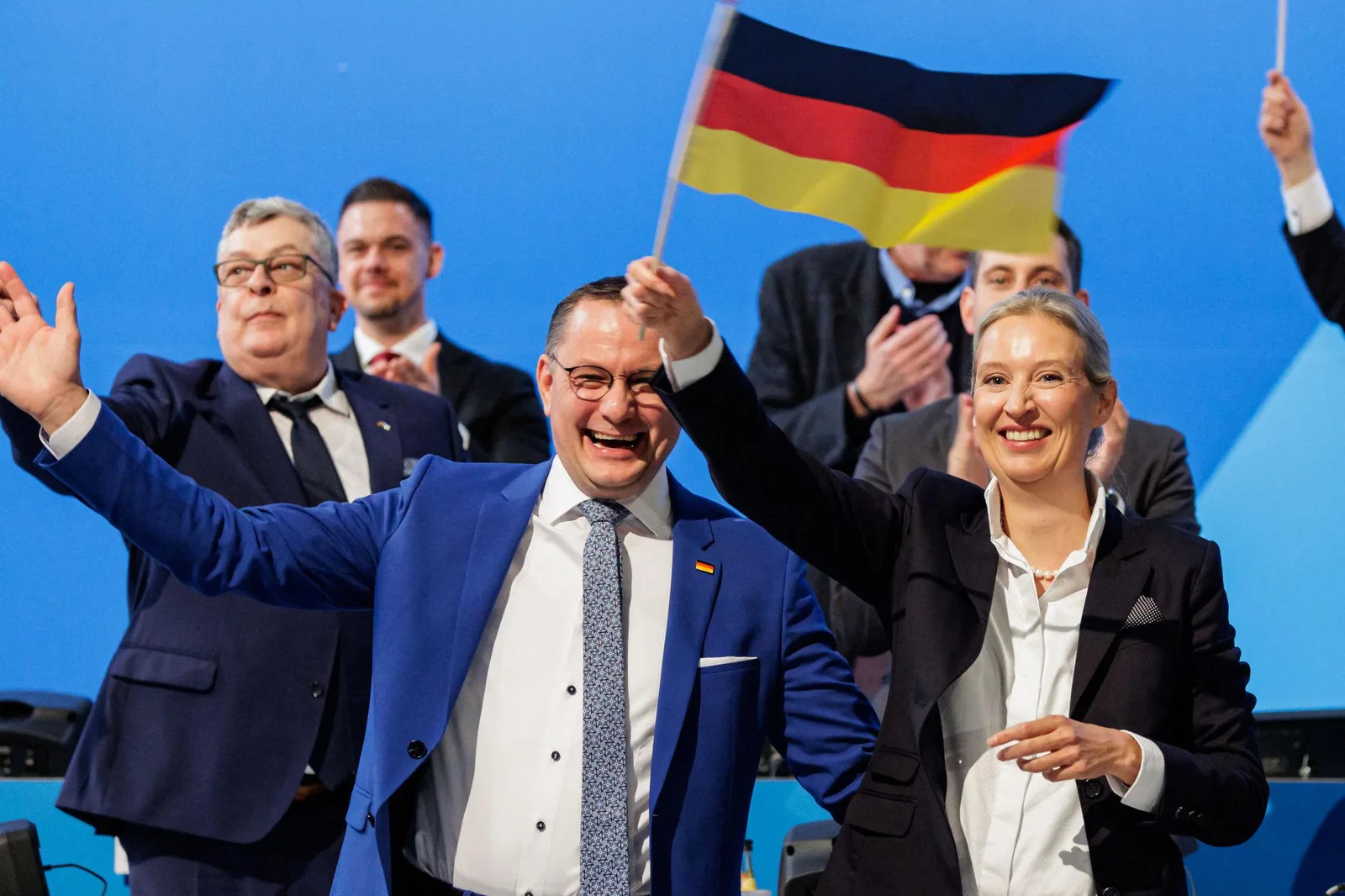
In early October 2026, the circulation of a map depicting an enlarged Germany incorporating territories now belonging to France and other European countries brought the territorial question back into discussions surrounding the AfD. The document was associated with activists from Germany's nationalist political milieu and appeared at a time when the party was seeking to consolidate its political influence.
Alsace and Moselle occupy a particular place in this history. Following the Franco-Prussian War, the Treaty of Frankfurt of May 10, 1871, transferred most of Alsace and part of Lorraine to the German Empire. These territories returned to France after the First World War. In 1940, Nazi Germany annexed them in practice, without a formal international treaty providing for their transfer. Their restoration to French sovereignty at the Liberation ended a succession of upheavals that had made the Rhine frontier one of Europe's principal areas of confrontation.
Postwar Franco-German reconciliation was specifically intended to prevent this history from repeating itself. The Élysée Treaty of 1963, followed by the development of the European common market, gradually transformed the border into an area of cooperation. Strasbourg became one of the institutional symbols of that reconciliation.
The significance of the map circulated in Germany therefore lies less in its immediate ability to change geography than in the conception of nationhood it revives. If a territory can be claimed because it was once administered by another state, where should the historical limit of that claim be drawn? Should the relevant borders be those of 1871, those of 1914, those preceding 1939, or an earlier linguistic geography that existed before the emergence of modern states?
European history provides no single answer. It consists of successive sovereignties, displaced populations, shared languages and overlapping identities. Making one particular historical period the foundation of a contemporary territorial right necessarily means privileging one national memory over those of neighboring countries.
This is why the distinction between historical nostalgia, political provocation and an actual territorial claim remains essential. A map published by an activist does not establish the existence of an annexation project. Its circulation nevertheless shows that territorial representations long confined to the political margins can regain public visibility.
Europe's Far Right Gains Political Weight
This resurgence comes at a time when Europe's electoral landscape has undergone a profound transformation. For several decades, radical nationalist parties generally occupied peripheral positions, sometimes influential in public debate but rarely central to the formation of governing majorities. That situation has evolved, although unevenly across countries.
The European elections of June 2024 provide a significant reference point. In the 720-seat European Parliament, Patriots for Europe, the European Conservatives and Reformists, and Europe of Sovereign Nations initially held 84, 78 and 25 seats respectively. Together, these three groups accounted for 187 seats, approximately 26% of the assembly.
This combined figure does not represent a homogeneous ideological bloc. It includes sovereignist conservatives, nationalist parties, populist formations and movements classified as far right, whose positions sometimes diverge substantially. Nevertheless, it illustrates the parliamentary weight acquired by political currents that challenge, to varying degrees, the direction of European integration.
In France, the National Rally won 30 of the country's 81 seats in the 2024 European elections. In Germany, the AfD received 15.9% of the vote in the European elections, followed by 20.8% in the February 2025 federal election. In Austria, the Freedom Party (FPÖ) came first in the September 2024 legislative elections with 28.8% of the vote. In Italy, Giorgia Meloni has governed since October 2022 at the head of a coalition dominated by Brothers of Italy, while in Hungary, Viktor Orbán has long defended a sovereignist conception of the state and European integration.
These political trajectories are not interchangeable. France's National Rally does not officially advocate annexing neighboring territories. Brothers of Italy governs within the internationally recognized borders of the Italian Republic. Austria's FPÖ, Germany's AfD and Hungary's Fidesz have distinct histories, programs and relationships with European institutions.
Their common ground lies more broadly in the reaffirmation of national primacy, criticism of certain supranational powers, migration controls and efforts to redefine the relationship between the state, its population and European institutions.
Territorial revisionism is therefore not an automatic consequence of their electoral progress. It represents one possible direction nationalist currents may take when historical and cultural identity becomes central to the definition of sovereignty.
The Paradox of Reclaimed Sovereignty
Contemporary Europe rests on an unusual political arrangement. It brings together states that retain territorial sovereignty while voluntarily accepting limitations on the independent exercise of certain powers.
Member states do not abandon their national existence or their borders. Instead, they establish mechanisms designed to reduce the economic and political consequences of those boundaries. The single market facilitates the movement of goods, services, capital and people. The Schengen Area removes systematic controls at internal borders between participating countries, subject to exceptions permitted under common rules. European institutions provide a permanent framework for negotiation among national interests.
This architecture functions as long as governments consider cooperation more beneficial than confrontation. It also presupposes that disagreements can be resolved without challenging the territorial existence of their partners.
Yet part of contemporary sovereignist discourse is built around criticism of this interdependence. The European Union is portrayed as a structure restricting the ability of nations to determine their own migration, industrial, fiscal and cultural policies.
Such criticism does not necessarily imply rejecting existing borders. On the contrary, many nationalist movements advocate reinforcing them. The paradox emerges when a historical or ethnocultural conception of the nation comes into conflict with the recognized territorial limits of the state.
A border may then be regarded as insufficiently protective when immigration is concerned, yet historically unjustified when it separates populations considered members of the same national community.
These two positions follow different lines of reasoning, but they can coexist within certain political currents: the border as an instrument protecting sovereignty, and the border as a boundary that might be redrawn in the name of identity.
This is where the European question becomes particularly sensitive. If every nation claimed the right to reinterpret its borders according to its own history, continental stability would depend less on shared law than on each state's ability to impose its interpretation of the past.
A Geography of Competing Memories
The Franco-German case is not the only European setting in which history continues to produce competing territorial representations.
In Central Europe, the Treaty of Trianon of 1920 remains a defining event in Hungarian national memory. It resulted in the loss of approximately two-thirds of Hungary's prewar territory and left substantial Hungarian-speaking communities outside the country's new borders.
Today, several million people of Hungarian origin or language live in neighboring states, particularly Romania, Slovakia, Serbia and Ukraine. Budapest maintains policies supporting the culture, citizenship and minority rights of Hungarian communities beyond its borders.
These policies do not, in themselves, constitute annexation claims. They nevertheless demonstrate that legal borders and national communities do not always coincide. The distinction between protecting minority rights and challenging a neighboring state's sovereignty therefore becomes a central diplomatic issue.
In the Western Balkans, disputes involving Kosovo, Bosnia and Herzegovina, and relations between national communities also demonstrate the persistence of unresolved territorial questions. These situations have their own legal and historical origins and cannot simply be equated with far-right discourse within the European Union. They nevertheless illustrate the uneven geographical distribution of peace and political settlement across the continent.
Western Europe presents different circumstances. Belgium has long experienced institutional tensions between linguistic communities and regionalist movements. Spain continues to face the Catalan question. The United Kingdom, now outside the European Union, must navigate Scottish independence aspirations and Northern Ireland's political arrangements.
Not all these movements belong to the far right. Several are democratic, autonomist or independence movements advocating constitutional and electoral procedures. Bringing them into the same discussion must not erase their differences.
They nevertheless reveal a permanent feature of the continent: European borders have never corresponded perfectly to the distribution of languages, identities and historical memories.
Stability does not arise from the disappearance of these differences. It depends on institutions' ability to reconcile them with recognized sovereignty.
Russia and the Return of Territorial War
The question of European borders can no longer be examined independently of the war in Ukraine.
Since Russia's annexation of Crimea in 2014, followed by its full-scale invasion in February 2022, the continent has faced an armed challenge to the territorial sovereignty of an internationally recognized state. Moscow also proclaimed the annexation of four Ukrainian regions in September 2022, a move widely rejected by the international community.
The Russian case differs fundamentally from the circulation of a historical map within a German political movement. In one case, a state has deployed military force to impose territorial changes. In the other, activists are circulating representations whose political and institutional significance remains limited.
Conflating these situations would erase the distinction between rhetoric, government policy and the use of force.
Nevertheless, a common question emerges: can the legitimacy of a border be subordinated to a national interpretation of history?
Russia has invoked historical, linguistic and identity-based arguments to justify its claims over Ukrainian territory. International law does not recognize such arguments as legitimizing the acquisition of territory by force.
This distinction is fundamental for Europeans. The continental order does not rest on the assumption that existing borders are historically perfect. It rests on the principle that changes must result from peaceful procedures, valid agreements and respect for international law, rather than unilateral decisions backed by coercion.
The return of territorial warfare in Eastern Europe consequently makes revisionist discourse more sensitive, even when it remains marginal and without institutional consequences.
European Institutions Confront Nationalism
The European Union possesses a legal framework intended to protect the sovereignty and territorial integrity of its members.
Article 4(2) of the Treaty on European Union requires the Union to respect member states' national identities, fundamental political and constitutional structures, and essential state functions, including safeguarding their territorial integrity. The United Nations Charter and the principles established by the 1975 Helsinki Final Act reinforce this framework through the prohibition on the use of force against states' territorial integrity and the principle of the inviolability of frontiers.
These rules do not make every territorial modification impossible. They establish the conditions under which changes may be considered: without the use of force, in accordance with applicable law and with respect for the states concerned.
The principal difficulty is therefore not legal. The borders between France and Germany do not become legally contestable because an activist publishes a map. No European mechanism transforms a historical claim into a sovereign entitlement.
The difficulty is political.
The European Union was designed to organize compromises among governments that, despite their disagreements, recognize the legitimacy of their partners' institutions and borders. The growing influence of sovereignist movements can change the nature of these compromises, particularly concerning migration policy, the primacy of European law, Brussels' powers and relations with external powers.
Yet these movements do not form a coherent whole. Some favor cooperation among sovereign states, while others challenge common institutions more fundamentally. Some defend a European integration model restricted largely to economic functions, while others seek to redirect the Union politically rather than dismantle it.
Their national interests can also collide. A German nationalism advocating changes to the French border would necessarily confront a French nationalism committed to the integrity of French territory. A Hungarian claim over Romanian territory would encounter comparable opposition from Romanian nationalism.
Nationalism can bring parties together in their criticism of supranational institutions. It does not guarantee agreement over their respective states' territorial interests.
This contradiction represents one of the structural limits of any European nationalist coalition.
The Economic Foundations of Nationalist Growth
Europe's political transformation cannot be understood through historical memory alone.
It has developed amid successive crises that have changed how populations perceive globalization, the state and European institutions.
The 2008 financial crisis, fiscal adjustment policies, the 2015 migration crisis, the Covid-19 pandemic, the energy shock caused by the war in Ukraine and the inflation that followed have all contributed, in different national contexts, to demands for economic and political protection.
Industrial restructuring has also played a role. In some regions, factory closures and the disappearance of manufacturing jobs have weakened established social structures. Elsewhere, housing pressures, difficulties accessing public services or concerns about immigration have contributed to changing electoral behavior.
These factors do not explain nationalist voting uniformly. Electoral research shows that motivations vary across countries, generations, income groups and territories. Identity concerns, distrust of institutions, migration preferences and rejection of traditional parties can combine in different ways.
It would therefore be reductive to present the rise of the far right as an exclusively economic reaction. It would be equally insufficient to explain it solely as the return of older ideologies.
Part of its political effectiveness comes from translating complex transformations into a simple question: who decides?
Who determines borders, immigration, industrial standards, energy policy, public expenditure and relations with foreign powers?
In this context, sovereignty becomes a common language for very different demands. It may refer to control over economic policy, protection of cultural identity or the recovery of powers transferred to European institutions.
The transition from functional sovereignty to territorial revisionism is neither necessary nor inevitable. It nevertheless represents a change in kind: the question no longer concerns only the powers exercised within borders, but the legitimacy of the borders themselves.
The Material Cost of Contested Borders
An effective challenge to internal European borders would not merely create a diplomatic crisis. It would affect the economic foundations of the European market.
The European Union brings together approximately 450 million inhabitants in a deeply integrated economic area. In 2024, trade in goods between member states amounted to approximately €4 trillion. Industrial supply chains cross several national borders before a finished product reaches the market.
Germany's automotive industry depends on suppliers in Central Europe, France, Italy and the Iberian Peninsula. Electricity networks are interconnected. Businesses organize production, financing and investment on a continental scale.
The Franco-German border region provides a concrete illustration of this interdependence. Tens of thousands of workers regularly cross the border between Alsace, Moselle, Saarland, Baden-Württemberg and neighboring territories. Employment areas, transport systems and infrastructure often operate independently of the old political divisions.
A serious territorial dispute would immediately alter perceptions of political risk. It could affect investment decisions, administrative cooperation, cross-border infrastructure and confidence between governments.
Such a scenario must not be confused with migration controls or the temporary reintroduction of border checks, which may occur within the European legal framework. A more tightly controlled border is not necessarily a territorially contested one.
But if a state's sovereignty over part of its territory became subject to negotiation under political pressure, the logic of cooperation would change profoundly.
Territorial stability is therefore an invisible economic infrastructure. It allows businesses, households and public authorities to make long-term decisions without incorporating the risk of sovereignty disputes between neighboring countries.
European integration has made this stability so ordinary that it has gradually ceased to appear as a condition of prosperity.
The Boundary Between Rhetoric and Power
The electoral rise of nationalist parties makes an often-neglected distinction essential: a movement's ideological influence does not automatically correspond to its institutional capacity.
An activist can circulate a historical map. A political leader can adopt identity-based rhetoric. A party can change its platform. A government, however, remains subject to constitutional constraints, international treaties, diplomatic relationships and the economic consequences of its decisions.
These levels are not equivalent.
Contemporary Germany fully recognizes French sovereignty over Alsace and Moselle. The Franco-German border is not the subject of any official territorial dispute between Paris and Berlin. Bilateral cooperation remains one of the principal institutional foundations of the European Union.
The relevant question is therefore not whether a new Franco-German territorial confrontation is imminent. No established evidence supports such a conclusion.
Rather, the issue is to observe the conditions under which representations once confined to the political margins can enter public debate, acquire an audience and potentially influence the positions of parties that have become electorally significant.
Political history shows that institutional transformations are often preceded by changes in political language. Proposals long considered incompatible with the prevailing consensus can gradually become subjects of debate and eventually organized political demands.
This process is not automatic. It depends on the reactions of other parties, institutions, voters, the media and international partners.
Analytical vigilance consists precisely in tracing these transitions without presenting hypothetical developments as accomplished facts.
Europe and the Memory of Its Own Construction
European integration was never based on the disappearance of nations. It sought to resolve an older problem: how could historically rival nations preserve their political existence without turning their differences into permanent conflicts?
The answer was to multiply interdependencies, institutionalize negotiation and make recognized territorial sovereignty a prerequisite for cooperation.
This system has eliminated neither economic rivalry nor diplomatic disagreement. Nor has it erased national identities. But it has profoundly transformed the way Western European states approach their relationships.
The rise of nationalist and far-right movements comes at a time when this architecture already faces multiple pressures: the return of war to the continent, industrial competition with the United States and China, migration tensions, rearmament requirements and the growing difficulty of reconciling economic integration with political sovereignty.
Against this background, the map circulated by German activists does not, by itself, announce a territorial upheaval. It nevertheless serves as a reminder that European peace also depends on a particular way of interpreting history.
For decades, Franco-German reconciliation meant acknowledging past conflicts without turning them into programs for the future. Disputed territories became spaces of cooperation. Competing memories were gradually incorporated into a shared political narrative.
The reappearance of older territorial representations tests that approach.
Europe does not need its peoples to forget their history in order to preserve its borders. It needs them to stop treating every former possession as sovereignty waiting to be recovered.
This may be the deeper significance of the present political moment. The rise of nationalist movements does not necessarily imply a return to territorial wars. It does, however, make more visible a tension that European integration had long contained: the coexistence of nations that define themselves through their history and a political order that asks them to recognize the sovereignty of their neighbors as settled.
A border can remain perfectly stable under international treaties while becoming contested once again in the political imagination.
And it is precisely because Europe has learned to live without fighting over its territories that it now struggles to imagine what the return of that question would mean.
Main Sources
- European Parliament, official results of the June 2024 European elections, political group composition and allocation of seats by member state.
- Federal Returning Officer of Germany (Bundeswahlleiterin), official results of the February 2025 federal election and the 2024 European elections.
- German Federal Foreign Office and French Ministry for Europe and Foreign Affairs, documentation on Franco-German relations and the Élysée Treaty.
- European Union, Treaty on European Union, particularly Article 4(2).
- United Nations, Charter of the United Nations, Article 2(4).
- Conference on Security and Co-operation in Europe, Helsinki Final Act, 1975.
- Eurostat, intra-EU merchandise trade statistics and demographic indicators.
- Treaty of Frankfurt, May 10, 1871; Treaty of Versailles, June 28, 1919; historical documentation on Alsace-Moselle.
- Journalistic reporting from October 2026 concerning historical maps circulated by activists associated with the AfD, to be cross-checked against the original publications and any official responses.
Atlas Limits Research Desk
Atlas Limits’ editorial and analytical desk.