Berlin and Doha are entering a new phase of economic cooperation. Qatar's announcement of an additional €15 billion in planned investments in Germany over five years extends beyond capital allocation. It highlights the growing role of sovereign wealth funds in Europe's industrial transformation, where competitiveness, energy security and technological sovereignty increasingly converge.
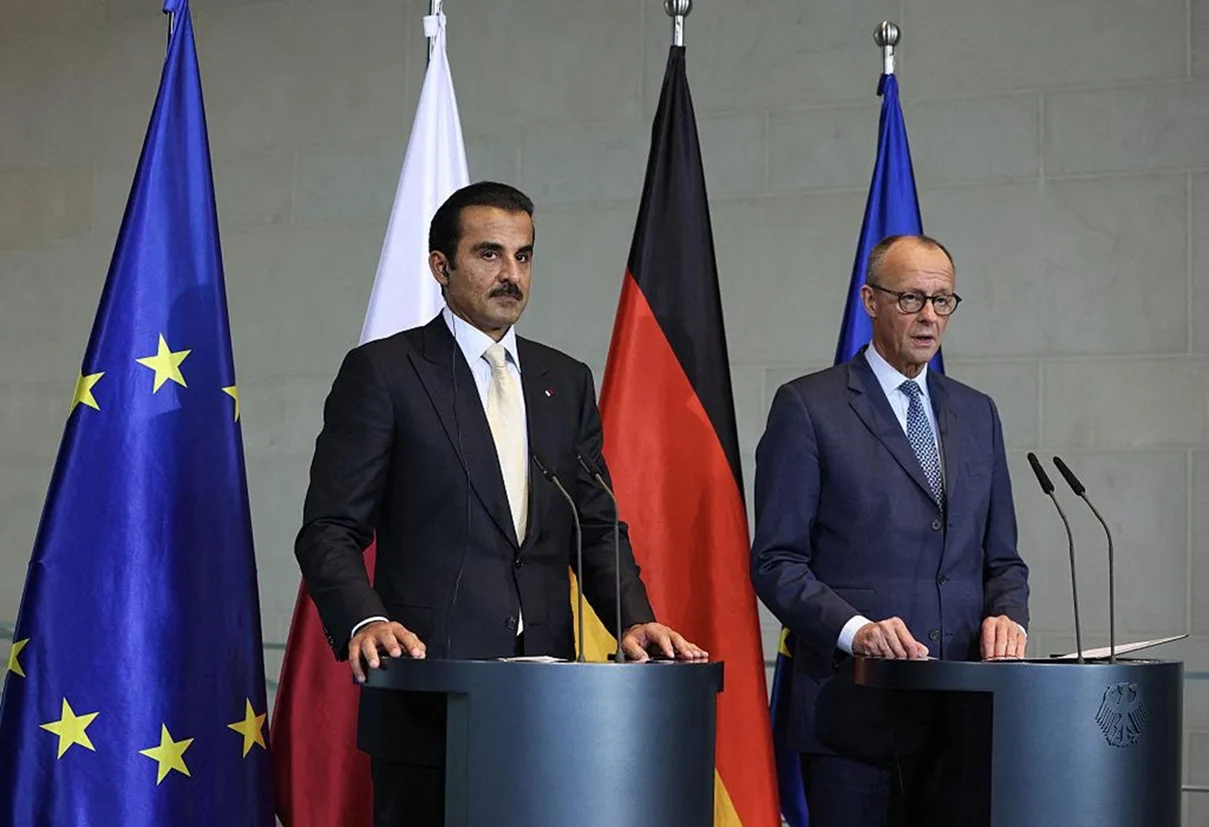
The state visit of Qatar's Emir, Sheikh Tamim bin Hamad Al Thani, to Germany on November 20–21, 2026 marked a significant development in the economic relationship between Berlin and Doha. Following talks on November 20, Chancellor Friedrich Merz announced that the Qatar Investment Authority (QIA), the country's sovereign wealth fund, intended to invest an additional €15 billion in Germany over the next five years. The announcement formed part of a broader joint declaration encompassing strategic industries, energy, advanced technologies and defense.
The financial nature of the commitment requires careful distinction. The €15 billion represents an announced investment objective, not capital already deployed or a portfolio of binding acquisitions. The joint declaration explicitly makes future transactions subject to independent investment decisions by the investors concerned. No comprehensive list of projects, sectoral allocation or annual disbursement schedule has been disclosed. Germany has therefore secured a significant expression of investor confidence, but the conversion of that commitment into productive assets will depend on transactions yet to be identified and executed.
The announcement builds on an established financial relationship. Qatar is already a major investor in Germany, with sovereign investment vehicles holding interests across automotive manufacturing, industrial activities, financial services and other sectors. According to statements attributed to Germany's Federal Ministry for Economic Affairs and Energy and reported by Qatar's national news agency on November 22, existing Qatari investments in Germany exceed €25 billion.
This established presence matters. It gives Qatari investors experience with German corporate governance, industrial cycles and regulatory requirements, while providing German companies with access to a source of capital capable of pursuing long-term investment strategies.
For Qatar, Germany offers a diversified industrial and technological economy in which sovereign wealth can be converted into international financial assets. For Germany, Qatari capital offers potential support for industrial modernization at a time when companies must simultaneously respond to technological disruption, changing energy economics and intensifying global competition.
The relationship is rooted in a structural complementarity. Qatar generates substantial financial resources from its hydrocarbon economy and seeks to diversify its national wealth across global assets. Germany possesses an extensive manufacturing base, technological expertise and internationally integrated companies, but requires considerable investment to maintain and renew those capabilities. Combining these resources can create opportunities for both economies, although the objectives of sovereign investors and national industrial policymakers will not necessarily coincide in every transaction.
Sovereign capital and industrial transformation
The joint declaration identifies strategic industries, energy infrastructure, green technologies, advanced manufacturing, digital technologies, research and development, and innovative small and medium-sized enterprises as potential investment priorities. Defense is also explicitly included.
These sectors reflect a common challenge confronting the German economy: industrial transformation is becoming increasingly capital-intensive.
Manufacturers must modernize production facilities, adapt to electrification, integrate artificial intelligence and improve the resilience of their supply chains. Energy infrastructure requires sustained investment, while emerging technology companies need financing to translate research into commercially viable industrial applications.
Sovereign wealth funds occupy a distinctive position in this environment. Depending on their mandates and liquidity requirements, they can maintain investment horizons extending beyond those of many conventional financial investors. This allows them to participate in projects whose economic returns develop over extended periods, although patient capital does not eliminate commercial, technological or regulatory risks.
For QIA, the German market offers several potential investment models. Listed companies provide exposure to established global businesses. Infrastructure assets may generate relatively predictable cash flows, subject to operational and regulatory uncertainty. Advanced manufacturing and technology companies offer growth potential but may carry higher valuation and execution risks.
The eventual composition of the €15 billion program will determine its industrial significance.
Purchasing existing shares in the secondary market primarily changes asset ownership. Subscribing to newly issued equity, financing additional production facilities or investing directly in infrastructure can provide companies and projects with new resources. These distinctions matter because an investment announcement does not automatically translate into additional productive capacity, employment or technological development.
The economic impact of the German-Qatari initiative will therefore depend less on its headline value than on the structure and destination of the capital ultimately deployed.
Defense enters the investment relationship
One of the most consequential elements of the declaration is the explicit inclusion of defense industries within the bilateral economic agenda.
Germany and Qatar intend to deepen cooperation between their security and defense sectors. The document identifies the August 2026 visit of German security and defense companies to Qatar as a starting point for expanding commercial relationships.
This development comes as defense has become increasingly central to European industrial policy. Military modernization, production capacity, secure supply chains and dual-use technologies now connect national security priorities with industrial financing and technological innovation.
Defense companies may require additional capital to expand manufacturing capacity, modernize equipment and develop technologies with both civilian and military applications. However, foreign sovereign investment in sensitive industries introduces questions extending beyond conventional financial performance.
Ownership structures, governance rights, intellectual property, access to critical technologies and national security screening can all influence whether a proposed transaction is permissible.
Germany and the European Union maintain frameworks for reviewing certain foreign investments in strategic sectors. Consequently, the political willingness to expand defense cooperation should not be confused with approval for specific acquisitions or equity investments.
The November declaration does not identify a confirmed Qatari acquisition of a German defense company. Its importance lies instead in the formal recognition of defense as a potential area for closer industrial and financial cooperation.
This reflects a broader change in international capital allocation. Sovereign investors are increasingly relevant not only to conventional infrastructure and corporate financing but also to industrial capabilities directly associated with national security.
Energy and technology as strategic foundations
Energy remains a central component of the relationship between Germany and Qatar.
Qatar is a major global supplier of liquefied natural gas, while Germany has restructured its energy supply strategy following the disruption of its previous dependence on Russian gas. The resulting relationship connects German supply diversification with Qatar's interest in maintaining long-term international energy partnerships.
The joint declaration identifies liquefied natural gas, renewable energy, ammonia, fertilizers and petrochemicals as areas for continued cooperation. Both governments emphasize the importance of diversified, resilient and affordable energy systems.
These priorities extend beyond commodity trade. Energy availability and cost influence industrial competitiveness, investment decisions and the geographical distribution of manufacturing activity. They also shape the economics of electricity-intensive technologies, including data centers and advanced production systems.
Technological cooperation forms the second major foundation of the partnership.
Chancellor Merz specifically highlighted artificial intelligence, semiconductors and aviation. The joint declaration also identifies quantum technologies and digital government as priorities.
These industries differ considerably in their technological requirements and commercial structures, but share a dependence on sustained financing, specialized expertise and complex infrastructure.
For Germany, attracting sovereign investment into these sectors could help support industrial renewal, provided that financial participation remains compatible with the protection of critical technologies and strategic decision-making.
For Qatar, the objective is to increase exposure to activities expected to shape global economic growth beyond hydrocarbons.
The strategic relationship therefore involves more than exchanging capital for financial returns. It creates potential connections between energy security, industrial production and the technologies underpinning future economic competitiveness.
Building an institutional investment framework
The November announcement is supported by a wider effort to institutionalize bilateral economic relations.
Germany and Qatar have agreed to strengthen their strategic dialogue and deepen cooperation between public institutions and business communities.
A strategic cooperation agreement between Qatar's Ministry of Commerce and Industry and the German state of North Rhine-Westphalia provides for the opening of a regional economic office in Doha.
The initiative is significant because North Rhine-Westphalia is one of Germany's major industrial centers. The office is intended to facilitate cooperation in investment promotion, industrial development, innovation, digital transformation and energy transition.
The two governments also intend to convene the seventh session of their Joint Committee for Economic and Trade Cooperation during the first quarter of 2027. Germany has separately indicated plans for additional economic delegations to Qatar in 2027.
Such institutional mechanisms can help convert diplomatic commitments into identifiable commercial opportunities. They can connect investors with companies, clarify regulatory requirements and support the preparation of transactions.
Their effectiveness, however, will ultimately depend on whether they facilitate commercially viable investments rather than merely expanding the architecture of bilateral cooperation.
This approach illustrates a broader feature of contemporary economic diplomacy: major investment relationships are increasingly accompanied by institutional arrangements designed to coordinate industrial priorities, regulatory processes and financial execution.
The sovereignty dilemma
The planned investments expose a fundamental tension in European industrial strategy.
European governments seek to strengthen domestic production, reduce selected external dependencies and preserve technological autonomy. Yet the capital required to pursue these objectives can exceed the resources available from domestic companies and investors.
Foreign sovereign wealth funds offer one potential response to this financing constraint. Their participation, however, requires a distinction between attracting capital and transferring strategic influence.
A minority investment without decisive governance rights may provide financing while preserving operational control within the company. A transaction granting significant voting power, access to sensitive information or influence over critical industrial decisions raises different considerations.
The investor's nationality is therefore only one dimension of the assessment. The transaction's legal structure, ownership rights, technological sensitivity and regulatory implications are equally important.
These questions are particularly relevant to defense, semiconductors, energy infrastructure and other critical technologies.
For Germany, the challenge is to attract sufficient investment to modernize its productive economy without creating new strategic vulnerabilities.
For Qatar, the challenge is to identify assets capable of generating attractive long-term returns in an international environment where geopolitical considerations increasingly influence investment decisions.
The relationship will be tested by how effectively these potentially competing objectives can be reconciled.
From political commitment to productive investment
The €15 billion announcement represents a substantial expression of strategic intent, but its ultimate significance remains dependent on implementation.
Several questions will determine the outcome over the next five years.
Will the investment program primarily involve acquisitions of existing corporate stakes, or will it provide fresh capital for industrial expansion? How much will be directed toward established manufacturing businesses rather than emerging technologies? What governance arrangements will accompany the investments, and which transactions will require national security approval?
The distinction between announced commitments and completed investments will be essential in evaluating the partnership.
Large sovereign investment announcements can establish strategic direction without immediately determining the transactions through which that direction will be realized.
Nevertheless, the agreement reached in Berlin illustrates a deeper transformation in the relationship between industrial economies and sovereign capital.
Industrial countries increasingly seek external financing to preserve their manufacturing capabilities and accelerate technological adaptation. Sovereign investors, meanwhile, seek to convert national wealth into diversified portfolios of financial and industrial assets capable of generating long-term returns.
Germany and Qatar are positioning themselves at the intersection of these two objectives.
Their evolving partnership demonstrates how industrial policy, sovereign wealth management and national security are becoming progressively interconnected. Its success will ultimately be measured not by the announcement of €15 billion alone, but by the ability to translate that commitment into productive investments consistent with both countries' economic interests and strategic constraints.
Atlas Limits Research Desk
Atlas Limits’ editorial and analytical desk.