Investment outlook and growth sectors for 2027–2030
Artificial intelligence, electrification, ageing populations and fragmented trade are reshaping investment needs. Yet the fastest-growing markets will not necessarily generate the strongest returns. Between 2027 and 2030, value creation will depend primarily on the ability to remove practical constraints, secure creditworthy customers and convert announced spending into sustainable cash flow.
Capital enters a more selective phase
The 2027–2030 horizon is about more than another technological wave. It is a period in which several transformations will have to become economically sustainable. Companies must turn computing capacity into productivity. Power systems must connect new uses. Governments must finance security and infrastructure while preserving borrowing capacity. Territories must produce, transport and accommodate more activity with water, energy and labour that may become harder to secure.
In its October 2026 World Economic Outlook, the IMF projects global growth of 3.1% in 2026 and 3.4% in 2027. These forecasts describe an institutional baseline rather than an assured trajectory. The Fund identifies conflicts, trade tensions, fiscal vulnerabilities and a possible reassessment of AI expectations among the risks. Extrapolating the projected recovery mechanically through 2030 would therefore be unwise. [1]
The central issue is the quality of expenditure. An announced factory is not yet an order. An order is not a profit. Accounting earnings do not guarantee cash available after capital expenditure. And a profitable business can still be a poor investment if its purchase price already assumes flawless execution.
This dossier provides an economic and sectoral assessment, without stock selections or price targets. Its priorities are editorial judgements about needs and business models, rather than a quantitative ranking of future performance. The 2028–2030 outlook rests on scenarios, separate from the observations and institutional projections cited.
Electricity and grids provide the first foundation
The broadest investment thesis concerns electrical infrastructure. A data centre, an automated factory, a desalination plant and an electric vehicle perform different functions, but each depends on a system capable of delivering reliable energy where it is needed.
In Electricity 2026, the International Energy Agency reports that more than 2,500 gigawatts of renewable, storage and large-load projects are waiting for grid connections worldwide. Its analysis suggests that meeting projected demand through 2030 would require annual grid investment to rise by roughly 50% from a level of $400 billion. This is an estimated requirement, not spending that has already secured financing. [2]
For investors, this constraint invites attention beyond power generation. Transformers, cables, substations, power electronics, metering, protection, operating software and maintenance can serve expenditure across multiple uses. Technologies that improve existing network utilisation also merit consideration when new infrastructure takes years to permit and build.
Profitability nevertheless depends on the position occupied. A manufacturer that expands production without compromising quality may benefit from recurring orders. A contractor committed to fixed prices may suffer from rising costs. A regulated operator may have visible revenues while carrying heavy debt and earning an inadequate allowed return. Order books must therefore be assessed against delivery capacity, customer advances and price-adjustment clauses.
Storage complements this system. Its value should be assessed against specific services: shifting demand, guaranteed capacity, balancing or reducing peaks. A project relying solely on exceptional price spreads remaining in place is vulnerable. Competing capacity can compress those spreads before the installation has repaid its investment.
AI must demonstrate value after investment
AI comprises at least three different economies: computing infrastructure, software and the businesses that use it. Their revenues and risks need not move together.
In the baseline published in its 2025 Energy and AI report, the IEA projected global data-centre electricity consumption of around 945 terawatt-hours in 2030. This figure covers all data centres, rather than AI alone, and is not a continuously updated certainty. [3]
Infrastructure creates potential demand for specialised semiconductors, interconnections, cooling, power supply and facility operations. But it combines customer concentration, equipment obsolescence, financing costs and a possible gap between construction and economically viable demand. A technically advanced building has limited economic value without electrical capacity or committed customers.
In software, the key question is less the number of features than the difficulty of replacing the supplier. Tools embedded in business processes, with authorised data access and effective distribution, appear better positioned than easily replicated services. Margins must be measured after model costs, infrastructure, support and human oversight.
Users may also capture value. A logistics, insurance or services business that improves operations without substantially increasing capital employed can benefit from AI without selling it. The improvement must appear in delivery times, errors, costs or revenues after deployment spending. From 2027, evidence of productivity will matter more than the number of pilot projects.
Cybersecurity protects operational continuity
Digital security accompanies almost every other transformation. As industrial operations, payments and public services depend more heavily on connected systems, the ability to maintain or restore activity becomes more valuable. ENISA’s threat landscape provides a reference framework for ransomware, vulnerability exploitation and dependencies between suppliers. [4]
Areas to examine include identity management, backup and recovery, cloud security, industrial-system protection and managed services. Supplier quality is reflected in customer retention, demonstrated effectiveness and integration with existing environments.
This market does not guarantee the prosperity of every participant. Tool proliferation can encourage customers to consolidate spending with a few platforms. Service providers may face recruitment constraints. Expensive customer acquisition can absorb much of the margin. Contractual recurrence is valuable only if customers renew and service costs remain controlled.
Water becomes a condition for development
Water has a distinctive economic feature: its importance increases as availability becomes less predictable, while pricing often remains politically sensitive. Physical need is consequently much larger than the immediately financeable market.
The World Bank highlights treatment and reuse for urban and industrial applications. Its Scaling Water Reuse report identifies up to $340 billion in potential investment by 2040 under enabling conditions. That horizon extends beyond this dossier and the amount should not be presented as funding available before 2030. [5]
Potential opportunities include leak detection, efficient pumps, membranes, treatment equipment, metering and plant operations. Reuse close to industrial sites can reduce some transport costs and provide an identifiable customer. Desalination can secure coastal supplies if electricity, maintenance, discharges and an affordable purchase price are incorporated into the economics.
Agriculture requires even more precise selection. Controlled irrigation, cold chains, storage and reduced losses can improve resource use. But a technically effective solution does not itself create a farm’s ability to pay. Financing, support and the economic return per hectare determine adoption.
Investors must establish who pays, under which contract and with what protection against delays. An essential service can remain difficult to operate profitably if tariffs do not cover costs or receivables accumulate.
Healthcare offers enduring needs within funding constraints
The WHO projects that one in six people worldwide will be aged 60 or over by 2030. This supports a long-term assessment of demand for care, diagnostics, rehabilitation and support. It determines neither available budgets nor corporate profits. [6]
Models to examine include equipment linked to consumables, diagnostics that improve treatment pathways, outpatient services, home care and tools that improve medical organisation. Their economics depend on clinical usefulness, reimbursement, recruitment and equipment utilisation.
This economy must be separated from biotechnology wagers. A company dependent on a clinical trial or authorisation concentrates risk around a small number of events. A care operator is more exposed to execution, tariffs and staffing. Both can create value, but they require different analysis.
Medical AI also needs specific evidence: validation, liability arrangements, integration and funding. Technical improvement becomes a sustainable business only when it fits a care pathway and finds a purchaser.
Defence has conditional political visibility
The June 2025 Hague summit established a commitment by NATO Allies to spend 5% of GDP on defence and security-related expenditure by 2035: at least 3.5% on core defence requirements under the Alliance’s definition and up to 1.5% on broader expenditure. The trajectory is to be reviewed in 2029. This framework implies neither immediate implementation nor a uniform military budget of 5% before 2030. [7]
Areas to monitor include ammunition, sensors, secure communications, maintenance, autonomous systems and infrastructure protection. The economics depend on firm orders, certification, industrial capacity and inventory financing as much as budget announcements.
Contracts can provide visibility while creating exposure to delays, overruns and public-sector dependence. Revenue growth is insufficient if it requires industrial expansion with poor returns. Valuation risk is especially relevant when markets capitalise several years of higher budgets before these translate into cash flow.
Automation addresses a productivity problem
Industrial robotics already has an established operating base. The IFR recorded approximately 542,000 industrial robot installations in 2024 in World Robotics 2025. This historical reference must not be confused with 2026 sales or with the distinct market for humanoid robots. [8]
The 2027–2030 horizon favours examining applications with measurable returns: handling, quality control, order preparation, repetitive production and predictive maintenance. Manufacturers do not capture all the value. Integrators, machine-vision specialists, component suppliers and maintenance businesses can serve factories whose main requirement is reliable systems.
The principal risk is customers’ capital-expenditure cycle. A business may recognise equipment’s usefulness and still defer buying it because demand is uncertain. Sector diversification, service revenues and customer payback periods are therefore essential. Humanoids represent a technological option to monitor; public demonstrations alone do not establish industrial profitability.
Minerals require asset-by-asset analysis
Copper, some battery materials and several specialist minerals sit at the intersection of electrification, digital infrastructure and security. In its 2026 outlook, the IEA estimates that identified projects could leave primary copper supply around 25% below requirements in 2035 under the policy conditions considered. This conditional projection beyond 2030 does not predict copper prices over the next four years. [9]
The metal, the mine and the processor are different investments. A higher commodity price may benefit a low-cost producer while hurting an industrial user unable to pass it through. A mining project may hold substantial resources without sufficient permits, financing or infrastructure.
Key criteria include deposit quality, costs, access to energy and water, jurisdiction, timelines and funding requirements. Recycling must be assessed against collectable volumes and material recovery. Processing must be judged on its own margins, without assuming that strategic importance automatically protects profitability.
Logistics and industrial services serve a more complex geography
The reorganisation of trade does not imply universal reshoring. It can involve partial duplication of facilities, supplier diversification and new traceability requirements. UNCTAD’s World Investment Report 2026 describes a concentrated recovery, notably around large digital-infrastructure projects. Its more recent first-half 2026 investment update also supports distinguishing financial flows from new productive establishments. [10]
Potential demand includes well-positioned warehouses, cold chains, port operations, trade-management software and certification services. An asset’s value depends on customers and connections, rather than the popularity of regionalisation as a theme.
A logistics site without access, a warehouse without a creditworthy tenant or a factory dependent on a reversible tariff advantage carries specific risks. Resilience may justify a premium paid by customers; it does not remove competition or the cost of capital.
Energy transitions must be assessed project by project
Solar, wind, efficiency solutions and dispatchable power infrastructure should be examined according to their local function. Renewable projects require grid connections, buyers and sufficient protection against periods of low prices. Nuclear services may provide activity around existing facilities; new reactors and emerging technologies involve very different timelines and risks.
Hydrogen illustrates the gap between ambition and financing. The IEA’s Global Hydrogen Review 2026 identifies persistent high costs, uncertain demand and infrastructure barriers. It highlights insufficient purchase commitments to enable large-scale deployment. [11]
Before 2030, the most credible projects will demonstrate an identifiable use, competitive electricity, water supplies compatible with local needs and a buyer able to commit. Large markets envisaged for later decades do not replace these conditions. Hydrocarbons should likewise be evaluated against costs, cash flow and price scenarios; their role in energy security does not guarantee growth for every producer.
Morocco must turn the 2030 timetable into productive assets
In Morocco, investment associated with the 2030 horizon can support numerous activities. The challenge is to distinguish event-related expenditure from infrastructure and services that retain their usefulness afterwards.
In its 2026 work on Morocco, the IMF examines an infrastructure investment scale-up over 2024–2030 estimated at 11.9% of 2024 GDP. Its analysis stresses investment efficiency, overrun risks and possible crowding-out of private activity. This estimate is not an expected investor return. The World Bank also places water, business competitiveness and human capital among its partnership priorities for the country. [12][13]
Water and energy appear as prerequisites for industrial and tourism development. Opportunities may lie in equipment, maintenance and services that improve resource availability. Export manufacturing creates potential for suppliers able to meet standards, deliver on time and diversify customers. Logistics and cold chains can connect producers with markets if sufficient volumes exist.
Tourism requires a location-specific and operational approach. A property must be assessed against its full cost, water access, management, sustainable occupancy and customers outside major events. Real estate is not homogeneous: a healthcare asset, warehouse and speculative residential property have different drivers.
For SMEs, specialist services may require less capital than large projects: electrical maintenance, energy efficiency, managed cybersecurity, business software, automation integration and technical training. Their potential depends on real customers, available skills and payment discipline. Public procurement and large buyers can accelerate growth while creating customer concentration and working-capital needs.
The financial framework must suit a Moroccan resident: revenue currency, exchange-rate exposure, taxation and applicable rules for overseas investment. This dossier does not assume unrestricted access to every international instrument. A domestic investment can also carry indirect dollar exposure through equipment, inputs or debt.
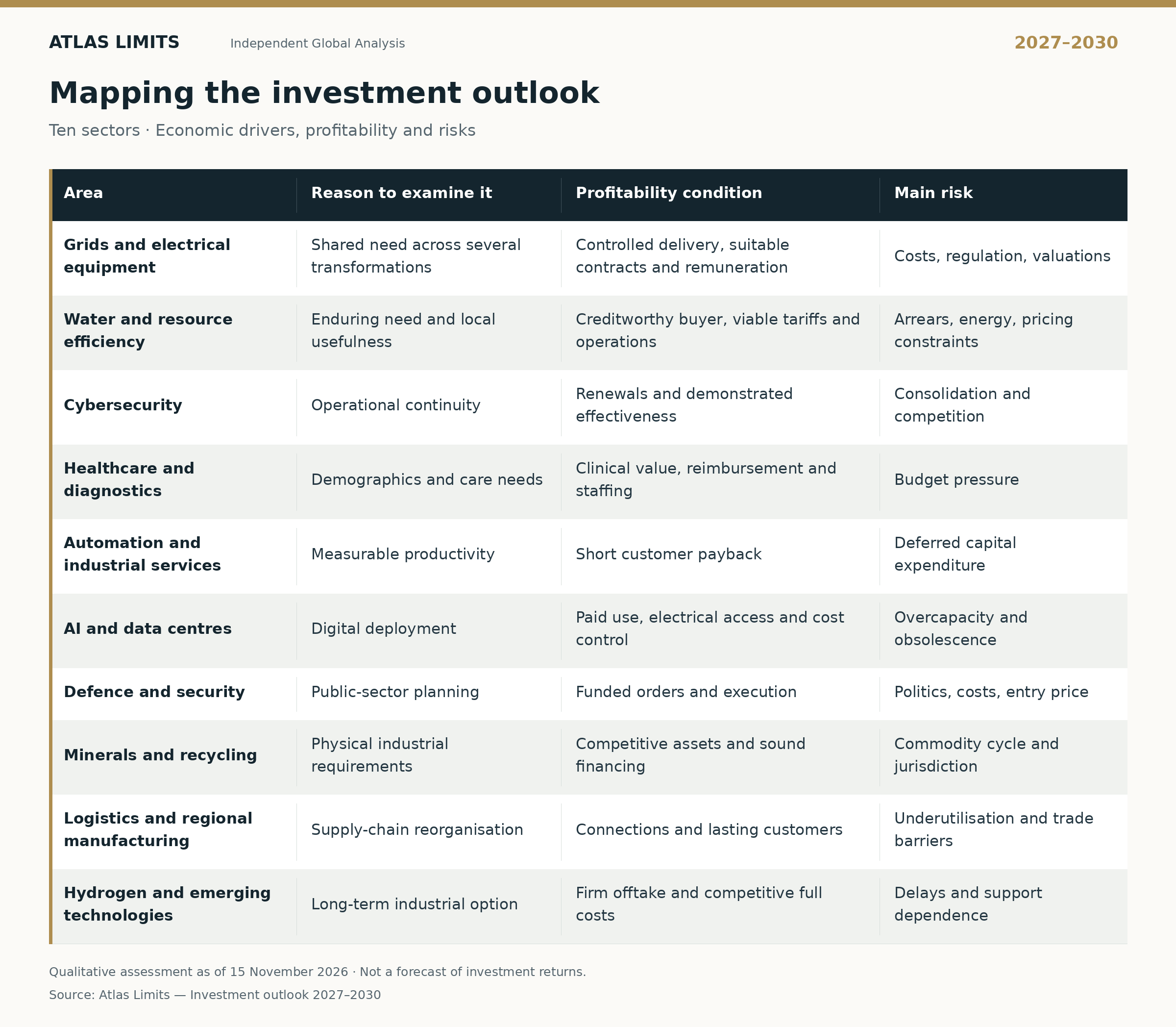
A map of priorities
This framework is a qualitative assessment as of 15 November 2026. It evaluates the visibility of needs and economic conditions, rather than forecasting stock-market performance.
Three scenarios for 2027–2030
The working central scenario assumes uneven growth, selective capital and investment concentrated on a limited number of priority needs. It supports examining models with recurring revenues, strong balance sheets and measurable usefulness. It does not assume continuously falling interest rates or universally rising markets.
In an acceleration scenario, AI diffusion delivers genuine productivity gains, financing conditions ease and grid connections progress. Automation, some business software and industrial equipment may benefit from broader demand. However, supply growing faster than actual use can still compress margins.
In a stress scenario, an energy shock, trade restrictions or persistent inflation increase project costs and weaken budgets. Essential services and maintenance may retain relatively resilient demand without becoming immune to market declines. Indebted businesses, projects without buyers and assets dependent on refinancing become more vulnerable.
No numerical probabilities are assigned. The scenarios are useful for testing whether an investment remains financeable and economically defensible when assumptions deteriorate.
Geographies offer different possibilities
The United States merits examination for digital businesses and related infrastructure, with particular attention to asset prices and customer concentration. Europe requires analysis of grids, efficiency, healthcare and security through its funding and execution frameworks. In Asia, industrial ecosystems, domestic markets and technological restrictions must be distinguished rather than treating the region as a single investment.
The Gulf provides a field of study for water, energy and diversification-related services, subject to understanding counterparties and dependence on public expenditure. In Africa, the scale of need never removes the requirement to analyse currency, creditworthiness and infrastructure. In Latin America, resources and industrial chains require country-specific assessment of permits and logistics costs. These are research directions rather than a ranking of national returns.
The investment vehicle changes the exposure
A listed share provides exposure to a company’s earnings and market price; a sector fund may diversify names while concentrating the same economic factors. A bond depends primarily on repayment capacity and interest-rate sensitivity. Project finance rests on specific contracts and cash flows. Private equity adds illiquidity and execution risks. Property depends on rents, expenses, vacancy and financing.
These differences prevent allocation being inferred from a sector theme alone. One infrastructure fund may mainly hold listed companies, another leveraged private assets. Direct commodity exposure does not reproduce a producer’s results. Before implementation, fees, liquidity, concentration, leverage, taxation and access arrangements must be checked.
For an entrepreneurial business, the logic differs again: the best market is one where it has customer access, skills and delivery capability. A small profitable market can create more value for its founder than a growing global sector in which it has no advantage.
Evidence to monitor through 2030
Monitoring should connect announcements to results. For grids, this means delivered orders and connected capacity. For AI, paid revenues, usage costs and returns on investment. For water, volumes sold, losses, costs and cash collection. For healthcare, reimbursed activity and staffing. For defence, funded contracts. For minerals, investment decisions and actual costs. In Morocco, lasting infrastructure utilisation, local-supplier participation and payment times matter.
The thesis should be revised if project delays multiply, growth persistently consumes more capital than it generates in cash, or valuations require profitability that contracts cannot support. An enduring need can outlive the failure of several companies seeking to meet it.
By 2030, the most robust perspective is an economy that must make its ambitions executable. Computing requires electricity; industry requires water and skills; security requires deliverable capacity; growth requires infrastructure that is actually used. Value creation will depend on that conversion. For capital, discipline means identifying businesses capable of accomplishing it, then avoiding paying for success before the evidence is sufficiently strong.
Principal sources
[1] IMF, World Economic Outlook, October 2026, global projections and risks. View link
[2] IEA, Electricity 2026, Grids chapter. View link
[3] IEA, Energy and AI, 2025, baseline scenario for data-centre electricity demand. View link
[4] ENISA, Threat Landscape 2025, covering July 2024–June 2025, revised in September 2026. View link
[5] World Bank, Scaling Water Reuse, 2025. View link
[6] WHO, Ageing and Health, demographic projection for 2030. View link
[7] NATO, The Hague Summit Declaration, 25 June 2025. View link
[8] IFR, World Robotics 2025, industrial robot installations in 2024. View link
[9] IEA, Global Critical Minerals Outlook 2026. View link
[10] UNCTAD, World Investment Report 2026 and investment trends update, October 2026. View link; View link
[11] IEA, Global Hydrogen Review 2026. View link
[12] IMF, Morocco: Selected Issues, 2026, macroeconomic implications of accelerated infrastructure investment. View link
[13] World Bank, overview of the partnership with Morocco and national priorities. View link
Atlas Limits Research Desk
Atlas Limits’ editorial and analytical desk.