By progressively transforming the Strait of Hormuz into a space governed by authorization, screening and sanctions, Tehran is experimenting with a form of control more sophisticated than a simple blockade. The stakes now extend beyond the current war: they concern the very status of the major arteries of globalization.
For decades, the question surrounding the Strait of Hormuz was framed in almost immutable terms: can Iran close it?
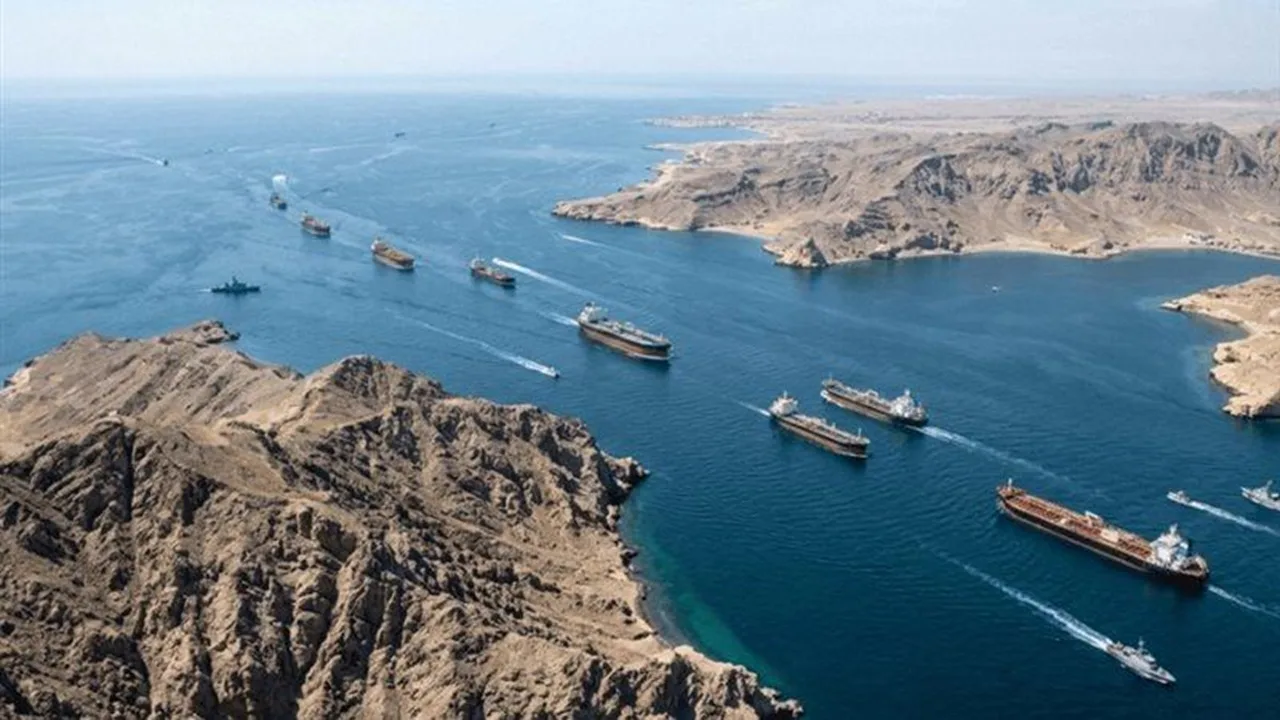
The question made sense. With Iran to the north and Oman to the south, this narrow passage connects the Persian Gulf to the Indian Ocean and, before the war that began on February 28, 2026, carried roughly one-fifth of global crude oil and liquefied natural gas flows. Any sustained closure would therefore constitute one of the most severe energy shocks the global economy could face.
But that framework is becoming insufficient.
Iran no longer appears to be seeking merely to demonstrate that it can interrupt traffic through the strait. It is gradually building a system through which it can determine which vessels may pass, under what conditions, carrying which cargoes and, increasingly, with which commercial counterparties.
The strait is no longer simply threatened with closure. It is gradually being subjected to a regime of selection.
On September 2, 2026, the Persian Gulf Strait Authority, or PGSA, the Iranian body administering the mechanism, added eleven vessels to its list of ships considered non-compliant. Fifty-six vessels are now blacklisted. They include very large crude carriers, LNG tankers, LPG carriers and ships transporting refined petroleum products.
The announced consequences are not symbolic. A listed vessel may face fines, detention or confiscation if it attempts to transit the strait.
More significantly, the mechanism is beginning to extend beyond vessels directly targeted. The PGSA has warned that ships cooperating with blacklisted vessels, particularly through ship-to-ship cargo transfers or transshipment operations, may themselves be added to the blacklist.
A new logic is therefore emerging in the Persian Gulf: not merely controlling a passage, but constructing a compliance system around it.
From Threat to System
The shift is considerable.
Iran has long used Hormuz as an instrument of deterrence. At almost every period of confrontation with Washington or the Gulf monarchies, the possibility of closing the strait resurfaced. The threat was spectacular precisely because it was extreme.
But completely closing Hormuz presents Tehran with an obvious strategic problem. Iran itself depends on the Persian Gulf, while a total interruption of regional trade would also punish countries with which it seeks to preserve relations, including several major Asian powers.
Selective control offers a far subtler alternative.
In theory, it allows some vessels to pass while blocking others, favors certain partners while pressuring particular companies, and introduces a political cost into decisions that previously belonged primarily to the realm of maritime logistics.
This evolution did not begin in September.
As early as June, the Council of the European Union described a system under which vessels were required to submit identification documents as well as information concerning their cargoes and destinations. Those data were subsequently transmitted to the Islamic Revolutionary Guard Corps Navy’s Hormozgan provincial command, which screened the vessels and determined which ships could transit the strait. The European Union also reported that transit fees had been imposed in some cases.
What initially resembled an exceptional wartime measure is therefore progressively acquiring the attributes of an administration: information collection, assessment, authorization, potential taxation, sanctions, blacklists and a procedure through which vessels can theoretically seek removal from them.
Iran is no longer merely asserting a military capability over Hormuz.
It is attempting to produce rules.
A Sovereignty International Law Does Not Recognize
This is precisely where the legal problem begins.
Hormuz is not an Iranian internal canal. It is an international strait bordered by Iran and Oman and indispensable to navigation between two international maritime spaces.
International law of the sea establishes a specific passage regime for straits of this kind. The European Union has explicitly stated that Iranian restrictions interfere with established rights of transit passage and innocent passage and are contrary to international law.
In June, Brussels sanctioned the IRGC Navy’s Hormozgan provincial command and two officials associated with Iran’s policy in the strait.
Yet the issue extends beyond the legal dispute.
A maritime right exists fully only as long as actors retain the practical ability to exercise it.
For a shipowner, insurer, bank financing a cargo or energy company, the decisive question is not merely whether Iran has the legal right to prevent a vessel from passing. It is whether that vessel could actually be intercepted, detained or confiscated.
The distinction between legality and operational reality is fundamental.
A state may fail to establish sovereignty in law while still succeeding in imposing constraints in practice.
The Power of the Blacklist
The blacklist published by the PGSA introduces an especially powerful mechanism in this respect.
Once a vessel becomes undesirable, the risk no longer concerns only its owner. It spreads throughout the commercial chain.
A charterer must decide whether to use that vessel. A trader must assess the risk to the cargo. An insurer must reconsider its exposure. A bank must examine the consequences of financing the transaction. A terminal must determine whether it wants to receive the ship. And when transferring cargo to or from a sanctioned vessel can potentially contaminate a second ship, caution spreads even further.
The mechanism then produces a phenomenon familiar from economic sanctions regimes: private compliance can become more restrictive than the rule itself.
This effect is already beginning to appear. Following the publication of an initial list of forty-five oil tankers in August, several Indian refiners and a major international energy company were considering avoiding the vessels concerned because of security risks.
This is probably one of the most significant dimensions of the Iranian experiment.
In a rudimentary and territorially anchored form, Tehran is borrowing a logic long associated with Western financial power: using uncertainty and the risk of sanctions to alter the behavior of private actors that are not directly under its jurisdiction.
But the instrument here is not the dollar, access to the American banking system or the threat of exclusion from Western markets.
It is geography.
Geography as an Infrastructure of Coercion
Hormuz belongs to a very particular category of spaces: chokepoints whose strategic value derives less from their size than from the practical difficulty of bypassing them.
The Suez Canal, Bab el-Mandeb, Malacca, the Bosphorus and Panama share this characteristic to varying degrees. Globalization has dispersed production across the planet while concentrating part of its flows through a remarkably small number of narrow corridors.
That contradiction constitutes one of its fundamental vulnerabilities.
The Strait of Hormuz is probably its most spectacular expression in energy markets. Gulf exporters possess immense hydrocarbon reserves, yet a substantial share of their access to the global market depends on a maritime space only a few dozen kilometers wide.
Iran is now attempting to convert that geography into an institution.
This is a deeper transformation than a temporary closure.
A blockade creates a shock. A passage regime creates a hierarchy.
It distinguishes authorized vessels from prohibited ones, cautious companies from exposed companies, acceptable partners from hostile ones. It gradually transforms a global infrastructure into an instrument of foreign policy.
A Strait Already Profoundly Degraded
Maritime traffic figures demonstrate how far conditions have moved from normality.
Before the war began on February 28, roughly 125 large commercial vessels transited Hormuz each day, according to data cited by Reuters: oil tankers, LNG carriers, bulk carriers and container ships.
On September 3, four vessels carrying commodities were recorded transiting the strait, compared with nine the previous day and an average of approximately fifteen over the preceding ten days. These figures must be interpreted cautiously because some vessels may transit the area with their Automatic Identification System switched off to avoid detection, but the order of magnitude is unmistakable.
The strait is operating far below its normal level.
The collapse in traffic has already produced extraordinary adaptations. LNG cargoes loaded in Qatar and the United Arab Emirates have recently been transferred from ship to ship outside the strait before continuing toward India and Japan.
In other words, the energy trade is beginning to reorganize its logistics around Hormuz.
And once the global economy begins rebuilding transportation chains around a geopolitical risk, that risk is no longer merely military.
It becomes structural.
The Iranian Paradox
The strategy nevertheless contains a major contradiction.
The more Iran demonstrates that Hormuz can be weaponized, the greater the incentive for other Gulf powers to reduce their dependence on it.
The United Arab Emirates already possesses export capacity that partially bypasses the strait through the pipeline connecting Abu Dhabi to Fujairah on the Arabian Sea. Saudi Arabia can similarly move part of its crude production toward the Red Sea through its East-West pipeline network.
These infrastructures cannot fully replace Hormuz, and the problem is even more difficult for Qatari gas. But every crisis increases the strategic value of alternative routes, storage capacity, terminals outside the Gulf and new energy corridors.
Iran may therefore increase the immediate value of its geography while simultaneously accelerating investment designed to circumvent it.
This is the classic paradox of coercion applied to infrastructure: using a strategic advantage too frequently encourages other actors to pay the price required to escape it.
A Battle Over Norms
The confrontation over Hormuz is therefore no longer only about ships.
It now pits two conceptions of the strait against one another.
For much of the international community, Hormuz is an international maritime route whose traffic should remain governed by the principles of the law of the sea.
For Tehran, the military reality created since February instead opens the possibility of imposing a far more extensive capacity to control flows passing immediately alongside Iranian territory.
The difference is enormous.
Under the first model, Iran’s geography gives Tehran a strategic position but does not confer discretionary authority over international commerce.
Under the second, that same geography becomes the material foundation of a power of selection.
This is why the creation of an administration, an authorization procedure and a blacklist matters more in the long term than the spectacular seizure of another tanker.
Institutions often begin as exceptional practices. They then become procedures. Procedures create habits. And when economic actors begin spontaneously adapting their behavior to those new rules, a balance of power can gradually acquire the characteristics of an order.
The Hormuz Precedent
The essential question is therefore one of duration.
If Iran’s system disappears with the end of the current military confrontation, it will remain one among many episodes of maritime coercion in the Gulf.
If it survives, even partially, the precedent will carry far greater significance.
Hormuz would then raise a question extending well beyond Iran: what happens to globalization when the states controlling its principal chokepoints begin transforming geography into an authorization regime?
Much of the contemporary economic order rests on an assumption that is rarely stated explicitly: goods can move through certain strategic spaces regardless of the political identity of those transporting them.
If that assumption disappears, the very meaning of a chokepoint changes.
A strait is no longer merely a passage that can be disrupted during wartime. It becomes a permanent filter capable of incorporating political, commercial and strategic criteria into global circulation.
That is precisely what Iran is experimenting with today.
For decades, the power of Hormuz lay in the possibility of closing it.
Its power may now lie in something more subtle:
keeping it open, but not for everyone.
Main Sources
Council of the European Union, June 8, 2026 — Freedom of navigation in the Strait of Hormuz: EU lists two individuals and one entity. Description of the control system, information required from vessels, screening conducted by the Hormozgan command and transit fees.
Reuters, September 2, 2026 — Iran blacklists more ships trying to sail through Hormuz, govt website shows. Update of the PGSA blacklist to 56 vessels and extension of potential sanctions to ships participating in transfers or transshipment operations involving listed vessels.
Reuters, September 4, 2026 — Gulf shipping traffic via Hormuz keeps below 10-day average, data shows. Kpler data on recent traffic through the strait and comparison with volumes observed before the conflict.
Reuters, September 2, 2026 — Reporting on Qatari and Emirati LNG cargoes transferred ship-to-ship outside the Strait of Hormuz. Documentation of logistical adaptations introduced for LNG shipments.
Persian Gulf Strait Authority / Iranian official sources, September 2026 — Communications concerning vessels deemed non-compliant, applicable sanctions and delisting procedures. Iranian claims regarding the legal legitimacy of the system are distinguished in this article from the position expressed by the European Union and are not presented as established under international law.
Atlas Limits Research Desk
Atlas Limits’ editorial and analytical desk.