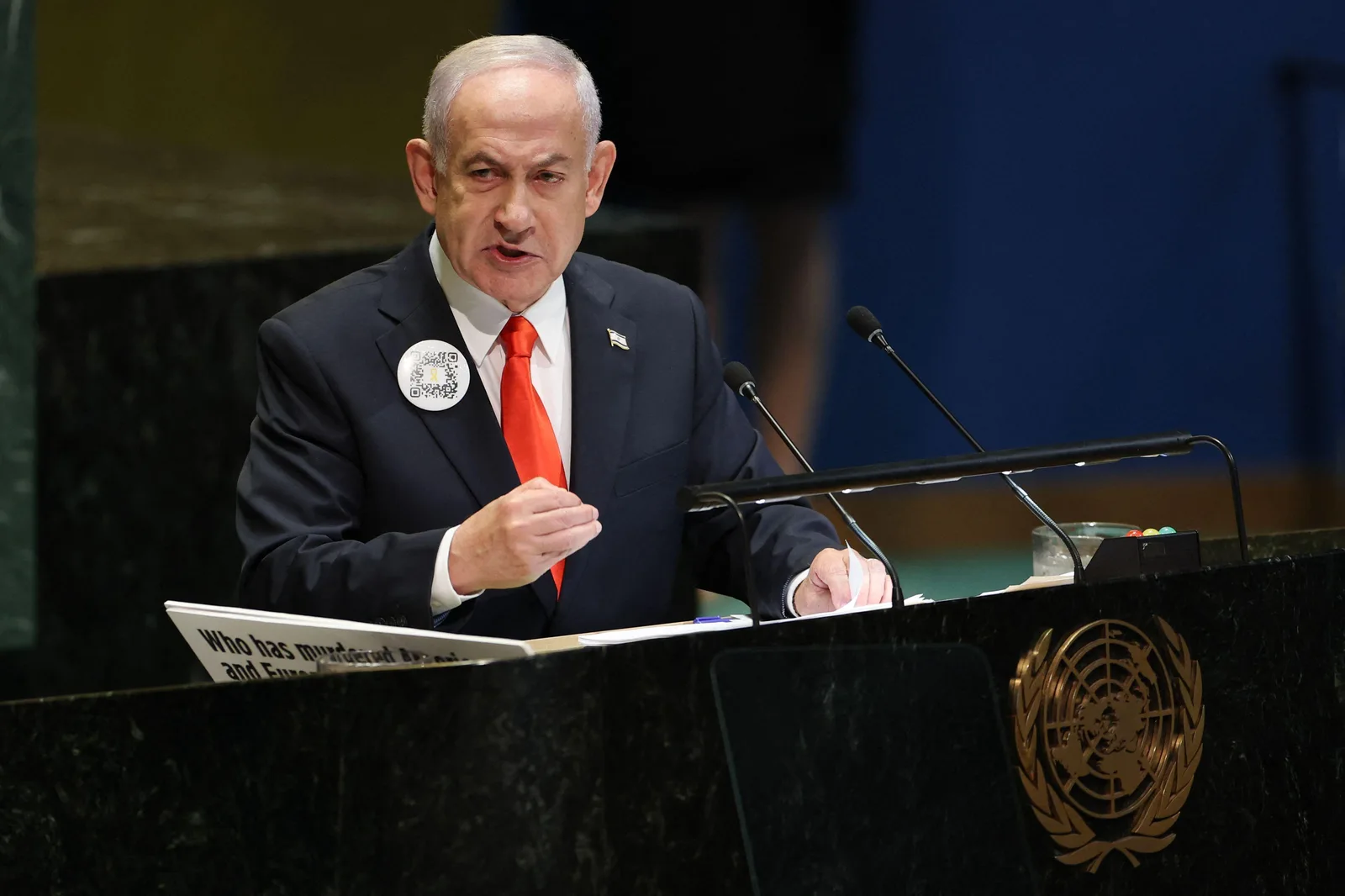
The hall begins to empty before Benjamin Netanyahu has truly begun to speak. Inside the United Nations General Assembly, diplomats rise from their seats and head for the exits, while others remain and guests in the galleries applaud. The Israeli prime minister watches the scene, waits a few moments, then addresses those who are leaving. He calls them “moral cowards” and invites anyone who shares their position to leave as well.
The scene could have served as a summary of the diplomatic isolation confronting Israel. Netanyahu turns it into something else. He makes no attempt to stop those leaving, nor does he soften the confrontation. Instead, he immediately folds it into his argument. Israel, he effectively tells the Assembly over the course of nearly an hour, will not wait for the rest of the world to understand the threats it believes it faces before acting against them.
That may be the essential message of his September 24, 2026 speech. Behind the attacks on Iran, Qatar, Turkey, New York Mayor Zohran Mamdani and several European governments, Netanyahu lays out a remarkably coherent conception of Israeli power. It is one in which security is no longer merely a policy to be defended before allies, but a necessity that legitimizes action when diplomacy, international institutions or Israel’s partners fail to provide guarantees Jerusalem considers sufficient.
The hall empties. Israel will continue.
The logic of survival
Netanyahu does not construct his address as a succession of independent crises. Gaza, Iran, Hezbollah, the Houthis, regional militias and attacks against Israel belong, in his account, to the same system. October 7, 2023 remains the starting point, but the argument extends far beyond Hamas. It describes a state confronted not by a single adversary, but by an environment in which several forces simultaneously seek to constrain its freedom of action or, in the prime minister’s words, threaten its existence.
Iran naturally occupies the center of this architecture.
Netanyahu says that the decision to strike Iran’s nuclear capabilities was one of the easiest decisions he has had to make. The formulation is striking precisely because it almost entirely removes the dimension of dilemma. In his reasoning, when a threat becomes existential and the means to neutralize it exist, the question is no longer whether to act, but when.
This represents a particular conception of deterrence. For decades, part of Israeli security rested on convincing adversaries that the cost of attacking would exceed any possible benefit. The doctrine presented in New York goes further. When Israel believes a threat is approaching a threshold it considers unacceptable, it claims the right to eliminate that threat before it becomes irreversible.
The boundary between deterrence and prevention therefore moves with Israel’s perception of danger.
Netanyahu does not present this evolution as a theoretical doctrine. He presents it as the product of experience.
October 7 as a rupture
Since 2023, one conviction has run through much of Israel’s strategic debate: the assumption that certain threats could be contained collapsed with the Hamas attack. Deterrence had not prevented the offensive. Barriers had not been sufficient. Intelligence had not produced the operational warning required. An organization believed to have been contained had demonstrated its ability to break violently through the limits of the system.
Netanyahu turns that failure into an argument for the future.
His speech does not dwell on political or institutional responsibility for October 7, despite the central place that question occupies in Israeli debate. Instead, he draws a strategic conclusion: Israel can no longer accept that the security of its population should depend on the assumption that a rationally deterred adversary will refrain from using the capabilities it accumulates.
Iran then becomes the maximal demonstration of this logic. If an organization equipped with rockets and fighters could produce October 7, what might follow, the Israeli argument implicitly asks, from a state possessing ballistic missiles and potentially a nuclear capability?
In this reading, waiting itself becomes a risk.
This is where the pragmatism of the speech appears in its coldest form. Netanyahu does not ask his audience to believe that the use of force is desirable. He asks it to accept that Israel sometimes regards its use as less dangerous than inaction.
When war becomes a system
This logic also transforms the geography of conflict.
For a long time, Israel’s wars could still be described by their fronts: Gaza, Lebanon, Syria. The contemporary Middle East makes that segmentation increasingly difficult. Missiles can be launched from Yemen, military capabilities financed from Iran, armed organizations operate from Lebanon, Iraq or the Palestinian territories, while critical infrastructure and energy routes extend across the region.
War becomes a network.
Israel’s response increasingly functions as one as well. National borders continue to exist legally and politically, but they no longer fully delimit the strategic space in which Israel believes it must operate.
The pager Netanyahu holds up before the General Assembly is, in that respect, a particularly revealing symbol. It refers to the 2024 operations targeting Hezbollah’s communications systems. But the message extends beyond the object itself: Israeli superiority does not rest solely on aircraft, missiles or armored vehicles. It also rests on the ability to penetrate infrastructure, supply chains, communications and adversarial organizations.
Minutes later, Netanyahu holds up a Starlink terminal while discussing Iran. The contrast is almost perfect. One small device evokes Israel’s capacity to disrupt an enemy network; another symbolizes the possibility of circumventing a state’s control over information.
Contemporary warfare no longer unfolds solely across territory. It passes through the systems that allow that territory to function.
Gaza on trial
This strategic architecture nevertheless collides with a reality the speech cannot avoid: Gaza.
Netanyahu categorically rejects accusations of genocide against Israel and argues that his country instead prevented a genocidal project directed against Israelis. He points to humanitarian aid entering the enclave, vaccination campaigns and measures that Israel says it has taken to limit civilian casualties. He describes the Israeli military as the most moral army in the world.
Those claims are deeply contested. Gaza health authorities report tens of thousands of Palestinian deaths since the beginning of the war, without systematically distinguishing between civilians and combatants in the overall toll. Humanitarian organizations have denounced restrictions on aid and their consequences for the population. Israel, for its part, argues that Hamas operates from civilian areas and says it takes measures intended to reduce casualties among non-combatants.
The disagreement now extends beyond the conduct of a military operation. It concerns the nature of the war itself, the proportionality of the means employed and Israel’s responsibility for its human consequences.
Netanyahu does not attempt to narrow that divide. He directly attacks those accusing Israel, including several Western governments, and reverses the moral accusation: in his account, those condemning Israel refuse to acknowledge the nature of the adversaries it faces.
Two narratives are therefore becoming increasingly difficult to reconcile. For Israel’s critics, Gaza demonstrates the moral and legal limits of an increasingly expansive security doctrine. For Netanyahu, Gaza demonstrates what happens when Israel allows a threat to develop long enough to acquire the ability to strike its territory.
The same event produces opposite conclusions.
What disappeared from the speech
Political speeches can sometimes be as revealing for what they omit as for what they declare.
Saudi Arabia is almost absent.
So are the Abraham Accords.
The omission contrasts sharply with several of Netanyahu’s previous appearances at the United Nations. For years, regional normalization occupied a central place in the future he projected from this same podium. Israel was gradually to become one of the hubs of a new economic and strategic space connecting the Mediterranean, the Gulf and, potentially, Saudi Arabia.
That prospect supported an ambitious thesis: the Palestinian question did not necessarily have to determine relations between Israel and the Arab world. Shared interests — trade, technology, security and opposition to Iran — could progressively reconstruct the regional order.
The 2026 speech barely develops that promise.
This does not mean that the Abraham Accords have disappeared or that Saudi normalization has been permanently abandoned. But their absence from such a carefully constructed address is significant. Netanyahu no longer comes to New York to present a map of the Middle East of the future. He presents the mental map of the threats Israel believes it must survive today.
The change in time horizon is considerable.
America remains, but differently
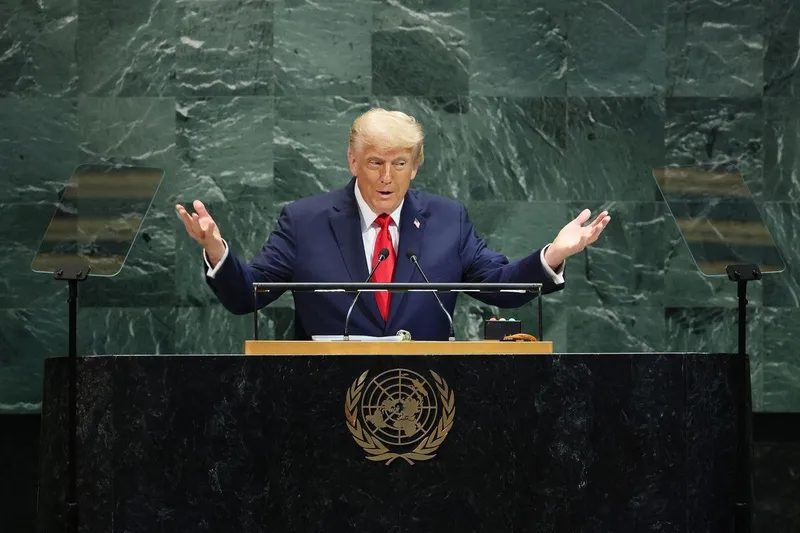
The United States naturally remains at the center of the equation. Netanyahu pays tribute to Donald Trump and his role in the confrontation with Iran. Operations against Iranian capabilities are presented as the manifestation of a shared interest extending beyond Israeli security alone.
But here too, something has changed.
The American partnership is no longer presented primarily as the foundation of a sweeping regional diplomatic realignment. It appears principally as the decisive element in a balance of power. Washington provides Israel with strategic depth that no other partner can replace; Israel, in return, offers exceptional military, technological and intelligence capabilities in a region central to American interests.
The alliance remains. Its immediate function has hardened.
This evolution comes at a time when the interests of the two countries are not always perfectly aligned. Washington must simultaneously support Israel, manage relations with the Gulf monarchies, prevent lasting disruption to energy flows, contain Iran and avoid allowing successive escalations to transform the Middle East into a conflict that can no longer be contained.
Israel thinks first in terms of national security. The United States must think in terms of the regional system.
The distinction is not new. But the more preventive Israeli doctrine becomes, the more structural that potential tension becomes.
The price of necessity
This is ultimately where the central contradiction of the speech lies.
A doctrine built on necessity possesses considerable political force because it simplifies decision-making. If the alternative is existence or disappearance, diplomatic costs become secondary. International condemnations, tensions with certain allies, demonstrations or even a United Nations chamber emptying as the prime minister speaks can be incorporated into the narrative rather than treated as signals requiring a change of course.
But that strength is also its limitation.
The more a state expands the category of threats it considers existential, the broader the range of actions it may regard as necessary. The question then becomes one of thresholds: who determines when a threat has become sufficiently serious to justify preventive action, and how far can that logic extend without itself generating new threats?
Netanyahu’s speech does not resolve that contradiction. It argues that Israel’s experience has already resolved it.
That is probably why the opening scene matters so much.
Diplomats leave the chamber. Netanyahu watches them go. He does not alter his speech, seek their approval or offer them a compromise. He explains why Israel will continue to act even when they disapprove of its actions.
For years, Benjamin Netanyahu came to the United Nations carrying maps to explain the Middle East Israel wanted to build.
In 2026, he came to explain why Israel would continue fighting in the one that exists.
Main sources
- United Nations — 81st Session of the General Assembly, address by Benjamin Netanyahu, September 24, 2026
- PBS NewsHour — full broadcast of Benjamin Netanyahu’s address to the UN General Assembly, September 24, 2026
- Reuters — coverage of the UN General Assembly and Israel’s positions on Gaza and Iran, September 2026
- The Times of Israel — coverage of the address and reporting on the absence of Saudi Arabia and the Abraham Accords, September 24, 2026
- Associated Press — coverage of Netanyahu’s address and the walkout by multiple delegations, September 24, 2026
Atlas Limits Research Desk
Atlas Limits’ editorial and analytical desk.