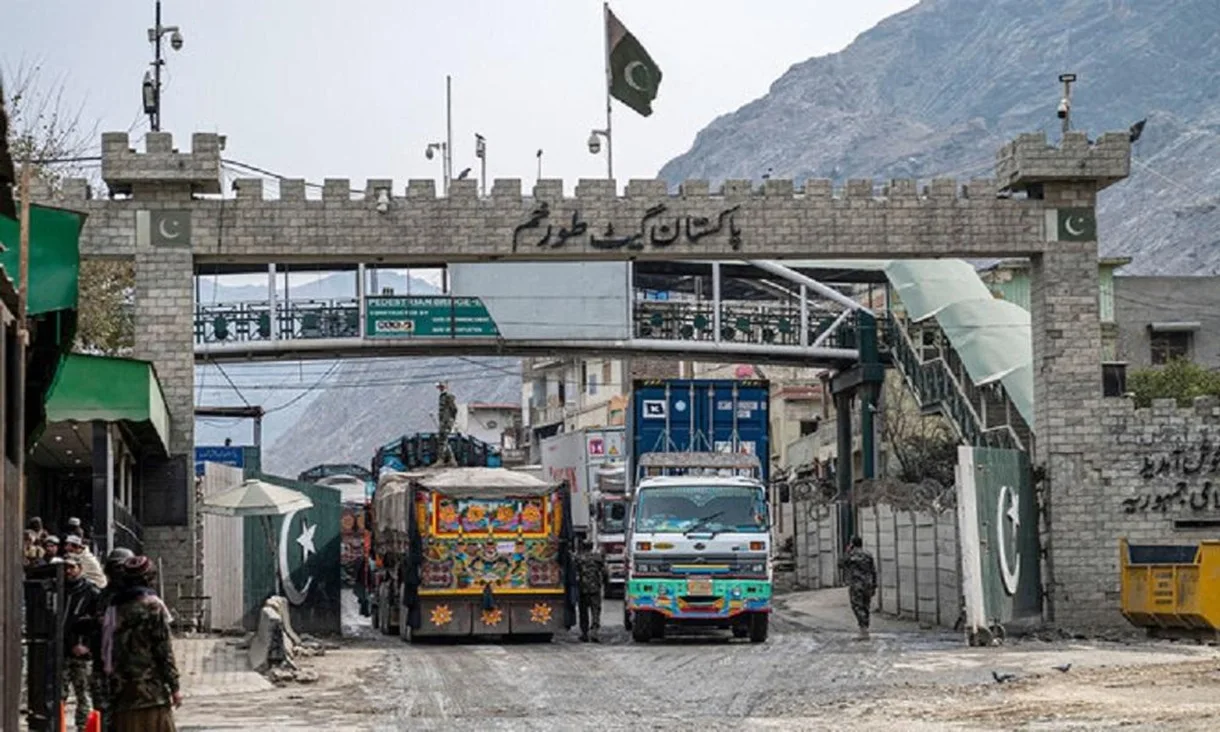
For a long time, the border between Pakistan and Afghanistan was above all a disputed line on a map. It separated two states without truly separating the populations, commercial networks, tribes or armed groups moving across the Durand Line. It is now becoming something else: an increasingly uncertain boundary between two wars.
On the night of September 23–24, Pakistani forces struck ten sites inside Afghanistan. Islamabad says the targets were used to store and launch drones deployed against Pakistani territory the previous day. Kabul disputes that account and says the attacks hit the provinces of Khost, Paktia and Kandahar, killing four civilians.
Taken in isolation, the episode could be interpreted as another border confrontation between two neighbours whose relationship has deteriorated sharply. But the September 24 strikes did not occur in isolation. Three days earlier, Pakistan had already attacked several targets inside Afghanistan, including in Kunar. Islamabad said 28 militants had been killed; Afghan authorities and the United Nations reported civilian casualties.
After nearly three months of relative calm, the military sequence has therefore resumed. And it is returning according to a logic that now extends far beyond the border itself.
Kandahar provides the symbol.
The city is not just another Afghan periphery. It is the historical birthplace of the Taliban movement and remains one of its principal centres of power. The movement's supreme leader, Hibatullah Akhundzada, resides in the region, where a significant part of the regime's religious and political authority is concentrated. When a Pakistani strike reaches Kandahar, Islamabad is no longer merely striking the mountainous margins through which armed groups have traditionally moved. It is demonstrating a willingness to employ air power deep inside one of the most symbolically important spaces of Taliban rule.
That development tells the story of a relationship that many once assumed would be almost natural.
When the Taliban retook Kabul in August 2021, Pakistan appeared to have secured a considerable strategic advantage. For decades, Islamabad had maintained complex but deep relations with the Afghan movement, to the point of being routinely described as one of its principal external backers. The withdrawal of Western forces was theoretically supposed to leave Pakistan with a less hostile neighbour while reducing Indian influence in Afghanistan.
Five years later, Pakistan's western frontier has become one of its most serious security problems.
At the centre of the rupture is Tehreek-e-Taliban Pakistan, the TTP. Despite its name and ideological affinities with the Afghan Taliban, the movement pursues a separate objective: fighting the Pakistani state. Islamabad has argued for years that its fighters operate from sanctuaries inside Afghanistan from which attacks against Pakistan are organised. The Afghan Taliban reject that accusation and maintain that Pakistan's insurgency is primarily a Pakistani domestic problem.
Behind this disagreement lies an almost insoluble contradiction.
For Islamabad, the Afghan government exercises sovereignty over its territory and must therefore prevent that territory from being used against Pakistan. For Kabul, accepting this logic would amount to acknowledging responsibility for an insurgency it says it does not control. Between these two positions, the diplomatic space has progressively narrowed.
Pakistan has consequently begun to alter its doctrine.
The border is no longer merely a line to defend. It is becoming a line that the Pakistani military considers it may cross when the threat it identifies lies on the other side. Repeated air strikes reflect that evolution: when Islamabad concludes that Kabul is not neutralising infrastructure used by groups hostile to Pakistan, it increasingly reserves the option of doing so itself.
Similar reasoning has been used elsewhere by states confronting armed organisations operating from neighbouring territories. Here, however, it carries a particular significance. Pakistan and Afghanistan are not divided by an ordinary political frontier.
The Durand Line was drawn in 1893 between Afghanistan and British India. It cuts through Pashtun territories whose family, tribal and economic structures long predate it. After Pakistan was created in 1947, Kabul refused for decades to fully recognise the frontier as definitive. Tensions surrounding its status have never entirely disappeared.
For much of that history, the ambiguity could be managed because it coexisted with a form of interdependence. People crossed the frontier, trade networks did the same, and Islamabad maintained considerable influence inside Afghanistan.
Today, that same permeability is becoming a conflict multiplier.
The question is no longer simply where the border lies. It is how far one state's responsibility extends for violence originating from the territory of the other.
Islamabad is increasingly answering that question through force.
The transformation matters all the more because diplomatic instruments have so far produced few results. Pakistan says it has repeatedly raised the issue with the Taliban authorities and has turned to several mediators, including China, Qatar, Türkiye and Saudi Arabia. As recently as September 17, Pakistan's Foreign Ministry explicitly linked the normalisation of trade, transit and visa arrangements to Afghan cooperation against armed groups operating against Pakistan.
The connection between security, commerce and the border reveals the depth of the rupture. What was supposed to become a corridor connecting Pakistan with Central Asia is gradually becoming a zone of closure. Trade flows, visas, border crossings and now the use of military force have become components of the same relationship of pressure.
Air power, however, does not necessarily solve the problem that made its use appear necessary.
Each Pakistani strike may destroy infrastructure or kill militants. It may also reinforce the conviction in Kabul that Pakistan treats Afghanistan less as a sovereign state than as strategic depth in which it can intervene whenever its interests require it. For the Taliban, who built much of their legitimacy around expelling foreign forces and restoring Afghan sovereignty, accepting such a situation indefinitely carries a considerable political cost.
That is where the risk of escalation lies.
Islamabad argues that Afghan inaction leaves it little choice but to intervene. Kabul argues that Pakistani intervention leaves it little choice but to respond. Between them, every TTP attack inside Pakistan can increasingly become the opening act of a confrontation between two states.
The fighting earlier in 2026 had already demonstrated how far this mechanism could go. The renewed strikes in September indicate that it did not disappear during the relative calm that followed. It was merely suspended.
The paradox is considerable. For decades, Pakistan's strategy in Afghanistan was largely shaped by the search for strategic depth and by the desire for a political environment in Kabul compatible with its security interests. At first glance, the Taliban's return appeared to bring Islamabad closer to that objective.
Instead, it produced a far more ambiguous configuration: an Afghanistan governed by a movement historically close to Pakistan, yet sufficiently autonomous to refuse its most important security demands.
Pakistan is discovering the limits of influence when influence must become control. The Taliban, for their part, are discovering the constraints of sovereignty when an ideologically related insurgent movement uses territory under their rule to threaten a militarily stronger neighbour.
Kandahar marks another stage in that transformation.
A border can remain disputed for more than a century without continuously producing war. What becomes much harder to contain is a border behind which neither state any longer believes that the threat ends.
The Durand Line has never completely separated the people who cross it.
It may now be ceasing to separate the wars being fought on either side.
Main sources
- Reuters — Pakistan air strikes kill 4 civilians in Afghanistan, Kabul says, September 24, 2026.
- Reuters — Pakistan says it killed 28 militants, Afghan Taliban and UN report three civilian deaths, September 21, 2026.
- Ministry of Foreign Affairs of Pakistan — Press briefing, September 17, 2026.
- United Nations — Statements concerning Pakistan–Afghanistan hostilities and calls for diplomatic de-escalation.
Atlas Limits Research Desk
Atlas Limits’ editorial and analytical desk.