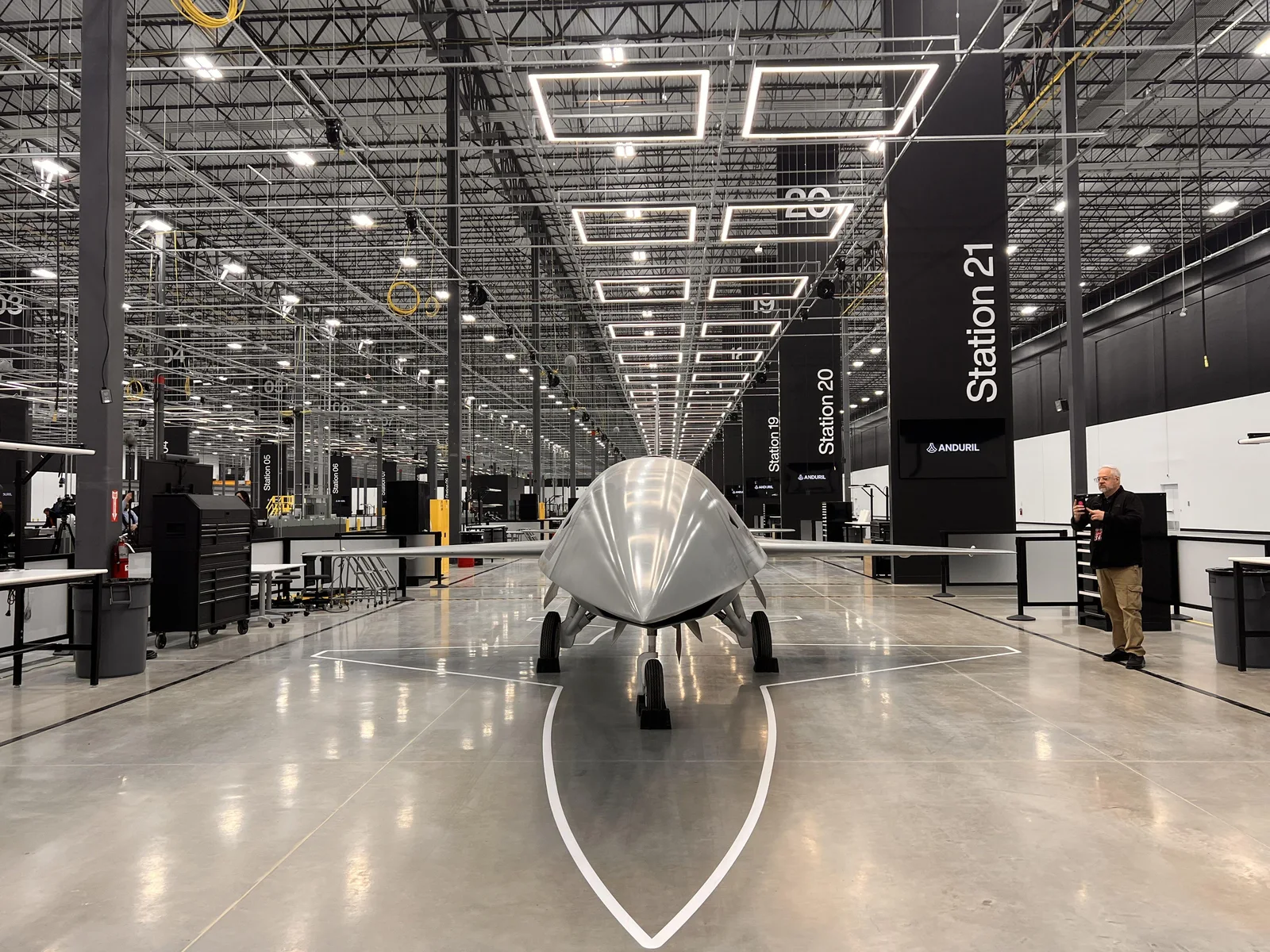
In the workshops of Aster, in Yokote, northern Japan, an industrial transformation is underway. Long specializing in the manufacture of components for the automotive industry, including parts for Toyota vehicles, the company, which employs around 100 people, now supplies electric motors to Anduril Industries, one of America's leading emerging defense technology companies. Since entering the defense sector in 2025, this business has already grown to account for 10% of its revenue. Its president, Takenobu Hongo, sees profitability prospects that certain segments of the automotive industry no longer offer.
Behind this commercial diversification lies a deeper transformation of the Japanese economy. Faced with declining automotive competitiveness, China's industrial ascendancy and a deteriorating security environment, Japan is seeking to mobilize part of its civilian manufacturing base in support of its defense policy. The objective is not merely to increase military expenditure, but to reshape the industrial foundations on which the country's ability to ensure its own security depends.
For a nation whose economic reconstruction was largely built around a separation between industrial and military power, this development represents a historic departure.
The Limits of the Automotive Model
For several decades, the automotive industry has been one of the principal engines of Japanese economic power. Toyota, Honda, Nissan, Mazda, Suzuki, Mitsubishi Motors and Subaru have built extensive industrial ecosystems encompassing metallurgy, electronics, robotics, chemicals, precision engineering and materials science.
This organization relies on a particularly dense network of suppliers and subcontractors, many of which remain heavily dependent on orders from a handful of major manufacturers. The competitiveness of the Japanese model has long rested on cost control, continuous improvements in manufacturing processes, component reliability and close coordination across different levels of the production chain.
Yet the economic conditions that enabled its development are changing. Vehicle electrification is gradually reducing demand for certain traditional mechanical components, while Chinese manufacturers are establishing new standards in costs, innovation speed and technological integration. Value creation is shifting toward batteries, semiconductors, embedded electronics and software.
For Japanese automotive suppliers specializing in technologies associated with internal combustion engines, this evolution represents a structural risk. It threatens not only their commercial markets but also the economic value of industrial investments accumulated over several decades.
In 2025, Japanese factories produced nearly 900,000 fewer vehicles than in 2015. Although the country maintains annual production exceeding eight million units, the contraction of its automotive manufacturing activity raises a question that extends beyond the individual performance of its carmakers: what should become of industrial capacities whose traditional markets may gradually disappear?
Defense is beginning to emerge as one possible answer.
The State Orchestrates Industrial Diversification
Tokyo's ongoing transformation follows the strategic shift announced in December 2022. Japan adopted a defense capability enhancement program worth approximately ¥43 trillion for the 2023–2027 period, with the ambition of bringing overall national security-related expenditure closer to 2% of gross domestic product.
Under Prime Minister Sanae Takaichi's government, this momentum is acquiring a more explicit industrial dimension. Preparations for a new national security strategy, expected before the end of 2026, are accompanied by efforts to broaden Japan's defense manufacturing base.
The Acquisition, Technology & Logistics Agency (ATLA), an organization operating under Japan's Ministry of Defense, is directly involved in bringing civilian and military industries closer together. It identifies capabilities available among automotive suppliers, facilitates connections with specialized defense contractors and provides financial support for selected technological development programs.
The Ministry of Economy, Trade and Industry is also participating in this diversification policy. The government is seeking to reduce the economic and technical barriers that have traditionally restricted the entry of new suppliers into the military sector.
This approach addresses a challenge shared by major industrial powers undergoing rearmament. An increase in military budgets does not automatically translate into an equivalent increase in manufacturing capacity. Between budgetary decisions and equipment deliveries lie constraints involving supplier qualification, raw material availability, investment in production facilities and the recruitment of specialized personnel.
By mobilizing an already established manufacturing infrastructure, Tokyo intends to shorten some of these lead times and avoid rebuilding capabilities that its civilian economy already possesses.
Aster, Kyowa and Kaaz: Automotive Suppliers at the Forefront
The transformation is currently more visible among small and medium-sized industrial enterprises than among major automotive manufacturers.
Aster illustrates this initial phase of diversification. Its relationship with Anduril provides access to a market distinct from that of major automotive manufacturers, with different commercial requirements and production volumes. Defense is not replacing its historical business, but it now constitutes a second market capable of gradually reshaping its revenue structure.
Kyowa Industrial is following a similar trajectory. Historically specializing in automotive engine components and already maintaining a limited presence in defense, the company is seeing its military business gain increasing importance. Between the spring of 2025 and November 2026, defense's contribution to annual revenue rose from 3% to 10%. The evolution of its order book reflects demand from defense contractors whose traditional suppliers are facing capacity constraints.
Kaaz, known in particular for its motorsport components, is also exploring new opportunities in unmanned aviation. The company has engaged with Japanese authorities and is pursuing development work for military applications. ATLA has notably facilitated its engagement with Terra Drone, a Japanese company specializing in unmanned aerial technologies.
In Ota, Ishikawa Energy Research offers another example of convergence between the two industrial sectors. Emerging from the civilian drone ecosystem, the company relies on automotive suppliers located around Subaru's industrial operations to develop its business. More than half of the components used in its aircraft already come from the automotive industry. Initially focused on agricultural applications, the company is now exploring defense-related uses.
These companies reveal a fundamental characteristic of Japan's transformation: industrial conversion does not necessarily require an entire factory to change its purpose. It can occur gradually through customer diversification, adaptation of existing manufacturing processes and the development of new activities within companies that retain their civilian markets.
It is precisely this coexistence that gives the model its economic significance.
Nissan and Anduril: Repurposing Industrial Capital
The case of Nissan, however, could give this transformation an entirely different scale.
In June 2026, reports emerged of discussions between Nissan Motor and Anduril Industries regarding a possible acquisition of the Oppama automotive plant, south of Tokyo. Opened in 1961, the landmark facility has produced approximately 18 million vehicles since its inauguration and employs around 2,400 people.
Nissan plans to end automotive production at the site by 2028 as part of its industrial restructuring. For Anduril, a potential acquisition would provide access to an existing manufacturing infrastructure in Japan, embedded within a highly developed industrial environment.
As of November 24, 2026, no definitive transaction has been publicly confirmed. Nevertheless, the proposal illustrates the economic trade-offs facing Japanese industrial companies.
An automotive plant that ceases production does not immediately lose its entire productive value. Its facilities, land, logistics infrastructure, energy connections, supplier network and workforce capabilities constitute a collection of assets whose economic value may survive beyond their original use.
Closing the site may result in asset impairments, restructuring charges, decommissioning costs and the destruction of industrial expertise. Conversely, a sale followed by industrial conversion offers the possibility of preserving part of that value, provided that the expenditure required to adapt the facility remains compatible with future revenue.
For a potential buyer, the decision rests on comparing the total cost of acquiring and converting an existing facility with that of an entirely new investment. Immediate access to industrial land, infrastructure and a pool of skilled labor can constitute a decisive economic advantage.
The Oppama case also raises a question of sovereignty. Converting a Japanese industrial asset for use by an American company could strengthen manufacturing capacity located within Japan without necessarily ensuring Japanese control over the associated technologies, intellectual property and strategic decisions.
The location of production and control over the value chain are not necessarily synonymous with industrial autonomy.
Defense Profitability Versus Automotive Margins
The reorientation of certain Japanese automotive suppliers also follows a financial rationale.
In the automotive industry, large production runs allow industrial investments to be amortized across considerable volumes, but they are accompanied by constant pressure on prices. Suppliers are regularly required to pass productivity gains on to their customers while absorbing part of the costs associated with technological change.
When a market segment reaches maturity or experiences structural contraction, companies may find themselves caught between declining volumes, rigid fixed costs and an inability to pass their expenses on to customers in full.
Defense operates according to a different economic model. Production volumes are often smaller, development cycles longer and qualification requirements more demanding. However, product specialization, the difficulty of replacing suppliers and the duration of certain programs can offer greater commercial visibility.
Public investment support and government-funded research programs can also reduce the financial risks associated with entering this market.
For an automotive supplier, the appeal of diversification therefore lies as much in utilizing existing production capacity as in the possibility of improving returns on invested capital and reducing dependence on a limited number of automotive customers.
It would nevertheless be misleading to regard defense as an inherently more profitable market. Certification costs, regulatory obligations, export restrictions, specialized capital expenditure and uncertainty surrounding government procurement can weigh heavily on actual project profitability.
Rising military budgets create a market; they do not, by themselves, guarantee the commercial success of companies entering it.
Subaru and Mitsubishi Electric: Alternative Industrial Trajectories
Not all Japanese companies are discovering military activities for the first time.
Subaru, whose international identity is primarily associated with automobiles, has long operated an aerospace division working with the Japan Self-Defense Forces. This dual presence allows the group to approach rising military expenditure from a position of established expertise, institutional relationships and industrial experience. The company intends to benefit from the anticipated growth in demand across the sector.
Mitsubishi Electric represents another important participant in this convergence. Already established in defense electronics, the group is seeking to expand its cooperation with suppliers from the automotive industry. Some companies approached have nevertheless declined to participate in new military projects, fearing damage to their relationships with their principal civilian customers.
These reservations demonstrate that the transformation of Japan's industrial ecosystem depends on more than the availability of manufacturing expertise. It also requires changes in contractual relationships, commercial strategies and corporate governance practices.
Toyota currently maintains a restrictive position regarding military activities. Honda has indicated that it has no concrete plans to enter the sector, while Nissan has not announced a strategy of direct diversification into defense.
For these groups, the question extends beyond the potential profitability of a new market. Their substantial international exposure, particularly in China, their reputation among consumers and the nature of their industrial commitments impose trade-offs that medium-sized suppliers may sometimes navigate with greater flexibility.
Japan's industrial restructuring could therefore advance through the networks surrounding its major corporations without those corporations themselves becoming direct participants in the country's rearmament.
The End of Postwar Industrial Compartmentalization
Following its defeat in 1945, Japan gradually rebuilt its power around civilian economic specialization, within a security framework largely guaranteed by its alliance with the United States.
Article 9 of the 1947 Constitution, the Yoshida Doctrine and historical restrictions on arms exports helped shape a model in which economic development occupied a central position while military ambitions remained institutionally constrained.
This model never implied the complete absence of a defense industry. Mitsubishi Heavy Industries, Kawasaki Heavy Industries, IHI, NEC, Mitsubishi Electric and Subaru maintained military and aerospace operations. For decades, however, these activities remained relatively compartmentalized from the country's vast civilian manufacturing base.
China's military modernization, North Korea's ballistic missile and nuclear programs, tensions surrounding Taiwan and deteriorating relations with Russia are now prompting Tokyo to reconsider this organization.
At the same time, the United States is encouraging its Asian partners to assume a growing share of responsibility for their own security. The integration of Japanese suppliers into American defense value chains could contribute to a redistribution of industrial responsibilities within the alliance.
The relationship between Aster and Anduril, alongside the discussions surrounding Oppama, illustrates this evolution. Japanese-American relations would no longer rest solely on the supply of American military equipment to Japan, but increasingly on the integration of Japanese manufacturing capabilities into transnational industrial programs.
This interdependence could strengthen collective manufacturing capacity while shifting certain dependencies toward technologies, software and intellectual property controlled by American companies.
A New Geography of Productive Capital
The Japanese phenomenon forms part of a broader transformation of the global economy. Across Europe, the United States and Asia, geopolitical fragmentation is prompting governments to reassess the strategic function of industrial assets.
During the decades of globalization, factory locations, supply chain organization and investment allocation were primarily determined by costs, productivity and market access. Economic security, industrial resilience and the availability of manufacturing capacity are now playing an increasingly important role in public and private decision-making.
Underutilized manufacturing capacity can thus become a strategic asset. A company weakened by technological transition may find new markets through national security policies. A factory scheduled for closure may recover economic value in a sector with little immediate connection to its original purpose.
This transformation nevertheless carries risks of its own. Excessive dependence on government procurement may leave companies vulnerable to changes in budgetary priorities. A sustained reorientation of investment toward defense may also compete with the modernization requirements of civilian industries and divert some of the expertise needed for future technological transitions.
For Japan, the challenge is therefore to mobilize its manufacturing heritage without compromising its ability to remain competitive in the industries that established its prosperity.
In Aster's workshops, at Kyowa Industrial and around Nissan's facilities in Oppama, this challenge is beginning to take tangible form. The companies that helped make Japan one of the great industrial powers of the postwar era are now being called upon to participate in the redefinition of its strategic power.
The question is whether this new allocation of productive capital will enable Japan to renew its industrial model or whether it will primarily serve as a response to the growing vulnerabilities of the very model it seeks to preserve.
Atlas Limits Research Desk
Atlas Limits’ editorial and analytical desk.