The announced upgrading of Moroccan-Israeli relations to embassy level extends far beyond the bilateral relationship. Six years after diplomatic ties were restored, Rabat, Tel Aviv and Washington are reactivating the strategic triangle established in 2020 just as the Sahara issue itself enters a potentially decisive phase.
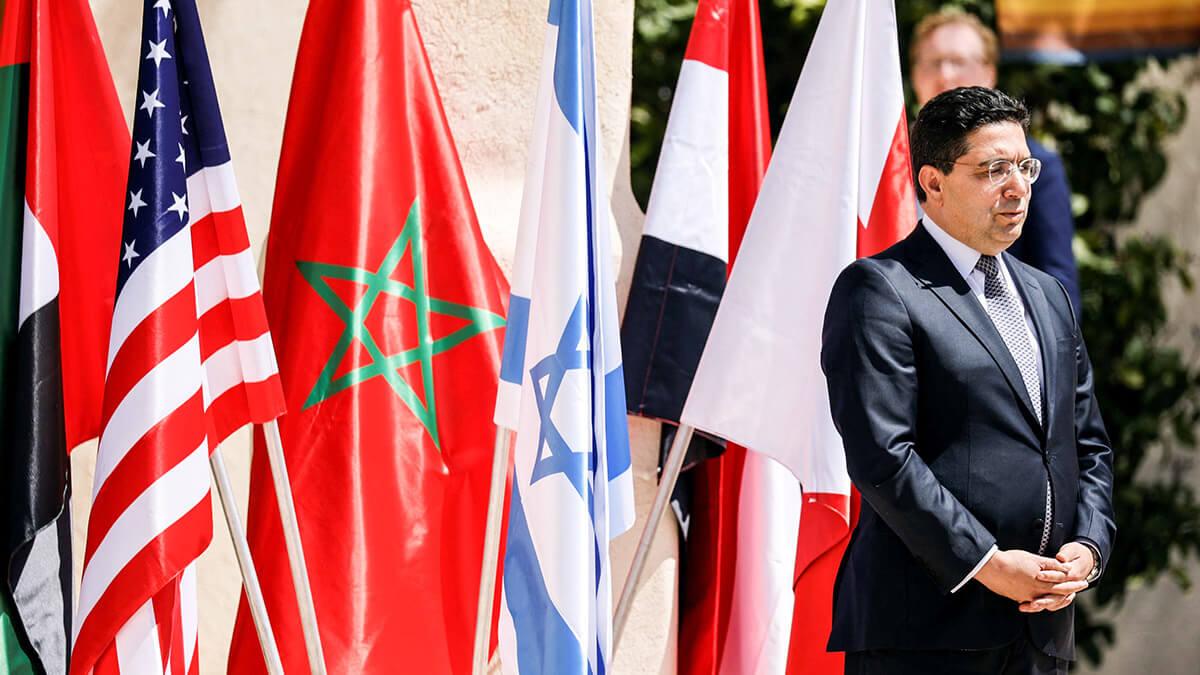
On September 16, 2026, in New York, Moroccan Foreign Minister Nasser Bourita, his Israeli counterpart Gideon Sa’ar and U.S. Ambassador to the United Nations Mike Waltz met for a trilateral diplomatic summit. Following the meeting, Morocco and Israel announced their intention to upgrade their liaison offices to embassies and appoint ambassadors.
The move had been anticipated for some time. Morocco and Israel restored diplomatic relations in December 2020 as part of a trilateral arrangement involving the United States. Israel subsequently formally recognized Moroccan sovereignty over the Sahara in July 2023.
But the context of September 2026 gives this new step a different significance. The relationship built over the past six years no longer rests solely on diplomatic recognition, security cooperation or a succession of ministerial visits. It is beginning to acquire the conventional instruments of a durable interstate relationship.
The transition to embassies is its most visible manifestation. It comes with an economic agenda: the planned completion of investment-protection and double-taxation agreements, the expansion of air links and an increase in high-level bilateral visits.
In other words, a normalization process long exposed to regional political fluctuations is beginning to be transformed into institutional infrastructure.
And behind that infrastructure remains the issue that has accompanied the relationship from its inception: the Sahara.
The 2020 triangle has not disappeared
When Rabat and Tel Aviv restored relations in December 2020, Washington simultaneously recognized Moroccan sovereignty over the Sahara. The two decisions belonged to the same diplomatic sequence.
Israel followed in 2023.
Six years later, the three capitals are once again operating within the same format.
The American presence in New York is therefore not incidental. It is a reminder that Morocco–Israel relations were constructed within a triangular diplomatic architecture in which Washington occupies a particular position. More importantly, the summit comes at a time when the Sahara issue has undergone a significant evolution at the United Nations.
On October 31, 2025, the Security Council adopted Resolution 2797 by eleven votes in favor, none against and three abstentions, with Algeria not participating in the vote. The resolution extended the mandate of MINURSO until October 31, 2026.
More significantly, the resolution called on the parties to continue discussions using Morocco’s autonomy proposal as a basis for seeking a final and mutually acceptable political solution providing for self-determination.
The wording matters.
It gives the autonomy plan a more prominent place within the UN-led process, but it does not mean that the United Nations has recognized Moroccan sovereignty over the territory, nor that the Sahara’s final status has been legally settled. Interpretations of the resolution remain deeply divergent: supporters of Rabat see it as further consolidation of the autonomy plan as the framework for a settlement, while its opponents emphasize that the text retains the requirement for a mutually acceptable solution and the reference to self-determination.
It is precisely this ambiguity that defines the current phase.
From recognition to negotiation
For several years, Morocco’s strategy has largely consisted of gradually transforming the diplomatic environment surrounding the conflict.
The United States recognized Moroccan sovereignty in 2020. Israel did so in 2023. Several states have backed the autonomy plan, while a number of foreign diplomatic representations have opened in Laayoune or Dakhla.
The question now is different.
What can this accumulation of diplomatic support actually produce?
Resolution 2797 did not close the issue. Rather, it shifted attention toward the conditions under which a political negotiation could take place. Discussions before the United Nations Special Committee on Decolonization in 2026 referred to meetings held earlier in the year and renewed consultations conducted by the UN Secretary-General’s Personal Envoy, Staffan de Mistura, including with Algeria in June.
The central problem, however, remains unchanged.
Morocco proposes autonomy for the Sahara under Moroccan sovereignty. The Polisario Front maintains that Sahrawis must have the right to choose independence and rejects any solution that predetermines sovereignty over the territory. Algeria supports the Polisario Front and remains an unavoidable actor in any regional architecture for a settlement.
The gap between the positions therefore remains considerable.
The transformation of the diplomatic balance surrounding the conflict should not be confused with its resolution.
Spain illustrates the limits of alignment
Another recent development illustrates this complexity.
On September 10, less than a week before the New York meeting, the lower house of Spain’s parliament approved legislation allowing Sahrawis born while the territory was under Spanish administration, as well as some of their descendants, to obtain Spanish citizenship. According to Reuters, as many as 110,000 people could be affected.
The decision is notable because it comes four years after Madrid changed its position on the Sahara.
In 2022, the Spanish government described Morocco’s autonomy plan as the most serious, realistic and credible basis for resolving the dispute, opening a new phase in relations with Rabat.
The September 2026 development does not necessarily amount to a reversal of that policy. It does, however, demonstrate that the strategic rapprochement between Madrid and Rabat has not eliminated the historical, legal and political weight of the Sahara within Spanish domestic politics.
This distinction is essential to understanding the conflict’s new phase: the accumulation of international support for Morocco’s autonomy plan does not automatically produce alignment across every policy concerning the territory.
October 31 as the next milestone
The next important sequence is already on the calendar.
MINURSO’s current mandate expires on October 31, 2026.
The Security Council will therefore have to return to the issue only a few weeks after the trilateral meeting in New York.
What matters then will be less the declarations than the language adopted by the Council: the place given to the autonomy plan, the reference to self-determination, the framework for renewed negotiations and the role assigned to the different regional actors.
Three dynamics can now be distinguished.
The first is diplomatic. Rabat is seeking to consolidate an increasingly broad coalition of international support around its autonomy proposal.
The second is institutional. The United Nations process remains the framework within which a final solution is to be negotiated, while MINURSO continues to operate more than three decades after its creation.
The third is regional. No durable settlement can be separated from relations between Morocco and Algeria, whose rivalry extends far beyond the Sahara and structures part of the strategic balance of the Maghreb.
The next phase will likely unfold at the intersection of these three dynamics.
A normalization process changing in nature
The September 16 meeting therefore reveals something deeper than the prospective opening of two embassies.
In 2020, the restoration of relations between Morocco and Israel was a striking diplomatic event, inseparable from the American decision on the Sahara. In 2026, the logic is different. The objective is now to transform what was achieved politically into relationships capable of enduring: embassies, ambassadors, legally protected investments, bilateral tax arrangements, air connections and regular government-level contacts.
The Sahara is, in a sense, following a similar trajectory.
Rabat has substantially transformed its diplomatic environment. But converting that evolution into a political settlement is a different undertaking altogether. It requires moving from national recognitions and international support for the autonomy plan toward an agreement capable of fitting within the United Nations framework and being accepted through a political process.
The New York summit therefore does not resolve the Sahara conflict.
It does, however, show that the diplomatic architecture constructed around Morocco since 2020 continues to consolidate at precisely the moment when the central question is becoming one of political translation.
Six years after the Abraham Accords, normalization between Morocco and Israel is no longer really the beginning of the story. It is becoming part of its infrastructure.
For the Sahara, the question over the coming months will be whether a comparable transition is possible: moving from a profoundly transformed diplomatic balance of power toward negotiations capable of producing a durable political settlement.
Main sources
- United Nations Security Council — Resolution 2797 (2025) and documents concerning Western Sahara.
- United Nations Special Committee on Decolonization — 2026 session and discussions concerning Western Sahara.
- Reuters — September 10, 2026, Spanish legislative developments concerning Sahrawis.
- Reuters — September 16, 2026, Morocco–Israel agreement to upgrade diplomatic relations.
- Israeli Ministry of Foreign Affairs — Morocco–Israel–United States trilateral meeting, New York, September 16, 2026.
Atlas Limits Research Desk
Atlas Limits’ editorial and analytical desk.