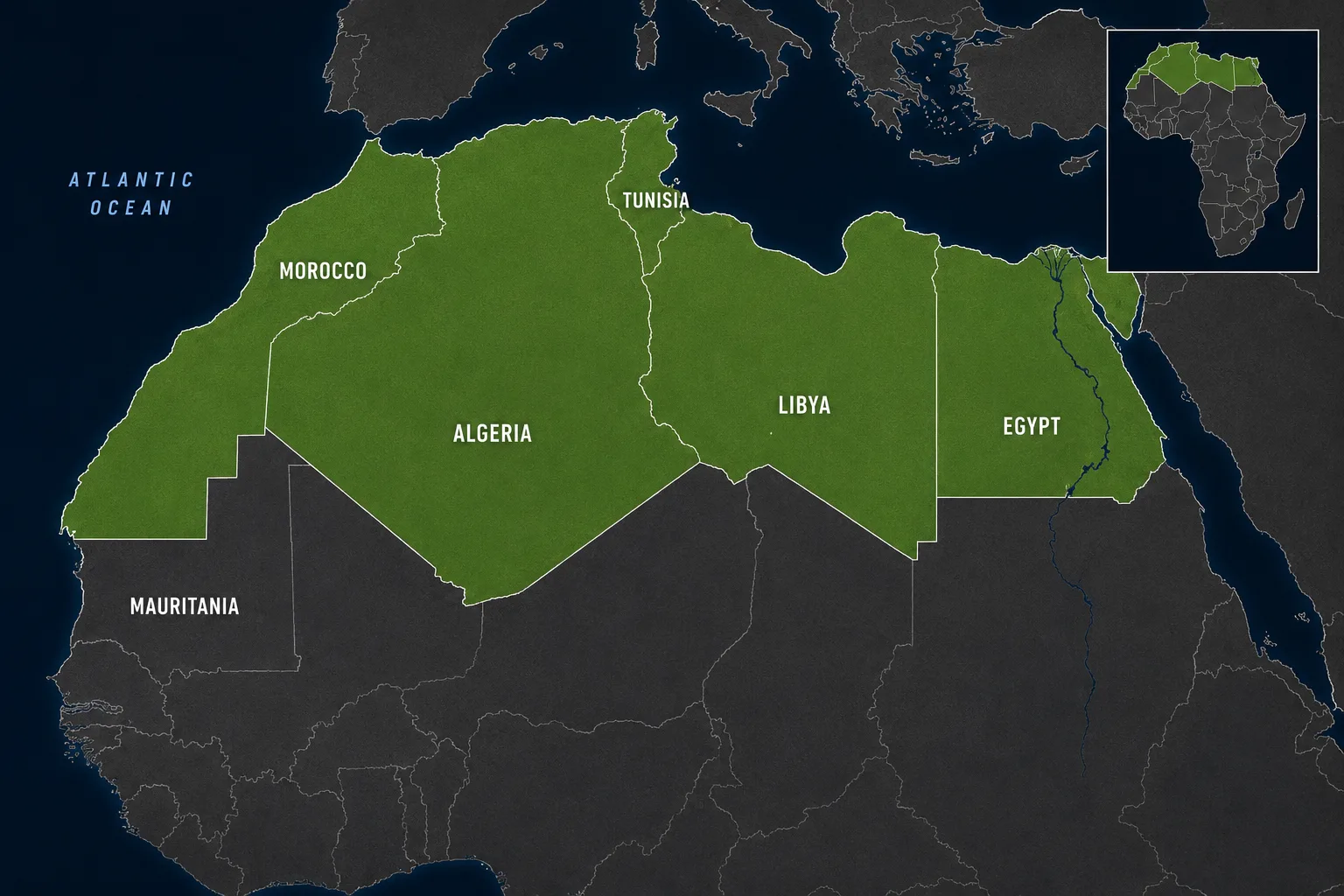
North Africa occupies a distinctive position in the global political economy. Located at the intersection of Europe, sub-Saharan Africa, and the Middle East, it controls or borders several of the world's principal maritime passages, possesses considerable energy and mineral resources, has diversified industrial capabilities, and is home to more than 260 million people. Yet this geographical region does not constitute a genuinely integrated economic area. Its infrastructure, trade flows, and industrial strategies remain primarily oriented toward external partners, while political rivalries and institutional differences restrict the regional movement of goods, capital, and factors of production.
This contradiction is one of the defining characteristics of contemporary North Africa. The region possesses several attributes of a collective economic power, but their combination remains largely theoretical. Morocco, Algeria, Tunisia, Libya, and Egypt pursue national strategies shaped by their respective resources, constraints, and alliances. Their geographical proximity has produced neither structured industrial coordination nor a regional market comparable to the world's major economic blocs.
North Africa's fragmentation therefore does not result from an absence of economic complementarities. It stems primarily from the political, institutional, and strategic conditions under which those complementarities might be exploited.
Geography nevertheless offers the region exceptional advantages.
To the west, the Strait of Gibraltar constitutes one of the principal passages between the Atlantic Ocean and the Mediterranean Sea. To the east, the Suez Canal connects the Mediterranean to the Red Sea and the Indian Ocean, considerably shortening maritime distances between Europe and Asia. Between these two extremities, North Africa's Mediterranean coastlines form part of commercial networks linking Europe's major economies to African and Asian markets.
The Suez Canal occupies a particularly important position within this architecture. Before major disruptions to navigation in the Red Sea, it accounted for approximately 12% of global trade by volume, according to certain commonly used estimates. This proportion nevertheless varies according to the year and the indicators employed. Attacks against commercial shipping and the diversion of vessels around the Cape of Good Hope have demonstrated that the canal's strategic value cannot be reduced to its share of global trade.
Egypt thus possesses an exceptional geographical asset, but one whose revenues depend directly on maritime security, shipping companies' decisions, and the evolution of international trade routes.
Morocco's position follows a different logic. Its immediate proximity to Europe, access to both the Atlantic and Mediterranean, and development of port infrastructure have encouraged the emergence of a logistics and industrial platform connected to European and global value chains.
Tanger Med represents one of the most significant achievements of this strategy. Its development has accompanied the establishment of export-oriented industrial activities, particularly in the automotive sector, and strengthened Morocco's position in commercial flows between Europe, Africa, and other international markets.
These two examples illustrate a fundamental reality: geography does not automatically generate wealth. It creates opportunities whose realization depends on infrastructure, institutional quality, political stability, and the ability to attract productive investment.
North Africa's economic trajectories demonstrate precisely the importance of these differences.
Egypt constitutes the region's largest demographic market. With a population exceeding 110 million, it possesses a consumer base, productive apparatus, and workforce whose scale distinguishes it from its neighbors.
Its economy combines agriculture, industry, construction, services, tourism, maritime transport, and energy activities. This sectoral diversification does not, however, eliminate several structural vulnerabilities.
Population growth places continuous pressure on infrastructure, public services, the labor market, and food resources. Dependence on grain imports exposes the country to fluctuations in international prices, while external financing requirements and the burden of public debt restrict fiscal flexibility.
Egypt therefore illustrates a contradiction frequently observed in large emerging economies: the size of the domestic market represents an economic advantage, but it also requires sustained job creation, investment, and productivity improvements.
Algeria operates under a different model.
Hydrocarbons dominate its exports and play a decisive role in financing public expenditure. Oil and gas revenues enable the state to support government spending, infrastructure, social transfers, and a substantial share of economic activity.
This specialization provides a considerable strategic advantage.
Algeria ranks among Africa's principal natural gas producers and maintains essential energy relationships with several European countries, particularly Italy and Spain.
The restructuring of European energy supplies following Russia's invasion of Ukraine in 2022 increased the strategic importance of Algeria's production and export capabilities.
But this position is accompanied by structural vulnerability.
When external revenues depend heavily on hydrocarbons, fluctuations in international prices can affect fiscal balances, foreign exchange reserves, and public investment capacity.
Economic diversification consequently becomes a question of macroeconomic stability as much as industrial development.
Algeria possesses substantial financial, energy, and human resources, but transforming them into a diversified export-oriented productive base remains a central challenge.
Morocco has followed a trajectory more closely oriented toward international industrial integration.
Since the 2000s, the country has developed logistics infrastructure, industrial zones, and sectoral policies designed to attract productive investment.
The automotive industry represents one of the most visible results of this strategy. Assembly operations and component manufacturing have enabled Morocco to integrate into European value chains, while aerospace, electrical industries, phosphates and their derivatives, agrifood, and services contribute to economic diversification.
This evolution represents an important transformation of the productive structure.
It does not, however, mean that all the value generated by these industries is captured locally.
Within international production chains, the distribution of margins depends on intellectual property ownership, technological capabilities, imported components, design functions, and contractual relationships between parent companies and subsidiaries.
Rising industrial exports therefore do not automatically guarantee an equivalent increase in domestic value added.
Economic development also depends on the ability to foster local suppliers, improve workforce qualifications, strengthen research activities, and increase the share of higher-value industrial functions.
Morocco also possesses a major strategic advantage in phosphates.
International geological estimates attribute to Morocco a predominant share of global phosphate rock reserves, frequently assessed at approximately 70%, including deposits in Western Sahara within the relevant statistics.
This concentration has implications extending far beyond mining.
Phosphate is an essential raw material for fertilizer production and, consequently, agricultural productivity and global food security.
The ability to transform this resource into higher-value products, secure the energy supplies required for processing, and develop international commercial networks constitutes a central element of Morocco's industrial strategy.
Tunisia presents another configuration.
Its economy possesses a relatively diversified industrial base, closely integrated into European value chains in electrical components, mechanical equipment, textiles, and certain service activities.
This productive proximity to Europe represents an important advantage, particularly as companies seek to shorten certain supply chains.
But Tunisia continues to face financial and institutional constraints that restrict its investment capacity.
Weak growth, fiscal pressures, financing difficulties, and unemployment, particularly among young graduates, weigh on its economic potential.
The availability of a qualified workforce is insufficient to guarantee industrial transformation when financing conditions, regulatory stability, and market prospects remain uncertain.
Libya, finally, offers the clearest example of the distinction between natural wealth and economic capacity.
The country possesses Africa's largest proven oil reserves. Its relatively small population could, in theory, allow substantial resources to be available per inhabitant.
Yet since the fall of Muammar Gaddafi in 2011, political and security fragmentation has considerably weakened the state's ability to organize a stable economic trajectory.
The coexistence of rival centers of power, tensions surrounding financial and petroleum institutions, and the influence of armed groups complicate the management of public resources.
Oil production can recover when security conditions permit, only to suffer renewed disruption during political crises.
Libya thus demonstrates that possessing natural resources does not guarantee development.
The ability to transform resource rents into sustainable investment depends first on the existence of institutions capable of controlling revenues, organizing public expenditure, and ensuring policy continuity.
These five trajectories reveal a region that is economically complementary but institutionally fragmented.
Algeria and Libya possess considerable energy resources. Morocco and Tunisia have industrial capabilities integrated into European markets. Egypt offers a large domestic market, strategic maritime infrastructure, and a diversified industrial base.
Deeper economic integration could theoretically combine these advantages.
Energy resources could support regional industrial chains. Port and land infrastructure could facilitate the movement of goods. National markets could provide additional outlets for businesses. Industrial and technological skills could be mobilized on a larger scale.
But these complementarities remain largely underexploited.
Trade among Maghreb countries represents a small proportion of their total foreign trade. Estimates vary according to geographical scope and reference year, but they converge on one conclusion: commercial integration within the Maghreb remains far below that of several other regional economic groupings.
This situation does not result exclusively from tariff barriers.
It also reflects missing infrastructure, administrative obstacles, regulatory differences, weak logistical connections, and, above all, political tensions.
The rivalry between Morocco and Algeria occupies a central position in this fragmentation.
The land border between the two countries has been closed since 1994. In August 2021, Algeria severed diplomatic relations with Morocco.
The dispute over Western Sahara constitutes one of the principal dimensions of this rivalry. Morocco administers most of the territory and considers it an integral part of its national territory. Algeria supports the Polisario Front and the principle of self-determination, while the territory's final status remains subject to the United Nations political process.
The differences between Rabat and Algiers nevertheless extend beyond this question.
They also concern regional military balances, diplomatic alliances, African strategies, and relations with major powers.
These tensions directly affect the prospects for economic integration.
The absence of normal overland circulation between the Maghreb's two largest economies restricts the development of logistical corridors and reduces opportunities to organize cross-border production chains.
It also contributes to weakening the prospects of the Arab Maghreb Union, established in 1989 to promote regional cooperation.
The institution still exists, but its economic and political potential remains largely unrealized.
The cost of this fragmentation cannot be measured solely through trade that does not take place.
It also appears in investments that are never made, economies of scale that cannot be achieved, and regional infrastructure whose profitability would be greater within an integrated market.
An industrial company established in one North African country could theoretically access several neighboring markets through relatively short land routes.
In practice, it may encounter greater difficulties trading with certain countries in the region than with much more distant European partners.
North Africa's economic geography therefore presents an anomaly: territorial proximity does not necessarily translate into commercial proximity.
This situation partly explains why national strategies have progressively developed around external corridors.
Morocco is strengthening its connections with Europe, the Atlantic, and sub-Saharan Africa. Algeria is developing its Mediterranean energy relationships and several Saharan connectivity projects. Egypt seeks to capitalize on its position between the Mediterranean, the Red Sea, and Middle Eastern markets. Tunisia remains closely oriented toward European production chains.
These orientations are not inherently incompatible.
They could even become complementary within a more structured framework of regional cooperation.
But their coexistence does not automatically produce a collective strategy.
Political fragmentation transforms potentially shared geographical advantages into national strategies that are sometimes competitive.
This dynamic is reinforced by the influence of external powers.
The European Union remains a central economic partner for several North African countries. Trade, investment, financial transfers, industrial standards, and migration policies structure a substantial part of relations between the two shores of the Mediterranean.
This proximity provides markets and investment opportunities, but it also creates dependencies.
North African industrial economies can be exposed to European economic cycles, regulatory changes, and investment decisions made by multinational groups.
European climate and trade policies represent an important transformation in this respect.
The European Union's Carbon Border Adjustment Mechanism, whose progressive implementation covers several industrial sectors, introduces new requirements for measuring and reducing emissions associated with imported products.
For North African exporters, competitiveness will therefore no longer depend exclusively on labor costs, geographical proximity, or logistical quality.
It will also depend on the carbon intensity of production, the availability of competitively priced energy, and companies' ability to meet increasingly demanding environmental and technical standards.
Europe's energy transition may thus create new industrial opportunities while intensifying certain adaptation requirements.
China occupies a growing position in trade, industrial equipment, and selected investment projects.
The United States maintains differentiated relationships with countries across the region, particularly in security, trade, and technological cooperation.
Russia retains significant military, energy, and diplomatic interests, particularly in its relations with Algeria, Egypt, and certain Libyan actors.
The Gulf monarchies also play a significant role in infrastructure financing, real estate investment, industrial holdings, and the financial balances of several North African economies.
This diversity of partners enables states to seek financing and preserve a degree of negotiating flexibility.
It can nevertheless intensify regional fragmentation when national strategies become embedded in external partnerships that are difficult to coordinate.
North Africa is therefore not merely a peripheral space subject to decisions made by major powers.
Its governments possess genuine resources and instruments of negotiation.
But their ability to convert these advantages into collective influence remains constrained by the absence of a coherent regional architecture.
The energy question illustrates this contradiction particularly clearly.
Algeria and Libya possess substantial hydrocarbon reserves. Egypt has gas infrastructure and liquefaction facilities, although its production and consumption balances can change rapidly. Morocco and Tunisia face greater energy import constraints while developing renewable generation capacity.
At the regional level, these differences could encourage complementarities among producers, consumers, transport infrastructure, and energy-intensive industries.
But the existence of abundant resources in some countries does not guarantee their economic availability to others.
Political decisions, commercial contracts, transportation capacity, investment, and diplomatic disputes determine the actual possibilities for exchange.
The closure of the Maghreb–Europe gas pipeline at the end of 2021, following the expiration of the agreement allowing Algerian gas to transit through Morocco, illustrates how political tensions can reshape regional energy infrastructure.
Energy consequently becomes an economic resource, a diplomatic instrument, and a source of vulnerability simultaneously.
The transition toward lower-carbon energy systems adds another dimension to these balances.
North Africa possesses considerable solar and wind potential. Climatic conditions across several territories offer significant opportunities for renewable electricity generation.
But this potential should not be confused with immediately available industrial capacity.
The construction of power plants, reinforcement of electricity networks, interconnections, storage systems, and financing capabilities are essential conditions.
Low-carbon hydrogen projects are also attracting growing interest, particularly because of the future requirements of certain European industries.
Their viability nevertheless depends on electricity costs, water availability, transportation infrastructure, purchasing commitments, and international competition.
Investment announcements do not necessarily correspond to projects that have actually been financed, built, and brought into operation.
The energy transition could therefore strengthen North Africa's strategic position, but only if the countries concerned succeed in developing industrial capabilities and infrastructure capable of transforming natural potential into competitive production.
This transformation is closely connected to another structural constraint: water.
North Africa ranks among the world's regions most exposed to water stress.
Low rainfall, climate variability, overexploitation of certain groundwater reserves, and increasing urban and agricultural demand are intensifying pressure on available resources.
National situations differ, but water scarcity affects the entire region.
In Morocco, successive periods of drought have intensified challenges related to urban water supplies, agriculture, and the development of desalination infrastructure.
In Algeria and Tunisia, water-resource management is also becoming an increasingly important priority.
In Egypt, dependence on the Nile gives water an additional geopolitical dimension, particularly in relations with countries located upstream in the river basin.
Water security therefore no longer belongs exclusively to agricultural or environmental policy.
It influences industrial production, energy choices, territorial planning, and relations between states.
Seawater desalination can help secure supplies for certain urban and industrial areas, but it requires substantial investment and significant energy consumption.
Agriculture also remains an essential sector for employment, food security, and social stability.
Water constraints consequently force governments to make choices among competing uses of an increasingly strategic resource.
These decisions take place within a broader demographic and social transformation.
North Africa has a large, relatively urbanized population characterized by strong demand for employment, housing, public services, and economic mobility.
National demographic profiles differ.
Egypt continues to experience substantial population growth. Tunisia has reached a more advanced stage of demographic transition. Morocco and Algeria occupy intermediate positions, while Libya displays particular characteristics linked to its population structure and migration patterns.
But the entire region faces a fundamental question: how can educational capacity and growth in the working-age population be transformed into productivity gains and sufficiently numerous jobs?
Youth unemployment, particularly among graduates in certain countries, reveals the limitations of several growth models.
The expansion of higher education does not automatically guarantee the existence of jobs corresponding to the qualifications acquired.
Economies can produce more graduates than their productive sectors are able to absorb, while certain companies simultaneously encounter difficulties recruiting specific technical skills.
This mismatch between education, investment, and productive structure contributes to social frustration and emigration.
It also highlights the importance of employment quality.
An industrial strategy cannot be assessed exclusively through the number of factories opened or the value of exports.
It must also be examined through the incomes generated, skills developed, productivity, working conditions, and capacity to foster local enterprises.
The political transformations that have taken place since 2011 have reinforced the importance of these questions.
The Arab Spring uprisings revealed profound demands for political representation, social justice, dignity, and improved economic conditions.
Their consequences differed considerably from one country to another.
Tunisia experienced a democratic transition followed by substantial institutional restructuring and increased concentration of executive power.
Egypt underwent a period of political upheaval before the consolidation of a strongly centralized presidential system.
Libya entered a prolonged phase of institutional and security fragmentation.
Morocco and Algeria followed distinct trajectories of protest, reform, and institutional continuity.
These developments demonstrate that political stability cannot be analyzed independently of economic and social conditions.
Institutional continuity can encourage investment and long-term planning. But it does not automatically guarantee inclusive growth or the resolution of territorial inequalities.
Conversely, political transformations may respond to important social demands while producing periods of economic uncertainty.
Institutional quality, regulatory predictability, public-finance transparency, and policy implementation capacity are decisive factors.
The North African question therefore cannot be reduced to a simple opposition between stability and change.
It concerns states' ability to build institutions strong enough to support lasting economic transformation.
This capacity also determines the prospects for regional integration.
A common market cannot function solely on the basis of cultural, linguistic, or geographical proximity.
It requires dispute-resolution mechanisms, compatible standards, interconnected infrastructure, legal guarantees, and sustained political commitment.
The experience of other regional groupings demonstrates that economic integration is an institutional process as much as a commercial one.
It requires compromises over the distribution of benefits, industrial policies, and competition rules.
In North Africa, these conditions remain difficult to establish.
The current fragmentation therefore produces a paradoxical situation.
Each state seeks to strengthen its international competitiveness, attract investment, and develop infrastructure. But the absence of coordination reduces the effective size of accessible markets, limits certain economies of scale, and prevents the emergence of more complete regional value chains.
Investment can improve national performance without producing an equivalent transformation across the region as a whole.
The question is not whether North Africa could become a perfectly unified economy.
Political, economic, and institutional differences make such a prospect particularly complex.
The challenge lies instead in developing pragmatic sectoral cooperation capable of generating economic benefits without requiring complete political convergence.
Transport infrastructure, certain electricity interconnections, food security, industrial research, water management, and academic exchanges are areas where targeted cooperation could be considered.
But even these initiatives require a minimum degree of political trust and institutional predictability.
Fragmentation therefore cannot be overcome through economic rationality alone.
It is a problem of regional governance and security.
This reality becomes particularly important in the context of restructuring global value chains.
International companies are seeking to diversify supplies, reduce certain geographical dependencies, and bring some activities closer to consumer markets.
North Africa possesses clear advantages that could allow it to benefit from these transformations.
Its proximity to Europe, port infrastructure, existing industrial capabilities, and energy potential can attract new investment.
But international competition remains intense.
Eastern European countries, Turkey, several Asian economies, and other African regions are also seeking to capture these industrial flows.
North African competitiveness will therefore depend on infrastructure quality, energy cost and reliability, available skills, regulatory stability, and the ability to develop local suppliers.
It will also depend on access to financing and companies' capacity to move into higher-value segments of production chains.
A region that merely hosts low-value assembly activities can increase exports without fundamentally transforming its economic structure.
Conversely, the development of technological capabilities, advanced industrial services, and competitive local enterprises can sustainably strengthen productivity and incomes.
This distinction is fundamental to assessing North Africa's prospects.
The objective is not simply to attract more foreign capital, but to determine what proportion of the value generated remains within national economies and contributes to their development.
Regional integration consequently becomes particularly important.
A more connected economic area could provide additional markets for businesses, encourage industrial specialization, and improve the profitability of certain infrastructure investments.
But it would not, by itself, resolve problems of productivity, governance, or financing.
Regional integration is a potential instrument of development, not an automatic guarantee of prosperity.
It must be accompanied by national policies capable of improving the productive environment, workforce skills, and institutional quality.
North Africa consequently stands at the intersection of several major transformations.
The restructuring of relations between Europe and Africa is changing commercial prospects. The energy transition is creating new opportunities while imposing industrial constraints. Geopolitical tensions are increasing the importance of logistical corridors and strategic resources. Demographic and water pressures are forcing states to reconsider their investment priorities.
Within this context, national trajectories may continue to diverge.
Some countries may strengthen their international industrial integration. Others may derive greater value from energy resources or logistical positions. Still others may remain constrained by institutional and financial weaknesses that restrict their potential.
The region could therefore become increasingly important in the global economy without necessarily developing into an integrated economic area.
This is one of the most significant contradictions in its development.
North Africa's geographical, demographic, and material power is real. But its conversion into collective economic influence depends on political and institutional mechanisms that remain insufficiently developed.
The existence of complementary resources does not automatically create a community of interests.
Market proximity does not guarantee market openness.
The construction of national infrastructure does not necessarily produce regional networks.
And the presence of powerful international partners does not replace the capacity for coordination among neighboring states.
North Africa thus illustrates a fundamental distinction between potential and effective power.
Potential lies in available resources, geographical position, population, and productive capabilities. Economic power depends on how these elements are organized, financed, and connected through coherent institutions and strategies.
North Africa possesses the resources of a major economic region, yet remains organized as a collection of national strategies. Its fragmentation does not eliminate its advantages; it limits their collective reach. In a global economy where market size, industrial chains, and supply security are increasingly becoming instruments of power, this inability to transform geographical proximity into economic integration constitutes one of the region's principal strategic constraints.
Atlas Limits Research Desk
Atlas Limits’ editorial and analytical desk.