For a few days, storage tanks can make it look as though a pipeline is still operating.
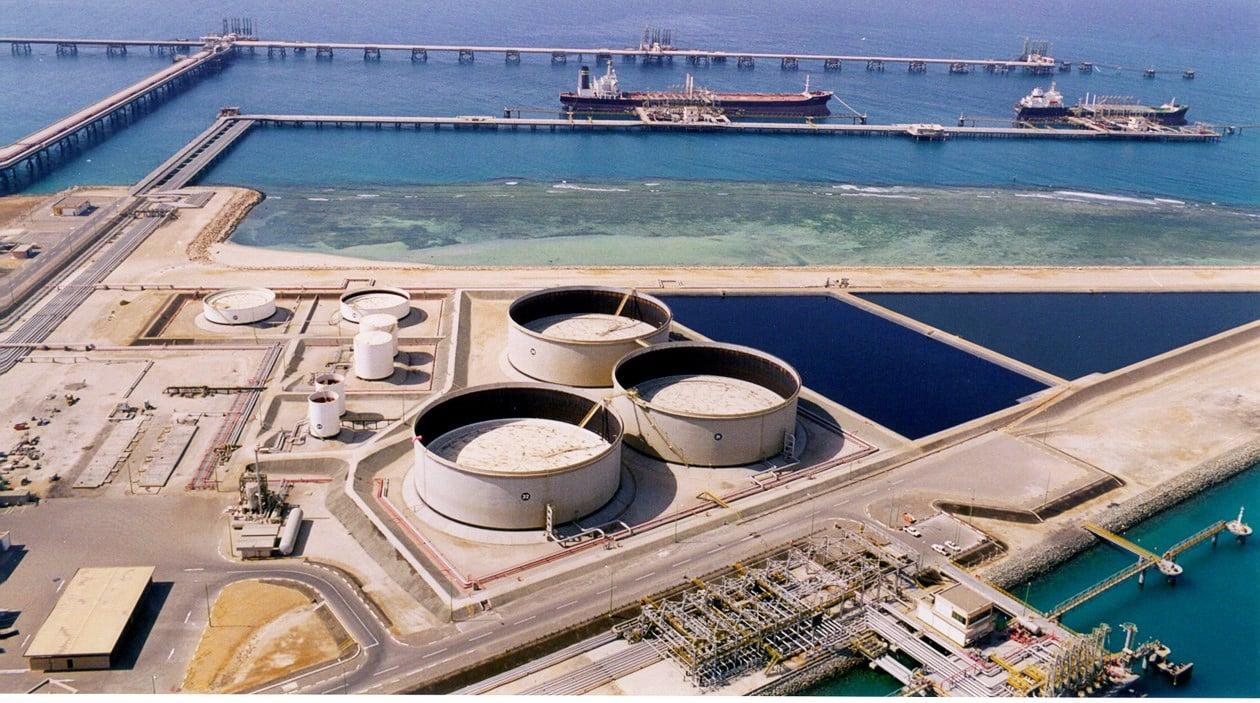
At Yanbu, on Saudi Arabia’s Red Sea coast, oil continues to be loaded even though the infrastructure carrying it from the east of the kingdom has stopped. That apparent continuity is precisely what makes the situation deceptive. Saudi Arabia still has crude accumulated near its terminals. It can therefore continue exporting without the interruption of the East-West pipeline immediately translating, barrel for barrel, into a loss of international supply. But that reserve of time can now be measured.
According to several oil buyers and traders interviewed by Reuters on September 13, available stocks at Yanbu could sustain exports for roughly five to seven days if no flows resume through the pipeline. Additional volumes are accessible at Egypt’s Ain Sokhna and Sidi Kerir terminals, connected to the regional crude transport system, but they would extend that autonomy by only a few more days.
Saudi Arabia’s problem is therefore no longer simply one of damaged infrastructure. It is becoming a race between the depletion of available stocks and the restoration of sufficient transport capacity.
When Redundancy Becomes the Main Route
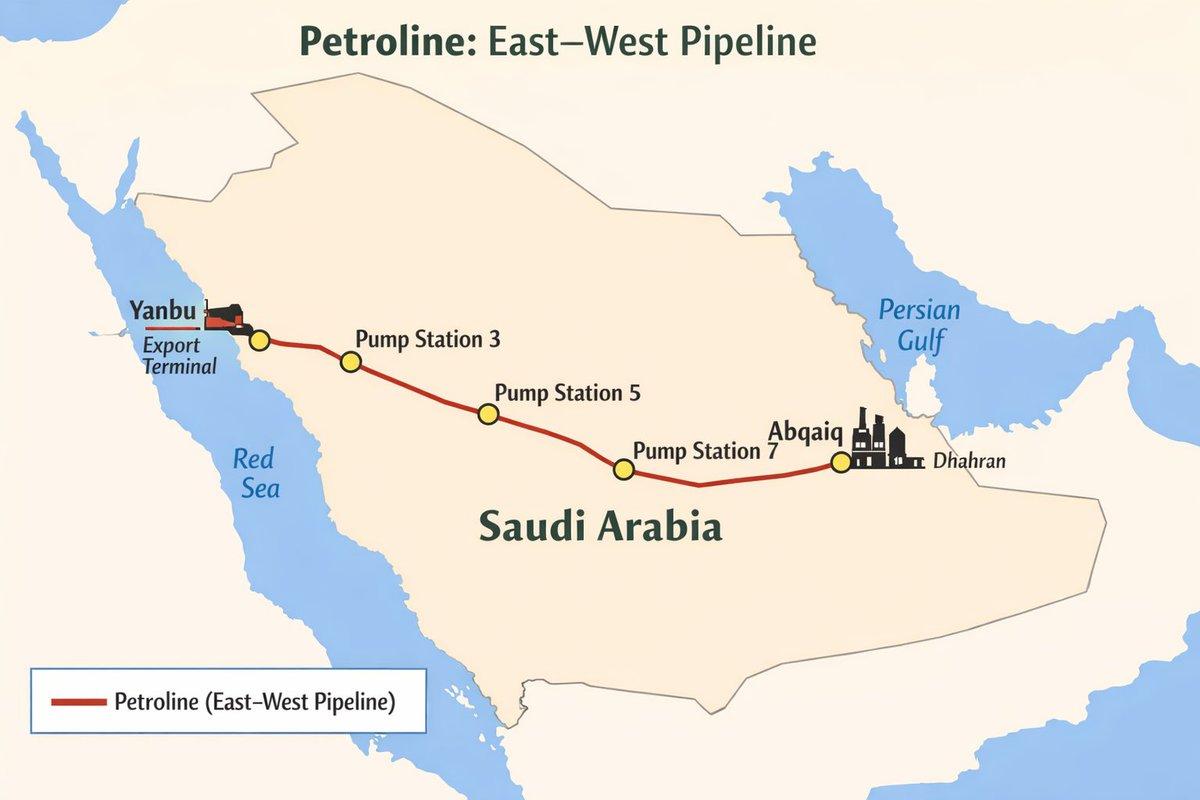 The East-West pipeline, also known as Petroline, crosses Saudi Arabia for more than a thousand kilometres between the producing regions in the east and Yanbu. Its strategic purpose has long been clear: to allow the kingdom to bypass the Strait of Hormuz by sending part of its production directly to the Red Sea.
What was historically a redundancy has become considerably more important since the severe disruption of oil traffic through the Gulf.
Before the shutdown, around four million barrels per day were moving through this route. In a global market consuming slightly more than one hundred million barrels a day, that represents close to 4% of world supply. Those four million barrels did not disappear when the pumps stopped: stocks accumulated in the west of the kingdom temporarily took over.
That distinction is precisely what matters. An infrastructure link can be interrupted without global supply immediately falling by the same amount. But once downstream inventories begin to run out, the mechanics change.
Logistics becomes lost supply.
Five Days, or Six Weeks
Two clocks are now running simultaneously.
The first measures inventories.
The second measures repairs.
One industry source cited by Reuters estimates that fully repairing the pipeline could take five to six weeks. Another believes that partial operations could resume sooner while work continues. Riyadh has confirmed neither those estimates nor the exact extent of the damage. Satellite imagery taken after the attack nevertheless shows damage to a facility located along the pipeline route.
The gap between those two time horizons is considerable.
If meaningful capacity is restored within the next few days, Yanbu’s inventories will have performed exactly the function for which they exist: absorbing a temporary interruption and preventing a physical incident from immediately becoming a global commercial shock.
If, however, the disruption lasts for several weeks, inventories cease to be a solution.
They become merely a delay.
And the delay is short.
A Market Already Missing Barrels
This vulnerability would be far less alarming in a normally supplied oil market.
That is not the market of September 2026.
Saudi production had already fallen sharply before the attack. Data submitted by Riyadh to OPEC show output at 6.2 million barrels per day in August, down from 10.9 million in February. The contraction of flows through Hormuz has profoundly reduced the Gulf’s ability to supply the international market normally.
The International Energy Agency has meanwhile revised its 2026 outlook downward. It now expects global oil supply to contract by 5.7 million barrels per day this year, with the anticipated restoration of part of the Gulf’s production pushed into 2027.
A prolonged Petroline shutdown would therefore not strike a market with several million barrels of immediately mobilisable spare capacity. It would affect a system already drawing on inventories, rerouting trade and attempting for months to compensate for reduced Middle Eastern supplies.
It is this accumulation of constraints that gives the event its significance.
When the Bypass Itself Needs a Bypass
The petroleum geography of the Gulf rested on a relatively simple idea: straits create vulnerabilities; land infrastructure provides alternatives.
Saudi Arabia developed its corridor to Yanbu precisely to avoid complete dependence on Hormuz. The United Arab Emirates follows a comparable logic with its access to Fujairah. Such infrastructure never removed maritime chokepoints from the global energy equation, but it prevented a disruption at sea from automatically producing an equivalent interruption in exports.
The present crisis exposes the limits of that architecture.
A bypass is redundant only for as long as it remains available when the main route is not.
Pressure is no longer concentrated on a single geographical point. Hormuz remains severely disrupted. Red Sea routes are themselves exposed to growing insecurity. And the land infrastructure allowing Saudi Arabia to connect its eastern oil fields to its western coast has now been hit as well.
The system still has alternatives, but they are becoming fewer precisely when they are needed most.
Iraq and the Question of Attribution
The investigation into the attack is advancing alongside the energy crisis.
Iraqi authorities have announced that they located and seized on their territory a platform used to launch the devices that struck the Saudi infrastructure. The discovery strengthens the assessment that the attack originated from Iraq, as Riyadh and Baghdad had previously indicated.
It does not, however, answer the essential question of attribution.
No group has officially claimed responsibility for the operation, and technical examination of the platform is continuing. Its presence on Iraqi territory is therefore insufficient to identify its operator, much less to establish a chain of external political responsibility.
That distinction matters particularly because the military interpretation of the attack could determine the Saudi response almost as much as its petroleum consequences.
Riyadh must now manage two timelines: repairing the infrastructure quickly enough to preserve exports and identifying the attacker precisely enough to decide whether and how to respond.
The two will not necessarily move at the same speed.
Four Million Conditional Barrels
It would be premature to say that the global market has just lost another four million barrels per day.
It has not.
That figure represents the approximate volume flowing through the pipeline before the interruption. Some crude is still reaching the market from available inventories. The amount of pipeline capacity that could be restored rapidly remains unknown. Actual inventory levels at Yanbu and the Egyptian terminals are not public.
The 4% figure therefore represents an identifiable maximum exposure, not a loss that has already materialised.
But that distinction does not make the problem less serious. It explains its dynamics.
For the first time since the pipeline stopped, the market has an approximate measure of how long inventories can conceal the consequences. That period is measured in days, while some estimates for repairs are measured in weeks.
That is where the risk now lies.
From Oil to Interest Rates
A further contraction in Saudi exports would quickly extend beyond the crude market.
Fuel prices are already reflecting tighter supplies and difficulties affecting refineries. A sustained increase in energy prices feeds into transport costs, industry, agriculture and, with varying delays, consumer prices.
For central banks, the situation becomes uncomfortable. A global economy weakened by an energy shock would normally call for more accommodative monetary policy. Inflation generated by the same shock pushes in the opposite direction.
Energy-importing countries face a similar contradiction. They must absorb a higher external bill precisely when slower economic activity reduces their fiscal room for manoeuvre.
Saudi Arabia itself would lose something harder to quantify than exported barrels: its ability to act as a shock absorber for the market.
For decades, Saudi oil power has rested not only on what the kingdom produced, but on what it could produce, move and export quickly when other suppliers could not. A bypass infrastructure immobilised in an already dislocated market diminishes that adjustment capacity.
Time Has Become the Strategic Variable
The attack on the East-West pipeline has therefore not yet removed four million barrels per day from the global market.
It has created the physical possibility that a significant share of those volumes soon could be.
Everything now depends on the distance between two events: the moment when available stocks at Yanbu are no longer sufficient to sustain loadings and the moment when enough of Petroline can resume carrying crude toward the Red Sea.
A few days may separate them.
Or several weeks.
In the first scenario, Saudi Arabia will have suffered a serious attack against strategic infrastructure, but the redundancy provided by its inventories will have contained the international consequences.
In the second, something more fundamental will have happened. After making Hormuz increasingly difficult to use, the crisis will have reached the infrastructure built precisely to bypass it.
The oil market would then discover that finding another route is no longer enough.
It still has to work.
Main Sources
Reuters, “Saudi pipeline outage threatens loss of 4% of global oil supply,” September 13, 2026.
Reuters, coverage of disruptions in the Strait of Hormuz, Saudi exports through Yanbu and the regional energy situation, September 2026.
International Energy Agency (IEA), Oil Market Report, September 2026.
Organization of the Petroleum Exporting Countries (OPEC), Saudi Arabia’s reported production data, August–September 2026.
Iraqi authorities / Security Media Cell, communications concerning the seizure of the launch platform and the investigation into the attack, September 2026.
Saudi Ministry of Energy, communications concerning the temporary shutdown of the East-West pipeline, September 2026.
Atlas Limits Research Desk
Atlas Limits’ editorial and analytical desk.