On a political map of the world, the Pacific still looks like an immense blue void. A scattering of archipelagos, tiny capitals and territories spread across millions of square kilometres of ocean. The major centres of power appear to sit along its edges: the United States to the east, China and Japan to the west, Australia to the south. Between them, almost nothing.
It is precisely this almost nothing that is changing.
The Pacific is gradually becoming a strategic space in its own right. Not because new borders have been drawn across it, but because military technologies, digital communications, undersea resources and great-power competition are giving distance itself a new value. An island can host a runway. A port can become a logistical node. A submarine cable can connect entire economies. An exclusive economic zone can contain coveted resources. An agreement with a small state can alter access across millions of square kilometres of ocean.
The geography has not changed. Its value has.
The return of distance
For much of the post-Cold War period, the Pacific Islands remained relatively peripheral to the way global power relations were understood. International priorities in the region were associated primarily with development, fisheries, natural disasters, climate change and foreign aid.
None of those issues has disappeared. For Pacific societies, they remain fundamental. But another reading of the region has been superimposed upon the first.
Washington now explicitly regards the Indo-Pacific as the principal theatre in which it seeks to prevent the emergence of a power capable of dominating the United States and its allies. The US defence strategy published in 2026 calls, among other things, for strengthened defences along the First Island Chain and greater contributions from regional allies and partners.
Yet the strategic logic extends far beyond that first line running from Japan towards the Philippines. Behind it lies an immense oceanic depth connecting Guam, Hawaii, Australia, New Zealand and the Pacific Island states.
In a major crisis in East Asia, that depth could matter almost as much as the front lines themselves. Moving aircraft, supplying ships, protecting communications, monitoring maritime spaces and maintaining logistical chains all require a succession of access points.
The Pacific is therefore no longer simply the space separating powers.
It is becoming the space that connects them.
Islands that are no longer peripheral
This transformation inevitably changes the strategic value of the island states.
Palau, the Federated States of Micronesia, the Marshall Islands, Solomon Islands, Fiji, Kiribati, Tonga, Samoa, Vanuatu and Papua New Guinea individually have relatively small populations and economies. Their geography produces the opposite effect: their territories and maritime spaces are scattered across the routes connecting Asia, the Americas and Australia.
What once appeared primarily as a disadvantage — remoteness — is becoming a strategic asset.
Australia provides one of the clearest illustrations. Canberra and Port Moresby began implementing the Pukpuk Treaty in 2025, moving their defence relationship towards a formal alliance and providing for greater integration between their military establishments.
But the transformation extends far beyond a single treaty.
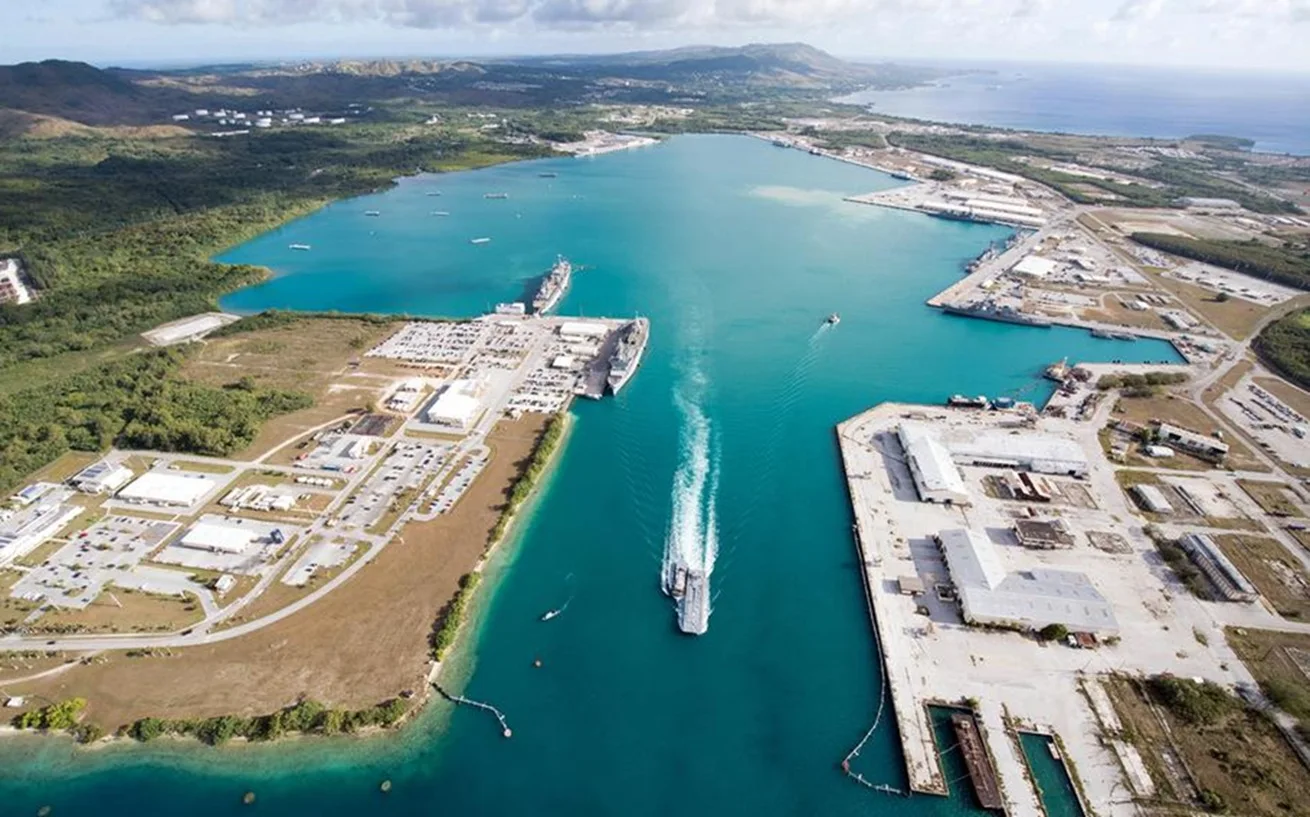
Civilian infrastructure itself is acquiring strategic significance. Ports determine resupply capacity. Airfields determine operational reach. Telecommunications determine the circulation of information. Satellite systems make it possible to monitor spaces that no fleet could continuously patrol.
Even the construction of a road, a wharf or a telecommunications facility can now be viewed through a question that might have seemed excessive only a few decades ago: who could use it in a crisis?
Washington and Beijing look at the same ocean
This new geography cannot be separated from US–China competition.
For the United States, the Pacific represents historical strategic depth. Hawaii, Guam and Washington's special relationships with several Micronesian states form an architecture connecting US territory with forward positions in East Asia.
For China, the logic is almost reversed. A global economic power heavily dependent on maritime routes cannot indefinitely conceive of its security from its coastline alone. China's expanding naval capabilities, port investments, economic diplomacy and partnerships with Pacific states are progressively extending Beijing's strategic horizon.
The result is not a clean division of the ocean into two opposing camps.
It is a multiplication of competing relationships.
The Pacific Islands Forum noted in its 2026 security assessment that competition involving China, the United States and their partners is contributing to a proliferation of security and defence arrangements. It also identified emerging arenas of competition, including critical minerals, seabed resources, emerging technologies and space.
The competition is therefore no longer exclusively naval.
It is becoming infrastructural, technological, economic and normative.
Beneath the ocean, another geography
An essential part of this transformation is almost invisible.
Beneath the Pacific run the cables that carry digital communications between continents. Its seabed also contains mineral resources that could become increasingly important as economies seek to secure supplies of critical raw materials.
Above it travel the satellites essential to telecommunications, navigation, intelligence and military operations.
The strategic depth of the Pacific now exists simultaneously beneath the water, on its surface and in space.
This is what distinguishes the current competition from earlier struggles for naval supremacy. Controlling an ocean no longer necessarily means physically occupying every territory. It means knowing what is happening across it, maintaining communications, securing reliable access and being able to move capabilities rapidly between extremely distant points.
Data becomes almost as important as the ship.
The cable almost as strategic as the port.
And the island becomes the fixed point within a system that is, around it, fundamentally mobile.
But the Pacific refuses to become a chessboard
There is, however, a risk inherent in this interpretation: reducing island states to their usefulness for larger powers.
The region is actively trying to avoid precisely that outcome.
For Pacific governments, security is not limited to missiles, bases and fleets. The Pacific Islands Forum continues to place climate change among the foremost threats to regional security, well-being and prosperity. Rising seas, natural disasters, food security, access to water, transnational crime and economic vulnerability belong to a much broader understanding of what security means.
That difference in perception is fundamental.
An external power may look at an island and see a strategic position. Those who live there first see a territory whose habitability must be preserved.
The Pacific is therefore seeking to construct its own architecture rather than simply choosing between architectures designed elsewhere. The concept of the “Blue Pacific Continent,” the 2050 Strategy for the Blue Pacific Continent and the Ocean of Peace initiative all reflect that ambition. In 2026, proposals even emerged to transform the latter into a regional peace and security treaty that could strengthen Pacific states' ability to establish the rules governing strategic competition within their own region.
In September 2026, Pacific leaders also considered a regional peace and security plan for 2026–2030 and the Waqa Moana concept, intended to deepen cooperation among Pacific states.
This search for autonomy does not imply systematic equidistance between Washington and Beijing. Interests, histories and alliances vary considerably from one country to another.
It means something else: a refusal to allow Pacific geography to be defined exclusively from Beijing, Washington or Canberra.
The ocean as an infrastructure of power
This may be where the deepest transformation lies.
For centuries, oceans were primarily represented as distances to be crossed. In the contemporary Pacific, they are becoming systems to be organised.
Ports, runways, cables, satellites, sensors, exclusive economic zones, seabed resources and security agreements are gradually forming a single architecture. None of these elements produces power on its own. Their connection, however, can transform an immense maritime space into an operational environment.
The competition emerging across the Pacific is therefore unlikely to reproduce exactly that of the twentieth century. Large naval bases will remain important, but they will coexist with more dispersed infrastructure, sometimes dual-use and often discreet. The most consequential positions will not necessarily be the largest. They will be those that make it possible to see, communicate, resupply and continue moving when established routes become vulnerable.
On maps, the Pacific will remain blue.
But the emptiness was a cartographic illusion.
As competition between powers expands into infrastructure, data, resources and space, every distance acquires value, every point of access becomes an option, and some of the world's smallest islands regain an importance entirely disproportionate to their size.
The Pacific is no longer merely the space between the centres of the world.
It is becoming one of them.
Main sources
- U.S. Department of Defense — 2026 National Defense Strategy — U.S. strategic posture in the Indo-Pacific, the First Island Chain, deterrence and the role of regional allies and partners.
- 2026 National Defense Strategy
- Pacific Islands Forum — Pacific Security Outlook Report 2026 — Regional security environment, geopolitical competition, climate security and the convergence of traditional and non-traditional threats across the Blue Pacific.
- Pacific Security Outlook Report 2026
- Pacific Islands Forum — 2050 Strategy for the Blue Pacific Continent — Pacific regionalism, sovereignty, ocean governance and the region’s long-term approach to security and development.
- 2050 Strategy for the Blue Pacific Continent
- Australian Department of Defence — Australia and Papua New Guinea advance Pukpuk Treaty — Implementation of the Australia–Papua New Guinea alliance. The treaty entered into force on 8 July 2026 and is PNG’s first alliance with another country.
- Australia and Papua New Guinea advance Pukpuk Treaty
- Australian Department of Defence — PNG–Australia Mutual Defence Treaty Implementation — Defence integration, aviation cooperation, training and capability development under the Pukpuk Treaty.
- PNG–Australia Mutual Defence Treaty Implementation
- Australian Department of Defence — Australia–New Zealand Foreign and Defence Ministerial Consultations 2+2 — Pacific-led security architecture, the Pacific Response Group and the expansion of regional defence partnerships.
- Australia–New Zealand Foreign and Defence Ministerial Consultations
Atlas Limits Research Desk
Atlas Limits’ editorial and analytical desk.