In Panama, the distance between two oceans is measured in kilometers. But the ability to connect them is increasingly measured in meters of water.
For more than a century, the Panama Canal has been presented as a triumph of engineering over geography. A system of locks allows ships to cross the isthmus instead of sailing around South America. The principle appears almost immutable. Yet it depends on a much more fragile condition: having enough freshwater to operate the system.
In 2026, that condition has once again become a constraint.
The rainy season arrived in Panama, but it did not immediately produce the expected volumes of water across the Canal watershed. After an unusually wet dry season, the first months of the rainy season brought precipitation below forecasts, against a backdrop influenced by El Niño. The Panama Canal Authority was forced to reduce transit capacity and prepare draft restrictions for vessels using the newer locks.
From September 3, nine daily booking slots were scheduled for the Neopanamax locks. For the Panamax locks, available slots were to be gradually reduced to twenty-three from September 15. Rainfall in August and September subsequently improved conditions: by September 25, the Canal administration said it could maintain approximately 32 daily transits and did not expect additional restrictions before December.
The immediate pressure has therefore eased slightly.
The constraint has not disappeared.
An infrastructure that consumes its own strategic resource
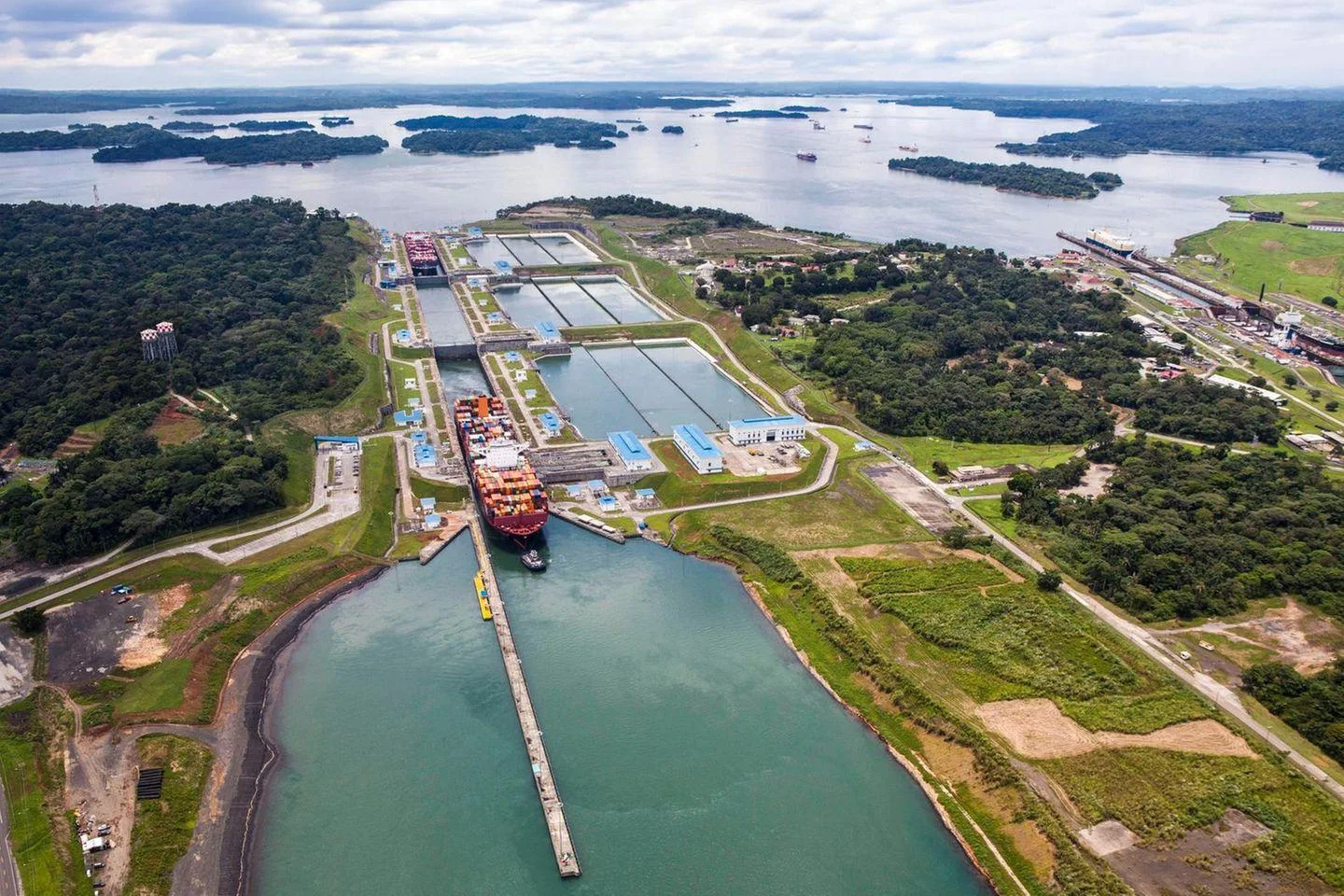
The Panama Canal has a fundamental characteristic that distinguishes it from the Suez Canal. It is not simply a maritime trench connecting two seas. Ships must be raised to the level of Gatún Lake before descending toward the other ocean.
That mechanism requires freshwater.
With every lock cycle, part of that water is released toward the sea. The newer locks use water-saving basins that allow part of it to be reused, and the Canal Authority has spent years developing techniques to reduce consumption. But no optimization eliminates the system's fundamental dependence on its reservoirs.
Those reservoirs do not serve ships alone.
The water system associated with the Canal also contributes to supplying more than half of Panama's population with drinking water. The same resource must therefore satisfy two imperatives that can become competing priorities: operating one of the world's most important commercial infrastructures and providing water to the country's inhabitants.
This is where the nature of the problem changes.
For decades, managing the Canal was primarily about organizing the passage of ships. It is increasingly becoming a policy of allocating a scarce resource.
The warning of 2023
The alarm had already sounded.
In 2023, rainfall across the Canal watershed was nearly 30 percent below normal. It was the third-driest year in the watershed's recorded history. Available reserves became insufficient to maintain normal operating conditions while adequately preparing for the following dry season.
The Canal Authority responded by reducing daily transits and restricting the draft of some vessels.
For shipping companies, a few centimeters less are not an abstract hydrological measurement. They can mean fewer containers on board, a more expensive booking slot, additional waiting time or, in some cases, choosing another route.
Panama's water problem can therefore propagate almost mechanically through the global economy.
A rainfall deficit in a Central American watershed can become, a few weeks later, a capacity problem for a ship loaded in Asia, an American gas exporter or a European supply chain.
In 2026, that interdependence has become even more visible.
Disruptions affecting other maritime routes have increased pressure on Panama. In September, a shipping company paid more than $5 million simply to secure a transit slot at auction — on top of the Canal's normal toll. The episode was spectacular, but what it revealed was more important: transit capacity becomes extraordinarily valuable when several chokepoints in global trade are under pressure simultaneously.
Straits and canals can no longer be understood as independent infrastructures.
They form a system.
A disruption at one diverts flows toward the others. An additional constraint elsewhere then amplifies costs throughout the network.
Río Indio
Panama now understands the equation. It needs more stored water.
The answer has a name: Río Indio.
The project involves creating a new artificial lake in the Río Indio basin, west of the Canal. In February 2025, the Panama Canal Authority's board formally designated it a priority for national water security.
Its purpose extends far beyond navigation.
The new reservoir is intended to increase storage capacity in order to secure both the population's water supply and Canal operations. The administration estimates that the infrastructure could help meet the water requirements of the country and the interoceanic route for the next fifty years.
But additional water carries a territorial cost.
The project requires land acquisition, compensation and the relocation of communities living in affected areas. The Canal Authority has established resettlement and compensation mechanisms, while the first procedures are expected to begin as part of the 2027 fiscal cycle.
The question is therefore no longer merely technical.
It becomes political: how much territory must a country transform to secure the water required by its own development and by an infrastructure serving the global economy?
Five years to bridge
Even if Río Indio achieves its objectives, there is an immediate difficulty: the reservoir does not yet exist.
The Canal's new administrator, Ilya Espino de Marotta, has said the infrastructure could provide a durable response to much of the Canal's water challenge. But completing it will still require roughly five years.
Between now and then lies a much more uncertain period.
The budget prepared for fiscal year 2027 explicitly incorporates the possibility of difficult hydrological conditions and a potentially powerful El Niño. At the same time, the Canal plans to continue investing in watershed conservation, water management and Río Indio.
This transition creates an unusual situation for one of the world's most important pieces of trade infrastructure.
The solution exists on paper.
The constraint already exists in the reservoirs.
Geography returns
The Panama Canal was built to eliminate a geographical limit.
Before it opened in 1914, a vessel traveling between the Atlantic and Pacific had to sail around South America. The isthmus imposed its geography on global commerce. Engineering shortened that journey by thousands of kilometers and transformed Panama into one of the central nodes of the international maritime system.
More than a century later, another limit is emerging.
It is no longer horizontal, but vertical.
A few meters in Gatún Lake can determine how many ships are allowed to cross. A few months of insufficient rainfall can reduce the capacity of a route used by global supply chains. An infrastructure capable of moving hundreds of millions of tons of cargo remains dependent on a variable as elementary as rain.
The implications extend beyond Panama.
The great infrastructures of globalization were long conceived as instruments for overcoming physical constraints. Canals, ports, dams, pipelines, power grids and data centers continuously expanded the capacity available to the global economy.
Climate change, rising consumption and the concentration of flows are beginning to reverse that logic. The question is no longer always how much additional capacity can be built.
Sometimes, it is becoming a question of how much of a finite resource can still be allocated.
Panama is beginning to enter that world.
For more than a century, its Canal has shortened the distance between oceans. Its next challenge is no longer to defeat distance.
It is to have enough water to keep shortening it.
Main Sources
- Panama Canal Authority — “Panama Canal Adopts Additional Measures to Address Reduced Precipitation in the Canal Watershed” — August 20, 2026
- Primary source for the 2026 operational restrictions: below-expected rainfall, El Niño conditions, reduction to nine daily Neopanamax slots, adjustment of Panamax capacity, and draft restrictions.
- Panama Canal Authority — Reduced precipitation measures
- Panama Canal Authority — Río Indio Lake Project
- Primary source for the long-term water-security response. The Authority describes Río Indio as the most viable solution for securing water for more than 50% of Panama’s population while supporting productive activities, including Canal operations, over the next 50 years.
- Panama Canal Authority — Río Indio Lake Project
- Panama Canal Authority — FY2027 Budget
- Useful for the article’s central argument that scarcity is becoming embedded in Canal planning. The FY2027 budget explicitly assumes potentially challenging water conditions, including the possibility of a strong El Niño event, while funding water-resource management and strategic investments.
- Panama Canal Authority — FY2027 Budget
- Panama Canal Authority — Annual Report 2023
- Important historical baseline for the earlier water crisis. The report records 1,998 mm of rainfall in FY2023, 25% below the historical average, making FY2023 the driest fiscal year in the Canal watershed’s 1951–2023 record. This is worth using instead of the “third-driest year” formulation in the current draft.
- Panama Canal Authority — Annual Report 2023
- Panama Canal Authority — “Beyond Scarcity: How the Canal Manages the Fresh Water Challenge”
- Useful background on the underlying mechanism: declining Gatún levels, the competition between Canal operations and human consumption, operational water savings, and the effects of El Niño on the watershed.
- Panama Canal Authority — Fresh Water Challenge
- Panama Canal Authority — Advisory to Shipping, 2026
- The technical reference archive for the actual shipping measures, including A-29-2026 on reduced precipitation and subsequent advisories modifying booking slots and draft limits.
Atlas Limits Research Desk
Atlas Limits’ editorial and analytical desk.