Constitutional crisis, institutional confrontation, and the vulnerabilities of a strategic European power
An extraordinary situation can arise when a state possesses all the institutions required for its functioning yet can no longer agree on the authority of those who lead them. The constitution remains in force, parliament continues to legislate, the government administers public affairs, and the courts formally retain their powers. Yet beneath this apparent continuity, a fundamental question emerges: what remains of constitutional order when public authorities no longer mutually recognize the legitimacy of their decisions?
Poland is now confronting precisely this question.
The events that unfolded in Warsaw on October 30–31, 2026, transformed a longstanding legal dispute into an open institutional confrontation. The contested suspension of the Constitutional Tribunal's president, the deployment of police officers outside the court, the head of state's abrupt return from a diplomatic trip, and the mobilization of demonstrators exposed a crisis that has been developing within Poland's political system for more than a decade.
President Karol Nawrocki denounces what he describes as a forced takeover of a constitutional institution. Prime Minister Donald Tusk, by contrast, maintains that his government is defending the restoration of the rule of law following the judicial transformations introduced under previous conservative administrations.
Both sides therefore invoke the constitution to justify incompatible positions.
This contradiction extends far beyond the rivalry between two political leaders. It concerns the legal continuity of the state, judicial independence, and the ability of a democracy to correct its own institutional dysfunctions without reproducing the mechanisms it seeks to overcome.
It also emerges at a particularly consequential moment. Poland has become a central actor in European security, a major supporter of Ukraine, and one of the European Union's most committed members in expanding military capabilities.
The country's strategic power is growing even as its institutional equilibrium becomes increasingly contested.
I. Warsaw, October 30: The Crisis Becomes Visible
The confrontation began with a decision whose administrative scope initially appeared limited.
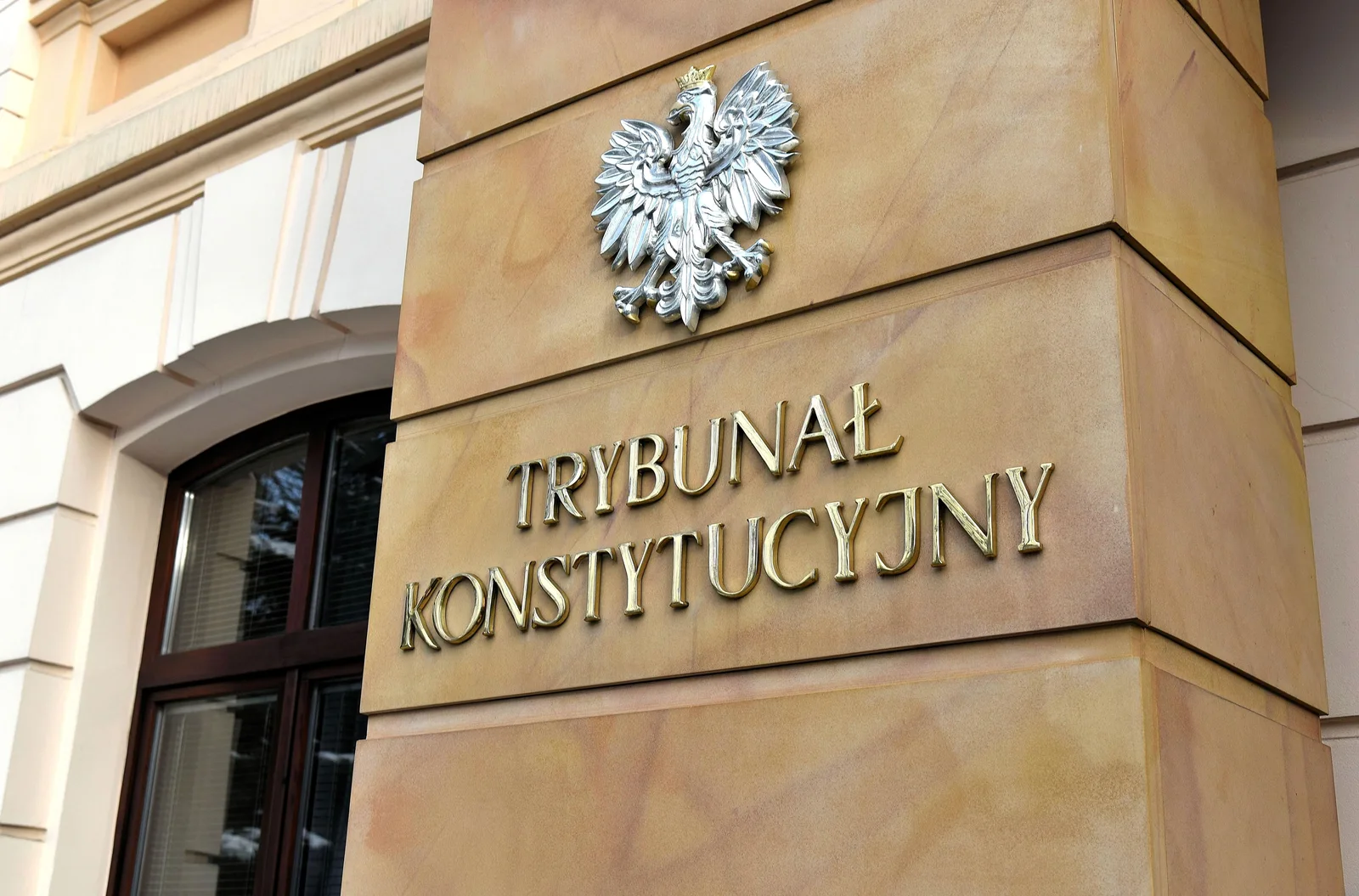
On October 30, 2026, Judge Anna Korwin-Piotrowska announced the one-month suspension of Bogdan Święczkowski, president of the Constitutional Tribunal, and his deputy, Bartłomiej Sochański. She asserted that she would temporarily assume responsibility for directing the institution.
Both officials immediately challenged the legality of the measure.
Święczkowski, appointed under the influence of the former conservative majority, refused to recognize the judge's authority. His supporters argued that she lacked the legal competence required to suspend the Tribunal's leadership.
The dispute therefore concerned more than the validity of a disciplinary decision. It raised the question of which authority was legally entitled to govern the constitutional court.
The confrontation quickly moved beyond the institution's walls.
Supporters of the Law and Justice party, commonly known by its Polish acronym PiS, gathered outside the Tribunal. Police officers were deployed to secure the premises, and tensions emerged around access to the building.
President Karol Nawrocki, then traveling to Senegal, ordered his aircraft to turn back. He returned to Warsaw and initiated institutional consultations.
In an official statement issued on October 31, he argued that constitutional order had been violated and demanded the restoration of what he considered the legally established situation.
Donald Tusk defended the opposite interpretation. According to his government, the crisis stemmed primarily from the persistence of a deeply contested judicial system whose structures had, in its view, been used to obstruct reforms initiated after 2023.
The situation became particularly revealing when the competing leaderships began issuing their own administrative instructions.
On October 31, Bogdan Święczkowski announced that November 3–6 would be non-working days for Tribunal employees, while preserving their remuneration. Anna Korwin-Piotrowska, meanwhile, issued her own provisions concerning working arrangements and access to the court's services.
Two authorities were thus claiming the power to organize the same institution.
At that point, the issue was no longer simply which decision was legally justified. It was also which decision would actually be implemented.
II. The Constitutional Tribunal: An Arbiter That Has Become the Object of Conflict
Understanding the gravity of this confrontation requires examining the Constitutional Tribunal's particular role within Poland's political architecture.
The institution consists of fifteen judges and performs an essential function: reviewing the compatibility of legal norms with the constitution.
It can examine legislation, assess the constitutionality of specific provisions, and intervene in disputes over institutional competences.
In a constitutional democracy, this function limits the exercise of majority power. A government may command parliamentary support without acquiring the authority to adopt any measure it wishes.
The constitution remains superior to the political preferences of the moment.
But this architecture depends on constitutional judgments being recognized as legitimate, including by those who politically oppose them.
When that recognition disappears, the system encounters a distinctive difficulty: the institution responsible for arbitrating disputes becomes the subject of the dispute itself.
This is precisely the situation into which Poland has gradually moved.
For several years, appointments to the Tribunal, the legality of its composition, and the authority of its judgments have been challenged at both national and European levels.
The conflict has therefore shifted the constitutional debate onto more fundamental ground: who has the authority to determine whether an institution is legitimate when the bodies responsible for answering that question are themselves contested?
The difficulty becomes circular.
Restoring the Tribunal's authority requires legally defensible decisions. Yet conclusively determining their legality would ordinarily require reliance on a constitutional authority whose legitimacy is not itself in dispute.
This contradiction helps explain why an administrative suspension could trigger a national institutional crisis.
III. 2015: The Origins of an Institutional Fracture
The current confrontation cannot be understood without returning to Law and Justice's accession to power in 2015.
The conservative party then initiated a profound transformation of Poland's judicial organization.
Its leaders presented these reforms as a necessary modernization of institutions they considered insufficiently accountable to elected representatives. They also emphasized the need to break with certain institutional continuities inherited from the country's political history.
Their opponents, by contrast, argued that the new rules increased the influence of the executive and parliamentary majority over judges.
The controversies concerned appointments to the Constitutional Tribunal, the National Council of the Judiciary, disciplinary procedures, and the organization of the Supreme Court.
The European Commission, the Court of Justice of the European Union, and the European Court of Human Rights gradually became involved in these disputes, each within its respective jurisdiction.
Several European judgments challenged elements of Poland's judicial framework under requirements relating to judicial independence and effective legal protection.
The Polish authorities of the time disputed some of these assessments, invoking national constitutional competences.
The confrontation consequently extended beyond judicial appointments.
It became a dispute over the relationship between constitutional sovereignty, European law, and the supervision of political power.
The Constitutional Tribunal occupied a central position in this development. Its composition and certain judgments became subjects of persistent controversy.
From that point onward, every political transition risked encountering an unprecedented problem: how can a new government operate within a legal order when it considers some of the institutions inherited from its predecessors to be irregularly constituted?
IV. 2023: Political Alternation Without Institutional Reconciliation
The parliamentary elections of October 2023 opened a new political period.
Although PiS retained substantial parliamentary representation, a coalition led by Donald Tusk secured the majority required to form a government.
Political alternation had taken place.
Institutional alternation, however, remained incomplete.
The governing coalition announced its intention to restore judicial independence and bring Poland's legal system into conformity with European requirements.
Yet it quickly encountered several obstacles.
First, the mandates of judges and institutional officials do not automatically expire when the parliamentary majority responsible for their appointments loses power.
Second, legislative reforms must comply with constitutional procedures that cannot simply be bypassed because existing arrangements are politically contested.
Third, the president of the republic possesses independent constitutional prerogatives, particularly concerning the promulgation of legislation and institutional appointments.
Karol Nawrocki's victory in the 2025 presidential election reinforced this configuration.
Supported by PiS, the new head of state represented a political orientation distinct from that of the Tusk government.
Poland consequently found itself with a politically divided executive: the government enjoyed parliamentary majority support, while the presidency could exercise its constitutional powers to oppose certain initiatives.
Such an arrangement is not inherently exceptional in a democratic system.
It becomes particularly difficult, however, when the two centers of power no longer agree on the legality of the institutions responsible for reviewing their decisions.
During 2026, this disagreement gradually developed into a direct confrontation.
V. Eight Appointments, Five Refusals, and Contested Legitimacy
The composition of the Constitutional Tribunal represents one of the decisive elements of the current crisis.
In 2026, the Polish parliament elected eight judges to serve on the court.
President Nawrocki agreed to administer the oath to three of them but refused to do so for the remaining five.
Those five subsequently took their oaths without his participation, under a procedure defended as valid by supporters of their appointments.
The Tribunal's president, Bogdan Święczkowski, nevertheless refused to allow them to exercise judicial functions.
The situation produced a fundamental distinction between parliamentary election, institutional recognition, and the effective exercise of office.
A judge may be regarded as properly elected by one part of the institutional system while being denied access to the court by those controlling its administration.
The controversy cannot be reduced to a simple confrontation between judges supportive of or opposed to the government.
It raises specific legal questions. What are the constitutional requirements for a judge to assume office? What role does the president play in administering the oath? What legal consequences follow from a presidential refusal? Can a court's leadership prevent an elected judge from exercising judicial functions?
An assessment of these questions must also distinguish the validity of appointments from the legality of measures adopted to overcome institutional obstruction.
Even where institutional dysfunction is established, the means used to remedy it remain subject to law.
This distinction lies at the heart of the October 2026 confrontation.
VI. The Contested Suspension: Legal Necessity or Dangerous Precedent?
Anna Korwin-Piotrowska justified her intervention by invoking the need to restore the Tribunal's regular functioning.
She argued that persistent obstruction prevented the institution from properly fulfilling its constitutional responsibilities.
Her opponents challenged both her authority to adopt such a measure and the legal basis on which it rested.
The controversy concerns, among other matters, the application of rules governing the temporary suspension of judges and their compatibility with the particular status of constitutional judges.
Three questions must be distinguished.
The first concerns the existence of previous irregularities in the Tribunal's composition or functioning.
The second concerns the competence of the judge who ordered the suspension.
The third concerns the proportionality and legality of the measures adopted to enforce that decision.
These questions do not necessarily have the same answer.
It is legally possible to conclude that an institution suffers from serious dysfunction while questioning the validity of the procedure intended to correct it.
Conversely, controversies surrounding current measures do not erase earlier concerns about judicial independence.
Justice Minister Waldemar Żurek, who also serves as prosecutor general, has initiated steps that could lead to proceedings concerning the suspended officials, including matters relating to their judicial immunity.
This introduces another layer of complexity.
The confrontation no longer concerns only competing interpretations of the Tribunal's internal organization. It also involves prosecutorial authority, safeguards attached to judicial office, and the limits of executive intervention.
The institutional danger lies less in the existence of legal disagreement than in the absence of an arbitration mechanism accepted by all parties.
When a decision is recognized only by those who benefit from it, law risks losing its ability to organize political competition peacefully.
VII. President and Government: Two Mandates, Two Strategies
The crisis directly confronts Karol Nawrocki and Donald Tusk.
The former derives his mandate from the presidential election. The latter leads a government supported by a parliamentary majority.
Their mandates are distinct, and their constitutional competences do not overlap completely.
The Polish presidency cannot be regarded as merely ceremonial. It possesses a legislative veto and participates in several important institutional procedures.
The government, meanwhile, retains responsibility for directing national policy within its constitutional remit.
The constitution therefore establishes a distribution of power that requires cooperation, negotiation, and respect for established procedures.
In the current crisis, both leaders claim to be defending this equilibrium against the other's actions.
For Nawrocki, the suspension of the Tribunal's leadership constitutes an illegitimate intervention in a constitutional institution.
For Tusk, the refusal to recognize certain judges elected by parliament contributes to the persistence of an obstruction incompatible with restoring the rule of law.
These positions reflect opposing interpretations of institutional continuity.
The first emphasizes protecting existing officeholders against measures considered unlawful.
The second emphasizes correcting institutional mechanisms whose legitimacy has been disputed for years.
The difficulty is that both interpretations can turn any concession into an apparent acknowledgment of the opposing side's illegality claims.
Negotiation consequently becomes politically costly.
As political actors increasingly frame the confrontation as a question of constitutional survival, the space available for compromise narrows.
VIII. Police Outside the Tribunal: When Legal Conflict Acquires a Coercive Dimension
Images of police officers deployed outside the Constitutional Tribunal gave the crisis international visibility.
They do not, however, establish the legality or illegality of the contested measures.
Police authorities indicated that their intervention responded to security concerns involving judges, employees, and public order.
This explanation must be distinguished from political accusations of a forced institutional takeover.
The presence of police outside a constitutional institution does not automatically amount to its occupation or to legal validation of decisions taken inside it.
Nevertheless, it reveals an important development.
As long as institutional disagreements remain confined to procedures, judgments, and appeals, the confrontation remains primarily legal.
When they begin to concern physical access to buildings, personal protection, document circulation, and the implementation of administrative instructions, they also acquire a material dimension.
Control over an institution then depends on several factors: recognition of appointments, the ability to organize hearings, access to premises, authority over administrative services, and the capacity to implement decisions.
The coexistence of competing leadership claims demonstrates that these dimensions can become separated.
An official may retain a legal claim to office without possessing all the practical means required to exercise it.
Another may exercise administrative authority in practice while facing challenges to the legality of that authority.
This separation between claimed legality and effective power represents one of the most concerning aspects of the crisis.
It does not mean that the Polish state has ceased functioning.
It does indicate, however, that one of its fundamental institutions is experiencing a breakdown in its recognized chain of authority.
IX. The European Union Confronts Its Own Standards
Since Poland joined the European Union in 2004, relations between Warsaw and European institutions have undergone several transformations.
The country has gradually established itself as one of the major economies of the single market and an increasingly influential participant in European political affairs.
Yet disputes concerning judicial independence have repeatedly complicated its relationship with Brussels.
The European Union rests on an essential principle: member states retain their national institutions but must guarantee the effective application of European law and the judicial protections associated with it.
This requirement does not mean that the Union possesses general authority to organize national judicial systems.
It means that certain guarantees, particularly the independence of courts responsible for applying EU law, also fall within European legal obligations.
The Polish crisis presents this architecture with a new difficulty.
European institutions criticized several judicial reforms introduced under PiS governments.
They must now assess institutional changes intended to correct those reforms without assuming that every measure presented as restoring the rule of law automatically satisfies the requirements of legality.
The issue is one of consistency.
Judicial independence cannot be evaluated exclusively according to the political orientation of those claiming to defend it.
It rests on more durable criteria: lawful appointments, legal certainty, procedural guarantees, separation of powers, and access to effective judicial review.
For Brussels, the challenge is to uphold these principles without becoming a partisan arbiter of Poland's domestic political confrontation.
For Warsaw, it is to demonstrate that restoring legality can be achieved through procedures that are themselves legally justified.
X. An Institutional Crisis in a Rising Economic Power
Poland in 2026 bears little resemblance to the country that began its postcommunist transition.
Since the 1990s, it has undergone a remarkable economic transformation driven by European integration, investment, industrial development, and the expansion of its domestic market.
With approximately 36–37 million inhabitants, Poland represents one of Central Europe's largest consumer markets.
Its economy rests on a diversified productive base: automotive manufacturing, industrial equipment, household appliances, logistics, business services, information technology, and manufacturing activities integrated into European value chains.
Its proximity to Germany plays a decisive role in this organization.
Polish companies participate in numerous cross-border production networks, while the country benefits from its geographical position between Western Europe, the Baltic states, and Ukraine.
The Polish economy has also demonstrated considerable resilience in the face of several European economic shocks.
This structural progress does not make institutions less important.
On the contrary, as a country attracts more capital and assumes greater economic responsibilities, the predictability of its legal system becomes increasingly central to its attractiveness.
Investors seek more than competitive production costs, a skilled workforce, or access to the European market.
They must also be able to anticipate how rules will be applied, whether administrative decisions will remain stable, and whether reliable judicial remedies will be available.
The current crisis does not justify concluding that Poland's economic fundamentals have immediately deteriorated.
There is no automatic relationship between constitutional confrontation and financial crisis.
However, persistent uncertainty surrounding institutional functioning can gradually affect perceptions of legal risk, particularly for long-term investment.
This distinction is essential.
A country's economic power may continue to expand despite political tensions. But its ability to convert economic growth into lasting influence also depends on the quality and predictability of its institutions.
XI. Ukraine, Russia, and Warsaw's Strategic Weight
The international significance of Poland's crisis derives from the country's increasingly important position within European security.
Since Russia's full-scale invasion of Ukraine in February 2022, Poland has become one of the principal transit territories for Western assistance destined for Kyiv.
Its geographical location gives it major logistical importance.
It shares a border with Ukraine, lies close to Belarus, and borders the Russian exclave of Kaliningrad to the north.
This configuration places Warsaw at the center of NATO's security concerns along its eastern flank.
Polish authorities have undertaken a substantial expansion of defense expenditure, accompanied by major procurement and modernization programs.
The strategy reflects a conviction widely shared within Poland's security establishment: credible deterrence requires effective military capabilities, industrial mobilization, and close cooperation with allies.
Poland is consequently seeking to strengthen its role in European conventional defense while preserving a privileged strategic relationship with the United States.
This position gives it growing influence in discussions concerning the future of continental security.
The constitutional crisis does not automatically undermine these commitments.
Military institutions, defense administrations, and allied cooperation mechanisms do not depend directly on the dispute over the Constitutional Tribunal's leadership.
Nevertheless, a prolonged confrontation between the country's principal political authorities could complicate national coordination, delay certain decisions, and divert political attention.
It could also weaken the coherence of Poland's political representation among its partners.
For NATO and the European Union, the issue therefore extends beyond Poland's democratic stability.
It also concerns the ability of a major strategic actor to maintain decision-making continuity in an exceptionally demanding security environment.
It would nevertheless be excessive to conclude that the current crisis already compromises the defense of NATO's eastern flank.
Such a conclusion would require concrete evidence concerning military institutions and the implementation of international commitments.
XII. 2027: Elections on the Political Horizon
Poland's next parliamentary elections are expected in 2027, unless the political calendar changes.
This approaching deadline adds another dimension to the crisis.
For the governing coalition, restoring the rule of law has been a central political commitment since taking office in 2023.
A lack of sufficiently visible progress could intensify criticism from its own supporters.
For PiS and its allies, the events of October 2026 provide a political argument centered on constitutional protection and criticism of the government's methods.
The judicial confrontation thus becomes an electoral issue.
But electoral mobilization must be distinguished from the institutional resolution of the dispute.
A new parliamentary majority could alter the political balance of power. It would not necessarily resolve disagreements concerning the legality of appointments, the validity of decisions, or the constitutional limits of public authority.
Poland could therefore experience another political transition without permanently resolving the institutional controversies inherited from previous governments.
This is one of the defining difficulties of prolonged constitutional crises.
Elections renew the legitimacy of political leaders, but they do not replace the procedures required for institutions to regain common recognition.
XIII. Three Possible Institutional Trajectories
Several developments remain possible in the short term.
The first would involve negotiated de-escalation.
This would require the principal actors to distinguish their political disagreements from the procedures necessary to preserve the Tribunal's minimum functioning. Mutual guarantees could allow the court to continue operating while a more comprehensive legal settlement is pursued.
A second trajectory would involve prolonged institutional confrontation.
Competing authorities would continue asserting their legitimacy, while administrative, disciplinary, and judicial proceedings multiplied. The Tribunal might then function only partially, with the authority of its decisions remaining contested.
The third possibility would be further escalation.
Additional measures targeting judges, disputed administrative interventions, or larger political mobilizations could deepen the rupture between the presidency, the government, and judicial officials.
None of these trajectories can be treated as predetermined.
The consultations announced by President Nawrocki, reactions from judicial authorities, and proceedings expected in early November will be important in assessing the immediate evolution of the situation.
A meeting of Constitutional Tribunal judges has reportedly been discussed for November 3. Its composition, capacity to deliberate, and the recognition of any decisions it produces could become further sources of confrontation.
The existence of competing claims to the institution's leadership makes any projection particularly uncertain.
XIV. The Fundamental Question: How Can a Contested Legal Order Be Restored?
Beyond the events in Warsaw, Poland's crisis raises a problem relevant to many democracies.
Institutions are not merely administrative organizations. They depend on formal rules, but also on a sufficiently shared recognition of those rules.
A constitution can define the competences of each branch of government. It cannot, by itself, prevent every conflict of interpretation.
Courts exist precisely to resolve such disagreements.
But when courts themselves become the subject of persistent contestation, the system loses part of its ability to produce decisions accepted as authoritative.
The temptation then emerges to resolve the dispute through democratic mandate alone.
A government may believe that its parliamentary majority gives it the legitimacy required to correct institutions inherited from its predecessors.
A president may believe that his electoral mandate gives him a duty to oppose those corrections when he considers them unconstitutional.
Both positions may rest on genuine democratic legitimacy.
Neither, however, removes the obligation to respect the legal limits of its own authority.
This is precisely what distinguishes a constitutional state from a system in which every political majority redefines the rules according to its immediate interests.
Democracy does not rest solely on the possibility of acquiring power through elections.
It also requires those who win to accept that they cannot exercise every power they might politically desire, and those who lose to recognize the authority of properly constituted institutions to make decisions they dislike.
When this reciprocity disappears, every political transition risks becoming an exercise in institutional reconstruction.
Law then gradually ceases to provide a common framework and becomes one of the principal instruments of political confrontation.
Poland today illustrates the difficulties created by such a dynamic.
XV. A European Power Confronting Its Own Institutional Architecture
Poland's recent history presents a remarkable contrast.
Economically, the country has substantially increased its weight within the European Union.
Strategically, it has established itself as a central actor in continental security.
Diplomatically, its influence has expanded as defense, borders, and relations with Russia have returned to the forefront of Europe's political agenda.
Yet this rise in power has not been accompanied by a durable consensus over the organization of some of its most fundamental institutions.
The current confrontation demonstrates that a state can possess a dynamic economy, an expanding military, and a strengthened international position while experiencing a profound crisis of constitutional legitimacy.
It also reveals an important limitation of democratic alternation.
Replacing a government does not necessarily resolve the institutional conflicts created under its authority. Conversely, correcting earlier irregularities does not guarantee that the methods employed will themselves be legally unassailable.
Rebuilding institutional trust requires more than a change of parliamentary majority.
It requires recognized procedures, safeguards applicable to all political actors, and the willingness to accept that legality does not change with election results.
The events of October 30–31, 2026, do not yet establish how the confrontation will be resolved.
They nevertheless reveal a significant reality: within one of Eastern Europe's most important states, political and judicial authorities no longer agree on the legitimate leadership of an institution responsible for protecting the constitution.
Poland is therefore facing more than a dispute between its president and prime minister.
It must resolve a more fundamental contradiction: restoring the authority of law when the institutions entrusted with enforcing it no longer enjoy common recognition.
And therein may lie the true significance of this crisis.
The power of a state cannot be measured solely by its capacity to produce, finance, or defend itself. It also depends on its ability to secure acceptance of the same rules among those who govern, those who oppose them, and those who will eventually succeed them.
In Warsaw, that ability is now being tested.
Principal Sources
- Reuters, October 31, 2026 — Confrontation between Poland's presidency, government, and Constitutional Tribunal leadership.
- Presidency of the Republic of Poland, official statement by Karol Nawrocki, October 31, 2026.
- Agence France-Presse, October 31, 2026 — Polish president's return and emergency political consultations.
- Le Monde, October 31, 2026 — Institutional escalation and historical origins of the dispute.
- Deutsche Welle, October 31, 2026 — Demonstrations, police deployment, and government reactions.
- Rzeczpospolita, October 30–31, 2026 — Competing administrative decisions within the Constitutional Tribunal.
- Polish Press Agency (PAP), October 31, 2026 — Contested suspensions and administrative instructions.
- Notes from Poland, October 31, 2026 — Chronology and institutional confrontation.
- Constitution of the Republic of Poland, April 2, 1997 — Constitutional powers and organization of the Constitutional Tribunal.
- European Commission, annual Rule of Law Reports — Developments concerning judicial independence in Poland.
- Court of Justice of the European Union and European Court of Human Rights — Case law concerning judicial independence and procedural safeguards in Poland.
Editorial note: Events on October 30–31 are presented on the basis of information available as of November 1, 2026. Descriptions such as “forced takeover,” “constitutional violation,” and “restoration of legality” reflect the positions of the relevant actors rather than definitive judicial findings. The economic and geopolitical sections provide structural analysis distinct from the immediate events.
Atlas Limits Research Desk
Atlas Limits’ editorial and analytical desk.