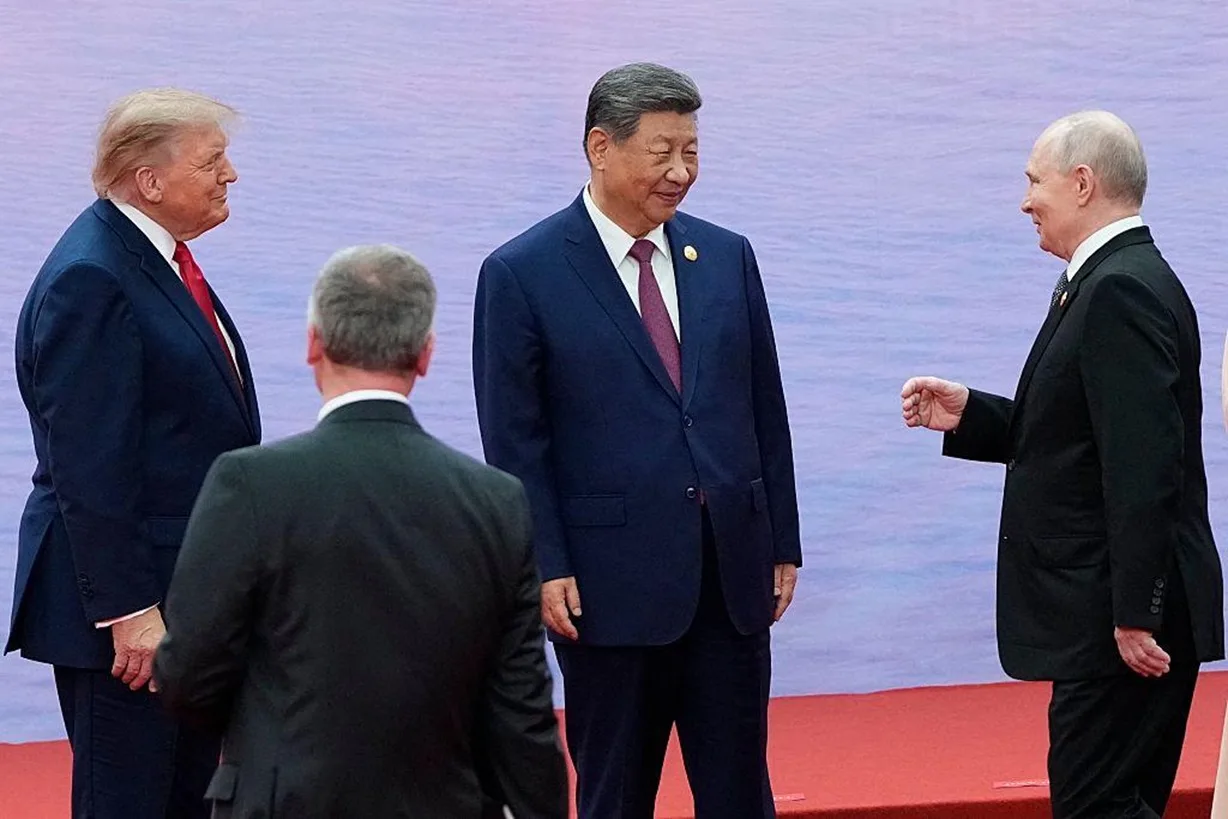
On November 19, 2026, in Shenzhen, Donald Trump, Xi Jinping and Vladimir Putin gave diplomatic substance to a configuration that had already shaped much of international tension without previously possessing a common negotiating framework. Meeting on the sidelines of the Asia-Pacific Economic Cooperation (APEC) summit, the American, Chinese and Russian presidents held an unprecedented trilateral encounter, concluding with a joint declaration addressing four areas: reform of the United Nations, stability of energy supplies, principles governing international criminal justice and the reduction of nuclear risks.
The document, published by the White House and the Chinese authorities, is remarkable both for the subjects it brings together and for the commitments it does not contain. It establishes no weapons ceilings, sets no negotiating timetable, provides no verification mechanism and offers no solution to the conflicts dividing the three powers. The war in Ukraine, the confrontation involving Iran and the Taiwan question are absent from the declaration, although several regional crises were reportedly discussed during the exchanges.
This contrast between the historic significance of the encounter and the modesty of its operational results provides the first key to understanding it. Shenzhen has not produced a new international order. The summit has nevertheless established a political recognition: despite their rivalries, the three states consider themselves to bear particular responsibility for managing certain global risks and acknowledge that direct dialogue can serve their respective interests.
This development comes in a strategic environment fundamentally different from that of the Cold War. The United States remains the leading global military power, China constitutes a major industrial, commercial and technological center, while Russia retains nuclear and military capabilities that give it international influence exceeding its economic weight. The three powers possess neither the same resources, nor the same ambitions, nor the same vulnerabilities. Their strategic interdependence has nonetheless become sufficiently significant for each country's decisions to directly affect the security of the others.
The Shenzhen summit therefore reveals less the emergence of an understanding than the search for a method of managing competition. Its importance will depend on whether the three capitals can transform a political declaration into lasting mechanisms without subordinating state sovereignty and international institutions to their own arrangements.
A Historic Encounter, Limited Commitments
The summit's first significance is diplomatic. For the first time, the leaders of the three powers have met in a format specifically devoted to their shared responsibilities for international stability. This encounter does not mean that they constitute a homogeneous group. Rather, it reflects the emergence of a configuration in which bilateral relations are no longer sufficient to address certain risks.
For several decades, nuclear arms control was structured primarily around relations between Washington and Moscow. China's rise has altered that architecture. The United States must now consider the capabilities of two nuclear competitors, while Russia and China must incorporate the consequences of their closer relationship into American strategic calculations.
The summit acknowledged this reality without resolving the difficulties it creates.
The joint declaration contains four commitments of different kinds. United Nations reform represents a broad institutional ambition. The proposed increase in the production and supply of refined petroleum products concerns an immediately sensitive economic dimension. The position on the immunities of state officials touches upon the very conception of international responsibility. Finally, the commitment to continue nuclear dialogue addresses a major strategic risk but remains devoid of binding provisions.
The document specifies neither implementation mechanisms, nor responsibilities assigned to each country, nor conditions for assessing results. This lack of precision prevents the declaration from being regarded as a substantive agreement on global governance.
It does not, however, render the document insignificant. In diplomacy, recognition of a shared problem can precede negotiations over solutions. But it can also constitute a largely symbolic endpoint when participants' interests remain too divergent.
The entire uncertainty surrounding Shenzhen lies in this distinction.
Nuclear Security: Strategic Priority Without a Disarmament Agreement
The nuclear question represents the area in which the three powers share the clearest interest in preventing uncontrolled confrontation.
The expiration of the New START treaty in February 2026 marked the disappearance of the last major legally binding bilateral instrument limiting the deployed strategic nuclear arsenals of the United States and Russia. Under its specific counting rules, the treaty notably capped each side at 1,550 deployed strategic nuclear warheads.
Its expiration comes as nuclear balances become increasingly complex. Washington and Moscow retain the world's two largest arsenals, while Beijing continues expanding and modernizing its capabilities from a quantitatively lower base. The challenge is therefore no longer simply to limit two comparable arsenals. It is to determine how a third power, whose capabilities are growing but whose strategic circumstances remain different, might be incorporated into a future framework.
The United States has an interest in preventing a future bilateral agreement with Russia from leaving the expansion of China's arsenal entirely unconstrained. Beijing, by contrast, may regard a system imposing identical restrictions on powers possessing vastly unequal arsenals as detrimental to its interests. Moscow could seek to incorporate additional dimensions of strategic security, including missile defenses and advanced conventional capabilities.
These differences explain the caution reflected in the Shenzhen declaration. The three leaders reaffirmed the principle that a nuclear war cannot be won and must never be fought. They also announced dialogue on reducing nuclear risks and preventing proliferation.
They did not, however, adopt an arms-reduction treaty, establish common ceilings or announce a negotiating timetable. No permanent trilateral verification mechanism was established.
The distinction is fundamental. Nuclear risk reduction may involve crisis communications, doctrinal transparency, the prevention of misinterpretation or procedures designed to limit military incidents. Arms reduction, by contrast, requires quantified commitments, technical definitions, monitoring procedures and guarantees of reciprocity.
Progress toward the first objective does not necessarily imply achievement of the second.
The evolution of military technologies further complicates this distinction. Hypersonic weapons, space capabilities, missile-defense systems and the integration of artificial intelligence into certain military functions can alter decision-making timelines and perceptions of vulnerability. Strategic stability increasingly depends on preventing conventional crises, technical errors or mistaken interpretations from triggering irreversible escalation.
Shenzhen has acknowledged the need for dialogue. The real test will now be whether that recognition produces technical mechanisms capable of functioning independently of political fluctuations among the leaders.
Energy: The Summit's Unexpected Economic Dimension
The inclusion of energy in the joint declaration deserves particular attention. Although the meeting was primarily anticipated as a discussion of nuclear security, the three governments expressed their intention to increase the production and supply of refined petroleum products and emphasized the importance of stable energy flows.
This formulation is significant because of its relative specificity. It concerns not merely crude oil production but refined products, whose availability depends on processing capacity, storage infrastructure, logistics networks and commercial routes.
Global energy security cannot be reduced to the volume of oil extracted. Disruptions affecting refineries, port facilities, transportation networks or strategic straits can generate supply tensions even when resources remain available. Fuels used in road transport, aviation and certain industrial activities are particularly sensitive to regional imbalances.
The three powers occupy different positions within this system. The United States possesses a major oil and gas industry alongside substantial refining capacity. Russia remains a leading energy producer and exporter despite sanctions and the redirection of trade flows. China is a central player in industrial processing and energy consumption, with decisions that influence regional markets and international flows.
Their declared willingness to contribute to supply stability may reflect shared concerns about the economic consequences of conflicts and commercial disruptions.
But this convergence is insufficient to establish that their energy policies are effectively coordinated.
The document specifies neither the additional volumes envisaged, nor the countries responsible for producing them, nor the infrastructure involved, nor the arrangements for bringing them to market. It also leaves unexplained how these commitments might be reconciled with existing sanctions, industrial constraints and the sometimes divergent interests of producers and consumers.
The announcement should therefore be interpreted as a political orientation rather than an operational program.
Its potential significance nevertheless remains considerable. If the three governments were able to facilitate certain energy flows or reduce disruption risks, the effects could spread to fuel prices, transportation costs, logistics chains and inflation expectations. Conversely, without concrete measures, the commitment could have little lasting impact on markets.
Energy thus emerges as an area in which limited cooperation could generate measurable economic benefits, but where the declaration does not yet identify tangible results.
International Justice: Political Convergence and Legal Division
The declaration's third point is arguably among its most politically sensitive passages.
The American, Chinese and Russian leaders affirmed the importance of state consent and respect for the immunities of public officials. They also stated that the International Criminal Court and similar institutions should not abuse their jurisdiction.
This position reveals diplomatic convergence around the need to restrict what the three governments may regard as excessive extensions of international jurisdiction. It must nevertheless be examined carefully, because it brings together distinct legal principles.
State sovereignty, consent to treaties, the personal and functional immunities of public officials, and the jurisdiction of international criminal courts are not interchangeable concepts. Their relationship depends on the applicable instruments, the status of the states concerned and the nature of the proceedings.
The International Criminal Court, established by the Rome Statute, exercises jurisdiction defined by that treaty and by certain provisions allowing, among other mechanisms, Security Council referrals. Its authority therefore does not depend exclusively on the direct consent of the state whose official is being prosecuted.
The Shenzhen declaration does not amend the Rome Statute. It does not invalidate any judicial proceedings and does not constitute a judicial determination concerning immunities.
Its significance is primarily political.
For Vladimir Putin, who has been subject to an ICC arrest warrant since 2023 in connection with the war in Ukraine, the joint affirmation concerning immunities and jurisdictional limits carries an evident interest. The United States, which is not a party to the Rome Statute, also maintains a complex relationship with the Court. China is likewise not a party and has traditionally defended a demanding conception of sovereignty and state consent.
These positions are not identical in their foundations or implications. Their inclusion in a single declaration nevertheless sends an important political signal: the three powers challenge, to varying degrees, the idea that international criminal justice may exercise unrestricted authority over state officials.
This convergence raises a broader question concerning the future of international accountability.
International criminal law seeks to establish that certain grave violations cannot be shielded from accountability solely through appeals to sovereignty. States, meanwhile, may contest the jurisdiction of courts they do not recognize or the manner in which such jurisdiction is exercised.
The tension between these principles cannot be resolved through a general diplomatic formula.
The significance of Shenzhen will therefore depend less on the declaration itself than on its possible consequences for judicial cooperation, the enforcement of warrants, the positions adopted by states parties to the Rome Statute and negotiations concerning international institutions.
In this area, the meeting reflects more than a desire for stabilization. It also reveals a conception of the international legal order in which great powers seek to preserve an especially extensive margin of sovereignty.
Reforming the United Nations Without Defining the Reform
The shared commitment to United Nations reform constitutes the first point of the declaration, but also one of its least precise.
The three governments express their intention to make the organization more effective in responding to international challenges and fulfilling its mission of maintaining peace and security.
This ambition is difficult to dispute in principle. The Security Council has long experienced paralysis arising from disagreements among its permanent members, particularly when crises directly involve one of them or their principal partners.
Yet United Nations reform encompasses several distinct, sometimes incompatible projects.
It may involve expanding the Security Council, changing its working methods, restricting the use of the veto, strengthening conflict-prevention capabilities or transforming certain administrative structures.
None of these approaches is explicitly endorsed in the Shenzhen declaration.
The absence of detail is particularly important because all three participants possess veto power in the Security Council. They therefore occupy a distinctive institutional position: they acknowledge the need to improve an organization in which they themselves hold some of the principal instruments of obstruction.
This contradiction is not necessarily insurmountable. Permanent members could contribute to procedural reforms or improved consultation mechanisms for managing crises. But substantive reform of representation and the distribution of power within the Council would require much broader negotiations.
Demands for greater African representation, the ambitions of India, Brazil, Japan and Germany, and the positions of different regional groups cannot be treated as secondary questions.
A reform negotiated primarily among three permanent members would risk reproducing the institutional imbalance it purported to correct.
Shenzhen has therefore produced political recognition of the need for reform, but no identifiable compromise concerning its substance.
The real question is whether the declaration opens a more inclusive multilateral process or remains a general affirmation intended to emphasize the particular responsibilities of the three powers.
China: The Principal Beneficiary of the Diplomatic Stage
The choice of Shenzhen and Xi Jinping's role give the encounter an additional dimension.
China hosted the summit in one of its principal industrial and technological centers while chairing APEC proceedings. The city embodies part of the transformation that has made the Chinese economy a central actor in global value chains.
Hosting the meeting provides Beijing with a diplomatic advantage that does not directly depend on the conclusion of substantive agreements.
By bringing the American and Russian presidents together on Chinese territory, Xi Jinping was able to present China as a venue for dialogue among rival powers. This position reinforces the image of a country capable of contributing to the management of major international balances rather than merely challenging existing rules.
The Chinese Ministry of Foreign Affairs also presented the encounter as a major initiative intended to preserve world peace and stability in relations among great powers.
This presentation corresponds to a longstanding ambition of Chinese diplomacy: securing recognition of its strategic status while defending a vision of international governance that places considerable emphasis on sovereignty and consultation among states.
But China's position also involves constraints.
Beijing maintains a close partnership with Moscow without necessarily wishing to assume all the diplomatic and economic costs associated with Russian decisions. At the same time, it remains engaged in technological and commercial competition with Washington while preserving substantial economic interdependence with the United States and its partners.
Trilateral diplomacy allows China to capitalize on this intermediate position without resolving its contradictions.
It also offers an opportunity to demonstrate that Beijing does not simply belong to a bloc opposed to the United States. By hosting Washington and Moscow in a common format, China asserts its capacity to engage both powers and organize part of their interaction.
This symbolic benefit is real. It should not, however, be confused with a demonstrated capacity to arbitrate their conflicts.
Washington: Between Strategic Competition and Risk Reduction
For Donald Trump, the meeting follows a different logic.
The United States faces two strategic competitors whose capabilities and objectives do not overlap entirely. China represents a long-term industrial, technological, commercial and military challenge. Russia remains a major nuclear power engaged in confrontation with Europe's security architecture.
Closer relations between Beijing and Moscow complicate the simultaneous management of these rivalries.
Washington may have an interest in maintaining direct channels with each competitor while preventing their interests from systematically converging against American positions.
The Shenzhen encounter could therefore form part of a strategy for managing power relationships in a differentiated manner.
It does not necessarily represent an attempt to reproduce the Sino-American rapprochement of the 1970s. At that time, Washington exploited tensions between Beijing and Moscow within a bipolar environment. Today's circumstances are fundamentally different: China now possesses major economic and industrial power, while the Sino-Russian relationship rests on relatively established strategic interests.
The summit may instead reflect an American desire to preserve negotiating flexibility with both powers without abandoning competition.
The joint declaration partially serves this objective. It allows Washington to demonstrate a capacity for dialogue on nuclear security, energy and international institutions without accepting publicly identifiable concessions on the principal security disputes.
This flexibility is both a strength and a limitation.
It facilitates an encounter among leaders whose interests diverge. But it also restricts the significance of their commitments in the absence of mechanisms capable of transforming declarations into results.
Moscow: Diplomatic Recognition Without Economic Rebalancing
For Vladimir Putin, participation in the summit carries particular political value.
Since the full-scale invasion of Ukraine in 2022, Russia has experienced a profound deterioration in relations with Western powers. Sanctions, technological restrictions and reduced trade with Europe have reinforced its orientation toward non-Western partners, particularly China.
Putin's presence alongside the American and Chinese presidents helps reaffirm Russia's status as an indispensable strategic power.
This recognition rests on genuine capabilities. Russia retains one of the world's two largest nuclear arsenals, a permanent seat on the Security Council and substantial military, energy and space capabilities.
It does not, however, eliminate economic asymmetries.
Russia lacks an industrial, commercial and financial base comparable to that of the United States or China. Its influence within a trilateral format therefore rests more heavily on military and nuclear capabilities than on its overall economic weight.
This distinction is essential to understanding the summit's significance.
Moscow can benefit from political recognition without necessarily obtaining an immediate improvement in its economic position or relief from the constraints resulting from the war in Ukraine.
The declaration concerning the immunities of state officials represents an additional diplomatic benefit, given the proceedings initiated before the International Criminal Court.
But no agreement concerning sanctions, Ukraine or European security has been announced.
The meeting therefore confirms Russia's continued ability to participate in major strategic negotiations. It does not demonstrate that the underlying conditions of its confrontation with the West have substantially changed.
The Conflicts Absent From the Declaration
One of the summit's most revealing characteristics concerns its treatment of international crises.
Chinese authorities indicated that the leaders discussed several regional issues, including Ukraine, the Middle East and the Korean Peninsula. Yet none of these matters appears among the four commitments of the final declaration.
This absence does not mean the conflicts were ignored. Rather, it suggests that the participants did not publicly establish a sufficiently precise common compromise to incorporate into the text.
Ukraine provides the clearest example.
The United States and Russia remain directly involved, in different capacities, in the military and diplomatic balances surrounding the war. China maintains important relations with Moscow while seeking to preserve an image of a power committed to international stability.
These positions cannot be reconciled through a general declaration about peace.
The absence of any trilateral commitment concerning the war demonstrates the limits of the consensus reached in Shenzhen. The leaders were able to agree on the need for dialogue without defining a common solution to one of the principal contemporary conflicts.
Similar caution is required regarding Iran and tensions in the Middle East.
The declaration concerning refined petroleum products may indirectly respond to concerns about regional energy disruptions. It does not, however, constitute a ceasefire agreement, a maritime security arrangement or a political settlement.
Taiwan is likewise absent from the document.
This omission is particularly significant given the importance of the Taiwan Strait in Sino-American relations. It confirms that the summit, at least in its present form, is not intended to resolve every strategic disagreement among the participants.
Shenzhen thus reveals a boundary between areas where declaratory convergence is possible and those where disagreements remain too profound to produce common commitments.
Europe Confronts the Concentration of Strategic Dialogue
The Shenzhen meeting raises a major question for powers that did not participate.
The European Union remains a leading economic and regulatory actor. It represents a substantial market, possesses important industrial capabilities and influences international commercial, technological and environmental standards.
It does not, however, possess a unified strategic decision-making center comparable to those of the three states gathered in China.
France maintains an independent nuclear arsenal, the United Kingdom remains a European nuclear power outside the Union, and several countries across the continent possess significant military capabilities. But national disagreements and the dependence of parts of Europe on American security guarantees complicate the development of a fully autonomous strategic position.
The summit does not mean that Europe has been excluded from negotiations directly concerning its security. No agreement of that nature has been announced.
It nevertheless reveals a structural risk.
If the principal mechanisms of strategic consultation were progressively concentrated among Washington, Beijing and Moscow, Europeans could find themselves in a position where their security depended partly on discussions in which they did not directly participate.
This prospect would strengthen arguments for greater European capabilities in defense, intelligence, planning and decision-making.
The question extends beyond the military dimension. It also concerns Europe's ability to translate its economic weight into diplomatic influence in a system where industrial power, energy resources and nuclear capabilities remain decisive instruments.
Shenzhen does not automatically marginalize Europe. It does, however, demonstrate that economic strength alone does not guarantee a place in the most sensitive negotiating formats.
The Risk of a Great-Power Directorate
The summit raises a broader question about the legitimacy of international governance mechanisms.
The United States, China and Russia exercise considerable influence over global military, energy and institutional balances. Their capacity for dialogue can help reduce risks affecting the entire international community.
But their strategic weight does not confer general authority to determine the interests of other states.
India, European powers, Japan, Brazil, African states and other regional actors possess their own interests, capabilities and responsibilities.
Trilateral dialogue can be useful when it complements existing institutions and helps overcome certain forms of paralysis. It would become problematic if it sought to replace multilateral processes with arrangements concluded among a restricted number of powers.
The issue is particularly acute concerning United Nations reform.
All three participants are permanent members of the Security Council and possess veto power. They can contribute to institutional reform, but cannot claim to represent the full range of demands for transforming the organization.
Their common commitment does not identify any mechanism for expanding international representation or modifying the distribution of power within the Council.
The same tension appears in the declaration concerning international criminal justice. Defending immunities and state consent may reflect legitimate legal concerns, but it may also be interpreted as an effort to shield the leaders of major powers from certain forms of accountability.
The distinction will depend on the concrete legal positions adopted and their consequences for international proceedings.
The principal danger therefore does not lie in dialogue among great powers. It emerges when the pursuit of stability among them displaces the principles of sovereign equality, accountability and participation by other states.
An Architecture of Stabilization Still in Its Infancy
The Shenzhen summit must be assessed on the basis of what was actually achieved.
Diplomatically, the meeting represents an important innovation. It establishes a precedent for direct consultation among the leaders of the three powers and demonstrates their capacity to produce a common document despite major disagreements.
On nuclear security, it reaffirms an essential principle of preventing nuclear war and announces dialogue on risks and proliferation. It does not, however, restore any binding arms-control regime.
On energy, it expresses an intention to contribute to supply stability without specifying the industrial, commercial or political means required.
Institutionally, it recognizes the need to reform the United Nations but defines no common reform project.
Legally, it produces explicit political convergence concerning immunities and the limits of international criminal jurisdiction, without modifying applicable rules or resolving disputes over their interpretation.
Finally, regarding the principal regional crises, no settlement or common resolution mechanism has been announced.
These results require a balanced assessment.
The summit constitutes a diplomatic achievement insofar as it opens an unprecedented channel of dialogue and formalizes several shared concerns. Its material effects remain limited in the absence of operational agreements and verifiable commitments.
Shenzhen's historical importance will therefore depend on what follows.
If the three governments establish regular consultations, technical working groups on nuclear risks, crisis communication arrangements or measurable energy commitments, the meeting could retrospectively be regarded as the starting point of a new stabilization architecture.
If none of these developments materializes, it will remain primarily a diplomatic event distinguished by its format and symbolic significance.
Power Recognized, the International Order Still Contested
The Shenzhen summit does not end the rivalry among the United States, China and Russia. It resolves neither the war in Ukraine, nor tensions surrounding Taiwan, nor confrontations in the Middle East. It does not replace international institutions or establish a durable system for sharing responsibilities.
Its importance lies elsewhere.
For the first time, the leaders of the three powers have agreed to meet within a common format and publicly recognize certain areas in which their interests may converge despite their disagreements.
This recognition reflects a structural reality: the principal powers possess sufficient capabilities to profoundly disrupt international security, but none can independently guarantee the system's stability.
Competition therefore does not disappear. It becomes an object of negotiation in its own right.
This development could open the way to stabilization diplomacy based on limited compromises, crisis-prevention mechanisms and a better understanding of mutual constraints.
It could also encourage the concentration of strategic dialogue among a handful of capitals, potentially weakening multilateral institutions and reducing other states' participation in decisions affecting them.
The choice between these trajectories will not be determined by the Shenzhen declaration, but by the commitments that follow and the manner in which they are implemented.
The meeting of November 19, 2026 demonstrated that Washington, Beijing and Moscow could sit at the same table without abandoning their rivalries. It has not yet demonstrated that they can jointly construct a durable mechanism for international security.
It is within this gap between the recognition of power and the organization of stability that Shenzhen's true historical significance will be determined.
Principal Sources
[1] White House, U.S.-Russia-China Heads of State Declaration toward Peace, November 19, 2026. Official joint declaration.
[2] Ministry of Foreign Affairs of the People's Republic of China, President Xi Jinping Chairs China-Russia-U.S. Summit, November 19, 2026. Official Chinese account.
[3] Chinese Government / Xinhua, Full text: China-Russia-U.S. Heads of State Declaration toward Peace, November 19, 2026. Full declaration published by Beijing.
[4] Associated Press, Takeaways from the historic summit between Trump, Xi and Putin, November 19, 2026. Assessment of the summit's results and limitations.
[5] Yonhap News Agency, Trump, Xi, Putin hold unprecedented 3-way summit with nuclear arms reduction in focus, November 19, 2026. Summit proceedings and leaders' positions.
[6] Interfax, Russian, Chinese, U.S. presidents adopt joint declaration, November 19, 2026. Reproduction of the joint document.
[7] Congressional Research Service, Trump-Xi Summits, 2025–2026, September 2026. Background on bilateral US-China relations.
Atlas Limits Research Desk
Atlas Limits’ editorial and analytical desk.