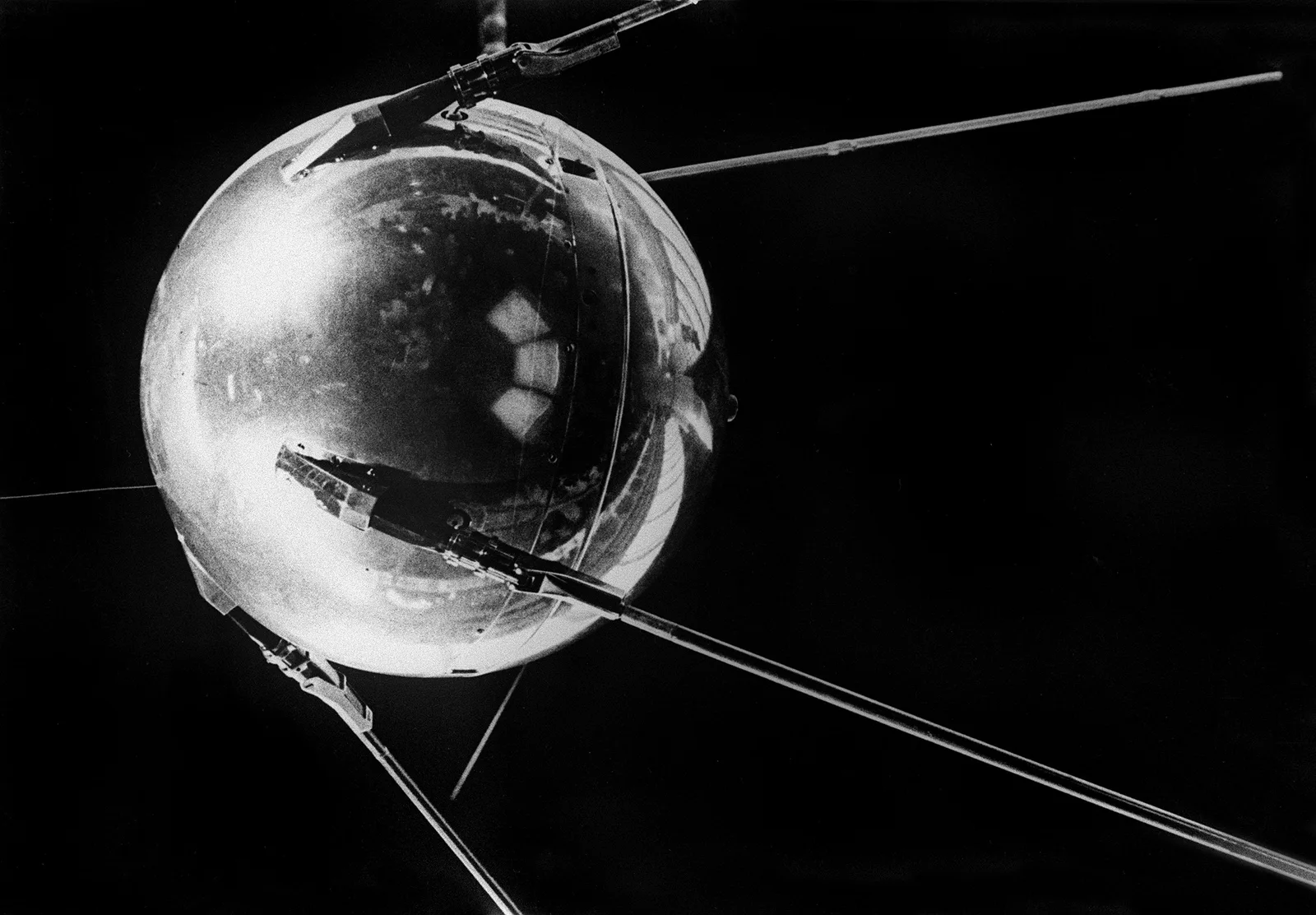
In October 1957, the Soviet Union placed Sputnik 1 into orbit, ushering in the space age and transforming the strategic balance of the Cold War. Nearly seventy years later, another Sputnik could mark a historic turning point, not through the conquest of space, but through the ability to compromise its use for years to come.
On November 23, 2026, a joint investigation by German media outlets NDR, WDR and Süddeutsche Zeitung revealed that several Western intelligence services believed Russia could be ready to place a satellite designed to carry a nuclear weapon into orbit. Known as Sputnik-S, the spacecraft was reportedly assembled several years ago and is believed to be stored in the Moscow region. German intelligence assessments suggest that a launch could take place as early as December 2026.
The Kremlin denies the allegations. No orbital deployment of a nuclear weapon has been publicly established. The precise nature of the spacecraft, its potential payload and Moscow’s operational intentions remain uncertain. Nevertheless, the convergence of Western intelligence warnings warrants a closer examination of their strategic implications.
A Weapon Against the Infrastructure of Power
The distinctive feature of Sputnik-S would lie less in its explosive power than in the nature of its operational environment. A nuclear detonation in space could damage electronic systems and generate artificial radiation belts capable of degrading orbital equipment over extended periods.
General Stephen Whiting, head of United States Space Command, has outlined a scenario in which approximately one-third of satellites in low Earth orbit could be disabled within the first hours or days, with additional failures occurring progressively. This estimate depends on the characteristics of the event and should not be interpreted as a definitive forecast.
Unlike conventional anti-satellite weapons, whose immediate effects may be confined to an individual target, a nuclear explosion would introduce a systemic and largely indiscriminate dimension. It could affect the space infrastructure of adversaries, neutral countries and allies alike, including Russia itself.
Space would no longer be merely a theater of military operations. It would become a global infrastructure vulnerable to partial incapacitation.
The Paradox of Western Technological Superiority
Since the end of the Cold War, Western powers have progressively integrated space-based capabilities into their military, industrial and financial architectures.
Satellites provide secure communications, intelligence, Earth observation, military operational synchronization and data transmission. In the civilian sphere, they support transportation, agriculture, telecommunications, financial markets and energy systems.
This dependence is both a source of power and a structural vulnerability.
The war in Ukraine has provided a tangible illustration. The deployment of the Starlink constellation demonstrated how privately owned commercial infrastructure could alter the operational conditions of a conflict. It also exposed the increasingly blurred boundary between civilian equipment and military capabilities.
The proliferation of distributed satellite constellations was intended to make space architectures more resilient. An orbital nuclear threat would partially undermine that logic by exposing large numbers of spacecraft simultaneously to a common hazardous environment.
The Forgotten Precedent of 1962
The risk is not entirely theoretical. On July 9, 1962, the United States conducted the Starfish Prime high-altitude nuclear test as part of Operation Fishbowl.
The explosion caused electromagnetic disturbances observed as far away as the Hawaiian Islands and created an artificial radiation environment that contributed to the degradation of several satellites.
At the time, the global economy was barely dependent on orbital infrastructure. Satellites were scarce, digital networks did not exist, and financial systems remained predominantly terrestrial.
A comparable phenomenon in today’s orbital environment would have implications of an entirely different magnitude.
The fundamental difference between 1962 and 2026 therefore lies not simply in the evolution of weapons technology, but in the transformation of the global economy since the first nuclear age.
Deterrence Through Space Denial
The alleged development of Sputnik-S could reflect a strategy of asymmetric compensation.
Faced with American superiority in commercial satellite constellations, launch capabilities and orbital digital services, Russia does not necessarily possess the industrial resources required to replicate these infrastructures on a comparable scale.
A space-denial capability could, in theory, alter this asymmetry by threatening an adversary’s technological advantages rather than attempting to match them.
This interpretation does not establish the existence of a corresponding Russian doctrine. It illustrates the strategic logic such a capability could embody if its existence were confirmed.
The mere presence of a nuclear weapon in orbit would introduce persistent uncertainty into military and economic calculations. Actual detonation would not necessarily be its sole purpose. The threat itself could become an instrument of coercion.
Such a deterrence architecture would nevertheless remain profoundly unstable. Its potentially indiscriminate effects would also expose China, India and other space powers, considerably complicating any attempt to manage escalation through political means.
An Underestimated Economic Threat
The consequences would extend far beyond the military domain.
Telecommunications operators, space insurers, Earth observation companies and digital service providers could face a sudden reassessment of their risk exposure.
The loss of orbital assets would generate replacement costs, service disruptions and financing difficulties. Operators confronted with a degraded radiation environment might not be able to restore their capabilities immediately through additional launches.
Financial markets and electricity networks, which rely in part on timing signals derived from satellite navigation systems, would need to strengthen their continuity arrangements and alternative terrestrial solutions.
The repercussions, however, would not be uniform. GPS, Galileo, GLONASS and BeiDou operate predominantly in orbital regimes different from those occupied by major low Earth orbit telecommunications constellations. Their exposure would therefore depend on the specific characteristics of the event.
The central risk would be the simultaneous degradation of several interconnected infrastructures rather than an immediate and uniform collapse of global digital services.
Space security could consequently become a major component of industrial policy, financial regulation and economic sovereignty.
The Erosion of International Space Law
Article IV of the 1967 Outer Space Treaty prohibits the placement in Earth orbit of objects carrying nuclear weapons or other weapons of mass destruction.
Russia, as the continuator state of the Soviet Union, remains a party to the treaty.
In April 2024, Moscow vetoed a United Nations Security Council draft resolution that reaffirmed, among other provisions, the prohibition on deploying such weapons in space. The veto does not constitute evidence of Sputnik-S’s existence, but it reflects growing divisions over the military governance of outer space.
A confirmed nuclear deployment would violate the treaty and represent a fundamental departure from nearly six decades of international legal restraint.
On November 23, 2026, NATO Secretary General Mark Rutte reaffirmed the Alliance’s commitment to ensuring its security in the space domain. His statement reflects the increasingly explicit incorporation of space into collective defense considerations.
The difficulty lies in responding to a threat whose consequences would recognize no territorial boundaries.
The End of the Orbital Sanctuary
The development of space surveillance capabilities, the hardening of electronic equipment, the diversification of communications infrastructure and the establishment of terrestrial backup systems could increasingly shape national resilience strategies.
Yet none of these measures could fully substitute for the stability of a shared orbital environment.
Cold War nuclear deterrence rested on the prospect of mutual destruction. An orbital nuclear anti-satellite weapon would introduce a variation of that logic: the possibility of simultaneously depriving several powers of part of the infrastructure upon which their societies depend.
The original Sputnik demonstrated humanity’s ability to transcend terrestrial boundaries. Sputnik-S, should Western intelligence assessments prove accurate, would serve as a reminder that this achievement has created a new form of dependence.
Above the Earth, a borderless infrastructure has gradually emerged, sustaining nations otherwise divided by their rivalries.
Its destruction would secure the sovereignty of none.
Atlas Limits Research Desk
Atlas Limits’ editorial and analytical desk.