Off the coast of Suriname, beneath the deep waters of the Atlantic Ocean, an economic transformation is taking shape on a scale far greater than the size of this small South American state. Roughly 150 kilometres from the coastline, an offshore oil development worth more than $10 billion could permanently alter the public finances, industrial structure and international standing of a country with fewer than 700,000 inhabitants.
Suriname is not a country without natural wealth. Tropical forests cover most of its territory, its mineral deposits include gold and bauxite, and its economy has long been connected to international commodity markets. Yet decades of resource extraction have not produced a diversified industrial economy or eliminated the country's structural vulnerabilities.
The arrival of large-scale offshore oil production could change that trajectory. It could also reproduce, in a new form, the weaknesses that have accompanied Suriname's dependence on extractive industries.
The central question is therefore not simply how many barrels Suriname will produce. It is whether a country of this size can convert a new source of natural wealth into lasting economic capacity, stronger institutions and greater international influence.
A Small Country with an Unusual Geography
Suriname occupies a distinctive position on South America's Atlantic coastline. Bordering Guyana to the west, French Guiana to the east and Brazil to the south, it belongs geographically to South America while maintaining deep historical, cultural and institutional connections with the Caribbean.
A former Dutch colony that gained independence in 1975, Suriname retains Dutch as its official language. Its population, shaped by African, Indian, Javanese, Chinese and European migration, alongside Indigenous and Maroon communities, makes it one of the most diverse societies in the region.
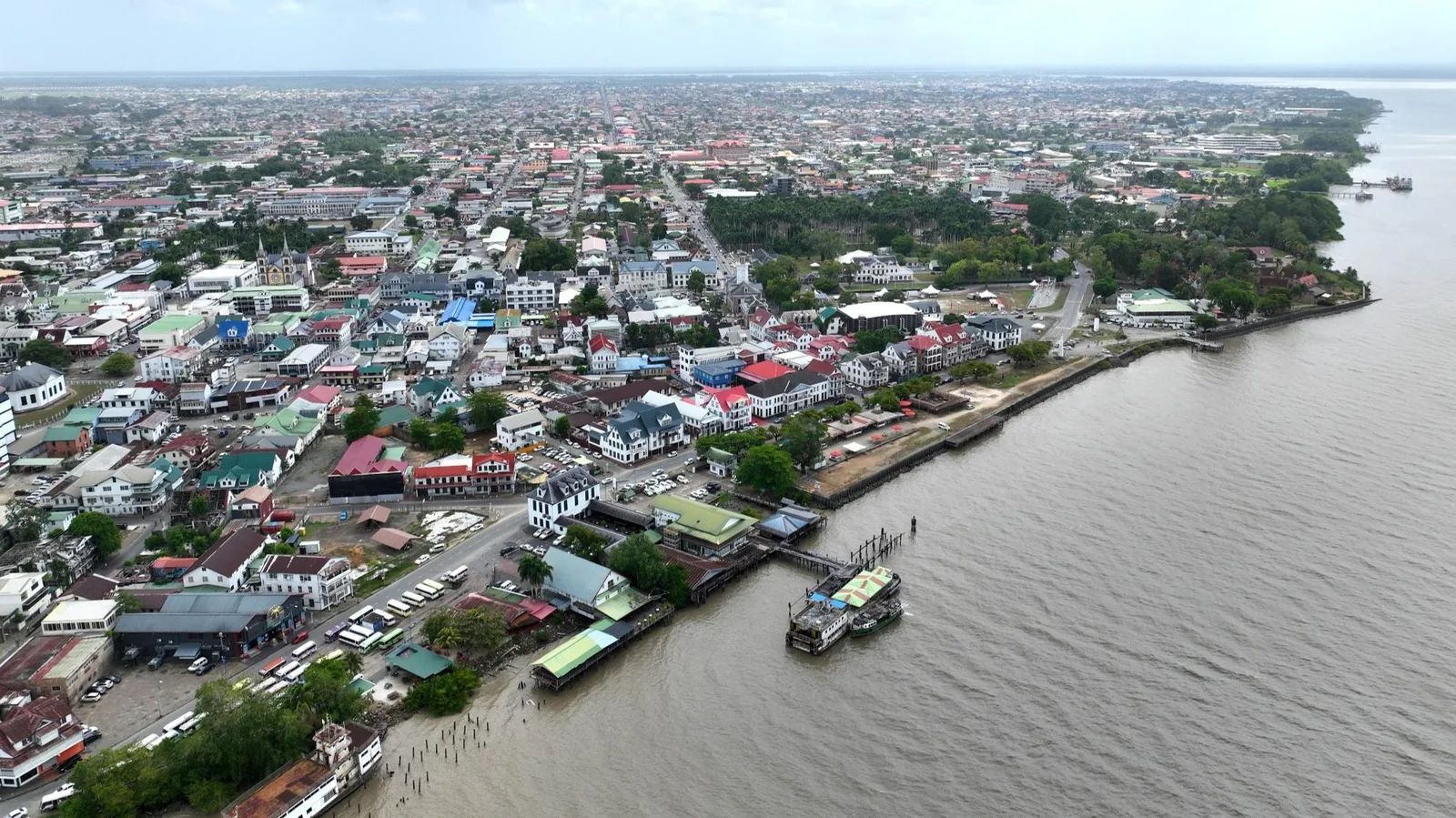
This diversity contrasts with the geographical concentration of economic activity. Most inhabitants live along the northern coastal belt, particularly around Paramaribo and the country's principal urban centres. The interior remains predominantly forested, sparsely populated and difficult to access.
Suriname covers approximately 163,820 square kilometres, an area larger than Greece, but has a population roughly fifteen times smaller.
The imbalance between territory and population is central to its development prospects. A limited domestic market constrains industrial diversification, while low population density increases the cost of infrastructure and public service delivery. At the same time, the country's natural resources and maritime position create opportunities that extend far beyond its demographic weight.
Historically, the economy has depended on bauxite, gold, onshore petroleum and agricultural production. Mining exports have accounted for a substantial share of foreign exchange earnings, exposing public finances to fluctuations in global commodity prices.
Offshore petroleum therefore does not represent a transition from a diversified economy to a resource-dependent one. It represents a potentially profound reconfiguration of an existing dependence on natural resources.
The Discoveries That Changed the Outlook
The Guyana–Suriname Basin has emerged as one of the Atlantic's most closely watched offshore petroleum provinces.
To the west, Guyana experienced a remarkable expansion of its oil industry following discoveries by ExxonMobil and its partners in the Stabroek Block. Commercial production began in 2019, initiating a period of extraordinary economic growth.
The geological formations responsible for Guyana's discoveries extend into Surinamese waters.
Beginning in 2020, significant discoveries in Block 58 confirmed Suriname's offshore potential. TotalEnergies and APA Corporation subsequently developed the technical and commercial foundations for the country's first major deepwater oil project.
In October 2024, the partners announced the final investment decision for GranMorgu, a development with an estimated capital cost of approximately $10.5 billion.
The project draws on the Sapakara and Krabdagu discoveries, located approximately 150 kilometres offshore. Its central infrastructure will include a floating production, storage and offloading vessel, known as an FPSO.
The facility is designed to process up to 220,000 barrels of oil per day.
First production is targeted for 2028, subject to construction, installation, commissioning and operational schedules.
This represents a fundamental transition. Suriname could move from relatively limited onshore petroleum production to an offshore industry operating at internationally significant scale.
GranMorgu's investment alone is substantial relative to the size of the national economy. It brings together international energy companies, specialised engineering contractors, financial institutions and Suriname's national oil company, Staatsolie.
The ownership structure has also evolved beyond the original development arrangements.
Staatsolie secured a 20% participating interest in GranMorgu, alongside TotalEnergies and APA, which each hold 40%. This gives the Surinamese national company direct exposure to the project's potential financial returns, but also to the financing obligations and commercial risks associated with its participation.
The development is therefore more than an oilfield. It is a long-term structure of contracts, capital commitments, technologies and fiscal arrangements that will determine how petroleum wealth is distributed over several decades.
What 220,000 Barrels a Day Actually Means
GranMorgu's planned capacity provides an indication of the potential economic transformation.
At a theoretical production rate of 220,000 barrels per day, the facility would produce approximately 80.3 million barrels over a full year.
At an illustrative oil price of $70 per barrel, that volume would represent approximately $5.6 billion in annual gross petroleum value.
This calculation is not a forecast of actual sales or government revenue. It assumes continuous production at full capacity and excludes technical interruptions, the production ramp-up, operating expenditure, capital recovery and contractual production-sharing arrangements.
Nevertheless, it illustrates the project's scale.
For an economy whose annual nominal GDP amounts to only several billion dollars, the gross market value of offshore petroleum output could become extraordinarily large relative to existing domestic economic activity.
The distinction between gross production value, domestic value added and government revenue will be decisive.
A substantial proportion of equipment, specialised services and financing will originate abroad. Investors must recover development costs and earn returns on their capital. Government receipts will depend on royalties, taxation, equity participation and contractual mechanisms governing petroleum production.
The value of oil extracted offshore therefore cannot be treated as money automatically available to the national treasury.
This distinction is essential to avoiding one of the most common analytical errors surrounding emerging petroleum economies: confusing geological wealth with the income actually captured by the population.
Guyana: Both a Promise and a Warning
Guyana provides the most immediate comparison.
The two countries share an Atlantic coastline, relatively small populations, colonial histories distinct from much of continental South America and geological formations that have attracted major international petroleum investment.
Their economic and institutional trajectories, however, are not identical.
Guyana began producing oil in 2019 and subsequently recorded some of the world's highest economic growth rates. Expanding offshore capacity transformed its fiscal outlook and increased its international visibility.
But this expansion also revealed the difficulties facing small states when a highly capital-intensive industry becomes dominant.
Housing costs, infrastructure pressures, shortages of specialised labour, reliance on foreign contractors and the concentration of economic activity around petroleum can all create significant domestic imbalances.
Suriname has one relative advantage: it can study Guyana's early experience before its own first major offshore project begins producing.
It can examine the management of petroleum revenues, local-content policies, public procurement procedures and the infrastructure required to absorb rapid economic expansion.
Yet Guyana's model cannot simply be reproduced.
The contractual arrangements, fiscal starting positions, institutional capacities and production profiles of the two countries differ.
The most useful comparison therefore concerns not headline GDP growth, but the ability of each government to convert petroleum expansion into durable improvements in productivity, employment, infrastructure and public services.
An Economy Emerging from Monetary and Fiscal Crises
The petroleum opportunity arrives after years of severe economic turbulence.
Suriname experienced a deterioration in public finances, a sovereign debt crisis, sharp currency depreciation and exceptionally high inflation.
Fiscal imbalances, external financing pressures and structural vulnerabilities led the authorities to pursue an economic reform programme supported by the International Monetary Fund.
In December 2021, the IMF approved a 36-month arrangement under the Extended Fund Facility, initially equivalent to approximately $688 million.
The programme aimed to restore debt sustainability, strengthen international reserves, improve economic governance and stabilise the macroeconomic framework.
Debt restructuring and fiscal adjustment imposed substantial costs on households and businesses.
This experience fundamentally changes how future oil revenues should be understood.
For a government facing immediate financing needs, the prospect of substantial future income can encourage spending commitments or additional borrowing before the revenues materialise.
Yet GranMorgu's proceeds are neither immediate nor guaranteed at any particular level.
They will depend on production schedules, international oil prices, reservoir performance and contractual arrangements.
The principal danger would be to finance permanent expenditure today using uncertain future petroleum income.
Fiscal discipline before the first commercial barrel may therefore prove as important as revenue management after production begins.
The IMF has repeatedly emphasised the importance of fiscal discipline, monetary stability and stronger economic institutions as Suriname prepares for offshore petroleum development.
The coming years will test whether the country can maintain that discipline while political and public expectations rise.
The Resource Curse Is Not Inevitable
The economic history of petroleum exporters demonstrates that natural-resource abundance does not automatically produce prosperity.
Some countries have used hydrocarbon revenues to finance infrastructure, strengthen human capital and accumulate long-term financial assets. Others have experienced growing dependence on extractive industries, weakened institutions and declining competitiveness outside the resource sector.
Suriname stands at precisely this crossroads.
The first danger is Dutch disease.
A substantial increase in foreign-currency inflows can place upward pressure on the real exchange rate, increase domestic costs and weaken the competitiveness of non-oil sectors.
Agriculture, tourism, manufacturing and internationally traded services may become less competitive even as the petroleum industry expands.
The second danger is fiscal volatility.
Oil prices respond to global forces over which a small state has virtually no control: Chinese economic growth, production decisions by major exporters, geopolitical disruptions, energy investment cycles and long-term changes in demand.
The third danger is institutional.
When public revenues become heavily concentrated in one industry, decisions involving licences, contracts, procurement and investment can acquire disproportionate political significance.
Transparency, independent oversight and the quality of public expenditure consequently become central determinants of economic performance.
Suriname already possesses mechanisms for managing resource revenues, but their effectiveness will depend on implementation, accountability and adaptation to potentially much larger financial flows.
The essential question is not whether the state should benefit from petroleum. It is how much revenue should be spent, invested or saved, under which rules and with what safeguards against political interference.
Building an Economy Around Oil, Rather Than Living Entirely from It
Deepwater petroleum is an exceptionally capital-intensive industry.
Projects require enormous investments, sophisticated technologies and demanding operational standards. Yet their direct employment effects remain relatively limited compared with the capital deployed.
An offshore production facility can generate billions of dollars in annual gross output while directly employing only a small proportion of the national workforce.
Suriname cannot therefore expect petroleum employment alone to transform its labour market.
The broader opportunity lies in supporting industries: port services, industrial maintenance, engineering, logistics, maritime transport, technical education, digital systems, insurance and financial services.
The challenge is ensuring that domestic companies can participate meaningfully in these supply chains.
Local-content policies seek to increase the involvement of national businesses in extractive industries. Their success, however, depends on whether domestic suppliers can meet international requirements for safety, quality, reliability and cost.
Imposing quotas without developing capabilities can increase project costs and create opportunities for unproductive intermediaries. Conversely, leaving supply chains almost entirely external would restrict the industry's contribution to the wider economy.
A credible industrial strategy must therefore combine vocational education, access to finance for smaller companies, industrial certification and technology partnerships.
The first stages of GranMorgu have already generated opportunities for local suppliers, with more than 100 Surinamese companies participating in project-related activities according to TotalEnergies' 2026 communications.
This is an important beginning, but participation must ultimately be measured by the value of contracts, the development of domestic expertise and the ability of firms to compete beyond the initial project.
Education may prove one of the most productive long-term uses of petroleum income.
With a relatively small population, Suriname could potentially achieve meaningful improvements in human-capital indicators if investment is sustained and regional inequalities are addressed.
The objective should not be to construct an oversized petrochemical sector merely because crude oil is available. It should be to identify industries in which the country can establish genuine and lasting competitive advantages.
A New Position on the Global Energy Map
Offshore petroleum could also change Suriname's diplomatic standing.
Until recently, the country occupied a relatively modest position in international energy strategies. Its economy was more closely associated with gold, forest resources and limited onshore hydrocarbon production.
GranMorgu has attracted the attention of major oil companies, offshore service providers, financial institutions and governments interested in diversifying energy supplies.
The Atlantic coastline between Guyana and Suriname is becoming an increasingly important petroleum-producing region.
This development is unfolding as major economies attempt to reconcile energy security, affordability and emissions reduction.
New offshore projects must demonstrate competitiveness in an environment where the long-term trajectory of global oil demand remains uncertain.
GranMorgu has been designed around an all-electric FPSO configuration, with measures intended to reduce routine flaring and operational emissions.
These characteristics may improve its operational environmental performance relative to some conventional developments. They do not eliminate the emissions associated with the eventual combustion of the hydrocarbons produced.
Suriname must therefore confront a fundamental contradiction: using fossil-fuel revenues to finance national development while the global economy pursues an uneven energy transition.
That contradiction is particularly visible in a country possessing one of the world's highest proportions of forest cover.
The Forest: Suriname's Second Strategic Asset
Suriname belongs to a small group of countries whose territories remain overwhelmingly forested.
This gives it environmental significance far beyond its demographic or economic weight.
Its forests store substantial quantities of carbon, support exceptional biodiversity and contribute to the ecological stability of the Guiana Shield.
Petroleum development consequently raises a question extending beyond national borders.
Can a country with globally significant forest resources finance its modernisation through hydrocarbons while preserving its environmental commitments?
The answer will depend partly on how petroleum revenues are allocated.
Energy income could finance electricity infrastructure, forest protection, environmental monitoring, education and the development of lower-carbon economic activities.
Alternatively, it could deepen dependence on extractive industries if public investment becomes concentrated on infrastructure directly supporting resource production.
This is not exclusively an environmental choice. It is an economic one.
Over the long term, natural capital, freshwater resources, biodiversity and ecosystem services could represent important strategic advantages.
The challenge is to prevent the exploitation of a non-renewable resource from weakening other forms of national wealth.
France, Europe and the Atlantic Dimension
Suriname's geography contains a frequently overlooked feature: it shares a land border with France through French Guiana.
The boundary, largely following the Maroni River, places Suriname directly alongside the territory of a European Union member state.
Relations between Paramaribo, Paris and European institutions could acquire new importance as offshore production develops.
TotalEnergies, a French energy company, already occupies a central industrial position in GranMorgu. The project's supply chains involve international companies specialising in subsea equipment, engineering and energy infrastructure.
French Guiana could potentially participate in certain forms of logistical, environmental and educational cooperation, although geographical proximity alone does not guarantee economic integration.
Suriname could consequently become a point of connection between South America, the Caribbean, Europe and Atlantic energy markets.
Its location offers diplomatic opportunities disproportionate to its population.
It also requires careful management of cross-border trade, mobility, environmental protection and the shared natural ecosystems of the Guiana Shield.
The State Confronts a Historic Transformation
Ultimately, petroleum presents Suriname with an institutional challenge more profound than a budgetary calculation.
Can a state administering an economy worth only several billion dollars effectively oversee an industry whose investments and financial flows approach the scale of its entire national output?
The answer will depend on the capacity of its tax administration, regulatory authorities, statistical institutions and parliamentary oversight mechanisms.
It will also depend on policy continuity across political transitions.
Offshore petroleum projects operate over several decades. Governments change over much shorter electoral cycles.
A credible institutional framework must therefore establish rules capable of surviving successive administrations.
Public investment management will be particularly important.
Rapidly increasing revenues can support essential infrastructure, but they can also encourage poorly prepared projects whose maintenance costs become unsustainable.
Project selection, economic appraisal and procurement transparency will determine whether public spending creates productive assets or merely distributes short-term income.
The government must also balance immediate social needs against intergenerational savings.
Petroleum reserves are finite. The infrastructure, skills and institutions financed by their extraction can generate economic value long after production declines.
That conversion is the true measure of successful resource development.
2028 Will Be a Beginning, Not a Destination
The prospect of GranMorgu beginning production in 2028 may create the impression that Suriname's economic destiny is already determined.
It is not.
Offshore projects remain exposed to technical, financial and commercial risks. Oil prices can change dramatically. Public revenues may fall below expectations, particularly during the initial years of investment recovery.
Above all, producing petroleum does not automatically transform a country's productive structure.
Suriname nevertheless possesses a historic opportunity.
Unlike states that became major petroleum exporters with little time to prepare, it has several years of advance notice before its first large-scale offshore project is expected to begin producing.
That period can be used to strengthen institutions, consolidate public finances and establish a development strategy that does not depend exclusively on extraction.
Guyana's experience demonstrates how rapidly petroleum can transform macroeconomic indicators. The history of other resource-dependent economies shows why GDP growth alone cannot guarantee shared prosperity.
Suriname must therefore answer a more demanding question than how much oil it can produce: how can a temporary increase in natural-resource wealth become a permanent expansion of national economic capabilities?
Success will not be measured solely in exported barrels, fiscal receipts or growth rates. It will be measured in the quality of schools, the reliability of infrastructure, the productivity of businesses, the strength of public institutions and the economy's ability to prosper independently of petroleum.
Off the coast of Paramaribo, engineers are preparing the infrastructure that will extract wealth from beneath the Atlantic seabed. Onshore, a far more complex undertaking awaits: building the institutions capable of converting that wealth into a lasting future.
Oil may transform Suriname's fortunes. It will not, by itself, determine the country's destiny.
Main Sources
- TotalEnergies — GranMorgu final investment decision, October 2024; project specifications, construction progress and 2026 operational updates.
- APA Corporation — Block 58 development announcements, GranMorgu investment decision and participating interests.
- Staatsolie Maatschappij Suriname N.V. — Annual Report 2025; GranMorgu 20% participation, financing arrangements and national petroleum-sector developments.
- International Monetary Fund — Suriname Extended Fund Facility programme, Article IV consultations and macroeconomic assessments.
- World Bank — Suriname development indicators, population, GDP, economic structure and environmental data.
Atlas Limits Research Desk
Atlas Limits’ editorial and analytical desk.