In Rotterdam, Europe meets the world before it even knows what it will do with it. Oil arrives by sea, containers continue toward Germany, ores feed the continent’s industries, and chemicals change form before resuming their journey. In 2025, despite a 1.7% decline, the port still handled 428.4 million tonnes of cargo and 14.2 million twenty-foot equivalent containers. At this scale, Rotterdam is no longer simply a Dutch port. It is one of the physical gateways to the European economy.
That disproportion captures the Netherlands rather well.
The country had a population of 18.13 million at the beginning of 2026. Its territory is smaller than many European regions. It has neither an enormous domestic market, nor the abundance of natural resources enjoyed by major commodity economies, nor the demographic depth that would allow it to build prosperity primarily on domestic demand. Yet Dutch goods exports reached €655 billion in 2025. Add services, and the national accounts record nearly €955 billion in exports for an economy whose GDP stood at approximately €1.17 trillion.
This relationship with the outside world is not a by-product of the Dutch model. It is its architecture.
For centuries, the Netherlands has compensated for the modest size of its territory by mastering circulation. It transports, stores, transforms, finances, insures, re-exports and connects. Rather than seeking to possess every resource, it has repeatedly positioned itself between those who possess them and those who need them.
In the age of global value chains, this old commercial intuition has taken on a new form.
The Netherlands has become an economy of interfaces.
The Continent Behind the Port
Rotterdam would matter far less if Germany did not exist behind it.
Dutch geography rests on this simple reality. The Rhine-Meuse-Scheldt delta opens the North Sea onto one of the wealthiest industrial and consumer regions in the world. The port therefore serves far more than Amsterdam, Rotterdam or Eindhoven. It provides a maritime gateway to the Ruhr, the Benelux countries, France, Switzerland and, beyond them, parts of Central Europe.
The Netherlands’ real asset is therefore not merely its coastline.
It is the hinterland to which that coastline provides access.
This position has created around Rotterdam a system far more complex than a cargo-handling facility. Refineries, chemical plants, storage facilities, pipelines, gas terminals, railways and inland waterways have accumulated around the port. Goods can arrive, be transformed, divided, stored or simply continue their journey.
This distinction is essential to understanding Dutch trade statistics. A considerable share of the country’s commerce consists of re-exports: goods enter the Netherlands before being shipped to other markets. Even in agriculture, a sector more readily associated with domestic production, €49.1 billion of the €137.5 billion in agricultural exports recorded in 2025 consisted of re-exports.
The Dutch model, therefore, is not simply about producing a great deal.
It is about making an enormous amount circulate.
And when a country becomes a place through which things pass, every passage can leave something behind: logistics activity, employment, commercial margins, financing, insurance, industrial transformation, market knowledge, infrastructure and tax revenue.
Circulation itself becomes an industry.
From Rotterdam to Eindhoven
But the Netherlands would be considerably less interesting if it were merely a logistics platform.
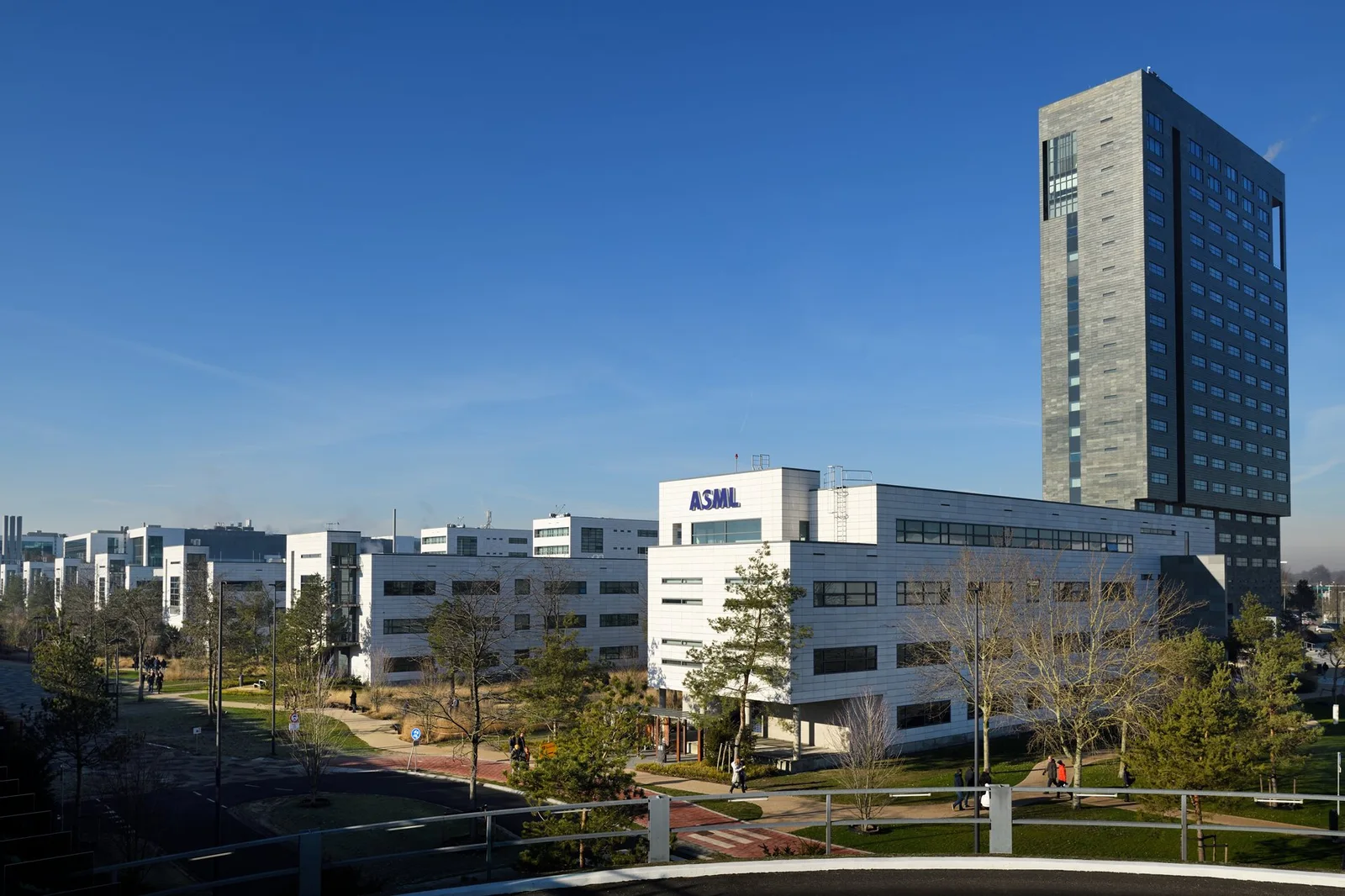
About one hundred kilometres from the port lies Eindhoven. There, the logic of flows changes completely.
ASML manufactures some of the most complex industrial machines ever built. Its lithography systems are used by semiconductor manufacturers to print the circuits that make up chips. In extreme ultraviolet lithography, required for the most advanced generations of semiconductors, the company occupies an exceptional position in the global supply chain.
In 2025, ASML generated €32.7 billion in revenue, spent €4.7 billion on research and development and sold 535 systems, including 48 EUV machines.
The contrast with Rotterdam is striking.
On one side, hundreds of millions of tonnes of materials and goods. On the other, a few dozen machines among the most sophisticated pieces of industrial equipment in the world.
Yet the underlying economic logic is remarkably similar.
In both cases, the Netherlands occupies a passage that is difficult to bypass.
Rotterdam controls a geographical interface. ASML occupies a technological one. The former connects the oceans to continental Europe; the latter connects parts of fundamental research to the industrial capabilities required to manufacture the world’s most advanced chips.
This is also what has transformed a Dutch company into a geopolitical asset. Export restrictions affecting certain semiconductor manufacturing technologies destined for China have demonstrated that technology developed in Eindhoven can become entangled in the strategic relationship between Washington, Beijing and their allies.
A small European country thus encounters one of the consequences of indispensability: when what you produce becomes strategic, larger powers begin to take an interest in how you sell it.
Producing More from Less Land
Agriculture tells a third version of the same story.
Seen from above, Dutch territory hardly resembles that of a major agricultural economy. It is dense, urbanised and industrialised, with land contested by housing, infrastructure, economic activity and nature.
Yet the Netherlands exported €137.5 billion worth of agricultural products in 2025. Of that amount, €88.4 billion consisted of goods produced or grown in the Netherlands and €49.1 billion of re-exports. The domestic economy derived more than €49 billion in value from those exports.
Again, sheer volume does not explain the phenomenon.
Dutch agriculture developed around productivity, plant breeding, seeds, greenhouses, water management, refrigerated logistics, food processing and immediate access to large European markets. A Dutch hectare is not merely a piece of farmland. It sits at the centre of a system combining agricultural research, infrastructure, suppliers, ports, trading platforms and affluent consumers.
The Netherlands has therefore applied to land the same logic it applies to its national territory: when space is scarce, more value must be extracted from it.
But this success is now revealing its limits. Intensive livestock farming and agriculture have increased pressures surrounding nitrogen emissions, soil quality, water and biodiversity. The country is confronting a familiar paradox of highly optimised economies: the system that made extraordinarily efficient use of a scarce resource eventually places that resource under pressures that become increasingly difficult to sustain.
The constraint of land never disappeared.
Technology merely pushed it further away.
Making Money Move as Well
There is another flow that cannot easily be seen from Rotterdam: capital.
The Netherlands has long occupied a distinctive position in the financial architecture of multinational corporations. Institutional stability, business law, an extensive network of tax treaties, specialised financial and legal services and European integration have encouraged the establishment of holding companies and intermediary structures used in international investment.
The figures indicate the scale of the phenomenon. At the end of 2024, inward foreign direct investment positions in the Netherlands amounted to 436% of GDP and outward positions to 508% — respectively €4.946 trillion and €5.759 trillion.
Those figures obviously do not mean that several trillion euros have been invested in Dutch factories. A substantial share reflects precisely the country’s role as a transit jurisdiction within the international corporate system.
For years, that function also fuelled criticism of the Netherlands over international tax optimisation. Dutch authorities have since changed several rules, while De Nederlandsche Bank has reported a decline in investment income and royalties flowing through the country toward low-tax jurisdictions.
But the phenomenon reveals something deeper than taxation alone.
The Netherlands succeeded in becoming an interface not only for merchandise, but also for the legal and financial structures accompanying globalisation.
A container, a semiconductor, a tomato and a dividend appear to belong to four entirely different economies.
In the Netherlands, they are nevertheless part of the same geography.
An Economy Built on the Outside World
This architecture explains why international openness produces such visible macroeconomic effects.
According to revised provisional data from Statistics Netherlands, the Dutch economy expanded by 1.6% in 2025. Exports of goods and services contributed 0.9 percentage points to that growth — more than half of the total expansion recorded during the year. Exports of machinery, food products and domestically produced agricultural goods were among those that increased.
Openness provides a formidable multiplier when world trade expands.
It is also an exposure.
An economy in which a significant share of value comes from intermediation necessarily depends on what it intermediates. Rotterdam depends on European and global trade. Schiphol depends on international mobility. The chemical industry depends on energy, raw materials and European competitiveness. ASML depends on the enormous investment programmes of a handful of global semiconductor manufacturers. Agriculture depends on foreign markets capable of absorbing its output.
Even favourable geography retains its value only for as long as the flows continue.
This is where the Dutch model encounters the new world.
When Flows Become Political
For several decades, globalisation rewarded interfaces. Lower trade barriers, European integration, the international fragmentation of production and the free movement of capital automatically increased the value of places capable of connecting different parts of the system.
Today, each of those flows is becoming more political.
Semiconductors are subject to export controls. Energy has become a security issue. Port infrastructure is increasingly treated as a strategic asset. Supply chains are judged on resilience as much as cost. Foreign investment is scrutinised more closely. Governments are attempting to relocate selected forms of production. Climate policies are transforming the economics of refining, chemicals, agriculture and transportation.
Rotterdam already offers a glimpse of the transition. Total throughput declined in 2025, while the port authority itself has highlighted the difficulties facing industries located in the port area, including announced closures in chemicals and delayed investment in areas such as renewable fuels.
The port that prospered by processing and redistributing hydrocarbons must gradually become one of the centres of Europe’s energy transition.
That transformation could provide it with a new function. Hydrogen, offshore electricity, low-carbon molecules, carbon capture and new energy infrastructure may tomorrow travel through some of the corridors built yesterday for oil and gas.
But an infrastructure transition is never a simple substitution. Existing assets can lose value before new ones necessarily achieve comparable profitability. Industries must invest at the same moment that their international competitiveness is coming under pressure.
The country that perfected the art of benefiting from flows must therefore now participate in transforming them.
When Territory Pushes Back
There is another limit, and this one is domestic.
Dutch success has concentrated an extraordinary quantity of activity on a small territory: housing, intensive agriculture, ports, airports, data centres, factories, railways, motorways, electricity networks and protected natural areas.
As the economy grows, these uses increasingly compete with one another.
Housing provides the most visible expression. Companies need workers; workers need homes; homes require land, infrastructure and electricity. In some areas, congestion on the electricity grid is already complicating connections for new projects. Agriculture must simultaneously reduce some of its environmental pressures. Schiphol Airport has for years embodied the trade-offs between international connectivity, noise and environmental constraints.
The Netherlands has historically responded to scarcity through engineering.
It reclaimed land from the sea, built dikes, managed water, intensified agriculture, densified infrastructure and increased the productivity of each unit of territory.
But even engineering eventually encounters physical limits.
The next Dutch challenge may therefore be less about creating new flows than deciding between those that already exist.
Indispensability as a Strategy
It is tempting to tell the story of the Netherlands as that of a small country that became large despite its geography.
The opposite may be closer to the truth.
The Netherlands succeeded because it understood its geography with remarkable consistency.
It sits between the sea and one of the largest industrial markets in the world. It built ports. Its territory is scarce, so it intensified its productivity. Its domestic market is limited, so it produced for the outside world. It sits at the centre of European flows, so it developed the services required to organise them. Then, when the world economy became increasingly technological, an ecosystem emerged around Eindhoven capable of occupying one of the hardest-to-replicate segments of modern industry.
The model is therefore not based on size.
It is based on position.
In the global economy, prosperity does not necessarily belong to whoever possesses the most territory, people or natural resources. It can also belong to whoever controls a port, a technology, an infrastructure, a body of knowledge or a sufficiently important stage in a process that others find it advantageous — or necessary — to pass through it.
That may be the real Dutch singularity.
For centuries, the country has fought water by organising its passage, diverting it, containing it and sometimes reclaiming territory from it. Its economy appears to have learned the same lesson.
The Netherlands could never prevent the world from dwarfing it in size.
Instead, it made sure that part of the world would pass through it.
Main sources
- Statistics Netherlands (CBS) — National Accounts and international trade
- Port of Rotterdam Authority — 2025 throughput and annual results
- ASML — Annual Report 2025
- De Nederlandsche Bank — Foreign investment and the Dutch conduit sector
- Statistics Netherlands / Wageningen Economic Research — Dutch agricultural trade
Atlas Limits Research Desk
Atlas Limits’ editorial and analytical desk.