On the night of 21–22 November 2026, several explosions rocked the port of Benghazi in eastern Libya. Flames rose from a Russian warship moored alongside the quay. Within hours, satellite imagery revealed a corvette almost entirely submerged, while Libyan authorities reported a second attack against a merchant vessel off their coast. The following day, Ukrainian President Volodymyr Zelensky claimed responsibility for the operation: seven Ukrainian naval drones had been deployed against Russian vessels, including the Merkury corvette, commissioned in 2023, and the Angara cargo ship, which Kyiv described as a transporter of military equipment.
The incident might initially appear to be another demonstration of Ukraine's ability to strike the Russian navy. Its significance, however, extends considerably further. Benghazi lies thousands of kilometres from the Ukrainian front, on the southern shore of a sea crossed daily by the energy, commercial and military flows connecting Europe, Africa and the Middle East. The strike did not merely target a warship. It reached one of the locations from which Moscow sustains its military presence across Africa.
More importantly, it was not an isolated event. Since December 2024, several vessels associated with Russian interests have experienced explosions, sinkings or attacks in the Mediterranean basin. Ukraine has claimed responsibility for some operations, while others have been attributed to Kyiv without confirmation, and several incidents remain unexplained. Their succession nevertheless points to a broader development: having challenged Russian naval superiority in the Black Sea, Ukraine is increasingly seeking to reach the maritime networks that sustain Moscow's economic and military power beyond its immediate neighbourhood.
The Mediterranean, long regarded as a secondary arena in the Russia–Ukraine war, is thus progressively entering its operational geography. This transformation raises a wider question: how far can a territorial conflict extend when the resources sustaining it circulate on a global scale?
From the Black Sea to a Wider Maritime Confrontation
When Russia launched its full-scale invasion of Ukraine in February 2022, its naval superiority appeared overwhelming. The Black Sea Fleet possessed frigates, submarines, amphibious vessels, cruise missiles and several major bases. Ukraine, which no longer had a comparable conventional naval force, seemed incapable of challenging that dominance over the long term.
Yet the first years of the conflict gradually overturned this balance. In April 2022, the cruiser Moskva, flagship of Russia's Black Sea Fleet, sank after being struck by Ukrainian missiles. Other units were subsequently damaged or destroyed by missiles and unmanned surface vessels. The port facilities of Sevastopol themselves became targets, forcing Moscow to redeploy part of its naval assets to Novorossiysk on the Russian coast.
The transformation was both technological and doctrinal. Unable to rapidly build a conventional fleet capable of competing with its adversary, Ukraine developed remotely controlled explosive vessels, autonomous navigation systems and operational capabilities combining intelligence, communications and remote guidance.
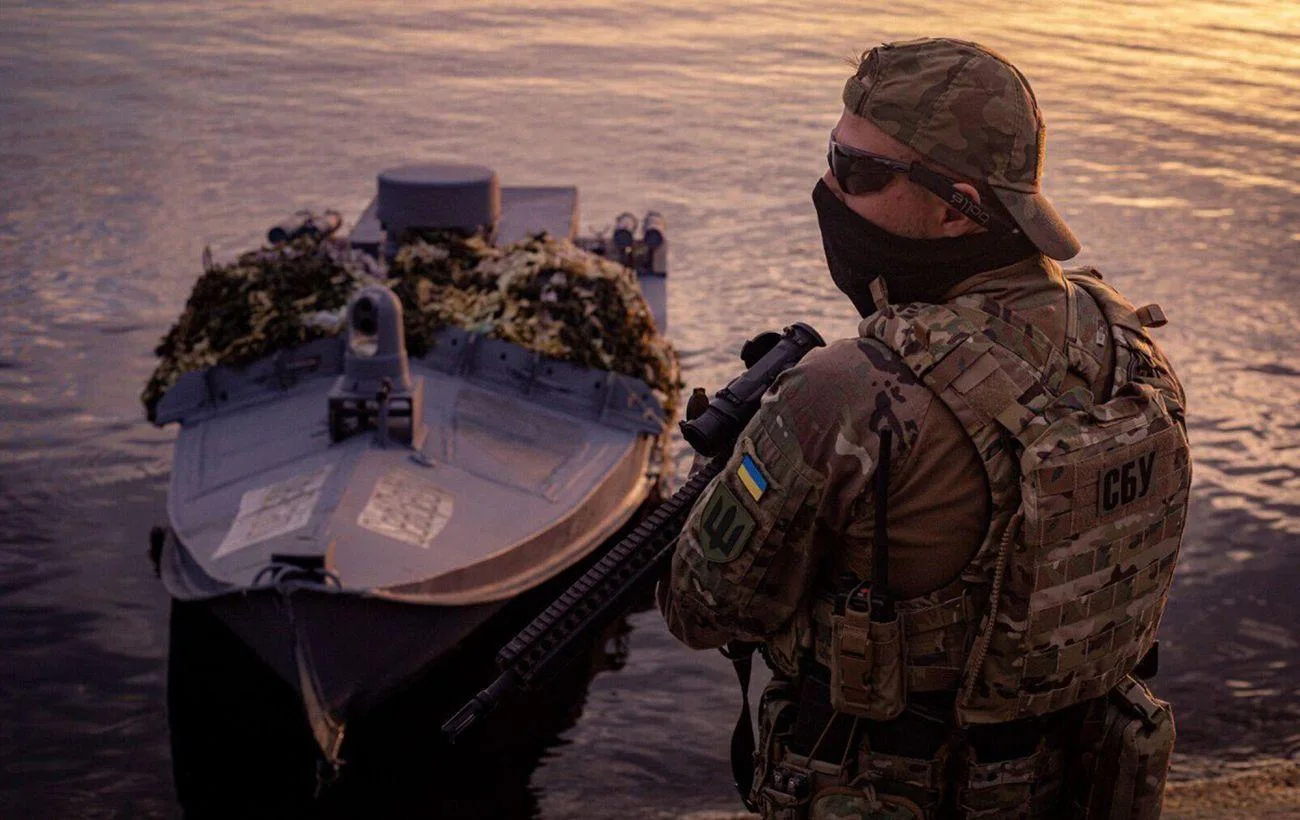
Ukrainian naval drones, particularly those belonging to the Sea Baby family, illustrate this development. By late 2025, Ukrainian security services had presented a version with a claimed operational range of up to 1,500 kilometres and a payload capacity of as much as two tonnes of explosives. These specifications, reported by the system's developers rather than independently verified across all operating conditions, indicate the growing scale of the capabilities available for maritime attacks.
The strategic outcome cannot be measured solely by the number of ships destroyed. Russia retains substantial conventional naval power, but it can no longer operate freely in certain parts of the Black Sea without accounting for the risk of asymmetric attacks. Naval drones have contributed to changes in Russian fleet deployment, while Ukraine has gradually restored maritime corridors for its exports.
This experience provides the starting point for the Mediterranean expansion. Once the vulnerability of Russian warships operating relatively close to Ukrainian territory had been demonstrated, the next question concerned the geographical reach of these capabilities. The answer depends less on drone endurance alone than on operational organisation: intelligence about targets, launch platforms, communications, logistical support and access to the relevant maritime areas.
This is precisely the dimension highlighted by the Benghazi strike. According to information released by Ukrainian security services, the drones were transported and launched from a mother ship. Such an arrangement allows attack systems to be deployed closer to their objectives without requiring the explosive vessels themselves to travel the entire distance between Ukraine and Libya.
The operation therefore suggests an important development: capabilities originally designed for the Black Sea can be adapted to distant theatres, provided that the necessary logistical and operational architecture is available.
2024–2025: Early Incidents and the Emergence of a New Threat
The series of incidents affecting vessels linked to Russia in the Mediterranean began before the Benghazi strike.
On 23 December 2024, the Russian cargo ship Ursa Major sank in the western Mediterranean, between Spain and Algeria, following an explosion on board. Two crew members were reported missing. The vessel, operated by a Russian company specialising in maritime transport, was involved in international logistical activities. Its owner alleged an act of sabotage.
That allegation, however, did not establish the cause of the explosion. Ukrainian responsibility has not been publicly demonstrated. Nevertheless, the incident highlighted the potential vulnerability of Russian vessels operating far from their territorial waters, at a time when Moscow's maritime trade and logistical activities were coming under increasing scrutiny.
In early 2025, other incidents drew attention to oil tankers that had previously called at Russian ports. The Seajewel, off the Italian coast, together with the Seacharm and Grace Ferrum, were associated with a series of suspicious explosions or damage incidents in different parts of the Mediterranean.
These events raised questions about the possible existence of sabotage operations targeting vessels connected to Russian energy trade. Yet their temporal proximity and apparent similarities were insufficient to establish a coordinated campaign. Responsibility remained uncertain, and automatically attributing these explosions to Ukraine would be unjustified.
A more clearly identifiable threshold was crossed on 19 December 2025. On that date, Ukrainian security services claimed responsibility for an attack against the oil tanker Qendil, west of Crete, along a maritime corridor connecting the eastern Mediterranean with the North African coast.
The vessel was described as belonging to the shadow fleet used to transport Russian oil while circumventing Western restrictions. According to Kyiv, it was empty at the time of the attack, limiting the risk of pollution. The operation involved aerial drones and reportedly caused substantial damage without completely destroying the ship.
The distinction is essential: unlike the earlier incidents, the attack against the Qendil was explicitly claimed by Ukraine. It marked the acknowledged extension of Kyiv's economic and maritime campaign against Russian interests into the Mediterranean basin.
The choice of target also reflected a broadening of military logic. The objective was no longer exclusively to neutralise Russian warships, but also to strike commercial assets accused of contributing to the financing of Moscow's war effort.
This strategy introduces a further difficulty. Oil tankers, liquefied natural gas carriers and cargo ships operating under different flags often belong to complex legal and corporate structures. Their ownership, commercial operation, cargoes and relationships with the Russian state do not necessarily coincide. Their participation in an economic network subject to sanctions does not, by itself, establish their status as lawful military objectives.
The maritime confrontation was therefore expanding into an area where economic, military and legal considerations were becoming increasingly intertwined.
2026: From Energy Carriers to Military Infrastructure
The year 2026 marked an intensification of this development.
On 3 March, the Russian liquefied natural gas carrier Arctic Metagaz was severely damaged in the central Mediterranean, near the maritime routes connecting Malta, Libya and the Suez Canal. The vessel, approximately 277 metres long, was carrying around 138,000 cubic metres of liquefied natural gas originating from the Russian Arctic.
Images released after the incident showed a ship devastated by fire and suffering extensive structural damage. Russian authorities denounced an attack involving naval drones and accused Ukraine. Kyiv did not officially claim responsibility.
The nature of the damage and the circumstances of the incident reinforced suspicions of an external attack, but the precise attribution remained separate from the material destruction observed.
The case primarily exposed a new category of risks. Unlike the Qendil, which was reportedly empty when attacked, the Arctic Metagaz was carrying a substantial energy cargo. An explosion or sinking involving an LNG carrier can produce consequences extending far beyond the interests of its owner: risks to crews, disruption of navigation, mobilisation of emergency services and environmental threats.
Russian maritime energy transport was thus becoming a potential arena of confrontation whose consequences could reach states not participating in the war.
On 6 September 2026, another incident involved the Russian cargo ship Lady Mariia, between Cyprus and Crete. The vessel, subject to American sanctions, was associated with Russian logistical networks. Reports concerning the incident referred to a Ukrainian operation, although its full circumstances and consequences could not be established with the same degree of certainty as attacks officially acknowledged by Kyiv.
This succession of events does not constitute a chain of evidence allowing every incident to be attributed to the same actor. It nevertheless reveals a transformation of the security environment: vessels associated with Russia, whether transporting hydrocarbons, commercial goods or military equipment, now face heightened risks along routes sometimes located far from the Black Sea.
The strike of 22 November in Benghazi belongs to this evolution, but crosses an additional threshold. This time, the principal target was a Russian warship moored within a foreign port.
Benghazi: An Operation Against Russia's Military Network
The Merkury corvette belongs to a relatively recent generation of Russian combat vessels. Commissioned in 2023, it represents a substantial military investment and contributes to Moscow's naval power-projection capabilities.
According to Ukrainian authorities, seven naval drones were deployed in the operation on 22 November. Footage released by Ukrainian security services showed several explosive vessels approaching the targeted ships. Satellite imagery captured after the explosions confirmed that the corvette had suffered catastrophic damage and was largely submerged.
Kyiv also claimed to have destroyed a Ka-27 military helicopter and struck the Angara cargo ship, which it described as a vessel used to transport weapons and military equipment to areas hosting Russian deployments.
The precise consequences of the strike against the cargo ship, as well as the reported destruction of the helicopter, have not been independently corroborated to the same degree as the loss of the corvette.
Authorities in eastern Libya reported Russian and Libyan casualties, while local military sources described the interception of numerous unmanned vessels off Benghazi. They denounced a violation of Libyan sovereignty and called for an investigation into the origin of the drones.
The military significance of the operation rests on several elements.
First, the selection of a recently commissioned corvette demonstrates that Ukrainian capabilities can threaten modern Russian naval units, including when they are stationed in ports far from the principal theatre of war.
Second, the use of a mother ship suggests an operational organisation more complex than a straightforward drone attack launched from a nearby coastline. Transporting the vessels, deploying them and coordinating their approach require preparation and appropriate intelligence.
Finally, the attack took place in an area where Russia maintains military relations with Khalifa Haftar's forces. The protection of Russian vessels therefore also depends on local security arrangements, whose surveillance and defensive capabilities may differ from those of a fully equipped Russian naval base.
Benghazi thus reveals a vulnerability inherent in military power-projection networks: their effectiveness depends on geographical dispersion, but that dispersion also multiplies the locations requiring protection.
Libya at the Centre of Russia's African Strategy
To assess the implications of the attack, Libya must be placed within Moscow's broader international strategy.
Since the overthrow of Muammar Gaddafi in 2011, the country has remained fragmented among several centres of power. The internationally recognised institutions based in Tripoli do not control the entire territory. In the east and much of the south, Khalifa Haftar's forces exercise decisive military and territorial authority.
This division has encouraged the involvement of foreign powers pursuing competing interests. Turkey provides military support to the authorities in Tripoli, while Russia has developed cooperation with Haftar's camp. That relationship has notably relied on the activities of the Wagner Group and, subsequently, on the reorganisation of Russia's military presence across Africa.
Libya occupies a distinctive geographical position. Facing southern Europe, it possesses a long Mediterranean coastline and overland connections towards Niger, Chad and Sudan. Its ports and airfields can serve as interfaces between international maritime routes and Russian operations in the Sahel.
This function became more important after the fall of Bashar al-Assad's government in Syria in December 2024. The disruption of the conditions supporting Russia's presence in Syria encouraged Moscow to seek arrangements capable of preserving its transit, support and power-projection capabilities across the region.
The ports of Benghazi and Tobruk, together with certain airfields in eastern Libya, form part of this wider logistical architecture.
Movements of Russian cargo vessels carrying vehicles and military equipment towards eastern Libyan ports were reported during 2026. Some of these supplies were reportedly transferred onwards to air installations used to support operations in Africa, particularly in the Sahel.
The significance of such movements must be assessed cautiously. A cargo vessel's presence in a port, an interruption in its location signal or its previous involvement in military transport does not independently establish the precise contents of every shipment.
Taken together, however, these developments reveal Libya's strategic function within Russian networks. Moscow is not merely seeking diplomatic influence or supporting a local partner. Libyan territory can also contribute to the logistical continuity of Russia's African military presence.
By striking Benghazi, Ukraine therefore potentially reached a connection point between the Russian navy, its transport capabilities and its overseas operations.
A Confrontation Against the Infrastructure of Power
The evolution of maritime warfare illustrates a broader transformation of contemporary conflicts.
A state's power does not depend exclusively on the armed forces directly engaged in combat. It also relies on infrastructure, supply chains and commercial networks that make it possible to finance, equip and sustain those forces.
For Russia, energy exports constitute an essential source of external revenue. Military transport vessels facilitate the movement of equipment to partners and overseas deployments. Foreign ports provide opportunities for refuelling, maintenance and transit.
These functions are legally and operationally distinct, but all contribute, to varying degrees, to Moscow's ability to maintain an international presence.
Ukraine has progressively sought to exploit this dependence on networks. Its strikes against Russian refineries and oil depots reflect a strategy of pressure against economic and logistical capabilities. Its operations against warships seek to reduce the Russian fleet's freedom of action. The attacks claimed against vessels associated with energy trade introduce an additional dimension.
The Mediterranean brings these different interests together within a relatively concentrated geographical space. Routes connecting the Black Sea, the Suez Canal, Gibraltar and the North African coast are used simultaneously by global commerce, energy transportation and the military structures of several powers.
An increase in attacks could lead maritime operators to strengthen security measures, modify certain port calls or face higher insurance and protection costs. These consequences remain to be measured, however: no evidence currently supports the conclusion that Ukrainian operations have caused widespread disruption to Mediterranean maritime traffic.
The distinction between military and commercial vessels also remains central. A warship is, by its nature, a military objective. In the case of a merchant vessel, the legality of an attack depends on factors including its actual use and contribution to military operations, together with the applicable rules governing the conduct of hostilities. Being subject to economic sanctions or belonging to a Russian commercial network does not automatically make a vessel a lawful target.
The geographical expansion of the conflict therefore also increases the legal and diplomatic complexity of military operations.
Libyan Sovereignty and Foreign Wars
The Benghazi strike introduces another contradiction into Libya's already fragile situation.
For more than a decade, the country's competing authorities have relied on foreign partners to consolidate their positions. These alliances can provide equipment, training, financing and political guarantees. They also expose Libyan territory to rivalries extending beyond the country's domestic interests.
Russia's presence in eastern Libya forms part of this dynamic. For Haftar's forces, cooperation with Moscow represents an instrument of military support and international recognition. Yet it also creates exposure to Russia's adversaries.
The Benghazi authorities condemned the attack of 22 November, stating that Libya was not participating in the war between Moscow and Kyiv. They also raised questions about the possibility that the operation had been prepared from western Libyan territory.
These suspicions do not constitute proof. The exact departure point of the mother ship, the arrangements used to deploy the drones and the possible existence of local support require independent investigation.
The issue is particularly sensitive in a country whose institutions remain divided. A clandestine operation conducted from a territory does not necessarily mean that the authorities exercising jurisdiction there were aware of it. Conversely, the absence of effective control over certain areas may facilitate the activities of external actors.
The United Nations mission in Libya called for an immediate, independent and transparent investigation, emphasising the need to prevent the country from becoming a battlefield for foreign conflicts.
This concern extends beyond the Benghazi incident. It reflects a structural weakness of the Libyan state: as long as competing authorities control different parts of the territory, foreign military partnerships can generate security consequences that national institutions are not fully capable of managing.
The Russia–Ukraine war could therefore add another layer to Libya's existing divisions, without Libyan actors necessarily possessing the political or military means to contain its effects.
The Mediterranean as a Shared Strategic Space
The Mediterranean is not a peripheral sea. It is one of the principal spaces connecting Europe, Africa and Asia.
The Strait of Gibraltar links the basin to the Atlantic, while the Suez Canal provides access to the Red Sea and Indian Ocean shipping routes. Mediterranean ports handle flows of containers, oil, liquefied natural gas, grain and industrial products. Submarine infrastructure, communications cables and energy facilities further reinforce its economic importance.
Militarily, the region brings together an unusually large number of strategic interests. European coastal states, the United States, Turkey, Russia and several regional powers maintain naval capabilities or surveillance systems there.
Russia's presence forms part of this configuration. Historically supported by facilities in Syria, it also depends on relationships with various Mediterranean partners. Political transformations in the Middle East and the war in Ukraine have made that presence more difficult to organise and protect.
The emergence of Ukrainian operations in the basin introduces another actor into an already contested environment.
For European countries, the potential consequences concern maritime surveillance, infrastructure protection and incident prevention. For North African states, the central issue is control over their territorial waters, ports and foreign military activities.
Algeria, Tunisia, Egypt and other coastal states are not directly involved in the Benghazi strike. Nevertheless, an intensification of operations could prompt Mediterranean authorities more broadly to reassess the risks affecting commercial routes and military port calls.
It would, however, be premature to describe the conflict as having caused the general militarisation of the Mediterranean. The recorded incidents remain limited relative to the intensity of regional maritime traffic. Their significance lies less in their number than in their nature and geographical progression.
Between the strike against the Qendil in December 2025 and the Benghazi attack in November 2026, the confrontation moved from a commercial vessel on the high seas to a Russian military unit inside a foreign port. This development changes the risk calculation for states hosting Russian vessels.
The Growing Cost of Russian Military Power Projection
Russia's strategy in Africa and the Mediterranean reflects an ambition for international presence extending far beyond the Ukrainian conflict.
Moscow seeks to retain political partners, economic opportunities and military capabilities that allow it to exercise influence across several regions. Maritime and air transport networks are indispensable to this strategy, particularly when operations involve countries far from Russian territory.
Yet the geographical dispersion of these infrastructures creates structural vulnerabilities.
A fleet can be powerful without being capable of protecting every vessel, route and port call simultaneously. Modern warships possess sophisticated defensive systems, but these must be adapted to rapidly evolving threats, including small unmanned surface vessels operating near port facilities.
The Benghazi attack illustrates this imbalance. A recently commissioned corvette, representing years of construction and substantial financial investment, was reportedly destroyed in an operation involving a limited number of drones.
The exact cost of the weapons employed and that of the vessel have not been publicly established on a sufficiently comparable basis to permit a rigorous financial assessment. The asymmetry nevertheless remains evident: relatively accessible systems can cause the loss of complex military equipment and impose additional protection costs.
For Moscow, the response cannot consist solely of replacing damaged vessels. It may require revised port-call procedures, improved detection systems, stronger protection for partner ports and adjustments to logistical routes.
These measures consume resources at a time when the war in Ukraine continues to exert considerable pressure on Russia's military, industrial and budgetary capabilities.
For Kyiv, the strategic value lies precisely in spreading those constraints. By threatening assets far from the front, Ukraine can seek to impose additional costs on Russia without committing equivalent conventional forces.
This strategy nevertheless has its own limitations. Distant operations require reliable intelligence, transport assets, secure communications and political conditions permitting their execution. Repeating them may prove more difficult than the success of a single strike suggests.
Ukraine's ability to turn Benghazi into a lasting precedent will therefore depend as much on its logistical and intelligence resources as on the technical performance of its drones.
A Conflict Expanding Beyond the Mediterranean
The Benghazi strike occurred in a context in which other incidents were also affecting Russian vessels outside the Black Sea.
On 21 November 2026, the Russian logistics vessel Sparta II was struck by a drone attack in the Gulf of Finland, in the Baltic Sea. A fire broke out on board, and the crew members were rescued. Finnish authorities referred to probable Ukrainian responsibility, although Kyiv had not officially claimed the operation at the time of the initial reports.
The temporal proximity between the Baltic incident and the events in Benghazi does not necessarily demonstrate the existence of a single operational plan. It nevertheless highlights a common development: Russian vessels associated with military and logistical functions may now face threats in several distinct maritime areas.
This dimension is important for understanding the transformation of the war.
The Black Sea remains the maritime theatre directly connected to Ukrainian territory. The Baltic is a strategic area where Russian interests intersect with those of NATO member states. The Mediterranean, meanwhile, connects Russian positions in the Middle East and Africa.
The occurrence of incidents in these three regions does not mean that they have become equivalent military fronts. Rather, it shows that confrontation can follow the transport and power-projection networks used by Moscow.
The geography of the conflict is therefore increasingly converging with that of the infrastructure enabling Russia to sustain its military effort and international influence.
A War with Increasingly Uncertain Boundaries
The extension of Ukrainian operations towards the Mediterranean does not, by itself, alter the overall balance of the war. Ground combat, industrial capabilities, human resources and international support continue to determine the essential relationship of forces between Moscow and Kyiv.
But it is gradually transforming the conditions under which Russia can employ its maritime power beyond its borders.
The succession of incidents since December 2024 reveals an evolution whose different stages must be carefully distinguished. The sinking of the Ursa Major and the suspicious explosions affecting several tankers raised questions without establishing Ukrainian responsibility. The claimed attack against the Qendil in December 2025 represented a more explicit precedent. The incidents involving the Arctic Metagaz and Lady Mariia subsequently increased attention to the security of Russian vessels in the Mediterranean. Finally, Benghazi marks another stage by directly striking a warship within a foreign port facility.
This chronology does not necessarily describe a continuous campaign in which every episode was planned by Kyiv. It nevertheless reveals a maritime environment in which geographical distance provides increasingly uncertain protection.
For Russia, the paradox is now visible. The overseas footholds that allow it to maintain international influence also become points of vulnerability. For Ukraine, drones and asymmetric operations create opportunities to exert pressure far beyond the boundaries of the land war. For Mediterranean states, these developments generate a new risk: their ports, waters and infrastructure may become exposed to the consequences of a conflict in which they are not participating.
Benghazi brings these three dimensions together. The strike calls into question the protection of a Russian naval unit, reveals the sensitivity of Moscow's logistical network in Africa and confronts Libya with the consequences of its foreign military partnerships.
The question is therefore no longer simply how far Ukrainian drones can reach Russian targets. It is whether the multiplication of distant operations will permanently transform commercial routes, partner ports and military power-projection networks into arenas of confrontation.
The Russia–Ukraine war remains territorially centred on Ukraine. But the infrastructure sustaining it, the resources financing it and the capabilities enabling it belong to a much wider geography. It is this geography that recent maritime operations are beginning to expose.
Atlas Limits Research Desk
Atlas Limits’ editorial and analytical desk.