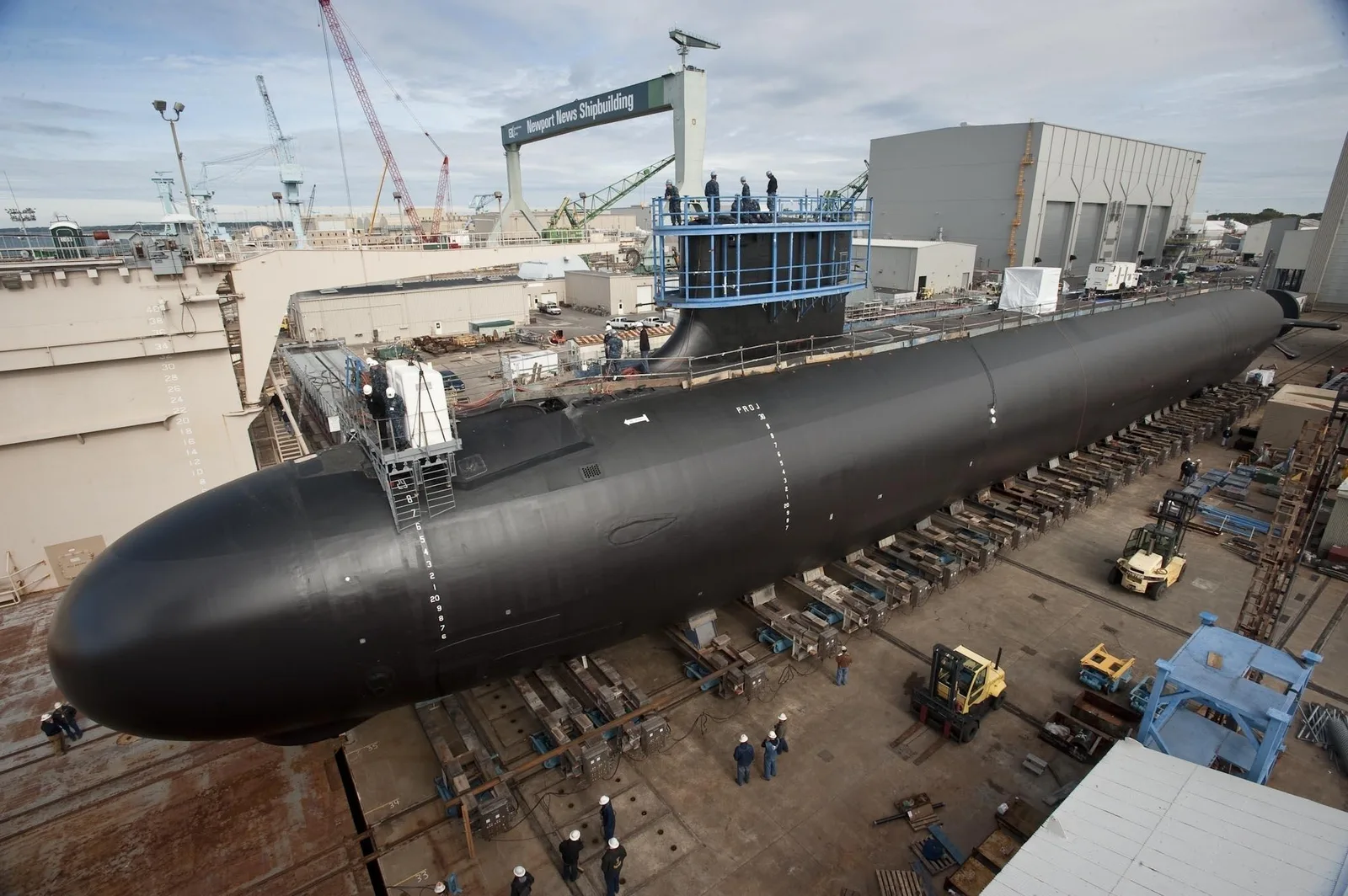
At Sparrows Point, near Baltimore, America intends to build part of its military future on the ground of its industrial past. The site once occupied by Bethlehem Steel is set to host Arsenal-2, a facility producing components for Virginia-class nuclear-powered submarines. On October 6, 2026, Anduril announced a $3.7 billion private investment, alongside a US Navy contract worth up to $2.9 billion. More than 3,100 direct jobs are expected over time. These figures represent different commitments: one finances industrial capacity; the other will pay for production outcomes. Together, however, they express a shared ambition. Washington wants, once again, to turn capital, labor and physical infrastructure into strategic power.
The following day, in Athens, Marco Rubio supplied a political narrative for that ambition. In the excerpt circulated by the State Department, the secretary of state connects the discrediting of nationalism with open borders, industrial offshoring and military decline. His speech defends the legitimacy of national interest and calls on Western societies to recover the determination to defend their inheritance. This is a political interpretation: it gathers developments with different causes into a single explanation. Yet it illuminates how the American administration intends to present its policies. Industry, energy, borders and armed forces become elements of the same promise of restoration.
The emerging proposition therefore extends beyond trade protectionism. The United States is seeking to redefine national power around the ability to produce, maintain and replace what it depends on. Buying equipment is no longer enough if nobody can repair it during a crisis. Designing a technology no longer guarantees control over it if manufacturing depends on a vulnerable location. Having the necessary financial resources offers no protection against a shortage when the supplier can refuse delivery. Geography is returning to the national balance sheet.
For much of the post-Cold War period, globalization encouraged a different arrangement. For companies, it seemed rational to separate functions, locate each stage wherever costs, skills and infrastructure were most favorable, and connect the whole through trade. The United States could retain research, software, brands, financial services and some of the most complex manufacturing while purchasing abroad a growing share of the goods it consumed. This arrangement delivered genuine gains: lower prices, larger markets and higher profitability for many businesses.
It nevertheless contained a blind spot. A company’s income statement does not fully capture what a place loses when an industrial ecosystem falls apart. Closing a factory can improve its owner’s profitability while weakening local suppliers, technical training, public revenues and the country’s ability to respond to an emergency. The private gain is immediately identifiable. The collective loss emerges later, when attempts begin to rebuild what once appeared replaceable.
This history cannot be reduced to offshoring. The Bureau of Labor Statistics recorded 19.6 million manufacturing jobs in June 1979, compared with 12.8 million forty years later. That decline accompanied several transformations: automation, productivity gains, international competition, recessions and a shift in demand toward services. It means neither that the United States stopped producing nor that every lost job moved to China. It does, however, reveal the scale of the social transformation on which the promise of reindustrialization now draws.
The current shift concerns, above all, what the state is prepared to leave dependent on foreign supply. An ordinary import becomes a strategic vulnerability when its interruption can immobilize an electricity network, an automotive production line or a military program. The question is no longer simply how much a product costs. It becomes how much power belongs to whoever can interrupt its supply. The cheapest supplier may also possess the most effective means of exerting pressure.
This reassessment predates Donald Trump’s return to the White House. The CHIPS and Science Act of 2022 had already established an explicit policy to rebuild American semiconductor capacity. The programs entrusted to the Department of Commerce provided $39 billion in manufacturing incentives and $11 billion for research and development. The Biden administration had therefore acknowledged that technological superiority could not rest solely on design and intellectual property. It also required facilities, equipment and manufacturing expertise on American soil.
There is consequently a strategic continuity beneath partisan conflict, without complete agreement on policy. Administrations differ over climate, alliances, immigration and the respective roles of subsidies and tariffs. They converge more closely on the need to reduce certain industrial dependencies. What distinguishes Trumpism is its placement of this reconstruction within a broader assertion of sovereignty, in which the American market itself becomes a bargaining instrument.
Tariffs play a central role in that logic. By making imports more expensive, Washington seeks to change corporate calculations: producing in the United States should become more attractive than serving the United States from abroad. But this protection has different effects depending on a company’s position in the value chain. A steelmaker may benefit from higher prices while a machinery manufacturer pays more for its inputs. A measure that supports one industry can weaken another’s competitiveness.
The first Trump administration offers evidence of this tension. In its assessment of measures applied between 2018 and 2021, the US International Trade Commission estimated that steel tariffs increased affected US production by 1.9% and prices by 2.4%. It also estimated that the corresponding steel and aluminum tariffs reduced production in downstream industries using those materials by $3.5 billion in 2021. The study found that American importers bore almost the entire cost of the tariffs. These historical findings are not an assessment of policies in 2026, nor do they measure their potential strategic benefits. They are a reminder that protection carries a domestic price.
The real question then becomes how the time purchased through protection is used. A company can take advantage of reduced exposure to competition to invest, train workers and improve productivity. It can also simply increase its margins. Successful industrial policy must be able to distinguish between those paths. Without competition, verifiable objectives and regulatory predictability, economic patriotism risks financing entrenched positions rather than new capabilities. Conversely, constantly renegotiated trade rules can delay the very investments that tougher protection was meant to encourage.
Critical minerals show why tariffs alone are insufficient. In rare earths used for magnets, industrial concentration extends far beyond extraction. According to the International Energy Agency, China accounted for approximately 60% of mining output for these rare earths in 2024, but 91% of refined output and 94% of sintered permanent magnet production. Owning a deposit therefore does not guarantee control over the supply chain. Between the rock and the motor lie separation, processing and manufacturing operations whose expertise and facilities are highly concentrated.
Rebuilding these activities requires making investment viable over the long term. A facility deemed essential to national security may remain unattractive to investors if global prices are volatile and a dominant competitor can suddenly expand supply. This was precisely the problem addressed by the partnership announced in July 2025 between the Pentagon and MP Materials: a $400 million investment in convertible preferred stock, a ten-year price floor of $110 per kilogram for neodymium-praseodymium products, and guaranteed demand for magnets from a new facility. The state intervened simultaneously in financing, pricing and demand.
This mechanism reveals the depth of the change. Public authorities consider that a productive capability can have a national value greater than its immediate commercial return. They are prepared to pay for a form of industrial insurance. That logic can be justified when a dependency is critical, but it demands discipline: identifying what truly deserves protection, verifying deliveries and preventing a strategic guarantee from becoming a permanent source of unearned profits. Taxpayers are not merely financing a company. They are purchasing the ability to avoid paralysis.
That ability rests on a basic condition: access to electricity. A semiconductor plant, a data center and a metalworking facility belong to different industries, but all depend on sufficient and reliable power. The digital economy makes this constraint more visible still. In a study published in December 2024, Lawrence Berkeley National Laboratory estimated that US data centers had consumed 176 terawatt-hours in 2023, approximately 4.4% of national electricity consumption. Its scenarios for 2028 placed their consumption between 325 and 580 terawatt-hours. These are projections, but their scale alone illustrates the physical demands of digital expansion.
Energy abundance cannot, however, be measured solely in oil and gas reserves. A facility needs a grid connection, transformers, transmission lines, capacity available in the right location and permits secured on time. An energy power can still face local electricity shortages. Industrial success therefore depends on coordinating investments whose schedules do not naturally align. Building a data center within a few years is insufficient if the network needed to power it takes longer.
At Sparrows Point, this coordination problem acquires a military dimension. A submarine requires a succession of specialized operations, certified materials and suppliers capable of meeting exceptionally demanding standards. Additional capacity at a critical stage can improve the performance of the whole system; it cannot replace the entire chain. Arsenal-2 is specifically intended to manufacture components for the Virginia program. The announcement of a new facility is therefore a step toward future capacity, whose value will depend on the qualifications, production rates and deliveries actually achieved.
Military power here recovers a dimension that sophisticated weaponry can obscure. It also depends on the number of systems available, the speed of repairs and the ability to replace losses. A budget can be approved quickly; a qualified welder, a specialized workshop or a certified supplier cannot be created by decree. Industrial depth determines how long a country can sustain its effort. Shipyards and arsenals thus become infrastructure of sovereignty, as essential in their own way as military bases.
Then comes the question of workers, which introduces a tension into the narrative of national restoration. Border control is a political and legal choice. Its economic consequences nevertheless depend on the people affected, the sectors involved and the measures adopted. Reducing irregular immigration, limiting the arrival of researchers and restricting the recruitment of foreign technicians are distinct decisions. Treating them as a single category would obscure their effects on production.
A country seeking to expand construction, manufacturing and energy capacity must be able to mobilize enough skilled people. Domestic training is essential, but it takes time. Restrictive immigration policy can therefore conflict with ambitious industrial policy if it reduces access to the workers required. Automation eases some shortages; it does not eliminate installation, maintenance or engineering. The coherence of the project will also be judged by how Washington reconciles the political community it wants to protect with the human capabilities its economy needs.
The social promise contains another difficulty. Rebuilding production does not mean recreating twentieth-century industrial employment in the same form. New factories are often more intensive in capital, software and automation. They can produce more with fewer employees. Their national contribution must therefore be assessed beyond announced job numbers: pay, training, local suppliers, domestic value added and the spread of expertise. A facility assembling imported components does not create the same industrial depth as an ecosystem capable of designing, manufacturing and maintaining its equipment.
Nor can that depth be entirely American. The pursuit of autonomy runs up against the complexity of technological supply chains. Manufacturing equipment, materials, expertise and resources remain distributed across several countries. American strategy must therefore decide what to produce domestically and what to secure through partners. It requires an industrial diplomacy in which the reliability of alliances matters as much as access to markets.
For those partners, the situation is ambiguous. Investing in the United States can provide access to substantial demand and lasting orders. It can also redirect capital and expertise that might otherwise have strengthened their own productive systems. American reconstruction thus poses a question for Europeans and allied Asian economies alike: how much of their own autonomy are they prepared to commit to Washington’s? An alliance can distribute capabilities efficiently; it can also become an arena of competition to attract them.
The return of the productive nation therefore describes neither an achievable autarky nor an industrial renaissance already accomplished. It describes a new hierarchy of priorities. Security of supply, equipment availability and control over critical capabilities are gaining weight relative to the pursuit of the lowest possible cost. The success of this approach will depend less on the force of its slogans than on the quality of its execution: stable rules, available infrastructure, skills, competition and scrutiny of public commitments.
At Sparrows Point, history offers an almost too convenient setting. Former steelmaking ground is to contribute to a new generation of submarines. Between the two, however, lie years of construction, recruitment and learning. It is within that interval that the doctrine’s real significance will be measured.
The United States could long afford to believe that its power allowed it to dispense with certain factories. It is rediscovering that an immense market, a dominant currency and a technological lead cannot always substitute for manufacturing capacity. In a world shaped once again by conflict, factories may also be what allows a country to remain a power.
Main Sources
Anduril Industries, announcement of Arsenal-2 and the associated US Navy contract, October 6, 2026; State of Maryland, presentation of the Sparrows Point project, October 6, 2026.
Reuters, Marco Rubio’s speech in Athens, October 7, 2026; speech excerpt circulated by the US Department of State.
Bureau of Labor Statistics, “Forty years of falling manufacturing employment,” November 2020.
National Institute of Standards and Technology, CHIPS for America program overview and funding allocations under the 2022 legislation.
US International Trade Commission, “Economic Impact of Section 232 and 301 Tariffs on U.S. Industries,” March 2023.
International Energy Agency, “Rare Earth Elements,” executive summary and industrial concentration data for 2024.
MP Materials, announcement of its partnership with the Department of Defense, July 10, 2025.
US Department of Energy and Lawrence Berkeley National Laboratory, “2024 United States Data Center Energy Usage Report,” December 2024.
Atlas Limits Research Desk
Atlas Limits’ editorial and analytical desk.