As the November 3, 2026 midterm elections approach, Barack Obama is returning to the campaign trail to support Democratic candidates and challenge Donald Trump’s record. Beyond the confrontation between two presidents lies a much larger institutional struggle: control of Congress, oversight of executive power, and the future balance of American democracy.
A Former President Returns to a Divided America
With the United States approaching its midterm elections, Barack Obama is once again assuming a familiar political role: mobilizing Democratic voters.
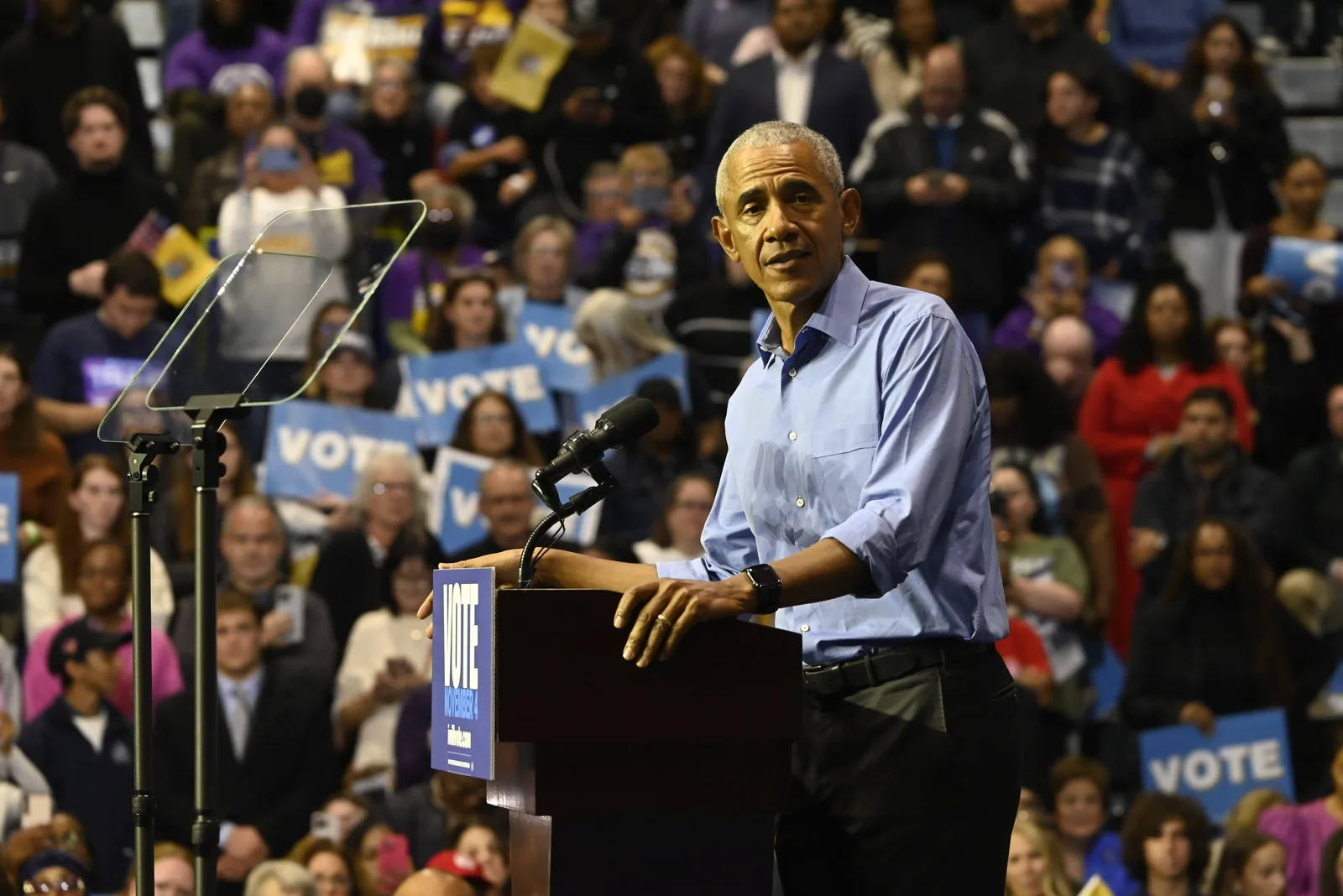
During a campaign rally in Ohio, the former president criticized Donald Trump, his administration, and the political priorities of the White House.
His intervention comes as Democrats seek to translate economic concerns, presidential controversies, and institutional tensions into electoral momentum.
Obama is not running for office. Yet his return illustrates a defining feature of contemporary American politics: former presidents can retain considerable influence over electoral campaigns, particularly when their parties are attempting to regain congressional power.
But the significance of his intervention extends well beyond the personal rivalry between Obama and Trump.
On November 3, 2026, American voters will elect all 435 members of the House of Representatives and approximately one-third of the Senate.
The outcome will determine the extent to which the Trump administration can advance its legislative agenda and the ability of Congress to exercise oversight over the executive branch.
These elections therefore represent a major institutional test for American democracy.
Midterm Elections as a Mechanism of Democratic Correction
Midterm elections occupy a distinctive position within the constitutional architecture of the United States.
Held two years after a presidential election, they allow voters to change the composition of Congress without waiting for the end of the president’s four-year term.
This mechanism creates an opportunity to rebalance power between the executive and legislative branches.
When the president’s party controls both chambers, the administration generally enjoys greater political flexibility in pursuing its legislative priorities.
Conversely, an opposition victory in either chamber can substantially alter the conditions under which the country is governed.
An opposition-controlled House of Representatives can launch congressional investigations, organize hearings, request documents from the administration, and influence federal budget negotiations.
The Senate performs a different institutional role, particularly through its authority to confirm presidential appointments and participate in major constitutional decisions.
Both chambers are also essential to passing legislation and determining federal spending.
The central question of the midterms is therefore not simply which party will win the most seats.
It is how presidential authority will be exercised during the remaining two years of Donald Trump’s term.
Obama Versus Trump: Two Models of Political Mobilization
Barack Obama’s reappearance on the campaign trail also highlights the growing personalization of American political life.
For many Democratic voters, Obama represents institutional continuity and the electoral coalitions built around major metropolitan areas, minority communities, younger educated voters, and progressive constituencies.
Donald Trump draws support from a different coalition, including substantial segments of conservative voters, rural communities, voters favoring restrictive immigration policies, and groups concerned about industrial and economic transformation.
These descriptions do not capture the full diversity of either electorate.
They nevertheless help explain why the confrontation extends far beyond competing electoral platforms.
It involves different narratives about American identity, the role of the federal government, democratic institutions, and the country’s position in the world.
Obama’s interventions are intended to energize Democratic voters while reaching Americans who have reservations about the current administration.
Trump, meanwhile, frequently frames electoral confrontations as decisive choices concerning national sovereignty, border security, and the preservation of his political agenda.
This polarization increasingly transforms congressional elections into national contests centered on the presidency.
The risk is that local candidates, their policy proposals, and the specific concerns of individual states become secondary to the broader confrontation.
The Economy at the Center of the Electoral Battle
Beneath the political rhetoric, economic concerns remain decisive.
Purchasing power, housing affordability, healthcare expenses, industrial employment, taxation, and economic prospects are among the issues likely to influence voters.
For Democrats, one objective is to connect decisions made by the Trump administration to the economic difficulties experienced by certain households.
For Republicans, the challenge is to defend their economic record, emphasize their policy priorities, and persuade voters that political continuity will support growth and economic security.
Yet economic perceptions do not necessarily follow macroeconomic indicators.
An economy can record positive growth while significant portions of the population continue to face high housing, insurance, and consumer costs.
Conversely, improvements in certain indicators may strengthen the governing party’s narrative without delivering equivalent benefits across all households.
This gap between national economic performance and individual economic experience is one of the defining characteristics of contemporary elections.
The 2026 midterms will therefore also represent a judgment on the American political system’s ability to translate economic performance into tangible improvements in living standards.
Congress Is the Real Prize
The composition of the next Congress will determine the political conditions surrounding the second half of Donald Trump’s presidency.
Three broad scenarios are possible.
Scenario One: Republicans Retain Both Chambers
If Republicans maintain control of the House and Senate, the administration would benefit from institutional continuity and a more favorable environment for advancing its legislative priorities.
Such an outcome would not guarantee passage of every presidential initiative.
Internal party divisions, congressional procedures, and Senate voting requirements would continue to constrain certain proposals.
Nevertheless, the president would be negotiating with a Congress more closely aligned with his political agenda.
Scenario Two: Democrats Win the House, Republicans Retain the Senate
This outcome would create a divided legislature.
A Democratic-controlled House could intensify executive oversight and reshape negotiations over federal spending.
The administration would face greater pressure to seek compromises to pass legislation.
Congressional committees could also assume a more confrontational role in examining government decisions and administrative practices.
Scenario Three: Democrats Win Both Chambers
A Democratic victory in both the House and Senate would represent a more substantial shift in institutional power.
The president would retain his constitutional authorities, but his legislative program would encounter organized parliamentary opposition.
Presidential nominations requiring Senate confirmation would become another major area of political confrontation.
In all three scenarios, the balance of power would be affected, although in significantly different ways.
Congressional Oversight and the Limits of Presidential Power
The American Constitution establishes a separation of powers designed to prevent excessive concentration of authority within a single institution.
Congress does more than pass legislation.
It possesses oversight mechanisms intended to examine executive conduct, the use of public funds, and the operation of federal agencies.
Congressional committees can hold hearings, conduct investigations, and request information from the administration.
However, the effectiveness of these powers depends on political majorities, applicable legal rules, and, in certain circumstances, judicial decisions.
An opposition victory does not automatically guarantee effective oversight.
It creates the political conditions under which stronger oversight may become possible.
This distinction is essential.
A democracy does not depend solely on the formal existence of checks and balances.
It also depends on whether those mechanisms can function effectively.
The November elections will therefore help determine whether American institutions produce a meaningful rebalancing of authority or preserve the existing distribution of political power.
An American Election With Global Consequences
The consequences of the midterms will extend far beyond the United States.
Congressional decisions influence several major dimensions of American international policy.
Trade and Industrial Policy
Commercial relations with China, the European Union, and other major economic partners may be affected by the legislative and budgetary priorities of the next Congress.
Tariff policy is partly exercised through presidential authorities established by legislation, but Congress retains significant constitutional powers over international commerce.
Changes in congressional majorities could therefore reshape debates concerning tariffs, supply chains, industrial subsidies, and international economic agreements.
Defense and International Alliances
Congress plays an essential role in authorizing military expenditure, funding certain operations, and scrutinizing strategic priorities.
American policy toward NATO, Ukraine, the Middle East, and the Indo-Pacific could become the subject of renewed political and budgetary negotiations.
However, the presidency retains considerable authority in diplomacy and national security.
An opposition-controlled Congress would not, by itself, be able to redefine the entirety of American foreign policy.
Public Debt and Financial Stability
Negotiations over the federal budget, government spending, and the statutory debt ceiling can become particularly difficult when the White House and Congress are controlled by opposing parties.
International investors closely monitor these confrontations because they can influence fiscal predictability, the functioning of federal institutions, and perceptions of American political risk.
The implications extend beyond domestic financial markets.
Given the central role of the US dollar and Treasury securities in the international financial system, prolonged budgetary deadlock can generate consequences across the global economy.
Is Polarization Weakening the Democratic Function of Elections?
Obama’s renewed political involvement raises a broader question.
In a deeply polarized democracy, can elections still serve as mechanisms through which citizens evaluate and sanction government performance, or are they increasingly becoming contests between entrenched partisan identities?
Both dynamics can coexist.
Voters may remain loyal to a political party while forming specific judgments about economic conditions, security, institutions, and foreign policy.
Yet when perceptions of political reality diverge sharply, the corrective function of elections becomes more difficult to interpret.
An electoral victory does not necessarily imply endorsement of every policy advanced by the winning candidate.
Likewise, defeat does not constitute a uniform rejection of an entire political program.
Election results aggregate a wide variety of individual motivations.
That is precisely why their significance must be assessed beyond the number of seats won.
Voter turnout, geographic shifts, independent voters’ behavior, and changes across demographic and socioeconomic groups will be essential to understanding the evolution of American politics.
Obama’s Return Also Exposes the Challenge of Political Renewal
Barack Obama’s participation in the Democratic campaign represents a potentially valuable mobilization asset.
But it also reveals a structural tension.
Nearly a decade after leaving the White House, the former president remains one of the Democratic Party’s most recognizable political figures.
His continued influence raises questions about the emergence of a new generation of leaders capable of building broad national electoral coalitions.
Democrats must simultaneously mobilize their traditional constituencies, persuade independent voters, and develop new political leadership.
Republicans face a different but related question: to what extent does the party’s political identity and electoral strategy remain structured around Donald Trump?
These developments illustrate a common transformation.
American politics remains heavily influenced by presidential personalities whose political authority extends beyond individual elections.
Congressional contests increasingly become extensions of presidential confrontations, even when the offices at stake are fundamentally different.
November 3: A Test for American Institutions
The 2026 midterm elections will not directly determine who occupies the White House.
They could nevertheless profoundly reshape the conditions under which presidential power is exercised.
Barack Obama’s return to the campaign trail demonstrates the importance Democrats attach to the election.
But the true significance of the vote will lie in its institutional consequences.
American voters will determine the composition of a Congress capable of supporting, negotiating with, or challenging the Trump administration.
They will also influence the conditions under which congressional committees exercise their oversight responsibilities.
For America’s international partners, the outcome will provide an important indication of political stability and the predictability of US policymaking.
Beyond the confrontation between two presidents from opposing political traditions, the midterms therefore raise a fundamental question:
In a deeply polarized presidential democracy, can midterm elections still produce an effective rebalancing of political power?
The answer will not depend solely on the results of November 3.
It will also depend on how American institutions operate after the election.
Because the strength of a democracy is not measured only by its ability to hold elections.
It is also measured by its capacity to translate electoral outcomes into political accountability, institutional oversight, and effective limits on the exercise of power.
Atlas Limits — North America | Politics, Institutions & Geopolitics
Editorial Analysis — October 25, 2026
Atlas Limits Research Desk
Atlas Limits’ editorial and analytical desk.