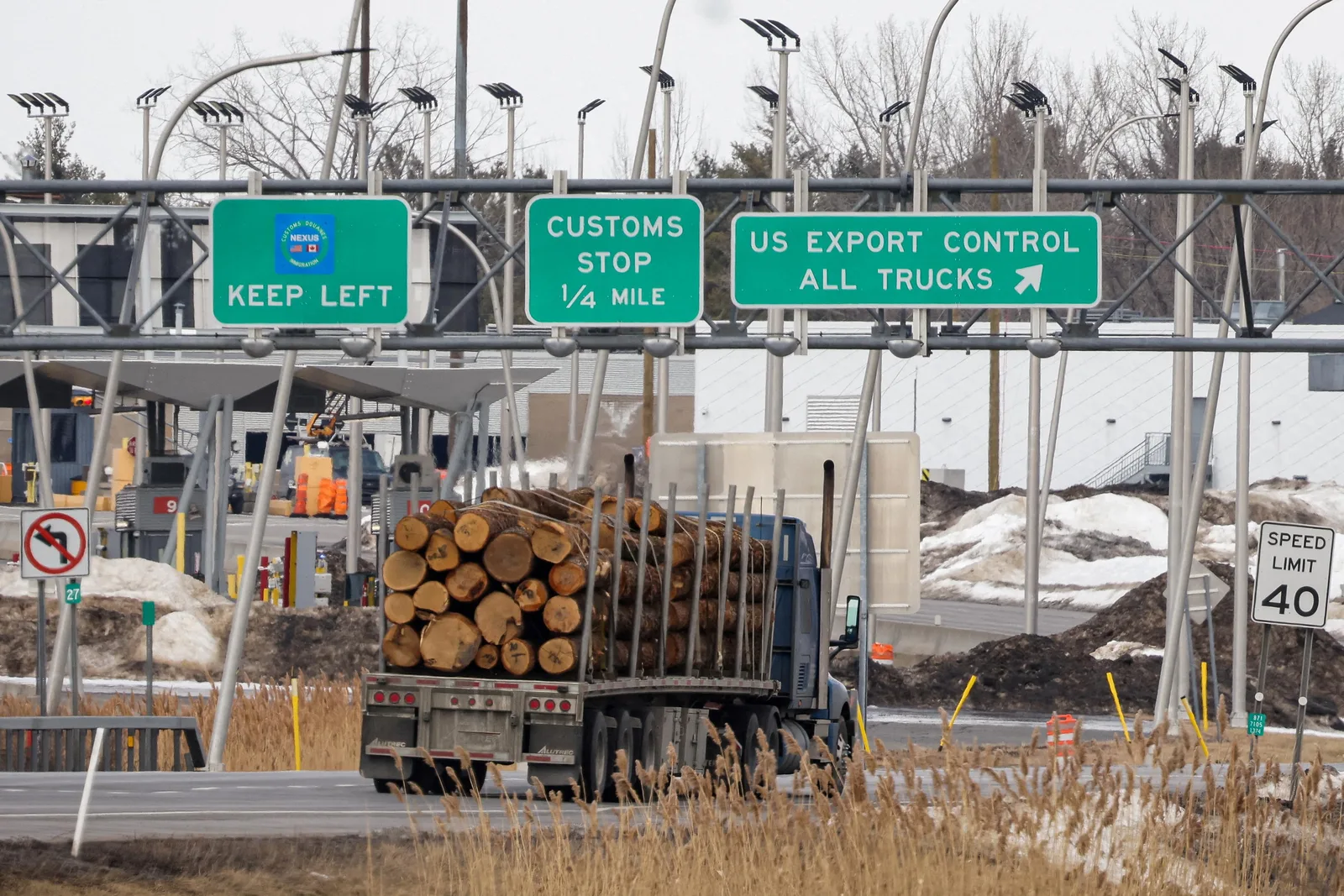
For decades, the border between the United States and Canada was less an economic divide than a seam. Cars could cross it several times before they were finished. Canadian energy supplied American cities and industries. Companies organized their supply chains by treating the two countries less as foreign markets than as different parts of the same productive space. Washington and Ottawa could quarrel over softwood lumber, dairy, aluminum or public procurement without fundamentally challenging that architecture.
That era has not disappeared. But it is changing.
On September 8, 2026, the United States announced that certain Canadian goods would soon be barred from entering the American market, including a broad range of alcoholic beverages, some dairy products and certain categories of motorcycles and mopeds. The measures are scheduled to take effect at 12:01 a.m. Eastern Time on September 29. Other products, including several categories of cheese and industrial goods, are being subjected to tariffs of 50%.
The same day, Donald Trump instructed the General Services Administration and the United States Trade Representative to begin removing Canadian-origin products from relevant federal procurement programs until Washington considers that sufficient reciprocity has been restored.
Taken separately, the prohibited products will not transform the balance of the North American economy. Taken together, however, the instruments being deployed reveal something much larger. After tariffs comes prohibition. After the commercial border comes public procurement. And behind these measures, a question is gradually resurfacing that the United States and Canada thought they had settled a generation ago: how integrated should their economies remain?
An Integration Built Over Four Decades
The contemporary trade relationship between the two countries was constructed in stages. The Canada–United States Free Trade Agreement, which entered into force in 1989, followed by NAFTA in 1994, progressively transformed the economic meaning of the border. Companies invested, specialized their plants and organized logistics around the assumption that goods could circulate with relatively little friction between Canada, the United States and Mexico.
The automotive industry became perhaps the clearest expression of this system. A component manufactured in a Canadian plant can be incorporated into a subassembly in the United States, return to Canada or move to Mexico, and eventually cross the border again inside a finished vehicle. In such a system, the economic nationality of a product becomes less obvious than its final place of assembly might suggest.
Energy created another form of interdependence. Canadian oil, natural gas, electricity and raw materials became deeply embedded in the American productive system. The United States became by far Canada's largest export market; Canada, in turn, became a strategic supplier to numerous sectors of the American economy.
Integration never eliminated disputes. Softwood lumber generated seemingly endless conflicts. Canada's supply-management system in agriculture regularly irritated Washington. Automotive rules of origin became the subject of difficult negotiations. But these disputes generally took place within an architecture whose underlying principle was rarely questioned.
Even Donald Trump, during his first term, ultimately replaced NAFTA with another continental agreement rather than abandoning North American free trade. The USMCA, which entered into force in 2020, altered the rules while preserving the essential premise: that the three economies had an interest in continuing to function as a deeply integrated commercial space.
Donald Trump's second term has progressively shifted that political boundary.
2025: The Return of the Border
Beginning in 2025, relations between Washington and Ottawa entered a much more confrontational period. American tariffs and Canadian countermeasures brought the border back to the center of economic decisions. Canada imposed 25% tariffs on C$30 billion of American goods in March 2025, then expanded its countermeasures in response to US tariffs on steel and aluminum.
The USMCA nevertheless absorbed part of the shock. A significant share of Canadian merchandise continued to enter the United States duty-free when it complied with the agreement's requirements. Trade was disrupted, but the continental architecture still held.
The effects nevertheless became visible in trade flows. By the end of 2025, Canadian merchandise exports to the United States remained significantly below the levels recorded before the commercial rupture of the spring. At the same time, Canadian exports to other markets increased.
Something was beginning to change beyond the tariffs themselves: companies were discovering that access to the American market, long treated as a structural fact, had once again become a political variable.
The change of government in Ottawa occurred precisely in this environment. Mark Carney inherited a relationship with Washington that had already deteriorated substantially. Canada's problem was no longer simply to negotiate a few tariff exemptions. Increasingly, it was about the country's economic dependence itself.
That dependence remains considerable. During the first months of 2026, roughly 68% of Canadian exports were still destined for the United States. The proportion had declined from earlier levels, but it was still enough to reveal the fundamental asymmetry of the confrontation. Canada is indispensable to specific segments of the American economy; the American market is indispensable to a much larger share of the Canadian economy.
Those are not quite the same dependencies.
The USMCA Is No Longer an Insurance Policy
The year 2026 deepened the rupture.
In July, Washington declined to extend the USMCA for another sixteen-year period, moving the agreement into a mechanism of annual reviews. The treaty did not disappear: legally, it can continue until 2036. But its political function changed. What was designed to provide companies with a horizon of stability became an object of recurring negotiation.
A few weeks later, Washington revived a much older instrument.
Section 338 of the Tariff Act of 1930 allows the US president to take measures against countries considered to discriminate against American commerce. In July 2026, Donald Trump invoked it to announce tariffs of up to 50% on several categories of Canadian products. After negotiations failed, those duties took effect on August 22 on C$27.6 billion worth of goods, according to the Canadian government.
Ottawa then chose reciprocity. On September 8, Canada imposed counter-tariffs of 15%, 25% and 50% on C$27.6 billion worth of American products, including steel, dairy products, household appliances, agricultural equipment, pulp and paper, plastics and electronics.
Washington responded the same day.
And this is where the sequence changed in character.
From Tariffs to Prohibition
A tariff, even one of 50%, still leaves companies with an economic choice. An exporter can reduce its margin. An importer can absorb part of the cost. The final price can rise. Production can be reorganized. Trade becomes less profitable, sometimes dramatically so, but it remains legally possible.
An import ban removes that equation.
From September 29, for the categories covered by the American proclamations, the question will no longer be at what price a Canadian product can enter the US market. It simply will not be allowed to enter.
The distinction may sound technical. Economically, it is substantial.
For a Canadian company dependent on the United States, three broad possibilities then emerge: find another market, relocate part of its production, or lose access to American customers. For groups that already operate facilities in the United States, relocation may become economically rational. For smaller companies, it may not be feasible at all.
Trade policy thus begins to become industrial-location policy.
The threat directed at Bombardier illustrates this evolution. Donald Trump has said that the Canadian manufacturer could be prevented from selling aircraft in the United States unless it produces more on American soil. The legal and industrial feasibility of such a measure remains uncertain, particularly because Bombardier already maintains a substantial network of operations, employees and suppliers in the United States. But the political message extends beyond the company itself: access to the American market could increasingly depend less on compliance with continental trade rules than on where production takes place.
Public Procurement Enters the Conflict
The decision concerning federal procurement opens a second front.
Public procurement is not an ordinary market. The state directly determines who can become its supplier. By instructing the General Services Administration and the US Trade Representative to begin removing Canadian goods from relevant federal programs, Washington is turning its own purchasing power into an instrument of commercial negotiation.
The actual reach of the measure will depend on implementing rules, the agencies involved, existing contracts and possible exemptions. It would therefore be premature to quantify its economic impact.
But the direction is clear.
The trade conflict is no longer only about what crosses the border. It is beginning to determine who is allowed to sell to the American state.
Tariffs, import prohibitions, industrial localization, public procurement: the instruments are accumulating. Their combination progressively reduces the practical value of the commercial preferences written into the USMCA.
The Automotive Industry Is the Real Test
The next threshold is already visible.
Washington has threatened to raise tariffs on Canadian automobiles, trucks and auto parts to 50% from January 1, 2027.
If that threat were implemented in full, the scale of the conflict would change.
The automotive industry is not a peripheral part of the economic relationship between the two countries. It is one of the historical products of North American integration. Canadian and American factories do not constitute two independent automotive systems that occasionally trade vehicles with each other. They belong to deeply intertwined production chains.
That is precisely what makes tariffs in this sector powerful, but also difficult to use.
A duty intended to punish a "Canadian" automobile can hit American components incorporated into that vehicle. Production shifted into the United States can reduce activity at a Canadian supplier while simultaneously increasing costs for an American manufacturer. A thicker commercial border does not neatly separate two economies: it cuts through companies that have spent decades learning to ignore it.
This is the central paradox of the new relationship between Washington and Ottawa. The more the United States seeks to use the border as an economic instrument, the more it discovers how difficult decades of integration have made that border to reconstruct.
Canada's Bet
For Ottawa, however, the response cannot be symmetrical.
The American economy is far larger and has a domestic market that allows it to substitute certain suppliers or production more easily. Canada possesses important forms of leverage — energy, minerals, aluminum, lumber, automotive supply chains, agriculture and access to strategic resources — but it does not possess an equivalent to the American market.
Mark Carney is therefore increasingly attempting to turn the crisis into a strategy of diversification.
The idea is hardly new. Canadian governments have spoken for decades about reducing dependence on the United States. Geography has generally provided a reminder of the limits of that ambition. There are few circumstances in which a Canadian company can replace a customer located a few hundred kilometers away with one in Europe or Asia without incurring additional logistical, regulatory and commercial costs.
The difference now is that dependence itself is becoming more expensive.
Trade statistics are beginning to show this shift. In July 2026, the US share of Canadian exports had fallen to roughly 66%, while exports to non-US markets were increasing. Across the year to that point, the proportion remained close to 68%, compared with roughly 73% previously.
This is not decoupling. It would be a strange description of a relationship in which more than two-thirds of one country's exports still travel to its neighbor.
But it may represent the beginning of diversification imposed by political risk rather than chosen solely for economic efficiency.
A Border Becoming Political Again
It would be premature to declare the end of economic integration between the United States and Canada. Trade flows remain immense. Production chains are too intertwined to be dismantled quickly. A large share of Canadian commerce continues to benefit from USMCA protections. And the measures announced by Washington can still be suspended, negotiated or modified.
But economic relationships do not depend only on the tariffs companies pay today. They also depend on what companies believe will happen tomorrow.
For decades, a Canadian manufacturer could invest while treating access to the American market as one of the most stable assumptions in its business environment. An American manufacturer could construct a supply chain in Canada without seriously imagining that a presidential decision might one day prohibit entire categories of products from crossing the border.
That certainty is eroding.
This may ultimately be the deepest consequence of the current confrontation. Tariffs can be removed. Import bans can be lifted. Washington and Ottawa can still reach another compromise. But when a company decides where to build its next factory, it does not calculate only the duties applicable today. It also calculates the probability that those duties — or the rules themselves — will change tomorrow.
September 29, 2026 will therefore probably not mark the economic closure of the US–Canadian border. A few categories of goods will stop crossing it while hundreds of billions of dollars of other products continue to move in both directions.
The change is more subtle.
For nearly four decades, the United States and Canada progressively learned to organize their economies as though this border mattered less and less.
They are now beginning to learn again that it exists.
Main Sources
The White House — Presidential proclamations of September 8, 2026 concerning Canadian imports and measures taken under Section 338 of the Tariff Act of 1930.
Government of Canada, Department of Finance — Canada's response to US tariffs and Canadian countermeasures taking effect on September 8, 2026.
Statistics Canada — Recent developments in the Canadian economy, Spring 2026; data on the evolution of merchandise trade between Canada and the United States.
Reuters — reporting on the September 8, 2026 US measures, Canadian counter-tariffs, the evolution of bilateral trade negotiations and the threat concerning the automotive industry.
Reuters — chronology of the US–Canada trade conflict since Donald Trump's return to the presidency in January 2025.
Atlas Limits Research Desk
Atlas Limits’ editorial and analytical desk.