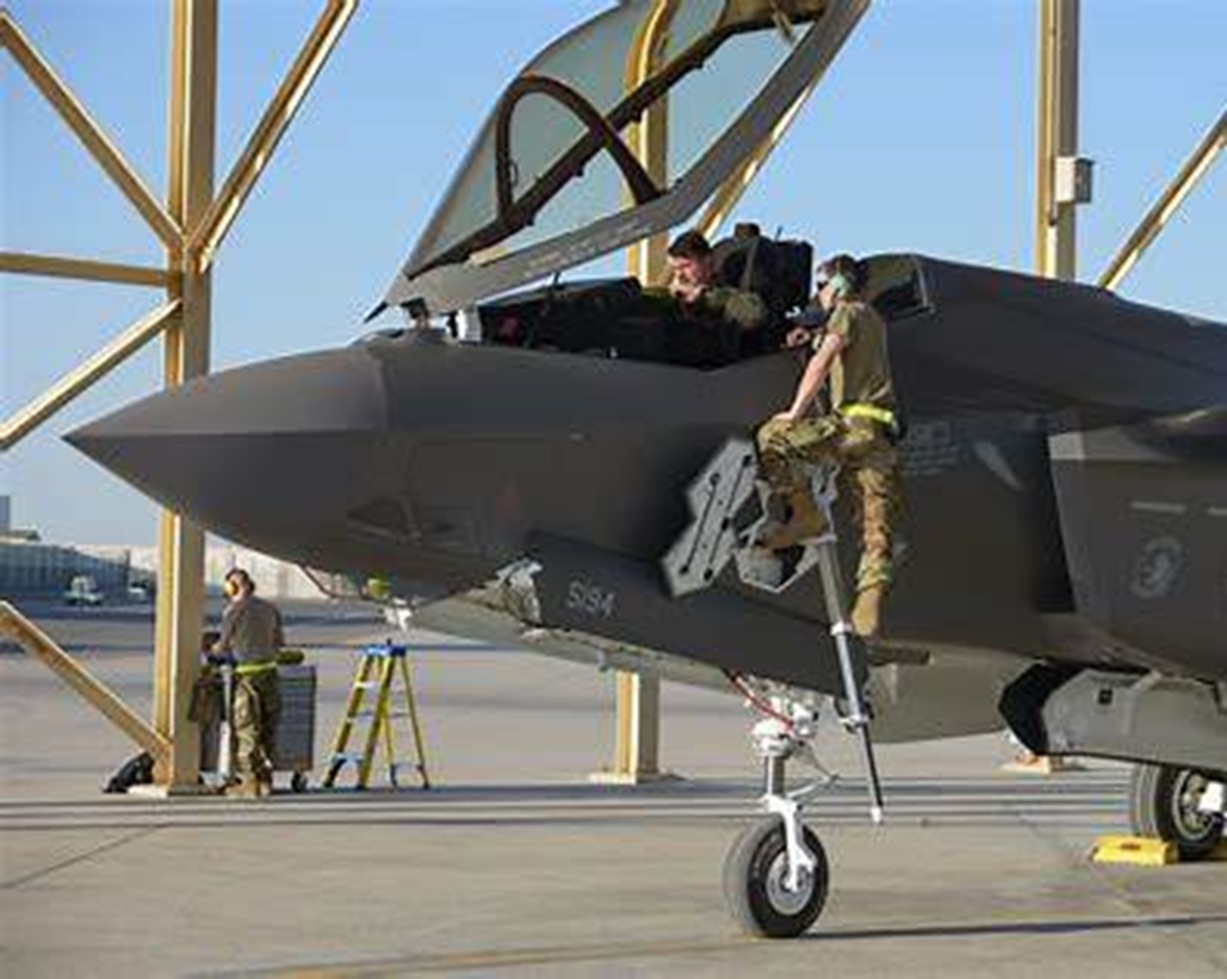
For years, the boundary was relatively clear. The United States sold Gulf monarchies some of its most advanced military systems, but the F-35 remained in a separate category. In the Middle East, Israel was the only operator of the American stealth fighter.
That boundary is beginning to disappear.
On September 17, 2026, the U.S. State Department approved a potential military sale to Saudi Arabia valued at up to $24.3 billion. The notification submitted to Congress under reference 26-69 covers 48 conventional takeoff and landing F-35 Lightning II fighters and 49 Pratt & Whitney F135-PW-100 engines, including one spare, as well as communications equipment, spare parts, training and support services.
Lockheed Martin and Pratt & Whitney would be the principal contractors.
This is not yet a finalized contract. Congress must now review the proposed sale, while the final commercial and technical terms remain to be negotiated. The $24.3 billion figure therefore represents the maximum estimated value of the notification, not money already committed by Riyadh.
The significance lies elsewhere.
For the first time, Washington has formally entered the process that could transfer its most advanced combat aircraft to Saudi Arabia.
A political promise becomes a formal process
Donald Trump had announced as early as November 2025 that he intended to allow Saudi Arabia to acquire the F-35.
That statement was politically important, but it did not amount to formal authorization for a transfer. The September 17 decision moves that policy into the institutional machinery of U.S. arms sales.
If the transaction is completed, Saudi Arabia would become the first Arab country and the second Middle Eastern state, after Israel, to operate the F-35.
The change would extend far beyond the purchase of 48 additional aircraft.
The Royal Saudi Air Force already fields a powerful fleet centered on American F-15s and European Eurofighter Typhoons. But the F-35 belongs to a different military architecture.
Its low-observable design reduces its exposure to hostile radar. Its sensors combine information into a unified operational picture. Its electronic and communications systems allow the aircraft to collect, process and distribute information across a wider combat network.
The F-35 is therefore less an isolated aircraft than a node within a military system.
That is precisely what makes the American decision structural.
Buying the F-35 means entering a system
Purchasing any modern combat aircraft creates a relationship lasting decades. With the F-35, that relationship is particularly deep.
Pilot and technician training, maintenance, spare parts, software upgrades, weapons integration, data management and capability updates all remain closely connected to the U.S. defense ecosystem.
Saudi Arabia would therefore not merely be purchasing 48 airframes manufactured by Lockheed Martin.
It would be integrating more deeply into a military infrastructure designed, updated and to a significant extent controlled from the United States.
This helps explain the broader geopolitical importance of the decision.
Riyadh has spent years diversifying its international relationships. China has become one of the kingdom's most important economic partners. Beijing's role across the Gulf has also expanded in energy, infrastructure and technology and, to a much more limited degree, defense.
Washington, however, retains an advantage that is extremely difficult to replicate: access to the most sophisticated parts of the American military ecosystem.
The F-35 can therefore be understood simultaneously as an expansion of Saudi military capability and as an instrument of strategic anchoring.
The more deeply Riyadh integrates such systems, the more some of its most important military capabilities will depend on a durable relationship with the United States.
The Israeli precedent
The proposed sale immediately raises another question: Israel.
Since its introduction in the region, the F-35 has represented one of the clearest manifestations of Israel's technological military advantage. Israel operates its own adapted version, the F-35I “Adir,” integrated with elements of its national military architecture.
U.S. law also requires Washington to consider Israel's “qualitative military edge” when approving arms transfers to Middle Eastern states.
The U.S. administration maintains that the proposed Saudi sale would not alter the regional military balance.
But that statement does not settle the issue.
The decisive question will be the configuration Washington ultimately authorizes for Riyadh.
Not every F-35 customer necessarily receives identical operational capabilities. Authorized weapons, electronic-warfare functions, secure communications and certain sensor or software capabilities can be subject to restrictions or customer-specific configurations.
The meaningful comparison will therefore not be limited to the number of aircraft.
It will depend on what Saudi F-35s are ultimately permitted to do.
The China question
Another issue is likely to accompany the program throughout its development: Saudi Arabia's relationship with China.
The F-35 incorporates some of the most sensitive technologies in the U.S. arsenal. Washington therefore places particular emphasis on physical security, digital infrastructure and the potential exposure of aircraft-related data.
This is not an abstract concern.
Economic and technological links between Riyadh and Beijing have expanded considerably in recent years. The presence of Chinese equipment or systems within sensitive Saudi infrastructure could therefore become the subject of additional negotiations or restrictions if Washington considers them incompatible with protecting F-35 technology.
The real cost of the program may consequently not be measured solely in dollars.
It could also require Saudi Arabia to make choices about the technological architecture surrounding parts of its military infrastructure.
A decision taken in a more dangerous region
The timing of the authorization adds to its significance.
Saudi Arabia continues to operate in a regional environment shaped by missile and drone proliferation, contested airspace, precision-strike capabilities and increasingly sophisticated air-defense systems.
The F-35 is not a direct answer to every one of these threats. Using a fifth-generation stealth fighter to intercept inexpensive drones would make little economic sense in many scenarios.
But the program addresses a broader requirement: Saudi Arabia's ability to operate in an environment where ballistic missiles, drones, integrated air defenses and long-range precision weapons are increasingly common.
The kingdom is no longer concerned solely with protecting its own territory.
It is also seeking an air force capable of operating inside a much more contested regional battlespace.
A transformation that will take years
It would nevertheless be premature to describe the Middle Eastern air balance as already transformed.
No Saudi F-35 has been delivered. No final contract has been announced. The proposal must pass through congressional review before moving into contracts, production, crew training, infrastructure construction and the creation of maintenance and support chains.
The process will take years.
During that period, numerous variables may still change: aircraft configuration, associated weapons, technological safeguards, delivery schedules or political conditions imposed by Washington.
Riyadh is also likely to seek a connection between the acquisition and its broader industrial strategy. Saudi Arabia increasingly wants more defense spending, maintenance capacity and industrial value to remain inside the kingdom.
The notification, however, does not by itself establish major industrial offsets. Any such arrangements would have to be negotiated separately with the contractors.
An alliance built through dependence
This may ultimately be the most durable dimension of the decision.
U.S.-Saudi relations have often been described through oil, Gulf security or the personal relationships between leaders. The F-35 creates a different form of connection — one that is much harder to unwind.
A program of this scale can outlast several U.S. administrations and several generations of Saudi leadership.
The aircraft will need maintenance. Pilots will require continued training. Software will evolve. New weapons will need to be integrated. Components will need replacement. Systems will have to remain compatible with American and allied military networks.
Each aircraft therefore becomes a political relationship extending far beyond the original commercial transaction.
Washington has not simply opened the way for the sale of 48 aircraft.
It has opened to Saudi Arabia one of the most restricted infrastructures within the American military alliance system.
Riyadh would gain an air capability currently possessed by no Arab state.
The United States, meanwhile, would deepen a strategic dependency that could endure well into the middle of the century.
The F-35 was designed to penetrate hostile defenses.
In Saudi Arabia, its most enduring effect may be different: making Riyadh's departure from the American military architecture considerably more difficult.
Main sources
— U.S. Department of State / military sale notification 26-69, September 17, 2026 — Reuters, September 17, 2026 — Associated Press, September 17, 2026 — Ahram Online, September 17, 2026
Atlas Limits Research Desk
Atlas Limits’ editorial and analytical desk.