In New York, a single sentence was enough to shift the debate.
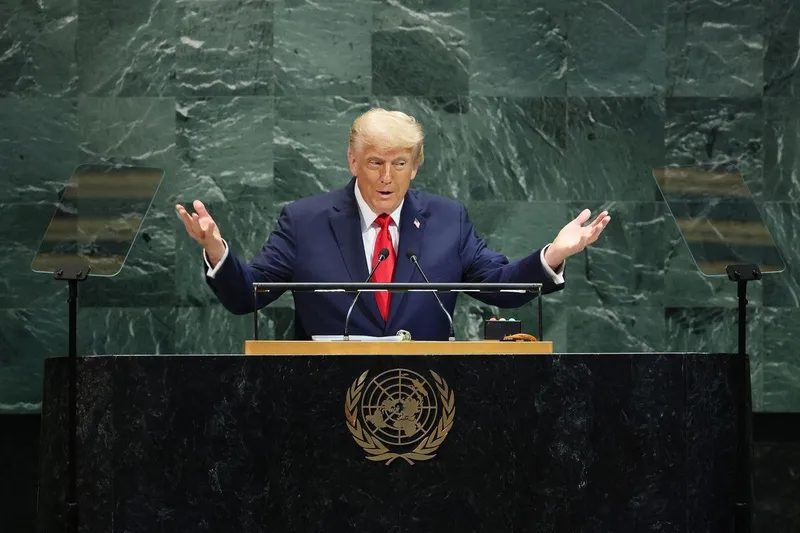
At the United Nations on September 22, 2026, Emmanuel Macron sought to draw a distinction between two Palestinian realities. Gaza, devastated by nearly three years of war and long governed by Hamas. And the West Bank, partly administered by the Palestinian Authority yet increasingly transformed, in the French president’s account, by territorial pressure. But when Macron declared that Hamas had “never operated” there, he handed Benjamin Netanyahu an immediate target.
The Israeli prime minister denounced the statement as historically false. Hamas members and networks have indeed operated in the West Bank and have claimed or supported attacks there. A French source subsequently clarified that Macron meant Hamas had never governed the territory. The clarification corrected the statement. It did not erase the controversy.
More importantly, it exposed something deeper.
Behind the verbal misstep lay the question Macron’s speech was actually trying to raise: if the West Bank is not Gaza, if it is not governed by Hamas, and if the Palestinian Authority is supposed to provide the institutional foundation of a future state, what becomes of that prospect when the territory on which such a state would have to exist is progressively fragmented?
This is becoming one of the central contradictions of the Israeli-Palestinian conflict. While international diplomacy continues to speak of two states, the geography required to make them possible continues to change.
The map before the state
The two-state solution was long framed primarily as a political problem. Borders had to be negotiated, Jerusalem’s status resolved, security guarantees established for Israel, the refugee question addressed, Palestinian sovereignty defined, and an agreement reached between two parties capable of implementing it.
Increasingly, it is becoming a physical problem.
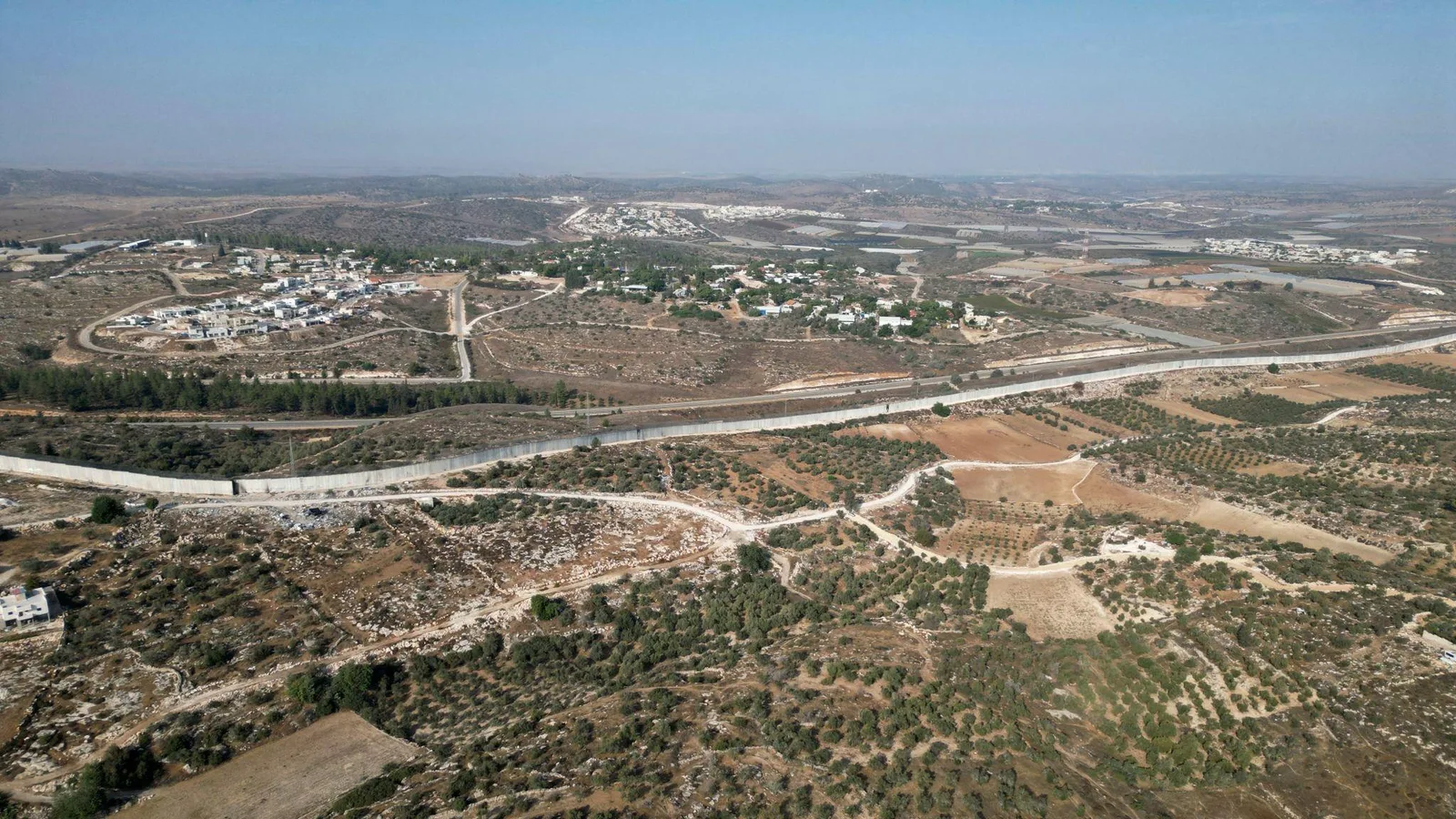
The West Bank is not a homogeneous territorial space simply waiting for a final border to be drawn around it. Since the Oslo Accords, it has been divided among different administrative and security regimes. Israeli settlements, their infrastructure, roads, military zones, movement restrictions and differing land regimes have produced a geography whose complexity has accumulated over three decades.
Each individual change can appear limited. Together, however, they determine whether territorial continuity remains possible.
This is why the E1 project, east of Jerusalem, has attracted such sustained diplomatic attention. The Israeli government has advanced plans allowing thousands of housing units to be built in the area between East Jerusalem and Maale Adumim. In August 2026, eleven Western governments, including France, the United Kingdom, Germany and Canada, warned that implementation would undermine Palestinian territorial continuity. The United Nations secretary-general went further, saying that E1 would deal a “fatal blow” to the prospect of a contiguous and viable Palestinian state.
The language is dramatic. The mechanism is not.
That is precisely what makes it consequential.
Recognition does not create a state
France recognized the State of Palestine in September 2025. Other European and Western countries made similar decisions. These moves altered the diplomatic framework surrounding the Palestinian question: they suggested that recognition of Palestinian statehood did not necessarily have to wait for the conclusion of final-status negotiations.
But recognizing a state and making its existence possible are two different things.
A state requires a population, institutions and political authority. It also requires territory over which that authority can exercise a minimum degree of continuity. This is where the Palestinian question enters a paradoxical phase: as international recognition expands, the governments supporting it are increasingly warning that the territorial conditions required to translate recognition into reality are disappearing.
Palestine can therefore acquire greater diplomatic existence at the very moment when its geographical materialization becomes more difficult.
That contradiction helps explain why the West Bank is gradually becoming almost as important as Gaza in the political struggle over what comes after the war. Gaza embodies the immediate humanitarian and security emergency. The West Bank embodies another question: what will remain to negotiate.
Because territorial negotiations require more than opposing claims.
They require alternative territorial configurations to remain physically possible.
When accumulated facts on the ground progressively narrow those possibilities, diplomacy is no longer merely negotiating a future. It is trying to preserve the space in which a future can still be negotiated.
Security and territory
From the Israeli perspective, the equation looks different.
The trauma of October 7, 2023 profoundly reinforced the centrality of security in Israeli politics. For a substantial part of the country’s political system and public opinion, the assumption that territorial withdrawal can mechanically produce peace has lost much of its credibility. Gaza is central to this perception: Israel unilaterally withdrew from the territory in 2005; Hamas seized control two years later; Gaza subsequently became the base from which the October 7 attack was launched.
From this perspective, the West Bank is not simply the prospective territory of a future Palestinian state. It is also strategic depth located only tens of kilometres from Israel’s main population centres.
This reality explains part of the Israeli opposition to the establishment of a sovereign Palestinian state. It does not, however, resolve the problem created by that opposition.
If territorial separation becomes impossible, two populations will continue to inhabit the same space without sharing the same political institutions or legal status. The question therefore does not disappear with the abandonment of the two-state solution. It changes form.
That may be the most important transformation now underway.
For decades, the conflict was conceived around the search for a border. If that border becomes physically impossible to construct, the debate will inevitably shift toward the political organization of the entire space between the Jordan River and the Mediterranean.
That question could prove even harder to resolve.
Time as a political actor
International diplomacy generally thinks in events: negotiations, ceasefires, conferences, recognitions, resolutions.
Territory evolves differently.
A road is built. A permit is approved. A settlement expands. An outpost appears. A community is displaced. A new piece of infrastructure changes patterns of movement. None of these developments, taken alone, determines the outcome of a conflict spanning generations. Their accumulation, however, gradually changes the range of available outcomes.
Time then ceases to be neutral.
It becomes a political actor.
This is what the international reaction to E1 reveals. When several Western governments argue that one particular construction project could undermine the two-state solution, they are implicitly acknowledging that this solution no longer depends solely on a future agreement. It also depends on the immediate preservation of a particular geography.
Diplomacy therefore confronts a fundamental asymmetry: negotiations can be postponed, but territory cannot be suspended while diplomacy waits.
Every year without a settlement is not necessarily another year available to reach the same agreement.
It may instead be another year in which the agreement itself becomes harder to imagine.
The West Bank after Gaza
This evolution also changes the meaning of the debate over post-war Gaza.
Many diplomatic scenarios envisage the return of a reformed Palestinian Authority to Gaza, the disarmament or political marginalization of Hamas, and the institutional reunification of Gaza and the West Bank under a single Palestinian authority. The United Nations secretary-general again defended their political, economic and territorial integration under one Palestinian government this week.
On paper, the logic is coherent.
But it encounters a difficulty rarely followed to its conclusion: politically reunifying two territories is insufficient if their territorial viability remains uncertain.
The reconstruction of Gaza, reform of the Palestinian Authority and international recognition could therefore accomplish much of the institutional work required to establish a state without resolving the most elementary question of all: the geographical form of that state.
This is where the controversy triggered by Macron’s sentence recovers its real significance.
The French president was wrong to frame the distinction between Gaza and the West Bank as the historical absence of Hamas from the latter. But the political distinction he was attempting to establish remains central to the European strategy: to demonstrate that a Palestinian alternative to Hamas still exists and can provide the counterpart for a political settlement.
For that strategy to work, however, it needs more than a counterpart.
It still needs a territory.
The state that could remain on paper
For decades, the international community has repeated that the two-state solution remains the most realistic outcome to the conflict. The formula has survived wars, attacks, changes of government, failed negotiations and settlement expansion.
Its longevity has gradually created an illusion: that the solution itself would remain available until political conditions finally allowed it to be implemented.
The West Bank shows why that assumption is becoming increasingly fragile.
A diplomatic solution does not exist independently of the territory to which it must apply. It, too, has a geography, infrastructure, distances and thresholds beyond which certain political arrangements become extraordinarily difficult to implement.
The question, therefore, is no longer simply whether Israelis and Palestinians will one day accept two states.
It is whether, by the time a political agreement becomes possible again, two territories capable of sustaining them will still exist.
That may be the deepest paradox of the international recognition of Palestine: never have so many governments asserted that this state should exist while those defending that outcome increasingly warn that the space required for its existence is closing.
A state can wait a long time for recognition.
Territory does not wait.
Main sources
— Presidency of the French Republic — Emmanuel Macron’s statements at the United Nations and France’s position on the two-state solution.
— United Nations — Secretary-General, address to the opening of the 81st session of the General Assembly, September 22, 2026.
— United Nations — Secretary-General’s remarks at the high-level meeting on the two-state solution, September 22, 2026.
— Joint statement by eleven governments, including France, the United Kingdom, Germany and Canada, concerning the E1 settlement project, August 21, 2026.
— Office of the United Nations High Commissioner for Human Rights — Khan al-Ahmar and the development of the E1 project, May 25, 2026.
— Reuters — Emmanuel Macron’s address to the United Nations General Assembly and Israeli reactions, September 2026.
— The Times of Israel / news agencies — Benjamin Netanyahu’s response to Emmanuel Macron’s remarks and the subsequent French clarification, September 23, 2026.
Atlas Limits Research Desk
Atlas Limits’ editorial and analytical desk.