For more than a century, much of Africa's mining economy has followed a relatively simple geographical pattern. Resources were extracted on the continent, transported to ports, and shipped to foreign industrial centers, where they acquired most of their added value. Mines changed ownership, governments renegotiated concessions, and global commodity prices experienced considerable fluctuations, but the underlying structure remained largely intact. Africa supplied the raw materials for an industrialization process that took place primarily elsewhere.
That arrangement may now be entering a new phase. Not because African resources have suddenly become indispensable — they have long been essential to numerous industries — but because their ownership, financing, processing, and transportation are becoming increasingly important components of the industrial strategies pursued by major powers.
The energy transition, the expansion of digital infrastructure, global demand for steel, and renewed interest in nuclear power are reshaping economic priorities. In this environment, the central question is no longer simply who will exploit Africa's mineral deposits, but where infrastructure will be built, where minerals will be processed, and who will capture the value generated.
Two announcements made on October 16 and 17, 2026, illustrate this evolution.
The first came from the Africa Finance Corporation (AFC), a pan-African financial institution headquartered in Lagos, which is considering expanding its investments into iron ore and uranium. The second involved major multilateral development banks, which announced stronger cooperation to support value chains extending from mineral extraction to industrial processing and manufacturing.
These initiatives do not yet constitute an economic revolution. They nevertheless suggest that development finance institutions are increasingly approaching mineral resources not merely as export commodities, but as potential foundations for a more integrated industrial development model.
Iron Ore and Africa's New Industrial Frontier
On October 16, Franklin Edochie, Deputy Director and Head of Mining and Metals at the Africa Finance Corporation, outlined the institution's ambitions in iron ore and uranium.
Already involved in projects related to gold, bauxite, copper, and manganese, the AFC intends to broaden its portfolio to include two resources governed by different market dynamics but occupying central positions in industrial and energy infrastructure.
The most significant announcement concerned West Africa.
According to Edochie, the combined iron ore production of Guinea, Liberia, Mauritania, and Sierra Leone could, over the next decade, reach a volume comparable to that of one of the world's three largest iron ore-producing countries.
This remains an industrial projection rather than an established production capacity. Achieving it would require the completion of several mining projects, the availability of appropriate infrastructure, and market conditions capable of supporting the necessary investments.
Nevertheless, the projection provides an indication of the scale being considered.
The global iron ore market has historically been characterized by a high geographical concentration of export supply, dominated particularly by Australia and Brazil. China represents the principal center of consumption because of the size of its steel industry.
This structure has encouraged the development of enormous logistics networks connecting a limited number of major mining regions to specialized ports and, ultimately, Asian steelworks.
West Africa possesses a geological foundation capable of partially modifying that balance.
Guinea occupies a particularly important position through the Simandou complex, whose high-grade deposits are among the most significant iron ore projects developed in recent decades.
Exploiting these resources requires extensive railway and port infrastructure, illustrating a fundamental characteristic of the mining economy: the existence of a deposit is not sufficient to create an industry. The mineral must also be extracted, transported, and marketed at a competitive cost.
Liberia has a long mining history and railway infrastructure directly associated with extraction activities. Sierra Leone is attempting to consolidate its iron ore sector after successive cycles marked by price volatility and financial difficulties among operators.
Mauritania, meanwhile, possesses a historically important industrial enterprise in the Société Nationale Industrielle et Minière (SNIM), together with a railway system connecting inland deposits to the port of Nouadhibou.
These four countries have different institutional, industrial, and financial circumstances. Their inclusion in a common production outlook nevertheless reflects a geographical reality: a substantial share of Africa's iron ore potential is concentrated along an Atlantic corridor that could become an increasingly important source of international supply.
One decisive question remains.
Will this expansion simply generate larger exports of unprocessed ore, or will it support the emergence of a regional steel industry?
The distinction is considerable.
Exporting iron ore generates revenue, employment, and fiscal income. Transforming it into steel requires an entirely different economic organization, combining energy, infrastructure, technology, skilled labor, financing, and industrial markets.
Steelmaking is not merely an additional activity within the mining value chain. It can provide the foundation for industries ranging from construction and transportation to mechanical equipment and energy infrastructure.
Yet it also requires substantial investment, reliable electricity supplies, and markets capable of absorbing production.
The availability of iron ore therefore guarantees neither the competitiveness nor the profitability of a steel plant.
Africa's industrial challenge lies precisely in the distance separating geological wealth from productive capacity.
Uranium and the Return of Energy Security
The AFC's announced interest in uranium introduces a different strategic dimension.
Unlike iron ore, whose demand is primarily determined by steel production, uranium belongs to a highly specialized energy value chain.
Its extraction, conversion, enrichment, and eventual use in nuclear reactors depend on industrial facilities, technical expertise, and regulatory frameworks concentrated in a relatively limited number of countries.
Africa has historically occupied an important position in this industry.
Niger has long been a significant uranium supplier to international markets, particularly in Europe. Namibia remains an important global producer, while several other African countries possess identified resources or exploration projects.
However, the strategic value of a uranium deposit cannot be measured solely by its extraction capacity.
The nuclear fuel cycle involves several layers of dependency.
Uranium ore must be processed into concentrate, then converted and, for most commercial nuclear reactors, enriched before being manufactured into fuel.
These operations require complex technologies and infrastructure subject to strict international regulations.
A producing country may therefore possess substantial uranium reserves without controlling the most technologically sensitive stages of the value chain.
This distinction is becoming increasingly important as several governments reassess nuclear energy's contribution to supply security and decarbonization.
For African uranium producers, renewed interest in nuclear power may improve the commercial prospects of certain deposits and strengthen their negotiating position.
It does not, however, guarantee permanently higher prices or the development of domestic processing capabilities.
The nuclear fuel market remains shaped by long-term contracts, exceptionally extended investment cycles, and political and regulatory constraints that distinguish it from other mineral markets.
Niger illustrates the difficulties inherent in this equation.
Disputes surrounding mining concessions, relations with foreign operators, and the restructuring of international partnerships demonstrate how sovereignty over natural resources can become an instrument of economic policy and diplomatic repositioning.
Yet the legal recovery of an asset does not automatically ensure its operational continuity.
Equipment, financing, commercial outlets, and technical expertise remain indispensable.
The issue is therefore not simply ownership of deposits. It is the capacity of governments to translate ownership into sustainable revenues, infrastructure, and industrial capabilities.
The potential contribution of an institution such as the AFC may lie precisely at the intersection of financing, industrial development, and continental strategy.
For the moment, the institution has not publicly identified the specific iron ore or uranium projects that might receive its next investments.
Edochie has indicated a six-to-twelve-month horizon for possible announcements.
It is therefore important to distinguish the strategic direction being communicated from financial commitments that have actually been concluded.
Financing Becomes an Instrument of Power
The second announcement, made on October 17, helps explain why these developments extend beyond the ambitions of a single African institution.
Meeting in Manila, major multilateral development banks confirmed the adoption of a cooperation framework focused on critical minerals value chains.
The objective is to strengthen coordination among financing institutions, infrastructure developers, public authorities, and private investors to help producing countries develop processing, refining, and manufacturing activities.
The initiative builds on commitments made in April 2026.
It does not constitute a single investment fund with a predetermined aggregate budget. Rather, it establishes a framework designed to bring the interventions of participating institutions into closer alignment.
Its significance lies in the change of approach it proposes.
For decades, mining investments were frequently assessed primarily according to the profitability of deposits and their export potential.
Infrastructure required for extraction could be developed as relatively isolated systems, directly connecting mines to ports without necessarily encouraging broader economic diversification in the territories concerned.
The new multilateral framework places greater emphasis on integrated value chains, coordinated infrastructure, and the development of industrial activities beyond extraction.
This orientation reflects a straightforward economic observation: mineral wealth does not automatically generate industrial development.
A deposit may produce billions of dollars in exports without triggering a comparable transformation of the domestic economy.
Equipment may be imported, technical services supplied by foreign companies, and a substantial share of financial returns transferred abroad.
Tax revenues can finance public policies, but their effectiveness depends on governance, fiscal stability, and the administrative capacity of governments.
Conversely, mining operations integrated into electricity networks, transport infrastructure accessible to other industries, and local processing facilities can generate broader economic effects.
The difficulty lies in achieving this integration without making projects financially unviable.
Multilateral development banks possess several instruments capable of addressing these challenges, including long-term loans, guarantees, co-financing arrangements, technical assistance, and risk-sharing mechanisms.
Their participation can make infrastructure projects possible when initial costs exceed the financial capacity of private operators or national budgets.
Financing, however, cannot substitute for industrial demand.
A processing facility does not become competitive merely because credit is available.
It requires energy, skills, technology, suppliers, and customers.
The effectiveness of the new framework will depend substantially on how successfully these elements are brought together.
The World Bank Expands Its Ambitions
On October 16, another announcement reinforced this emerging direction.
World Bank President Ajay Banga presented a target of $19 billion in financing for critical minerals over the 2026–2030 fiscal period, representing more than a fivefold increase compared with approximately $3.6 billion mobilized between 2021 and 2025.
The initiative forms part of a broader strategy to develop mining infrastructure and industrial capabilities in partner countries.
The difference between the two periods is substantial.
It indicates an intention to assign strategic minerals a considerably larger role in development financing.
Yet three realities must be distinguished.
The first is the announcement of a financing target.
The second concerns the projects that can actually be structured and approved.
The third, and ultimately most important, involves the investments that are effectively disbursed and the industrial capacity they produce.
Experience with major infrastructure programs demonstrates that several years may separate these stages.
Mining and industrial projects combine geological, commercial, environmental, political, and financial risks.
Railway and port infrastructure require exceptionally long investment commitments, while processing facilities remain exposed to fluctuations in energy prices and the markets for finished products.
International financial institutions can mitigate some of these risks without eliminating them.
The importance of the new approach nevertheless lies in the explicit recognition of a difficulty that has long been underestimated: financing extraction is not the same as financing industrialization.
Corridors and the New Geography of African Industry
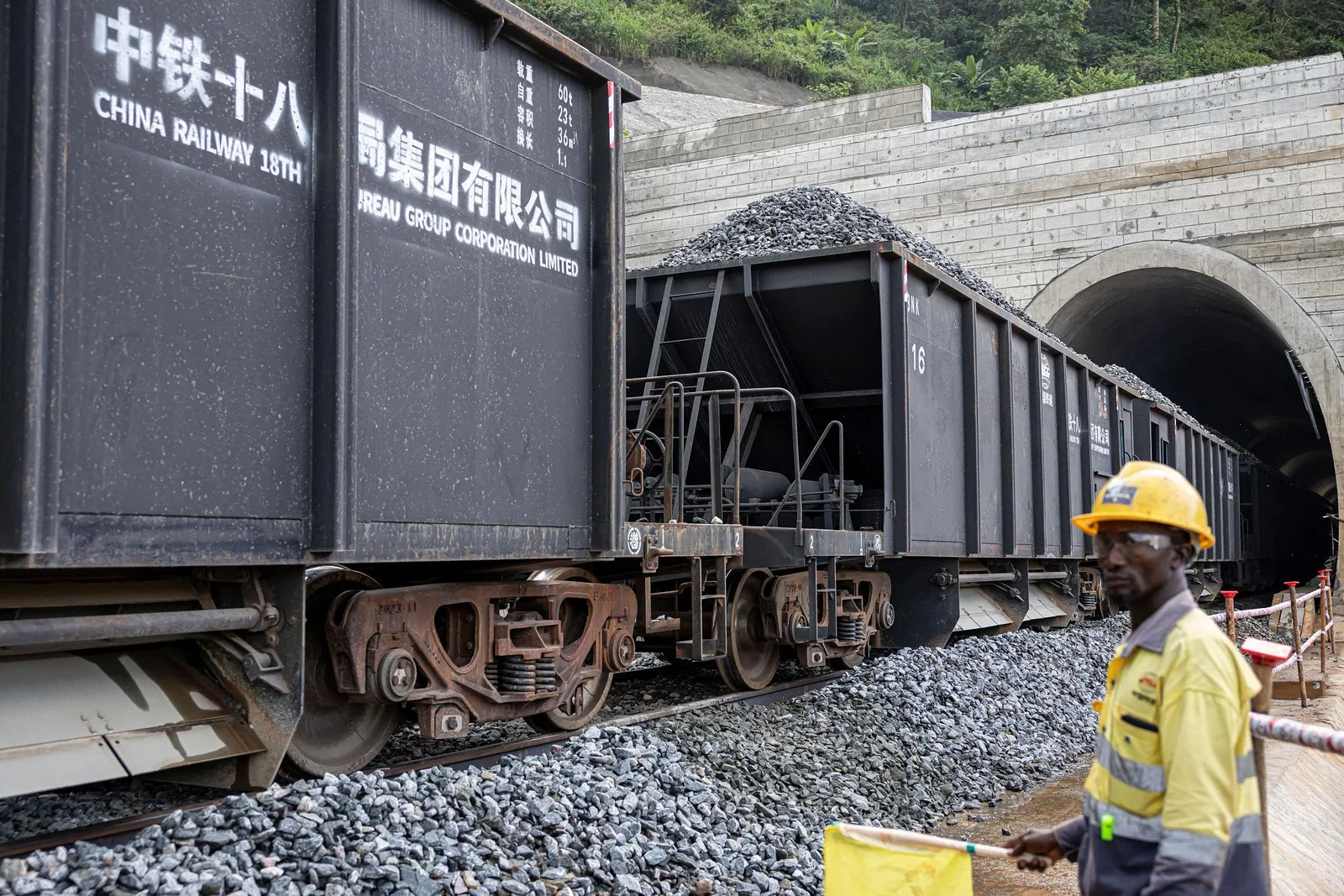
The Lobito Corridor provides one of the clearest illustrations of this transformation.
Supported notably by the United States and developed with the participation of the Africa Finance Corporation, the project aims to strengthen railway connections between the mining regions of the Democratic Republic of the Congo and Zambia and the Angolan Atlantic port of Lobito.
Its immediate rationale is commercial.
Copper- and cobalt-producing regions in Central Africa face significant logistical constraints.
Long distances, congested roads, border delays, and transportation costs undermine export competitiveness.
An efficient railway connection could alleviate some of these difficulties while diversifying transport routes.
But the corridor also possesses a geopolitical dimension.
Copper and cobalt occupy important positions in electrical infrastructure, batteries, and several strategic industrial sectors.
Securing access to these resources is consequently a priority for economies seeking greater resilience in their production chains.
The development of new African logistics routes forms part of a broader competition among commercial and financial partners.
China has established a considerable presence in infrastructure, mining, and processing activities across numerous African countries over several decades.
The United States and Europe are now seeking to strengthen their own partnerships and diversify their sources of supply.
Africa is consequently becoming a space where several external industrial strategies intersect.
This competition may create negotiating opportunities for African governments, provided that proposed projects correspond to their own economic priorities.
A transport corridor, however, can reproduce the traditional extractive model just as easily as it can help move beyond it.
A railway connecting a mine exclusively to a port improves export conditions.
It does not necessarily create a diversified industrial economy.
By contrast, infrastructure accessible to multiple operators, connected to processing zones, and capable of transporting agricultural and manufactured products may support a wider range of activities.
The difference lies less in the length of the railway than in the economic organization developed around it.
China, Europe, and the United States Confront the Same Problem
International competition for African minerals is no longer limited to securing mining concessions.
It increasingly concerns entire industrial value chains.
China occupies an important position in the refining and processing of numerous strategic minerals.
This capacity reflects decades of investment, economies of scale, specialized supplier networks, and integration into large industrial markets.
The United States is seeking to reduce dependencies considered sensitive, particularly in energy technologies and strategic industries.
The European Union is pursuing comparable diversification objectives while attempting to establish supply partnerships and industrial capabilities compatible with its environmental and regulatory requirements.
For African countries, these strategies present both opportunities and risks.
Diversifying partners can improve financing conditions and reduce dependence on a limited number of export markets.
It may also facilitate skills transfers, access to technology, and the construction of new infrastructure.
However, the priorities of importing powers do not necessarily coincide with those of producing countries.
A foreign industrial company may primarily seek a reliable and competitively priced supply of minerals.
An African government may want those same minerals to be processed domestically, even when local industrial conditions make processing more expensive.
Negotiations therefore concern the distribution of investment, risk, and economic returns.
Local-content requirements, processing obligations, public equity participation, and infrastructure commitments can help rebalance contractual relationships.
Their effectiveness, however, depends on governments' ability to design realistic arrangements and enforce them.
Industrial obligations that are excessively costly may discourage investment.
Conversely, concessions that are too favorable to operators may leave producing countries with only a limited share of the value generated.
Between these extremes lies the practical domain of industrial policy.
The Paradox of Local Processing
The argument that Africa should process more of its raw materials appears economically straightforward.
Its implementation is considerably more complicated.
Consider iron ore.
Steel production requires not only mineral resources but also heavy industrial facilities, energy supplies, metallurgical inputs, and appropriate logistics.
Direct-reduction technologies may offer opportunities in regions with access to natural gas or, over the longer term, competitively priced low-carbon hydrogen.
However, these technologies depend on specific technical and financial conditions, including the quality of available ore.
Mauritania could find in its iron ore resources and energy potential arguments supporting a transition toward higher-value industrial activities.
Guinea may similarly seek to capture more value from its deposits.
Such possibilities should not, however, be confused with industrial projects whose profitability has already been established.
Market size is equally important.
A steel industry requires sufficiently large and predictable outlets.
The domestic markets of several African countries may be too small to absorb the output of large-scale industrial facilities.
Regional integration consequently becomes a condition of competitiveness.
The African Continental Free Trade Area could help expand accessible markets, provided that logistical, regulatory, and customs barriers are progressively reduced.
Mining-based industrialization therefore requires coordination extending well beyond national borders.
It demands closer alignment among energy policies, transportation infrastructure, commercial strategies, and technical training systems.
This work is less visible than the announcement of a new mine.
It is nevertheless essential to transforming natural wealth into sustainable productive capacity.
Sovereignty Cannot Simply Be Declared
Africa's expanding mining ambitions are accompanied by increasingly frequent references to economic sovereignty.
The concept encompasses several distinct realities.
Legal sovereignty concerns the state's authority to regulate resource exploitation and determine the conditions under which companies operate within its territory.
Financial sovereignty refers to its ability to mobilize capital without depending exclusively on a limited number of lenders or investors.
Industrial sovereignty involves controlling a meaningful share of the technologies, infrastructure, and expertise required for production.
These three dimensions do not necessarily advance at the same pace.
A government may strengthen regulatory control over a mine while remaining dependent on foreign operators for its exploitation.
It may increase its equity participation in a project without possessing the financial resources required for development.
It may even secure the construction of a domestic processing facility without mastering the technologies necessary for its operation.
Economic sovereignty therefore cannot be reduced to a change in asset ownership.
It develops over time through the accumulation of expertise, institutional strength, access to finance, and the emergence of competitive domestic enterprises.
This is precisely where African financial institutions may play a distinctive role.
An organization such as the AFC possesses knowledge of regional constraints and can help structure financing arrangements involving governments, companies, and international partners.
Its participation does not automatically guarantee that projects will serve local economic interests.
It may nevertheless strengthen African participation in investment decisions.
The fundamental question then becomes one of control over industrial choices rather than merely the nationality of capital providers.
Environmental Constraints Enter the Equation
The expansion of mining projects also raises significant environmental and social questions.
Extraction and processing infrastructure may consume substantial quantities of water and energy, alter ecosystems, displace communities, and create lasting pollution risks.
Iron ore mining, metallurgy, and uranium-related activities involve different constraints, but all require appropriate monitoring and regulatory systems.
International competition for resources should not turn these requirements into secondary considerations.
On the contrary, integrating them into project design from the outset can help reduce local conflicts, legal risks, and future rehabilitation costs.
The multilateral development banks' cooperation framework explicitly addresses environmental and social standards, transparency, and community participation.
This orientation is important, but its practical significance will depend on financing and supervision practices.
African countries face a particular challenge.
They must attract substantial capital while ensuring that the environmental and social costs of extraction are not disproportionately borne by local populations.
The success of a project therefore cannot be measured solely by the volume of minerals exported or the revenue generated.
It must also be assessed through employment creation, skills development, infrastructure accessible to other sectors, and lasting economic effects on the territories concerned.
A Historic Opportunity Without Guarantees
The announcements of October 2026 come at a particular moment in the global economy.
Major powers are seeking to secure supply chains.
International financial institutions are assigning greater importance to strategic minerals.
Several African economies are attempting to retain a larger share of the value generated by their natural resources.
This convergence may create favorable conditions for a new investment cycle.
It does not, however, guarantee structural transformation.
African economic history contains numerous periods in which rising global demand generated ambitious industrial expectations.
Commodity price cycles, financial constraints, institutional weaknesses, and infrastructure shortages frequently limited the results.
The current environment nevertheless presents an important difference.
Supply-chain security no longer concerns access to deposits alone.
It increasingly encompasses processing capacity, logistics infrastructure, technological capabilities, and the resilience of industrial systems.
This evolution could provide African countries with greater negotiating room than they enjoyed when investment was concentrated almost exclusively on extraction.
But that room must be used to build productive capabilities.
Guinea, Mauritania, Liberia, and Sierra Leone may strengthen their positions in the global iron ore market.
Namibia and Niger remain important within the geography of uranium.
The Democratic Republic of the Congo and Zambia occupy central positions in copper and cobalt supply chains.
Yet these positions do not, by themselves, constitute a continental industrial strategy.
Such a strategy requires coherent national and regional choices, shared infrastructure, accessible markets, institutions capable of negotiating and supervising investments, and technical training adapted to the needs of industry.
It also requires recognizing that not every resource can be processed domestically under equally competitive economic conditions.
The realistic objective is not to reproduce every stage of every industrial value chain in every African country.
It is to identify the segments in which African economies can establish sustainable competitive advantages and organize the investments necessary to develop them.
Africa does not lack minerals.
What remains insufficient in many regions is the infrastructure and industrial capacity required to retain a larger share of their value.
The announcements by the Africa Finance Corporation, the World Bank, and the multilateral development banks suggest that this issue is becoming more central to development financing strategies.
The coming years will reveal whether this change in institutional priorities produces factories, electricity networks, genuinely integrated transport corridors, and companies capable of participating in global markets as more than exporters of unprocessed resources.
The real transformation will not occur simply when Africa extracts more minerals.
It will occur when an increasing share of those minerals contributes to building the continent's own productive capacity.
For generations, the wealth beneath African soil has supplied industries on other continents. The challenge now is to ensure that the infrastructure built to reach that wealth also helps develop the economies above it.
Main Sources
Reuters — October 16, 2026. AFC Eyes Iron Ore and Uranium Investments in Africa. Statements by Franklin Edochie concerning the Africa Finance Corporation's mining ambitions, West African iron ore production prospects, and the Lobito Corridor.
Reuters — October 16, 2026. World Bank's Banga Sets Goal of Quintupling Critical Minerals Financing in Five Years. Announcement of the World Bank's $19 billion financing target for the 2026–2030 period.
Multilateral Development Banks — October 17, 2026. Joint Statement by MDB Heads: Advancing Joint Action amid Global Uncertainty. Institutional statement addressing financial cooperation, critical minerals value chains, and industrial infrastructure.
European Bank for Reconstruction and Development — 2026. MDB Collaboration Framework: Critical Minerals-to-Manufacturing Value Chains. Cooperation framework addressing governance, infrastructure, industrial processing, and capital mobilization.
African Development Bank — April 16, 2026. Joint MDB Statement on Critical Minerals to Manufacturing Value Chains. Initial multilateral commitments supporting more diversified value chains and increased domestic value creation in mineral-producing economies.
G7 — June 17, 2026. G7 Leaders' Declaration on Securing Supply Chains for Critical Minerals. Policy directions concerning supply diversification, processing capabilities, and international industrial partnerships.
Atlas Limits Research Desk
Atlas Limits’ editorial and analytical desk.