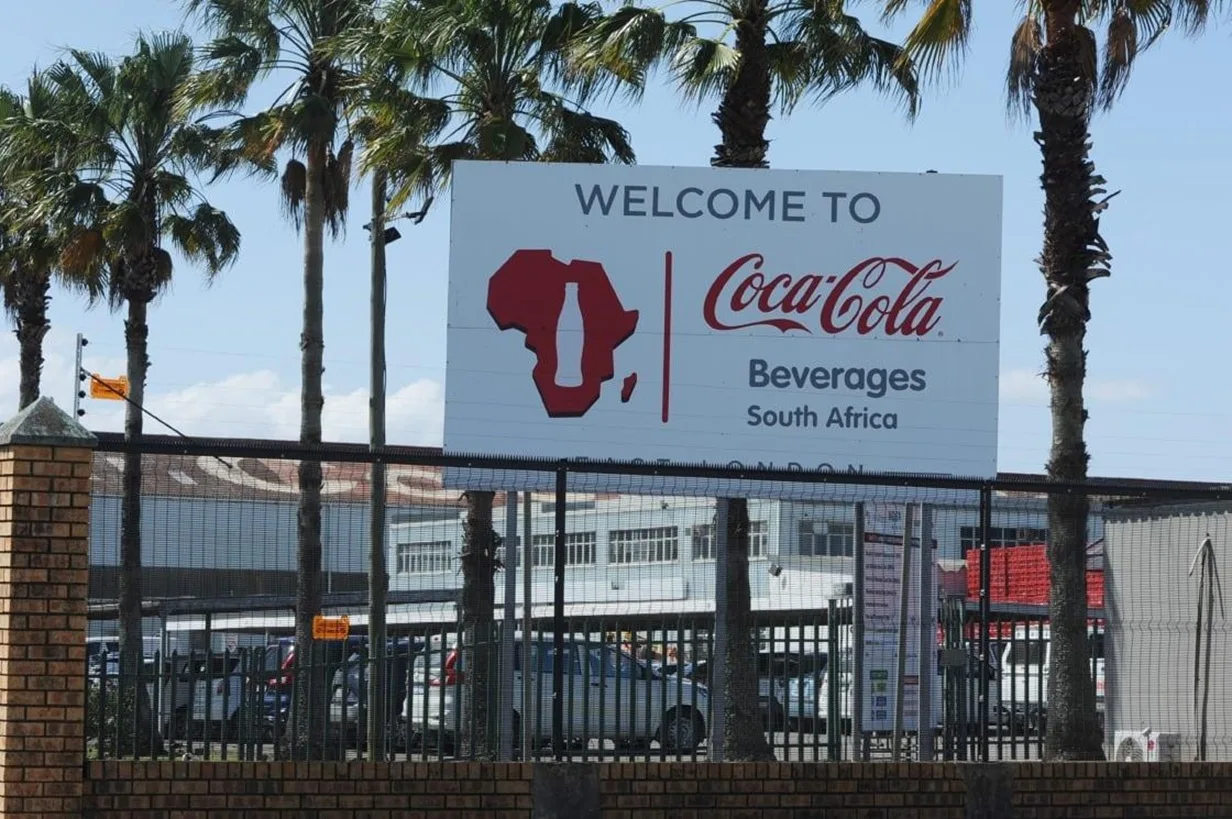
Johannesburg, November 23, 2026. A new company begins trading on South Africa's stock exchange. Coca-Cola HBC, the Swiss-incorporated bottling group already listed in London and Athens, opens its first Johannesburg session at 996 rand. Its shares rise to 1,039.50 rand before retreating to approximately 990 rand by late morning. Behind this market admission, which values the company at roughly 341 billion rand, lies a considerably larger industrial transformation: the planned acquisition of control over Coca-Cola Beverages Africa, one of the continent's most extensive production and distribution networks.
The Johannesburg secondary listing, effective November 23, precedes the expected completion of Coca-Cola HBC's acquisition of a 75% stake in Coca-Cola Beverages Africa (CCBA) on November 27. The two transactions are legally distinct, but their combination reflects a common strategic direction. Coca-Cola HBC is seeking to strengthen both its control over African distribution infrastructure and its presence in the continent's financial markets.
The move comes as consumer multinationals reassess the geography of their investments. Africa offers substantial long-term demographic and urbanization prospects, but its markets remain fragmented, its infrastructure uneven and its monetary and regulatory environments diverse. Under these conditions, the ability to manufacture, transport and distribute consumer products at scale can be as decisive a competitive advantage as the strength of the brands themselves.
An acquisition that reshapes the group's geography
The acquisition of CCBA represents a major step in Coca-Cola HBC's development. Founded in Nigeria in 1951, the group gradually established an industrial presence across Europe and several African markets. Its expansion accelerated in Egypt following the acquisition of bottling operations in 2022. Before integrating CCBA, Coca-Cola HBC operates across 29 countries and serves a potential consumer population of approximately 760 million.
The transaction is expected to expand that reach to around 1.2 billion consumers and establish the combined business as the world's second-largest Coca-Cola bottler by volume. In Africa, Coca-Cola HBC would account for approximately two-thirds of Coca-Cola system volumes and operate in markets representing more than half of the continent's population.
These figures illustrate the scale of the proposed transformation. They do not mean that the group will control two-thirds of Africa's entire beverage market. Rather, they describe its anticipated share of Coca-Cola system volumes on the continent. That distinction is essential when assessing the company's competitive position.
The transaction, announced at a value of approximately $2.6 billion, is intended to bring together industrial networks previously organized within separate corporate structures. Its rationale extends beyond increasing sales volumes. By combining manufacturing facilities, procurement capabilities, logistics infrastructure and commercial distribution systems, Coca-Cola HBC aims to create a business capable of exploiting complementarities across national markets.
Scale becomes an instrument of competitiveness. In the beverage industry, operating costs extend far beyond the manufacturing process itself. Packaging, energy, water, storage, transportation and the management of widely dispersed commercial networks all influence profitability. Potential economies of scale therefore concern procurement and industrial planning as much as supply-chain optimization and capital investment.
Such efficiencies are not automatic. Geographic proximity does not eliminate regulatory differences, customs constraints or infrastructure disparities. A pan-African organization may benefit from stronger coordination while remaining dependent on fundamentally local operating conditions.
Johannesburg and the financial architecture of consolidation
The November 23 secondary listing introduces another dimension to this transformation. Coca-Cola HBC was already traded in London and Athens. Its admission to the Johannesburg Stock Exchange does not constitute a conventional initial public offering designed to finance expansion through the sale of newly issued shares.
Instead, it gives South African investors access to the company's shares through their domestic market while preserving its international listing structure. The admission covers existing shares and does not itself represent a capital increase.
This distinction matters because the industrial transaction separately involves the issuance of new equity. Upon completion, Coca-Cola HBC expects to issue 21,027,676 ordinary shares to Gutsche Family Investments, representing 5.45% of the enlarged share capital. Under the announced ownership structure, Kar-Tess Holdings would hold 22.14%, The Coca-Cola Company 20.30% and Gutsche Family Investments 5.45%.
The Johannesburg listing therefore serves several purposes. It broadens market access to Coca-Cola HBC shares, establishes a more direct connection with South Africa's financial ecosystem and supports the contractual arrangements through which part of the CCBA acquisition consideration will be delivered in equity.
This structure illustrates an evolving relationship between international capital and African industrial assets. The transaction is not simply a transfer of ownership in exchange for cash. It also provides for a shareholder associated with CCBA's previous ownership structure to become an investor in the enlarged international group.
The significance extends beyond the visibility created by another exchange listing. By incorporating an existing investor in the African business into the acquiring company's capital structure, Coca-Cola HBC is combining industrial consolidation with a degree of shareholder continuity.
For Johannesburg, the admission comes amid renewed listing activity. Following years characterized by delistings and questions about the attractiveness of South African equity markets, the JSE has attracted transactions involving companies including Canal+, Boxer, Optasia and Cell C. Coca-Cola HBC's arrival as a major international secondary listing reinforces Johannesburg's position as a regional financial platform.
Yet the transaction should not be confused with direct financing of South Africa's productive economy. A secondary listing can improve access and potentially support trading liquidity without generating new industrial investment by itself. Its domestic economic consequences will depend primarily on subsequent decisions concerning production, employment, procurement and expansion.
Distribution networks as strategic assets
CCBA's economic value rests on a fundamental characteristic of consumer markets: the commercial power of an international brand depends on its ability to reach consumers.
Across a continent where commercial infrastructure varies considerably, distribution often represents one of the principal barriers to expansion. Modern urban retail systems coexist with independent shops, informal commercial networks and regions where transportation costs account for a significant share of final consumer prices.
Under these conditions, bottling and distribution infrastructure is more than an operational function. It constitutes a strategic asset that cannot be replicated quickly.
Established networks benefit from accumulated commercial relationships, knowledge of local consumption patterns, adapted production facilities and logistics capabilities requiring substantial time and investment to develop. Control over these networks also allows companies to adjust packaging formats, pricing and product volumes to local conditions.
The consolidation planned by Coca-Cola HBC could strengthen this adaptability. By bringing together operations across multiple markets, the company may be able to coordinate selected functions, rationalize procurement and accelerate the transfer of industrial and commercial practices.
However, greater efficiency also comes with increased concentration of economic power. When the distribution of an international brand becomes organized through fewer large corporate entities, relationships among producers, suppliers, independent distributors and retailers may change.
The benefits of consolidation must therefore be assessed alongside its consequences for host economies. Productivity improvements can support investment and product availability, but they may also alter the bargaining position of suppliers and commercial partners.
The central question is not simply whether the enlarged business will become more efficient. It is how the resulting gains will be distributed among shareholders, employees, industrial partners, distributors and consumers.
Continental ambitions and national regulatory constraints
The complexity of the transaction is also apparent in its regulatory treatment.
As of November 16, Coca-Cola HBC reported receiving merger-control approvals in five of the six relevant jurisdictions. Tanzania remained outstanding. The group nevertheless agreed with The Coca-Cola Company and Gutsche Family Investments to maintain the expected completion timetable, provided that the transaction would not be implemented in Tanzania until clearance had been obtained from the country's Fair Competition Commission.
This arrangement illustrates the institutional limits of continental consolidation. Even when a transaction is negotiated internationally, its implementation remains subject to national authorities exercising independent competition powers.
Regulators may examine the effects of consolidation on market structure, competitive access, commercial relationships and domestic economic interests. The industrial integration sought by multinational companies must therefore operate within multiple legal frameworks.
Macroeconomic risks add another layer of complexity. Currency fluctuations can affect consolidated earnings, while inflation, energy costs, transportation infrastructure and pressure on household purchasing power directly influence margins and sales volumes.
The enlarged group's scale may improve its ability to absorb certain shocks, but it will also increase its exposure to economies whose business cycles and financial conditions are not synchronized.
Integrating CCBA will therefore require Coca-Cola HBC to reconcile two potentially competing objectives: developing a more coordinated industrial organization while preserving sufficient flexibility to respond to each country's specific circumstances.
Africa's consumer growth and its economic conditions
The transaction is built around a long-term expectation: the expansion of consumer demand across African economies.
Population growth, urbanization and the transformation of retail networks can increase the markets accessible to consumer-goods producers. Yet demographic expansion does not automatically translate into an equivalent increase in purchasing power.
Commercial potential depends on real incomes, employment, infrastructure, prices and companies' ability to offer products suited to household budgets.
This distinction explains why multinational strategies cannot rely on demographic projections alone. They require sufficiently developed industrial operations to control costs, adjust pricing and maintain reliable distribution across contrasting economic environments.
The acquisition of CCBA addresses precisely this need for operational proximity. Rather than building new distribution networks gradually in each market, Coca-Cola HBC intends to integrate an established platform with existing facilities and commercial relationships.
This approach may shorten certain expansion timelines, but it also means assuming the commitments, constraints and risks associated with the acquired operations.
Future profitability will consequently depend less on the group's size alone than on its ability to convert that scale into sustainable operating efficiency.
A changing relationship between multinationals and African markets
Coca-Cola HBC's restructuring reflects a broader evolution in international corporate strategies toward Africa. Companies seeking to expand on the continent must balance several priorities: securing supply chains, achieving sufficient industrial scale, accessing capital and maintaining durable relationships with host economies.
The Johannesburg listing addresses one of these priorities by bringing the group's equity closer to a major African financial center. The acquisition of CCBA addresses another by consolidating control over productive and commercial assets.
Together, these developments may contribute to a changing role for African markets within multinational strategies. They are not merely destinations for consumer products but increasingly locations of industrial infrastructure, operational expertise and investors capable of participating in international corporate structures.
This transformation nevertheless contains a fundamental ambiguity. Larger corporate groups may improve efficiency and support additional investment without necessarily producing a more balanced distribution of the value created.
A locally listed company is not necessarily a locally controlled company. Likewise, the presence of manufacturing facilities across several markets does not, by itself, determine how much profit is reinvested in the economies concerned.
Governance decisions, local procurement, capital expenditure, employment policies and commercial practices will remain central to evaluating the consequences of this concentration.
The expected November 27 completion will therefore represent an important legal and financial milestone, but not the conclusion of the transformation. Its results will become visible over subsequent years through the integration of distribution networks, operating performance and the group's relationships with African markets.
By combining a new regional stock-market listing with one of the continent's most significant bottling consolidations, Coca-Cola HBC illustrates a shift in the organization of international consumer businesses. What remains unresolved is whether African economies will be able to translate this industrial and financial concentration into productive investment, stronger domestic supply chains and lasting local value creation.
Atlas Limits Research Desk
Atlas Limits’ editorial and analytical desk.