The artificial intelligence industry is accumulating physical capital at a pace that contrasts sharply with the speed at which its underlying technologies evolve. Computing infrastructure is financed over several years, while successive generations of semiconductors are introduced at increasingly short intervals. This divergence creates a fundamental uncertainty in the economics of AI: how long will the equipment acquired today generate sufficient revenue to justify its cost?
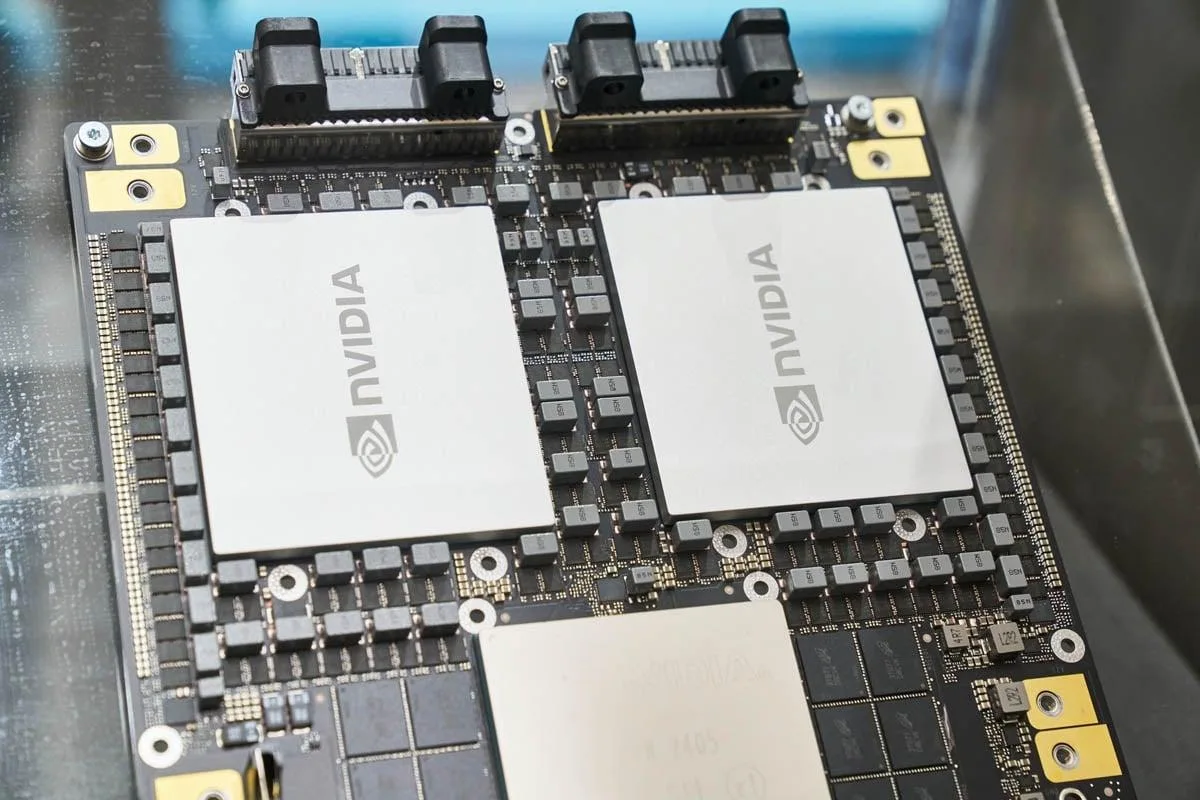
Nvidia’s transition from Ampere to Hopper, followed by Blackwell and Rubin, illustrates this acceleration. Each generation reshapes the economics of computing through improvements in performance, memory capacity, interprocessor communication and energy efficiency. Fully functional equipment can consequently lose a substantial portion of its economic value long before reaching the end of its physical lifespan.
Obsolescence no longer necessarily stems from the deterioration of a machine. It arises from the improvement of its successor.
This distinction is essential to understanding the financial structure of current infrastructure investments. Data center operators capitalize their equipment on their balance sheets and allocate its cost over an estimated useful life. This accounting treatment determines annual depreciation expenses, influences operating margins and directly affects reported returns on invested capital.
Yet several of the world’s largest investors in digital infrastructure have extended these useful lives in recent years.
In 2023, Microsoft increased the estimated useful life of its server and network equipment from four to six years. The change contributed $3.7 billion to annual operating income and $3 billion to net income. The company attributed its decision partly to software-driven efficiency gains and technological improvements that enabled more effective utilization of its infrastructure.
Alphabet introduced a comparable revision in 2023, reducing its annual depreciation expenses by $3.9 billion relative to what would have been recorded under its previous estimates.
At Meta, extending the useful life of most servers and network assets to five and a half years, effective January 2025, reduced annual depreciation expenses by $2.92 billion and increased net income by $2.59 billion.
Amazon followed a different trajectory. After extending the useful life of its servers from five to six years in 2024, the company shortened the estimated useful life of a portion of its computing equipment to five years in January 2025. In its annual report, Amazon explicitly attributed this revision to accelerating technological development, particularly in artificial intelligence and machine learning. The decision increased depreciation expenses by $1.4 billion and reduced net income by $1 billion in 2025, primarily affecting Amazon Web Services.
These divergent approaches do not establish that some companies are deliberately understating their costs. They nevertheless reveal the extent to which financial results depend on assumptions about the economic longevity of computing equipment. The accounting categories concerned generally encompass servers and network infrastructure, whose characteristics and replacement cycles do not necessarily coincide with those of AI accelerators.
The financial implications become apparent through a hypothetical example. A computing fleet acquired for $1 billion and depreciated on a straight-line basis over six years, with no residual value, generates an annual depreciation expense of $166.7 million. Reducing that period to three years increases the annual charge to $333.3 million. With revenue and other operating expenses unchanged, the difference amounts to nearly $167 million in annual operating income during the first three years.
Extending an asset’s depreciation period generates no additional cash. The investment has already been made. What changes is the allocation of its cost over time.
The problem becomes more complex when an asset’s initially estimated useful life no longer reflects its economic prospects. In the preceding example, after three years of operation, equipment depreciated over six years retains a net carrying amount of $500 million. If market conditions no longer support the recovery of that amount, a revision of accounting estimates, or potentially an impairment charge when the applicable accounting criteria are met, may become necessary.
For data center operators, however, the challenge extends well beyond the acquisition price of processors. Infrastructure competitiveness depends on the total cost of delivering a unit of computing capacity. Electricity consumption, cooling requirements, memory capacity, communication bandwidth, operating constraints and utilization rates collectively determine the effective profitability of computing assets.
A new generation of processors can therefore make older equipment economically less attractive even though its acquisition cost and energy consumption remain unchanged. Where electricity supply and grid connection capacity are constrained, retaining less efficient processors also entails an opportunity cost. Every megawatt allocated to an older architecture could deliver more computing capacity through newer infrastructure.
This dynamic does not necessarily imply that previous generations will rapidly lose their commercial applications. Processors that no longer meet the requirements of the most advanced AI models can be redeployed for inference, specialized training, scientific research or less computationally demanding industrial applications. Expanding demand could even extend their commercial lifespan.
But the ability to redeploy equipment does not guarantee the preservation of its original profitability. A processor can continue generating revenue while experiencing a substantial decline in its residual value. The decisive questions then become the price at which its computing capacity can be sold, the utilization rates it can sustain and the margins it can still generate.
The implications now extend beyond the financial statements of technology companies. The expansion of AI infrastructure increasingly relies on structured financing, asset-backed lending, leasing arrangements and multiyear commercial commitments.
CoreWeave provides a particularly instructive example. The company depreciates its technology equipment over six years and acknowledges in its 2025 annual report that its financial performance depends partly on its ability to extend the commercial utilization of its GPUs beyond their initial contractual commitments. Component replacement, estimated useful lives and equipment redeployment are among the risks identified by the company itself.
When financing arrangements rely on computing equipment or the future revenue it is expected to generate, technological obsolescence can simultaneously affect the value of collateral and the borrower’s debt-servicing capacity.
Declining equipment values can weaken collateral coverage ratios. Falling rental prices can reduce the cash flows available for debt service. Premature fleet replacement can require additional capital expenditure before the financing associated with the previous generation has been fully repaid.
The extent to which these risks are transferred to lenders nevertheless depends on contractual structures, the creditworthiness of commercial counterparties, repayment schedules and the collateral arrangements actually in place. Such a transfer cannot be assumed to occur automatically.
The semiconductor industry thus benefits from a technological dynamic whose consequences vary considerably according to an economic actor’s position within the value chain. For chip designers, accelerating innovation stimulates replacement demand. For infrastructure owners, it can shorten the period during which investments generate their highest returns. For creditors, it introduces additional uncertainty into the valuation of the capital they finance.
This asymmetry could become one of the principal mechanisms through which value is redistributed across the artificial intelligence economy.
Sustained growth in global demand for computing capacity would not necessarily neutralize this phenomenon. Industry revenue can increase while individual assets lose value, reinvestment requirements rise and returns on capital deteriorate.
Traditional financial market metrics, particularly EBITDA, do not always capture this reality. By excluding depreciation, they leave a significant component of the economic cost of infrastructure outside the calculation. In an industry where capital replacement becomes a permanent condition of competitiveness, free cash flow and returns on capital after accounting for replacement expenditure may prove more informative.
Artificial intelligence is often portrayed as an industry whose principal risk lies in insufficient commercial demand. It may also confront the opposite risk: innovation advancing rapidly enough to undermine the value of the infrastructure that makes its growth possible.
The paradox is that of an industry capable of producing ever more computing power, while the computing power acquired yesterday may be worth ever less tomorrow.
Atlas Limits Research Desk
Atlas Limits’ editorial and analytical desk.