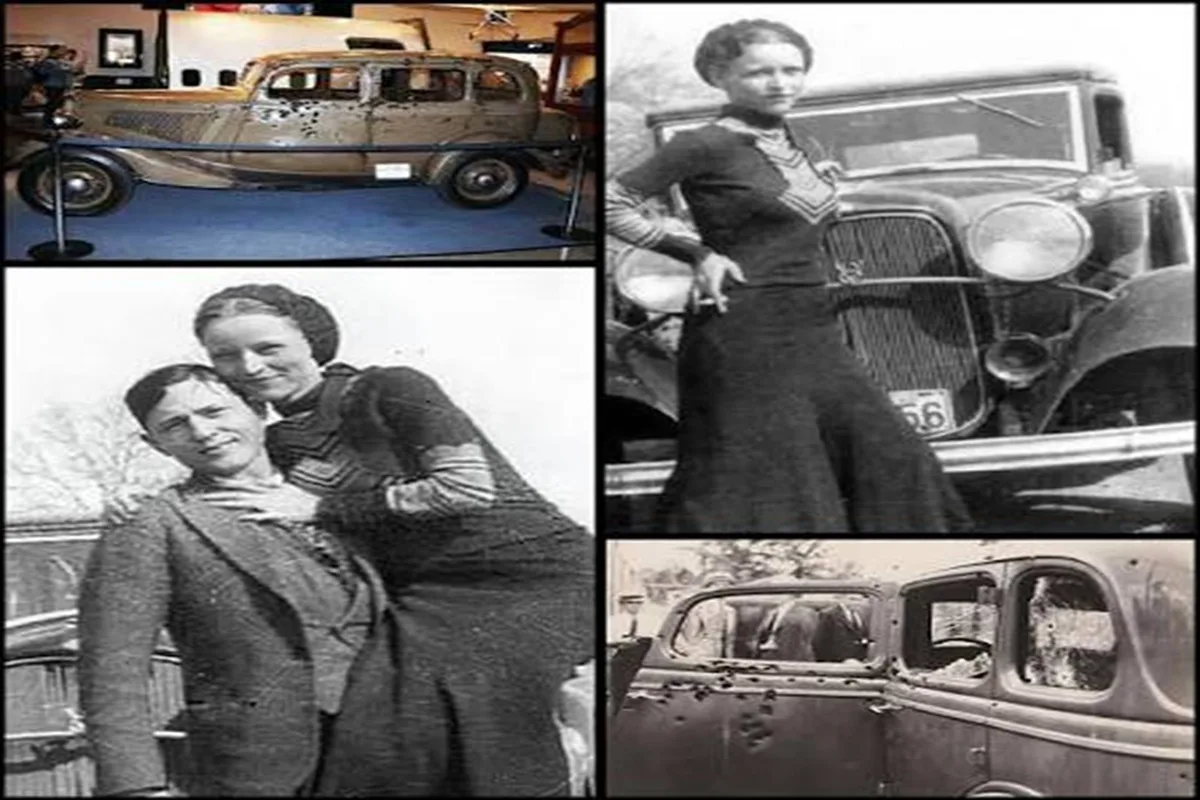
Introduction — Two Criminals Who Became an American Legend
They died young, together, on a road in Louisiana.
Bonnie Parker was 23. Clyde Barrow was 25.
On May 23, 1934, six lawmen were waiting for them near Gibsland, in Bienville Parish. When the Ford V8 driven by Clyde slowed down, the officers opened fire. The car was riddled with bullets. Bonnie and Clyde had virtually no chance to respond.
The manhunt that had fascinated part of America for nearly two years was over.
Yet in another sense, the story of Bonnie Parker and Clyde Barrow was only beginning.
Over the following decades, the two criminals would gradually leave the realm of the crime story and enter popular culture. Photographs, songs, books, documentaries and films would transform two young offenders from the impoverished margins of Texas into universal symbols of the rebellious couple: two lovers rejecting society’s rules, racing across America and ultimately dying together rather than surrendering.
It is an extraordinarily powerful image.
It is also deeply misleading.
Bonnie and Clyde were not revolutionaries. They were not waging an ideological war against American capitalism. They did not systematically redistribute the proceeds of their crimes to the poor. And contrary to the image created by some later portrayals, their criminal activity was not limited to spectacular bank robberies.
The Barrow Gang burglarized stores and service stations, stole automobiles, robbed various establishments and lived in a state of permanent flight. Police officers and civilians were killed over the course of their criminal trajectory.
The reality is therefore considerably less romantic than the legend.
But it may also be more interesting.
Because understanding Bonnie and Clyde requires understanding the America that produced them.
I. The Texas That Produced Bonnie and Clyde
A Generation Born Before the Disaster
Bonnie Elizabeth Parker was born on October 1, 1910, in Rowena, Texas. Clyde Chestnut Barrow had been born a little earlier, on March 24, 1909, in Ellis County, also in Texas.
They belonged to a particular generation in American history.
When they were born, the United States was still experiencing spectacular economic expansion. Industrialization was advancing, cities were growing, the automobile was beginning to transform the country, and American economic power was asserting itself.
But that national prosperity was distributed extremely unevenly.
In rural Texas, where the Parker and Barrow families originated, poverty remained an everyday reality for a significant part of the population. The Barrow family in particular belonged to the world of poor tenant farmers. When economic hardship pushed the family toward the Dallas area, they settled in circumstances far removed from the triumphant image America was projecting of itself.
Clyde grew up on the margins of the metropolis.
Bonnie also experienced insecurity at an early age. Her father died when she was a child, and her mother moved the family to Cement City, an industrial community west of Dallas.
The two future fugitives therefore grew up beside an expanding city, but on the wrong side of its prosperity.
This social geography matters.
Dallas represented an America in motion: commerce, industry, automobiles, infrastructure and new economic possibilities. Yet surrounding that modernity were impoverished communities in which upward mobility remained uncertain.
Bonnie and Clyde were not yet products of the Great Depression.
Their poverty preceded it.
The crisis would, however, radicalize an environment that was already fragile.
Clyde Before Bonnie
Clyde Barrow entered criminality relatively young.
His early offenses were hardly spectacular. Theft, burglary and stolen automobiles gradually became part of his world. His brother Buck was also involved in criminal activity.
This matters because it challenges one of the most persistent simplifications of their story: Bonnie did not introduce Clyde to crime, nor did Clyde suddenly transform Bonnie into a gangster.
By the time they met, Clyde already had considerable experience with the law.
The prison system would then play a decisive role in his evolution.
After a series of arrests, Clyde was sent to the Eastham Prison Farm in Texas. Conditions there were notoriously harsh. Forced labor, severe discipline and violence formed part of the Texas prison environment of the period.
Accounts of Clyde's life frequently describe this period as a turning point.
The young thief who entered prison was not quite the same man who emerged from it.
His experience of incarceration contributed to the hardening of a man whose earlier criminal activity had largely involved property offenses. It also fueled a profound hatred of the Texas prison system, and of Eastham in particular.
Years later, in January 1934, the Barrow Gang would participate in a spectacular operation to free several prisoners from that same institution.
Clyde's criminal trajectory therefore had an internal logic: poverty, petty crime, incarceration, violence, and finally permanent flight.
That is not a justification.
It is context.
Bonnie Before Clyde
Bonnie Parker's character has been distorted by the legend even more extensively.
Popular culture would often portray her as a woman somehow destined for criminal adventure, fascinated by guns and immediately seduced by the life of an outlaw.
The young Bonnie appears considerably more complex.
A good student with an interest in writing and poetry, she was also attracted to performance and cinema. As a teenager, she married Roy Thornton. The marriage quickly disintegrated, although the couple never formally divorced.
Bonnie would still be wearing Thornton's wedding ring when she died.
She worked, among other jobs, as a waitress.
Nothing at this stage suggested that within a few years she would become one of the most wanted women in the United States.
Then Clyde entered her life.
They met in the Dallas area in early 1930.
The precise circumstances of their first encounter have been recounted in different ways, but the essential point lies elsewhere: an extraordinarily strong relationship quickly developed between them.
It would survive arrests, separation, injuries and a life on the run that gradually made any normal existence impossible.
That relationship would eventually become the foundation of the myth.
But before America could transform Bonnie and Clyde into characters, a far greater event was about to transform America itself.
II. 1929: When a Country Falls Into Crisis
The Wall Street Crash of October 1929 did not by itself cause the Great Depression, but it became its defining symbol.
The economic contraction that followed was extraordinary in scale. Bank failures, business closures, collapsing investment, agricultural distress and mass unemployment transformed American society.
By 1933, at the darkest point of the crisis, roughly one quarter of the American labor force was unemployed.
Behind that statistic were millions of individual lives.
Families lost their savings when banks failed. Homeowners could no longer service their debts. Farmers abandoned their land. Workers moved across the country in search of jobs that had become increasingly scarce.
The United States remained a nation with immense resources and industrial capabilities.
But a substantial part of its population no longer believed that the economic system could guarantee an improvement in their lives.
This was the America in which Bonnie Parker and Clyde Barrow became famous.
When the Bank Changes Its Place in the Public Imagination
The Depression profoundly altered perceptions of certain institutions.
For millions of Americans, a bank was no longer simply the institution that safeguarded savings or financed the purchase of a home. It could also become the institution that foreclosed on property, denied credit or disappeared along with a family's savings.
This does not mean that Americans broadly supported bank robbers.
But the context helps explain why some criminals specializing in bank robberies could acquire an ambiguous public image.
John Dillinger, Pretty Boy Floyd, Baby Face Nelson and other outlaws became national celebrities.
The press followed their movements.
The public knew their faces.
Authorities announced nationwide searches.
Every escape added another chapter to the story.
The gangster became one of the media figures of Depression-era America.
Bonnie and Clyde would benefit from this fascination while occupying a distinctive position within it.
There were two of them.
And they were in love.
That difference would transform their media destiny.
The Couple as a Story
A gunman on the run is a criminal.
A young man and woman, in love and pursued across several states, can become a story.
With hindsight, the narrative mechanism seems almost obvious, but it is one of the keys to understanding Bonnie and Clyde's extraordinary fame.
Their relationship gave the press an immediately recognizable dramatic structure: love, transgression, flight, violence and an anticipated death.
American society now had a narrative that extended far beyond the crimes themselves.
Bonnie was no longer simply Bonnie Parker.
Clyde was no longer simply Clyde Barrow.
They became Bonnie and Clyde.
Two names that would henceforth be almost impossible to separate.
And soon, a chance discovery would give their story what every modern legend requires: Images.
III. Joplin: The Photographs That Changed Everything
In the spring of 1933, Bonnie Parker and Clyde Barrow were not yet the icons history would remember.
They were wanted, dangerous and constantly on the move. They lived with other members of their group in a state of permanent instability, regularly changing vehicles and hideouts. But their national fame had yet to fully emerge.
An episode in Joplin, Missouri, would dramatically accelerate that transformation.
In March 1933, Clyde, Bonnie and several of their companions moved into an apartment above a garage. Among them were Clyde's brother Buck Barrow, recently released from prison, and Buck's wife, Blanche.
The group attempted to remain discreet.
They failed.
The occupants' behavior attracted attention from neighbors. Unusual activity, the presence of several people and various other signs eventually raised suspicions. Local police were alerted.
On April 13, 1933, officers approached the apartment.
They believed they were confronting bootleggers.
Instead, they encountered the Barrow Gang.
A gunfight erupted.
Two law-enforcement officers, Detective Harry McGinnis and Constable J. W. Harryman, were killed. The gang nevertheless managed to escape.
In their haste, the fugitives left some of their belongings behind.
Among them was an apparently ordinary object: a camera and rolls of undeveloped film.
What the police discovered on those photographs would profoundly alter the public image of Bonnie and Clyde.
A Young Woman, a Cigar and a Gun
The photographs taken by the group initially resembled private snapshots.
The fugitives posed for the camera, joked, displayed their weapons and automobiles, and staged scenes for one another. They were personal photographs taken by a group of young adults living an extraordinary and extremely dangerous existence.
One image would become famous.
Bonnie Parker appears in a theatrical pose, holding a gun with a cigar between her lips.
The image was sensational.
It contained everything the press needed: a young woman, a weapon, a provocative attitude and an unmistakable violation of the gender conventions of 1930s America.
Once published in newspapers, the photograph transformed Bonnie.
The Texas waitress who wrote poetry and had once imagined a different life became, in the public imagination, a "gun moll" — an armed and dangerous gangster's companion.
The problem was that the photograph was precisely that: a performance.
Bonnie was playing for the camera.
But the distinction rapidly became almost irrelevant.
The photograph was more powerful than its context.
The media character began to replace the real person.
The mechanism feels strikingly modern.
A single image, detached from its original context, creates a public identity. That identity is repeated by the media and absorbed by the public until it becomes more real, in the collective imagination, than the individual herself.
Bonnie Parker thus became one of the most recognizable female figures of American crime to be shaped by mass photography.
And Bonnie and Clyde themselves were becoming increasingly aware of the power of their own image.
IV. The Barrow Gang: Behind the Couple, a Shifting Group
The legend simplified the story until only two names remained.
Bonnie.
Clyde.
The operational reality was different.
The "Barrow Gang" was not a stable duo traveling alone across the United States. Its composition changed through arrests, separations and deaths.
Around Clyde were, at different times, his brother Buck Barrow, Blanche Barrow, W. D. Jones, Raymond Hamilton and Henry Methvin.
Clyde nevertheless remained the group's center of gravity.
And he possessed a skill particularly suited to this new form of criminality: he understood automobiles exceptionally well.
Banditry Enters the Motor Age
To understand Bonnie and Clyde, it is necessary to understand what the automobile represented in the early 1930s.
The expansion of America's road network and the mass adoption of the car transformed distance.
They also transformed crime.
A few decades earlier, criminals had been severely constrained by the speed of available transportation. Trains could cover great distances, but their routes were predictable. Horses provided greater freedom, but their speed and endurance imposed obvious limits.
The automobile changed the equation.
A group could commit a robbery in one town, travel dozens or even hundreds of miles, and cross a state line before local authorities had organized an effective pursuit.
American law enforcement, meanwhile, remained highly fragmented.
Municipal police departments, county sheriffs, state authorities and federal agencies did not yet possess the degree of information integration that would become standard in later decades.
Bonnie and Clyde exploited that fragmentation.
They were not merely fugitives.
They were mobile fugitives operating within a law-enforcement system that was still largely territorial.
Clyde and the Fords
Clyde Barrow had a particular appreciation for powerful automobiles.
Ford's V8 occupies a special place in his story.
Introduced in the early 1930s, the Ford V8 offered remarkable performance in a relatively affordable automobile. For a fugitive, the combination was ideal: power, speed, widespread availability and the possibility of quickly acquiring another vehicle.
Clyde regularly stole cars.
His preference for Fords became so famous that a letter attributed to him and addressed to Henry Ford in April 1934 praised the quality of Ford automobiles.
As with many elements surrounding Bonnie and Clyde, the letter became part of an environment in which fact, publicity and legend rapidly became intertwined.
One fact, however, is beyond serious dispute: the automobile was essential to the gang's survival.
Their true territory was not a city.
It was the road.
Texas, Oklahoma, Missouri, Arkansas, Louisiana, Kansas, Iowa and other parts of the country became elements in a constantly shifting criminal geography.
Administrative borders organized the power of the state.
For Clyde Barrow, they represented opportunities.
V. A Life on the Run Far Less Glamorous Than the Legend
The photographs show smiles.
Everyday reality was considerably harsher.
Bonnie, Clyde and their companions lived under the constant threat of arrest or gunfire. They sometimes slept in their automobiles, hid in temporary accommodations, moved continuously and avoided places where they might be recognized.
Money was also a persistent problem.
Contrary to the image of a couple living extravagantly on the proceeds of spectacular bank robberies, the gang's operations frequently produced relatively modest sums.
They burglarized stores.
They robbed service stations.
They stole cars.
They occasionally robbed banks, but bank robbery was neither their sole activity nor the source of the immense fortunes later popular culture might suggest.
Their flight was therefore less a succession of triumphs than an increasingly precarious existence.
And the violence escalated.
The Line Between Escape and Murder
This is where any attempt to romanticize their story must stop.
Several police officers were killed in confrontations involving Clyde and his associates. Civilians also died over the course of the gang's criminal trajectory.
Establishing precise individual responsibility is sometimes difficult. Not every homicide historically associated with the Barrow Gang can necessarily be attributed personally to Clyde, much less to Bonnie.
That distinction matters.
The couple's fame produced a long-standing tendency to collectively attribute to them every act committed by the gang's various members.
Bonnie, in particular, has often been portrayed as an active killer.
The historical evidence is considerably less conclusive.
She unquestionably participated in the criminal enterprise and the life on the run. She assisted Clyde and shared his clandestine existence. But the image of Bonnie routinely shooting police officers and bystanders owes a great deal to sensationalist journalism and, later, fiction.
Clyde, by contrast, was deeply involved in a trajectory in which lethal violence became recurrent.
The distinction does not absolve Bonnie.
It simply separates the historical individual from the character constructed around her.
A Life With No Way Back
As the deaths accumulated, the possibilities of escape narrowed.
Clyde knew that capture would almost certainly mean a very long prison sentence, if not something worse. His previous experience of incarceration reinforced his determination never to return to the Texas prison system.
Bonnie also understood what remaining with him meant.
Their relationship gradually became a paradoxical form of confinement.
They were free to drive.
But they could hardly stop.
They could cross several states.
But they could no longer build a life in any of them.
They possessed guns, fast automobiles and an exceptional ability to evade law enforcement.
Yet their real world was shrinking month by month.
Every photograph published increased the chances of recognition.
Every officer killed intensified the hunt.
Every accomplice captured could provide information.
Every visit to their families could be watched.
The mobility that protected them gradually became the structure of their prison.
And in the summer of 1933, that structure nearly collapsed.
VI. 1933: The Gang Begins to Fall Apart
On June 10, 1933, near Wellington, Texas, Clyde lost control of his automobile.
The vehicle left the road, and Bonnie was seriously injured, particularly in one leg, following the crash and resulting fire.
Her injuries would permanently impair her mobility.
For a group whose survival depended precisely on its ability to move quickly, this created a major problem.
Clyde nevertheless refused to abandon her.
Other members of the gang had to help care for her. Travel became more difficult. More frequent stops increased the risk of discovery.
A few weeks later, the situation deteriorated further.
In July 1933, the group stayed at the Red Crown Tourist Court near Platte City, Missouri.
Once again, their behavior attracted attention.
Once again, law enforcement moved in.
And once again, a major gunfight erupted.
The gang escaped, but Buck Barrow was gravely wounded in the head.
A few days later, near Dexter, Iowa, the fugitives were surrounded again.
Buck was hit once more.
Blanche was injured and captured.
Buck died shortly afterward from his wounds.
The gang's core was disintegrating.
Bonnie was physically impaired.
Buck was dead.
Blanche was in custody.
The authorities possessed more information.
The story could have ended there.
But Clyde Barrow had not forgotten Eastham.
And a few months later, he would make a decision that transformed a regional manhunt into a priority for Texas authorities: he would return to challenge the prison system that had once held him.
The decision would give him one of his most spectacular victories.
It would also help seal his fate.
VII. Eastham: The Challenge That Went Too Far
Before dawn on January 16, 1934, Clyde Barrow returned to one of the places he hated most.
Eastham Prison Farm, Texas.
He did not return as a prisoner.
He returned armed.
The objective was ambitious: to free several inmates, including Raymond Hamilton, a former member of the Barrow Gang and one of Clyde's associates.
The operation succeeded.
Weapons had been smuggled into position near the prison. When the inmates retrieved them, gunfire erupted. Guard Major Crowson was mortally wounded. Several prisoners escaped and joined Clyde.
For Barrow, the operation almost certainly carried a personal dimension.
Eastham represented the prison system that had profoundly marked him. By helping prisoners escape, he was doing more than recovering accomplices.
He was humiliating the institution.
But this tactical victory triggered a political response.
Texas authorities could no longer regard Clyde as merely another fugitive. He had struck directly at the state's prison system and demonstrated that he was capable of mounting an operation against an institution designed to keep men like him confined.
The response changed accordingly.
Texas turned to a man whose experience was particularly suited to the problem Clyde Barrow represented.
Frank Hamer.
VIII. Frank Hamer: Hunting the Hunter
Frank Hamer belonged to a world almost entirely different from Clyde's.
A former Texas Ranger and highly experienced lawman, he had spent much of his career pursuing criminals across the vast distances of Texas.
When he joined the hunt for Bonnie and Clyde in 1934, he did not approach the problem as an ordinary police investigation.
He first sought to understand their behavior.
That distinction was fundamental.
For years, law-enforcement agencies had repeatedly attempted to capture the Barrow Gang by reacting to its appearances.
A robbery was reported.
A vehicle was identified.
Gunfire erupted.
An alert was transmitted.
But by the time the information circulated, Clyde was often already far away.
Hamer gradually reversed the logic.
It was no longer enough to chase the car.
He had to anticipate the man driving it.
Finding Patterns in Chaos
At first glance, Bonnie and Clyde appeared unpredictable.
They crossed state lines, changed vehicles, used secondary roads and avoided remaining in one place for long.
But their mobility was not entirely random.
They maintained family connections.
They needed accomplices.
They knew certain territories better than others.
They returned to people they trusted.
Their movements therefore contained recurring patterns.
Hamer studied their travels and relationships.
The objective was no longer simply to determine where they were at a particular moment.
It was to determine where they would eventually return.
The manhunt became an exercise in behavioral intelligence.
Bonnie and Clyde might have access to an automobile faster than many police vehicles.
They could not as easily replace their human attachments.
And it was through those relationships that the authorities would eventually reach them.
IX. The Final Months
By the spring of 1934, the net was tightening.
Bonnie and Clyde nevertheless remained extremely dangerous.
On April 1, 1934, near Grapevine, Texas, two members of the Texas Highway Patrol, E. B. Wheeler and H. D. Murphy, were killed in an encounter with members of the gang.
The killings caused widespread outrage.
A few days later, in Oklahoma, police officer William Campbell was killed in another confrontation involving the gang.
These deaths further eroded whatever public sympathy the fugitives may still have retained.
The story of a young couple defying the authorities increasingly collided with a reality that could not be ignored: men were dying in their wake.
The press nevertheless continued to follow their movements.
Bonnie and Clyde had become national celebrities.
The paradox was complete.
The more famous they became, the less capable they were of living anything resembling a normal life.
Their faces circulated across the country.
Their habits were studied.
Their relatives could be watched.
Law-enforcement agencies across multiple jurisdictions exchanged information.
The initial advantage created by America's fragmented policing system was beginning to disappear.
The state was learning.
Henry Methvin
Among the men who joined Clyde after the Eastham escape was Henry Methvin.
His role became crucial during the final weeks of the manhunt.
Authorities recognized that the Methvin family represented a potential point of access. Henry's father, Ivan Methvin, became one of the elements around which the final trap would be constructed.
The precise circumstances of the arrangements made with the authorities have been recounted differently over the years. As with so many aspects of the Bonnie and Clyde story, later testimony, journalistic reconstruction and legend complicate attempts to establish a completely uniform account.
The operational principle, however, is clear.
Lawmen knew that Bonnie and Clyde were likely to travel along a rural Louisiana road in connection with the Methvins.
This time, they would not chase them.
They would wait.
X. May 23, 1934: The Road in Bienville Parish
The final scene of Bonnie and Clyde's story bears little resemblance to the climax of a gangster film.
There is no great bank.
No city center.
No crowd.
No spectacular chase.
Only a rural road in Louisiana.
And armed men waiting in concealment.
The posse preparing the ambush consisted of six lawmen: Frank Hamer, B. M. "Manny" Gault, Bob Alcorn, Ted Hinton, Henderson Jordan and Prentiss Oakley.
They knew what kind of vehicle they were looking for.
They knew the probable route.
Above all, they knew whom they were dealing with.
Previous encounters had demonstrated that an attempted arrest could turn into a gunfight within seconds.
Clyde was armed.
Members of the gang had already killed police officers.
The six men therefore took their positions along the road.
And waited.
For hours.
A manhunt spanning multiple states had been reduced to a few yards of road and vegetation.
The Ford Appears
On the morning of May 23, 1934, a Ford V8 approached.
Clyde was driving.
Bonnie was beside him.
According to accounts of the ambush, the presence of Ivan Methvin or his vehicle beside the road contributed to Clyde slowing down.
It was the moment the officers had been waiting for.
They opened fire.
Prentiss Oakley is generally described as having fired among the first shots.
The others immediately joined him.
The volume of fire was overwhelming.
The six lawmen continued firing until any possibility of resistance had disappeared.
The Ford moved briefly before coming to a stop.
Bonnie Parker and Clyde Barrow were dead.
She was 23.
He was 25.
Inside and around the vehicle, the officers found weapons, ammunition and various possessions accumulated during the fugitives' life on the road.
The automobile itself immediately became an artifact.
Its bullet-riddled body physically embodied the brutality of the ending.
But the deaths of Bonnie and Clyde did not end the spectacle.
They intensified it.
The Crowd
News traveled quickly.
Local residents converged on the scene.
The vehicle attracted onlookers.
The bodies themselves became objects of morbid fascination.
In 1930s America, the boundary between news, spectacle and sensational crime reporting was already porous. The deaths of two of the country's most famous criminals therefore became an enormous media event.
Their bodies were returned to Texas.
Large crowds attended their funerals.
The paradox had reached its culmination.
For months, the authorities had tried to isolate Bonnie and Clyde.
In death, they attracted more people than ever.
And despite the romantic image of remaining together forever, they were not buried side by side.
Their families arranged separate burials in the Dallas area.
Their shared journey ended even in death.
XI. Bonnie Parker Had Already Written the Ending
Among the many elements that contributed to the legend, few are as powerful as Bonnie's own writing.
She liked to write.
During the years on the run, she composed poems about the world of outlaws, their notoriety and the prospect of their deaths.
The best known would become known as The Story of Bonnie and Clyde.
Its importance extends beyond its literary qualities.
Bonnie participated in the construction of the narrative herself.
She understood that their story now possessed a public existence. She knew the press was writing about them. She also understood that their trajectory was unlikely to end with a peaceful retirement.
She transformed that awareness into narrative.
In the poem, the couple already seems almost to belong to the past.
The ending is anticipated.
Death becomes the logical conclusion of the story.
It is a remarkable phenomenon: before Hollywood transformed Bonnie and Clyde into characters, Bonnie Parker was already helping transform Bonnie and Clyde into a legend.
She could not, of course, control what came afterward.
But she provided some of the raw material.
A couple.
A life on the run.
A society that condemned them while continuing to watch them.
And the certainty that one day they would fall together.
Within weeks, that prediction became reality.
XII. After Death: The Myth-Making Machine
The facts could have ended on May 23, 1934.
Culture did not.
Bonnie and Clyde gradually entered a particular category of American figures: historical individuals whose actual lives became secondary to the narrative constructed around them.
The process began almost immediately.
The photographs were reproduced.
Testimonies multiplied.
Newspapers reconstructed their journey.
Relatives told their stories.
Former gang members offered their versions.
Objects associated with the couple acquired symbolic value.
Then came the books.
The songs.
Television.
Cinema.
At each stage, the story became simpler.
The gang became a couple.
Everyday criminality became a succession of spectacular robberies.
Fear became adventure.
Precarity became freedom.
Violence became rebellion.
And two Texas criminals of the 1930s gradually became Bonnie & Clyde.
1967: Hollywood Completes the Transformation
More than three decades after their deaths, one film would permanently shape their international image.
Bonnie and Clyde, directed by Arthur Penn and released in 1967, with Warren Beatty as Clyde and Faye Dunaway as Bonnie, became a major cinematic event.
The context had changed.
The America of 1967 was no longer the America of 1934.
The Vietnam War, social tensions, challenges to authority, changing social norms and the emergence of a new generation created a cultural environment in which the story of two young outsiders defying the established order acquired a different meaning.
The film therefore did not merely depict the 1930s.
It also spoke, indirectly, to the 1960s.
Bonnie and Clyde became figures of counterculture.
Their youth was emphasized.
Their relationship became central.
Their violence was stylized.
And their extraordinarily brutal deaths entered the history of cinema.
The transformation was complete.
The real Bonnie Parker and Clyde Barrow now belonged to history.
"Bonnie and Clyde" belonged to the cultural vocabulary.
Their names no longer necessarily referred to the two Texans killed in 1934.
They had come to represent an idea:
Two lovers against the world.
And it is precisely at this point that the legend almost completely obscures the individuals who created it.
XIII. What Bonnie and Clyde Really Tell Us About America
Reducing Bonnie Parker and Clyde Barrow to two famous criminals would miss the larger story.
The United States has known more powerful criminals.
More successful robbers.
Criminal organizations of incomparably greater wealth.
Killers responsible for far more deaths.
Yet nearly a century after Bonnie and Clyde were killed, their names remain instantly recognizable across much of the world.
That endurance cannot be explained by the objective scale of their crimes.
It can be explained by the extraordinary convergence of several transformations in American society: the Great Depression, mass automobile ownership, the evolution of law enforcement, the popular press, photography and the emergence of a modern culture of celebrity.
Bonnie and Clyde appeared at precisely the intersection of these transformations.
The Great Depression Did Not Create Bonnie and Clyde
The first mistake would be to treat their trajectory as a mechanical consequence of the economic crisis that began in 1929.
Clyde had already entered criminality before the full effects of the Great Depression transformed American society. The poverty experienced by the Parker and Barrow families did not begin with the Wall Street Crash.
Millions of Americans endured poverty, unemployment and economic collapse without becoming criminals.
The Depression therefore does not explain their actions.
It helps explain the society that watched them.
That distinction is fundamental.
In a prosperous America confident in its institutions, Bonnie and Clyde might have been perceived primarily as criminals.
In the America of the early 1930s, they emerged amid a much broader crisis of economic confidence and individual advancement.
Banks failed.
Businesses disappeared.
Properties and farms were foreclosed upon.
Unemployment reached extraordinary levels.
Families that had believed in the prosperity of the 1920s suddenly discovered how fragile their circumstances really were.
In such an environment, the outlaw could acquire a symbolic meaning that he did not necessarily claim for himself.
He appeared to reject the rules of a system whose failures part of the population was experiencing every day.
This interpretation does not turn Bonnie and Clyde into social avengers.
It helps explain why some Americans could follow their flight with a fascination that extended far beyond ordinary crime reporting.
XIV. The Automobile Against the Geography of Power
The story of Bonnie and Clyde is also the story of a technological revolution.
The automobile.
Clyde Barrow belonged to the first generation of American criminals able to exploit mass motorization to its full potential.
The car allowed him to transform space.
A state border could be crossed rapidly.
A local jurisdiction could be left behind before information had been effectively transmitted.
A stolen automobile could be abandoned and replaced.
Hundreds of miles could separate one crime from the gang's next appearance.
Technology therefore temporarily altered the balance of power between the fugitive and the institution.
The phenomenon extends far beyond Bonnie and Clyde.
Every major transformation in transportation or communication creates a period during which individuals learn to exploit new possibilities faster than institutions can build mechanisms to control them.
The railroad had transformed nineteenth-century banditry.
The automobile transformed crime in the early twentieth century.
Later, aviation, telecommunications and digital networks would create comparable challenges in very different forms.
Bonnie and Clyde belonged to that particular moment when the automobile had become powerful enough to transform criminal mobility while American policing remained largely organized around territorial jurisdictions.
But that advantage could only be temporary.
The State Learns to Pursue
The other story contained within their manhunt is therefore one of institutional adaptation.
American authorities in the 1930s confronted a new generation of highly mobile criminals. John Dillinger, Pretty Boy Floyd, Baby Face Nelson, Alvin Karpis and others became "public enemies" whose activities exceeded the traditional capabilities of local law enforcement.
The federal government gradually expanded its capacity to respond.
The Bureau of Investigation, which would become the FBI in 1935, used available federal jurisdiction to intervene in cases that had previously been overwhelmingly local. In the Bonnie and Clyde case, the interstate transportation of stolen automobiles provided an important legal basis for federal involvement.
Records circulated more effectively.
Photographs and fingerprints facilitated identification.
Information was shared between jurisdictions.
Movements were reconstructed.
Personal networks were studied.
Pursuit gradually became intelligence.
Frank Hamer's approach illustrates this evolution particularly well.
He did not win because he possessed a faster automobile than Clyde.
He won because he understood that Clyde's mobility had limits.
A man can change cars.
He can change roads.
He can cross a state line.
It is much harder to continuously change family, relationships, habits and trusted associates.
The fugitive's physical geography was immense.
His human geography was much smaller.
That was where the authorities ultimately waited for him.
XV. Bonnie Parker and the Birth of Visual Celebrity
There is another reason this story feels so modern.
Bonnie and Clyde were not merely photographed by the media.
They produced their own images.
The photographs discovered after the Joplin shootout in 1933 are crucial in this respect.
Bonnie played with her appearance.
Clyde posed with weapons.
Members of the group photographed one another beside automobiles.
They were private images.
Once published, they became something else.
The press stripped them of their original context and constructed identities around them.
The photograph of Bonnie with a weapon was particularly powerful.
The public saw a young woman violating almost every social convention associated with women in her time.
She traveled with armed men.
She fled the police.
She held a gun.
She adopted a provocative pose before the camera.
The image was enough.
The real person gradually became inaccessible behind her representation.
The mechanism belongs unmistakably to the modern world.
A photograph selected from dozens can define a public personality.
A fragment of behavior can become an identity.
A performance can be interpreted as spontaneous reality.
A representation repeated often enough can eventually replace the individual.
Bonnie Parker encountered this phenomenon decades before social media.
But once the image left the camera, she no longer controlled it.
The press decided what Bonnie meant.
Hollywood would later make the same decision.
XVI. Why the Couple Is More Powerful Than the Gang
Collective memory simplifies.
The Barrow Gang included numerous members.
Popular memory retained two.
That is not accidental.
"The Barrow Gang" describes a criminal organization.
"Bonnie and Clyde" tells a love story.
The second narrative structure is infinitely more powerful.
It allows criminality to be transformed into tragedy.
Two young people meet.
They fall in love.
They refuse to separate.
They run.
The world pursues them.
They know the story will end badly.
They die together.
Every element of a universal narrative is present.
All that remains is to remove what disrupts it.
The victims.
The murdered law-enforcement officers.
The shopkeepers who were robbed.
The motorists whose cars were stolen.
The fear.
The injuries.
The exhaustion.
The weeks spent sleeping in precarious conditions.
Criminal reality gradually disappears behind romantic architecture.
Myth, therefore, does not necessarily require inventing an entirely false story.
Often, it merely requires selecting certain facts and forgetting others.
Bonnie loved Clyde.
Clyde appears to have been deeply attached to Bonnie.
They remained together even when their situation had become almost hopeless.
All of this may be true.
But love does not automatically transform a criminal trajectory into political rebellion.
Culture performed that transformation.
XVII. 1967: Every Era Creates Its Own Bonnie and Clyde
Arthur Penn's 1967 film was probably the decisive stage in the internationalization of the myth.
Warren Beatty and Faye Dunaway gave the couple faces perfectly suited to the cultural upheavals of their own era.
Audiences were no longer looking only at two criminals from the 1930s.
They saw two young people breaking with the established order.
That interpretation resonated in an America marked by social protest, cultural transformation and an increasingly visible challenge to traditional forms of authority.
The film therefore tells us as much about the America of the 1960s as it does about the Great Depression.
That is precisely how durable myths operate.
Every generation can reinterpret them.
In the 1930s, Bonnie and Clyde could embody fascination with motorized outlaws escaping institutions struggling to keep pace.
In the 1960s, they could become symbols of rebellion against the social order.
Later, fashion, music and advertising would increasingly retain the aesthetic of the inseparable and dangerous couple.
Eventually, their names became an expression.
Calling two people "Bonnie and Clyde" no longer necessarily implies a precise historical comparison.
It immediately evokes a couple bound together, transgressive and prepared to confront the world as one.
The myth had completely outgrown its creators.
XVIII. The Paradoxical Victory of Bonnie and Clyde
Clyde Barrow lost his war against the authorities.
Bonnie Parker never obtained the life she might once have imagined for herself.
The Barrow Gang was destroyed.
Its members were killed, captured or imprisoned.
The American state grew considerably stronger.
Police methods became more sophisticated.
The motorized criminals who had sometimes appeared almost impossible to catch in the early 1930s were gradually neutralized.
In strictly operational terms, Bonnie and Clyde lost.
Collective memory, however, granted them a strange kind of victory.
It remembered their first names.
It preserved their photographs.
It displayed their automobiles.
It retold their story.
It transformed their deaths into cinema.
It gradually forgot some of their victims.
And it turned two poor young Texans who died on a Louisiana road into one of the most famous couples of the twentieth century.
That may be the most unsettling dimension of their story.
Bonnie and Clyde never managed to escape the state permanently.
They did manage to escape their own historical reality.
Conclusion — Behind the Legend
On May 23, 1934, when the lawmen concealed beside a road in Bienville Parish opened fire on a Ford V8, they ended a manhunt.
They did not end a story.
The real trajectory of Bonnie Parker and Clyde Barrow was short, brutal and often miserable.
Two young people from impoverished Texas entered a spiral of crime, prison, flight and violence. For a time, the automobile allowed them to gain an advantage over fragmented institutions. The press transformed their movements into spectacle. Photography gave them characters. Their relationship provided a plot. Their deaths provided an ending.
Then culture did the rest.
Understanding Bonnie and Clyde therefore requires neither celebrating them nor reducing their history to a catalogue of crimes.
It requires looking at what surrounded them.
An economy collapsing.
A society losing confidence.
A technology transforming distance.
Institutions forced to adapt.
A press capable of producing national celebrities.
A photograph capable of defining a person.
A public capable of condemning violence while remaining fascinated by those who committed it.
And, ultimately, a cultural industry capable of transforming crime reporting into mythology.
Bonnie Parker and Clyde Barrow belong to American criminal history.
Bonnie & Clyde belong to something much larger: our need to transform certain lives into stories.
The distance between the two may be their real story.
Main Sources
Federal Bureau of Investigation (FBI) — Bonnie and Clyde. Historical case file covering Bonnie Parker and Clyde Barrow, the Bureau of Investigation's involvement in the manhunt, the Eastham prison break and the events leading to the May 23, 1934 ambush.
Federal Bureau of Investigation — History — The FBI and the American Gangster, 1924–1938. Historical context for the "public enemy" era and the development of federal law-enforcement capabilities in response to interstate criminal activity.
FBI Vault — Bonnie and Clyde. Digitized archival records relating to the federal investigation of the couple during 1933 and 1934.
Texas State Historical Association — Handbook of Texas — Parker, Bonnie, by Kristi Strickland. Biographical reference covering Bonnie Parker's childhood, family background, education, marriage to Roy Thornton and relationship with Clyde Barrow.
Texas Ranger Hall of Fame and Museum — Bonnie, Clyde & the Barrow Gang. Historical material covering the gang's activities, mobility, weapons, the manhunt and the circumstances surrounding the final ambush.
Texas Ranger Hall of Fame and Museum — Francis A. Hamer. Biographical material on Frank Hamer's career and his role as the special investigator assigned to pursue Bonnie Parker and Clyde Barrow.
Methodological Note
The story of Bonnie and Clyde became the subject of intense media construction while they were still alive and was subsequently reshaped by biographies, testimony, popular culture and cinema.
Some episodes remain subject to conflicting accounts, particularly the precise allocation of responsibility for certain killings, the circumstances surrounding the Methvin family's cooperation with law enforcement, and some details of the final ambush.
This article therefore distinguishes, wherever possible, between documented historical facts and elements belonging to the later construction of the myth. Where the surviving evidence does not support complete certainty, that uncertainty is preserved rather than replaced by a definitive narrative.
Atlas Limits Research Desk
Atlas Limits’ editorial and analytical desk.