For a long time, Central Asia existed on maps mainly through what surrounded it. Russia to the north. China to the east. Afghanistan and Iran to the south. The Caspian Sea and then the Caucasus to the west. Kazakhstan, Uzbekistan, Kyrgyzstan, Tajikistan and Turkmenistan appeared less as a region in their own right than as a vast continental space separating larger centres of power.
The geography has not changed.
Its meaning has.
In just a few years, the distances that once seemed to condemn Central Asia to the periphery have begun to give it new strategic value. Trade routes are being reorganised. Russia retains considerable historical, economic and security ties, but it is no longer the region’s only horizon. China is moving westward. Europe is looking for routes into Asia that do not depend on Russian territory. Turkey is deepening its relations with the Turkic world. Energy and mineral resources are becoming increasingly strategic. And the five Central Asian states, rather than simply being subjected to this competition, are gradually learning how to use it.
Central Asia’s return is therefore not the return of an empire.
It is something quieter: the return of a region.
The centre that disappeared
There is an irony in the name itself. A region called “Central Asia” spent decades being treated as a periphery.
Integration into the Russian Empire and later the Soviet Union organised much of its infrastructure along a north-south axis. Roads, railways, energy networks and industrial chains connected the Soviet republics of Central Asia to an economic system centred on Moscow. Independence in 1991 created five sovereign states, but it could not erase that economic geography overnight.
Over the following decades, other powers gradually entered this space. China became a major trading and financial partner. The United States developed an interest in the region, particularly through regional security and the war in Afghanistan. Turkey expanded its political and cultural relationships. The European Union built partnerships of its own. Russia retained powerful instruments of influence through trade, labour migration, infrastructure, language, investment and security arrangements.
But these influences increasingly accumulated rather than simply replacing one another.
That overlap is now becoming decisive.
Central Asia is not merely moving from Russian dependence to Chinese dependence. Its governments are instead seeking to multiply their relationships sufficiently to prevent any single power from becoming indispensable. This so-called “multi-vector” diplomacy, particularly associated with Kazakhstan but visible in different forms across the region, turns external competition into an instrument of sovereignty.
Moscow remains. Beijing is more present. Brussels is returning. Ankara is advancing. Other actors, from the Gulf monarchies to South Korea, Japan and India, are developing relationships of their own.
For the capitals of Central Asia, the objective is increasingly not to choose, but to avoid having to choose.
Ukraine changed the map
Russia’s invasion of Ukraine in 2022 did not create this transformation, but it accelerated it.
The breakdown of economic relations between Russia and much of Europe suddenly raised a very practical question: how can Asia and Europe remain connected when one of the principal land routes between them becomes politically more difficult?
One answer runs directly through Central Asia.
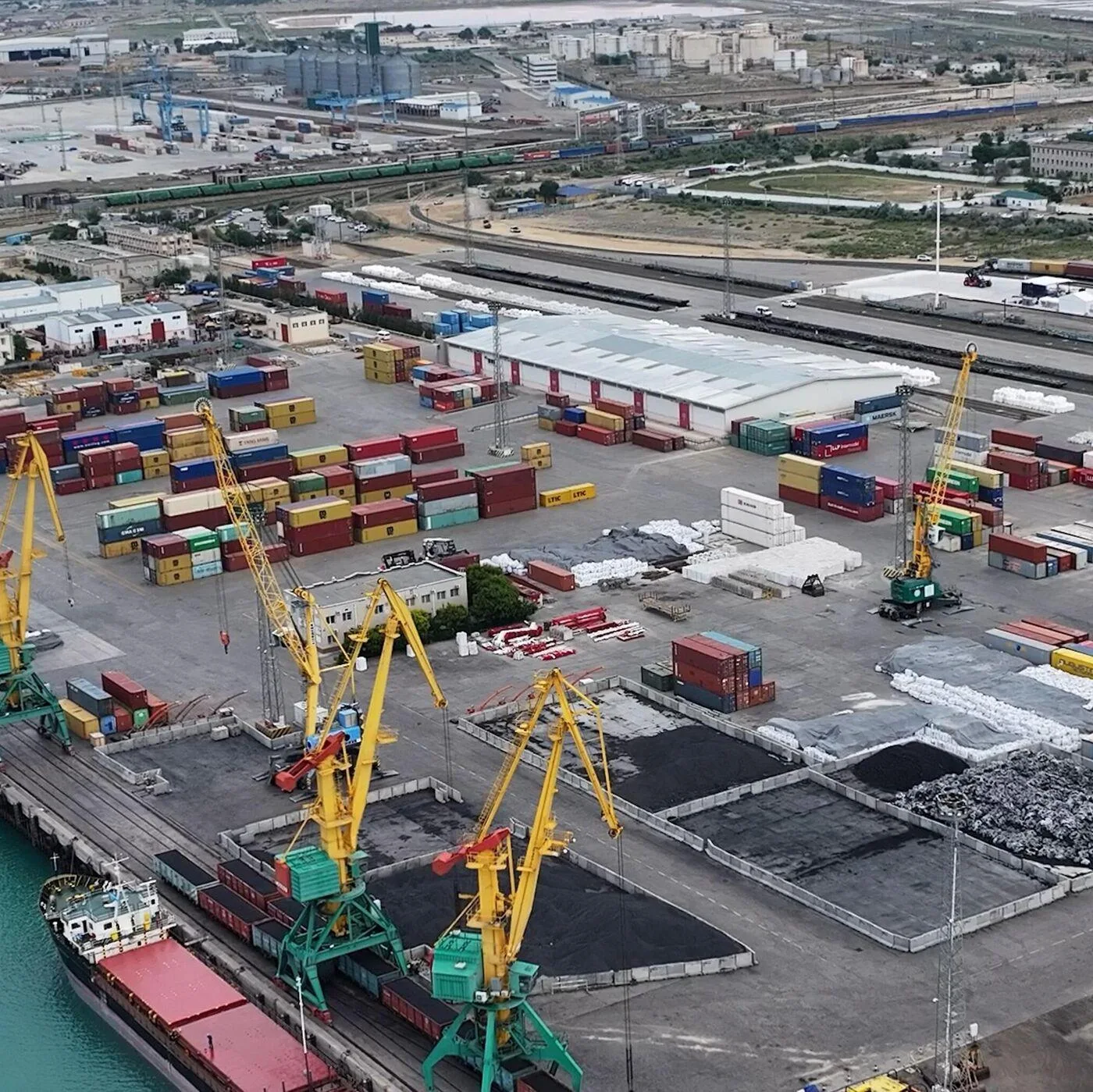
The Trans-Caspian International Transport Route, commonly known as the Middle Corridor, connects China and Central Asia to the Caspian Sea, then Azerbaijan, Georgia, Turkey and Europe. It remains more complex than a continuous railway connection. The Caspian must be crossed; railway networks, ports, customs systems and several jurisdictions must be coordinated.
But yesterday’s weakness — multiple transshipment points — is now being weighed against another advantage: the route offers an alternative connection between Asia and Europe.
The World Bank has estimated that a combination of investment and policy reforms could triple trade flows along the Middle Corridor while halving travel times. In September 2026, it went further, arguing that integrated development of the Trans-Caspian corridor could more than triple trade volumes along the route, reduce transit times by half and, by 2040, contribute to higher economic output and substantial employment creation across the economies involved.
Those projections should not be exaggerated. The Middle Corridor will not mechanically replace other Eurasian routes, and its logistical constraints remain significant.
But its importance now extends beyond transport.
A corridor produces geopolitics.
When a railway is modernised, a Caspian port expanded or a customs procedure harmonised, the economic distance between Astana, Baku, Tbilisi and European markets decreases. A landlocked region can then begin to function not as the end of a network, but as a space through which networks pass.
And a transit territory acquires a value that a periphery did not have.
Beijing did not wait
China understood the importance of this continental continuity earlier than most Western actors.
For Beijing, Central Asia is simultaneously a neighbourhood, a source of raw materials, a market, a security zone and a passage westward. Infrastructure developed under the Belt and Road Initiative has deepened relationships that existed long before the initiative itself.
But the China–Central Asia relationship is also changing in form.
At the second China–Central Asia Summit in Astana in June 2025, Xi Jinping and the leaders of the five Central Asian states signed a treaty on permanent good-neighbourliness, friendship and cooperation. Beijing and its partners also identified priorities covering trade, industrial investment, connectivity, green mining and agricultural modernisation.
The signal matters.
China is no longer dealing only with five neighbours individually. It is also helping institutionalise a China–Central Asia format in which the five countries increasingly appear as a regional grouping.
That does not constitute a political alliance or imply automatic alignment. The interests of the Central Asian states remain different, and their relationships with Beijing contain significant asymmetries of their own.
But the multiplication of regional formats is producing an unexpected consequence: by repeatedly seeking to speak to the five countries together, outside powers are themselves helping the “five” acquire political substance.
Europe rediscovers Samarkand
The European Union is following a similar logic.
On 4 April 2025, the first summit between the European Union and the five Central Asian states was held in Samarkand. The two sides decided to elevate their relationship to a strategic partnership. Brussels simultaneously announced a €12 billion Global Gateway investment package covering areas including transport, critical raw materials, energy, water and digital connectivity.
The choice of Samarkand was almost too perfect.
For centuries, the city prospered because it stood on routes connecting different worlds. Maritime trade, empires and modern borders eventually shifted the centre of gravity of global commerce elsewhere.
Today, infrastructure is once again attempting to shorten continental distances.
Europe is not looking towards Central Asia only because of trains. It is also looking for energy, raw materials and partners capable of diversifying strategic supply chains.
Kazakhstan illustrates this new importance. It is the world’s largest producer of uranium, accounting for roughly 40% of global mine production in recent years.
Then there is Kazakh oil, Turkmen gas, metals, Uzbekistan’s mineral resources and a wider energy potential attracting China, Russia, Europe and Gulf investors.
The energy transition does not necessarily make Central Asia less important.
It changes the list of assets that make it important.
A region begins by settling its borders
Yet the most consequential transformation may be the one receiving the least attention outside the region.
The five states are increasingly learning to think in relation to one another.
The recent history of independent Central Asia has been marked by disputed borders, enclaves, visa restrictions, water rivalries and occasionally difficult relations between governments. The Ferghana Valley concentrated many of these contradictions. Borders drawn during the Soviet era became international frontiers without all their ambiguities having been resolved.
Some of them produced deadly clashes.
In March 2025, Kyrgyzstan and Tajikistan finally signed an agreement settling their border after years of negotiations and several episodes of violence. Shortly afterwards, in Khujand, the presidents of Kyrgyzstan, Tajikistan and Uzbekistan signed a treaty establishing the junction point of their three national borders.
A border agreement alone does not create a regional community. Political systems remain different, economies are unequal, national interests sometimes compete and the distribution of water remains sensitive.
But the logic is changing.
A border gradually ceases to be only the place where the neighbouring state begins. It can become the place where trade with that neighbour begins.
For a landlocked region, that is a fundamental transformation.
The water behind the pipelines
There is another map of Central Asia, less spectacular than the one showing railways and hydrocarbons.
It is the map of water.
The region’s major river systems ignore political borders. Upstream states possess significant hydropower potential; downstream states depend heavily on the same water systems for agriculture. The energy interests of Kyrgyzstan and Tajikistan therefore do not always coincide with the agricultural requirements of Kazakhstan, Uzbekistan or Turkmenistan.
As populations grow, economies develop and climate change alters hydrological balances, that interdependence becomes increasingly difficult to avoid.
The World Bank has estimated that inadequate regional cooperation over water and energy resources already carries potential economic costs amounting to several billion dollars annually.
This may be where the true depth of regional integration will ultimately be tested.
It is possible to build a road with Chinese, European or multilateral financing without building a genuine political region.
Managing a shared river sustainably is much harder.
Central Asia will therefore have to learn not only how to negotiate with the powers surrounding it, but how to negotiate with itself.
Neither Russian, Chinese nor Western
The temptation from outside is always to ask the same question: who will dominate Central Asia?
Russia?
China?
The West?
The question is probably too simple.
Russia possesses relationships that no other actor can reproduce quickly. China has extraordinary economic weight and geographic proximity. Europe can offer markets, investment and political diversification. Turkey benefits from linguistic and cultural links with several of the region’s states. Other powers each possess their own specific instruments.
None of these relationships necessarily cancels out the others.
For the five Central Asian states, the most favourable environment may be precisely one in which several powers have enough interest in the region that none can easily monopolise it.
That strategy carries risks. Multiplying partners does not eliminate economic asymmetries, dependencies or pressure from larger powers. It can multiply them. Corridors can become instruments of influence as easily as instruments of autonomy. Investments can create new dependencies while reducing older ones.
But Central Asian governments now possess an additional asset: the ability to compare offers.
That, too, is a form of power.
The return of the middle
On school maps, Central Asia still appears far from everything.
It has no access to the open ocean. Kazakhstan is the world’s largest landlocked country, while Uzbekistan belongs to an exceptionally small category of doubly landlocked states: reaching the sea from its territory requires crossing at least two national borders.
For decades, these characteristics seemed to summarise a geographical disadvantage.
They now tell a different story.
Between China and Europe, between Russia and South Asia, between the Caspian and Asian markets, the five states occupy precisely the territory that several powers now want to cross, secure or connect. Hydrocarbons, uranium, minerals, electricity, railways and digital cables give material value to that position.
But the decisive transformation may come neither from Beijing, Moscow nor Brussels.
It will come from the ability of Kazakhstan, Uzbekistan, Kyrgyzstan, Tajikistan and Turkmenistan to convert a shared geography into shared interests.
Because a region does not exist simply because five countries appear beside one another on a map. It exists when decisions taken in one begin to change the possibilities available to the others; when infrastructure crosses borders; when disputes become costly enough to resolve; and when outside powers are forced to speak not merely to five capitals, but to a space.
For a long time, maps of Central Asia seemed to begin in Moscow, Beijing or Washington.
Increasingly, they begin in Astana and Tashkent.
Main sources
- World Bank — Central Asia Water & Energy Program (CAWEP), August 2026 — Regional water-energy interdependence, climate pressures, agriculture and cross-border cooperation.
- World Bank — Regional Water Management and Conservation Across Central Asia, July 2026 — Transboundary water management, Amu Darya and Syr Darya basins, ageing infrastructure and glacier retreat.
- World Bank — Regional Cooperation Reduces Poverty and Builds Resilience in Central Asia — Regional integration, transport and energy; estimates the cost of insufficient water-energy cooperation at more than $4.5 billion annually.
- European Council — First EU–Central Asia Summit, Samarkand, 4 April 2025 — First summit between the EU and all five Central Asian states and elevation of relations to a strategic partnership.
- Ministry of Foreign Affairs of China — Second China–Central Asia Summit, Astana, June 2025 — China–Central Asia cooperation and the treaty on permanent good-neighbourliness, friendship and cooperation.
- World Nuclear Association — Uranium and Nuclear Power in Kazakhstan — Kazakhstan’s uranium production and its position in the global uranium supply chain.
- President of Uzbekistan — Khujand Summit, March 2025 — Uzbekistan–Kyrgyzstan–Tajikistan trilateral summit and settlement of the three countries’ border junction.
- World Bank — Shared Water Infrastructure, Shared Prosperity, November 2025 — Cross-border hydraulic infrastructure and the gradual development of practical regional cooperation in Central Asia.
Atlas Limits Research Desk
Atlas Limits’ editorial and analytical desk.