Two bolts arrive in front of him. Charlie Chaplin tightens them. Two more appear. He tightens those too. The assembly line accelerates. His hands follow, his shoulders tense, his body learns the rhythm until it no longer knows how to escape it. When the work stops, his arms continue performing the same movement in empty space.
A few moments later, the worker disappears between the gears of an enormous machine.
The scene comes from Modern Times, released in 1936. It lasts only a few minutes, requires almost no dialogue, and yet contains much of what Chaplin would come to say about the twentieth century. Humanity had built systems capable of producing more, faster, and on a scale previously unknown. The question was what would happen to the individual when those systems began imposing a logic of their own.
Chaplin would never really answer that question. He would move it. From the factory to the street. From the street to politics. From politics to dictatorship. Until history eventually moved beyond the screen.
The Man Inside the Machine
Modern Times appeared at the end of an industrial transformation that had begun long before Chaplin. Scientific management had broken work into individual gestures. Fordism had made the assembly line one of the defining symbols of mass production. Electricity, mechanization and standardization had made it possible to manufacture quantities of goods that would have been unimaginable only a few decades earlier.
Then came the Great Depression. In the United States, unemployment reached roughly a quarter of the labor force at the height of the crisis in 1933. Millions of Americans encountered a new contradiction: an economy capable of producing on a massive scale could also leave a considerable share of its population without work.
It was in this America that Chaplin placed the Tramp in front of an assembly line.
The problem is not presented as an economic argument. Chaplin prefers to push industrial logic toward absurdity.
The company president watches his workers through screens. He orders the assembly line to move faster. Then a strange invention is tested on the Tramp: a machine designed to feed workers automatically while they remain at their stations.
Its purpose is perfectly rational. Eliminate the lunch break. A plate rotates in front of the worker, a mechanism pushes food into his mouth, another device wipes his lips. The machine malfunctions, accelerates and eventually torments the man it was supposed to make more productive.
The joke works because Chaplin barely alters the logic from which it begins. He simply follows it to its conclusion. If every minute has productive value, why should a man stop working in order to eat?
Chaplin would explain that Modern Times sought, among other things, to portray a life that had become “standardized and channelized,” in which human beings risked being transformed into machines.
But the film goes further. It distributes speech. The Tramp remains almost silent. The workers speak little. The machines, screens and figures of authority, by contrast, speak perfectly well. The boss’s voice travels through the factory. Instructions arrive through technological devices. Even the feeding machine comes with a recorded sales pitch.
The individual still possesses his body. The system already possesses the voice. Then the body itself gives way.
The Tramp continues tightening bolts that are no longer there. He applies his professional gesture to buttons on the clothes of people he encounters. The rhythm of industrial production has left the factory.
It has entered him. Chaplin makes us laugh at a man who has become incapable of stopping work. It may be one of the darkest scenes in the film.
The Tramp
It would nevertheless be too simple to make Chaplin an opponent of technology.
Modern Times is not an economic program. Chaplin proposes neither an alternative organization of industry nor a precise doctrine of labor. The machine is not even really his subject.
His subject is the man standing in front of it. The Tramp is almost perfectly designed for that purpose. He owns little, works when he can, sleeps wherever he finds shelter and seems incapable of belonging permanently to any institution. This constant precarity makes him a peculiar observer of modern society: he passes through all of its spaces without ever managing to settle inside them.
The factory employs him, then rejects him. Prison locks him up, then releases him. Commerce temporarily offers abundance. The street returns him to poverty.
Each time, the Tramp encounters rules he only partially understands, and precisely because he does not fully understand them, he exposes their occasional absurdity.
One day, a red flag falls from a truck. The Tramp picks it up and runs after the vehicle to return it to its owner. At that exact moment, a workers’ demonstration appears behind him. He walks forward holding the flag; the crowd follows; the police intervene.
Within seconds, the Tramp has become a revolutionary leader. 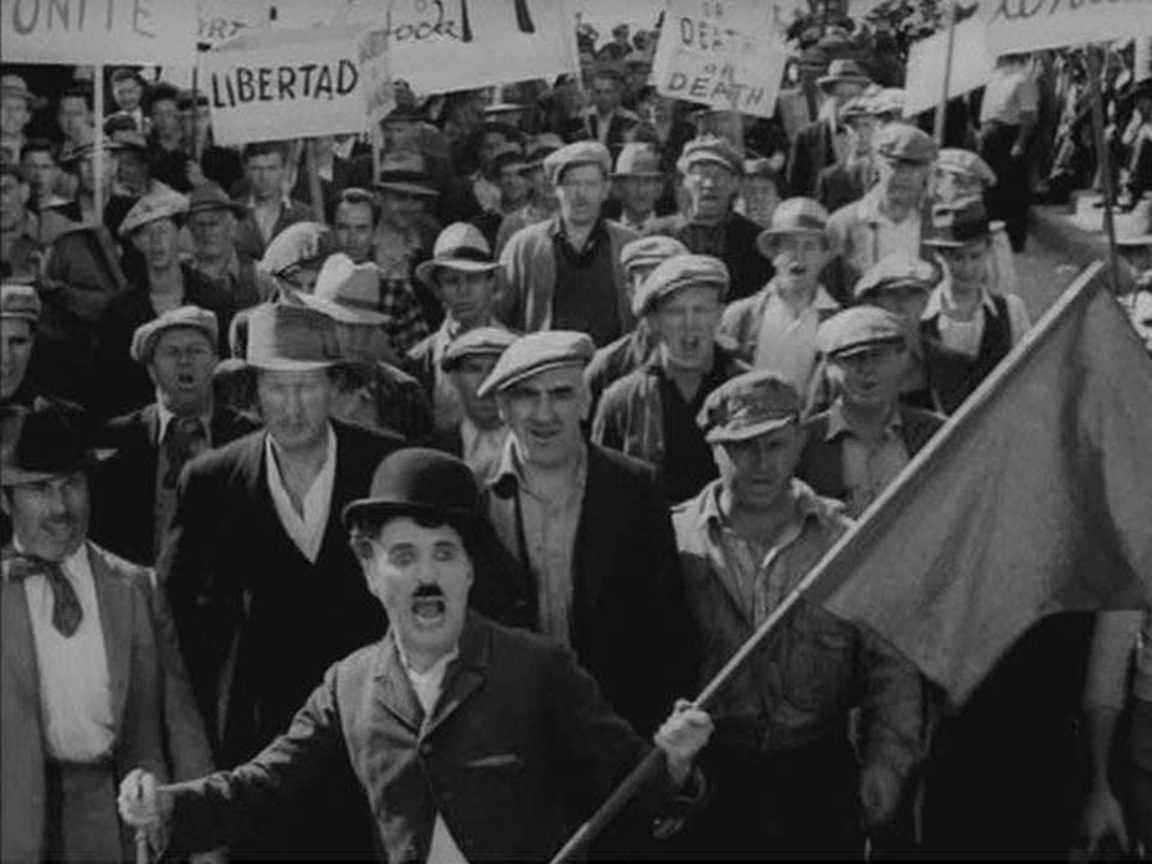 He has demanded nothing. He has delivered no speech. He simply happened to be in the wrong place with the wrong object in his hands. The police, of course, cannot know his intention. They see a man carrying a red flag at the head of a demonstration.
They arrest him. Chaplin has moved his subject. Inside the factory, the system imposed a rhythm on the individual. In the street, it assigns him an identity.
Four Years Later, the Moustache Changes Owners
In 1940, Chaplin uses almost the same face. But the Tramp has disappeared.
The small moustache now belongs to Adenoid Hynkel, dictator of Tomania and a barely disguised caricature of Adolf Hitler.
The Great Dictator was released in the United States in October 1940. Nazi Germany had invaded Poland and then much of Western Europe. France had fallen four months earlier. Britain was resisting.
The United States had not yet entered the war. Chaplin therefore took a risk that historical distance can make easy to underestimate: he turned Hitler into a comic character while Hitler was still in power.
Physical coincidence provided the weapon. Chaplin and Hitler had been born only four days apart in April 1889. The moustache that had helped make the Tramp universally recognizable now resembled the one associated with a political power of an entirely different nature.
Chaplin hardly needed to change anything. Only the body. The Tramp was small because the world around him always seemed too large. Hynkel, by contrast, tries to enlarge every gesture. He expands his chest, raises his arms, dominates the podium and transforms his own presence into spectacle.
The factory in Modern Times organized bodies. Dictatorship organizes the gaze. Uniforms, emblems, ordered crowds, speeches, architecture and gestures all participate in the same construction: making power visible before making it intelligible.
Chaplin understands that mass politics has a choreography. He decides to dismantle it.
The World as a Balloon
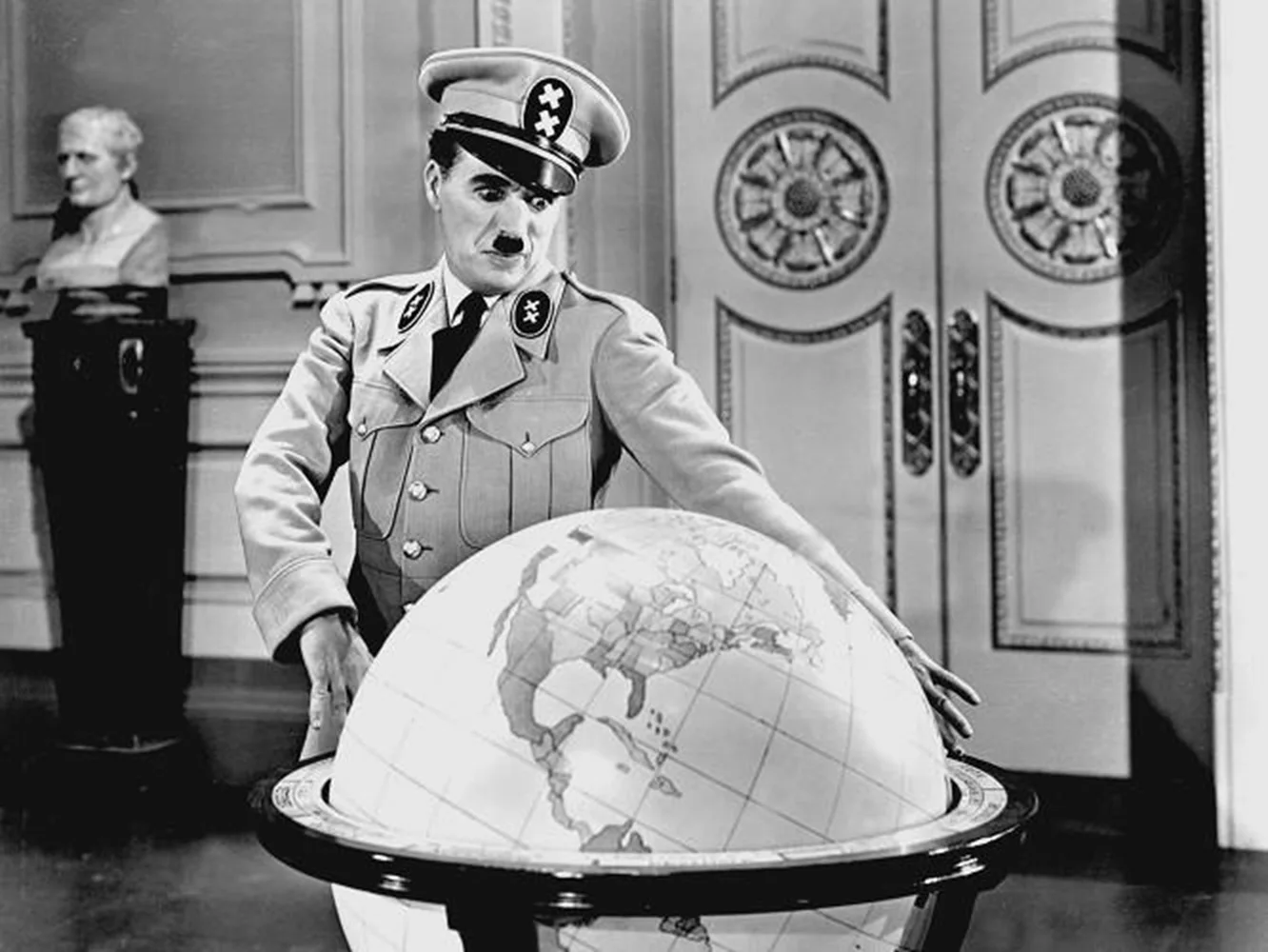
Hynkel finds himself alone in an enormous room. In front of him is an inflatable globe. He takes it in his hands, throws it into the air, catches it, dances with it. The world rises above his head and slowly falls back toward his arms. For several minutes, the dictator is no longer governing a state.
He is playing. The scene is almost silent. And it may be more damaging to the image of the dictator than any speech could have been.
Monumental power suddenly collapses into a childish desire for possession. Borders, armies and territorial ambitions become a balloon with which one man dances alone.
Then the globe bursts. Hynkel looks at the remains. And cries. Chaplin is not suggesting that the dictator is harmless. Europe in 1940 already made such an illusion impossible. He is doing something else. He deprives power of one of its most valuable resources: distance.
A regime that seeks to impress must control its image. Satire steals that image away. The dictator wants to appear enormous. Chaplin makes him small.
Then Chaplin Stops Laughing
Yet something breaks at the end of The Great Dictator.
Chaplin also plays a Jewish barber persecuted by Hynkel’s regime. Through a confusion of identities, the barber finds himself standing before a crowd that believes he is the dictator.
He has to speak. The character begins his speech. Then he almost disappears. Soon it is no longer really the barber addressing the crowd. It is Chaplin. “We think too much and feel too little.”
The filmmaker who had spent much of his career trusting gestures suddenly feels compelled to speak directly. The change is considerable.
For years, Chaplin had shown the contradictions of modern society without explaining to audiences what they were supposed to think. An assembly line, a red flag picked up by accident or a globe transformed into a balloon had been enough.
This time, the image is no longer enough. The final speech in The Great Dictator became one of the most famous passages in Chaplin’s work. It also remains one of the most debatable.
The satire stops. The character recedes. Cinema almost becomes a political platform. It can be read as an artistic rupture. But the year 1940 gives it another meaning.
Chaplin had reached the point at which laughter seemed insufficient.
Decades later, he would acknowledge a far more terrible limit. In his 1964 autobiography, Chaplin wrote that had he known the full horror of the Nazi concentration camps, he probably could not have made The Great Dictator in the same way.
The observation is essential. It establishes a boundary to his own method. Satire can diminish the tyrant’s pretensions. It can destroy his image, caricature his gestures and expose the theater of power. It cannot always contain what power actually does to human beings.
When History Leaves the Screen
After the war, Chaplin did not simply return to the America he had known. The context had changed.
The Soviet Union had become the strategic adversary of the United States. Anti-communism was gaining force in Washington. The House Un-American Activities Committee investigated alleged communist influence across American society, and Hollywood became one of the principal battlegrounds.
Chaplin was not an American citizen, despite having lived in the United States for nearly four decades.
His political positions had long attracted controversy. During the war, he publicly supported the opening of a second European front to relieve pressure on the Soviet Union. He later criticized aspects of American anti-communism. His associations were scrutinized. The FBI accumulated information about him.
His case was also burdened by controversies that had little to do with politics. His private life, his relationships with very young women, a highly publicized paternity case and several scandals had severely damaged his reputation among parts of the American public.
The two dimensions should not be confused. Yet eventually they converged.
Chaplin became less a controversial filmmaker than a public problem onto which questions of morality, politics, nationality and ideological suspicion were simultaneously projected.
In September 1952, he boarded the Queen Elizabeth with his family and sailed for Europe. He was traveling to London for the premiere of Limelight.
While he was crossing the Atlantic, U.S. authorities announced that his re-entry permit had been revoked. If he wanted to return to the United States, he would have to face immigration proceedings and satisfy the authorities that he should be readmitted.
Chaplin chose not to submit to the process. He settled in Switzerland. The man who had helped build Hollywood left the country in which he had lived and worked for almost forty years.
The U.S. government had not formally convicted him of belonging to the Communist Party. Nor does the available historical evidence establish that he was a member, something Chaplin himself denied.
That distinction matters. Chaplin’s story is not the simpler story of a dissident expelled solely for his political opinions. It is the story of an era in which several forms of suspicion could reinforce one another until a presence became undesirable.
The mechanism was more diffuse. And perhaps for that reason more revealing.
The Final Shot
Twenty years passed. In 1972, Chaplin finally returned to the United States. He was 82. The Academy of Motion Picture Arts and Sciences presented him with an honorary Oscar. When he appeared on stage, the audience rose. The ovation lasted for several minutes.
America was now celebrating the man whose return it had once made conditional. The story could end with that reconciliation. But another image remains. It appears thirty-six years earlier, in Modern Times. A man is walking down a street. A red flag falls from a truck. He picks it up.
A demonstration appears behind him. The police look at the scene and decide what it means. The Tramp becomes, without intending to, the man the system believes it has recognized.
In 1936, it was only a joke. Chaplin had spent his life filming a man whom systems classified before they understood him. It took almost an entire career for him to discover that the Tramp may not have been only his character.
Main Sources
- British Film Institute — Modern Times (1936), analysis of the film, mechanized labor and industrial dehumanization.
- Museum of Modern Art — documentation and analysis of Modern Times, including mechanization, standardization, authority and Chaplin’s use of sound.
- Library of Congress / National Film Preservation Board — Jeffrey Vance, The Great Dictator, historical essay on the film’s context, production and political satire.
- Library of Congress — National Film Registry documentation on The Great Dictator.
- Federal Bureau of Investigation — The Vault: Charlie Chaplin, declassified records concerning investigations into Chaplin.
- Charlie Chaplin — My Autobiography, Simon & Schuster, 1964.
- Scott Eyman — Charlie Chaplin vs. America: When Art, Sex, and Politics Collided, Simon & Schuster, 2023.
Atlas Limits Research Desk
Atlas Limits’ editorial and analytical desk.