For years, China’s response to the property slowdown followed a relatively predictable playbook: cut interest rates, ease purchasing restrictions, improve access to credit, support developers and mobilize state-backed banks. On September 29, 2026, Beijing added a different instrument to that arsenal. For some new homebuyers, the state will no longer merely make credit cheaper. It will directly pay part of its cost.
Starting October 1, some first-time homebuyers will be eligible for an annual one-percentage-point interest subsidy on new commercial mortgages. The support can last for five years and apply to a maximum loan amount of RMB 1 million per household. Eligible homes must be no larger than 120 square metres and cost less than RMB 1.5 million. The programme is initially scheduled to run for one year.
Taken in isolation, the measure could appear to be another attempt to stabilise a property market weakened by several years of adjustment. But it was announced alongside a much broader set of measures targeting bank refinancing, infrastructure, technology, small businesses and the private sector.
It is this combination that matters.
From cheaper credit to subsidised credit
China is not experimenting with direct government support for household interest payments for the first time. Since 2025, the government has subsidised interest on certain consumer loans, including a one-percentage-point interest subsidy. The programme was subsequently extended and expanded in 2026.
What changed on September 29 is its application to housing: Beijing is now extending this logic to new loans used to purchase a first home.
The distinction matters.
A general interest-rate cut changes the price of money across a broad part of the economy. An interest subsidy, by contrast, allows the state to select a category of borrower, a type of purchase, a price ceiling and a duration. Support becomes more targeted.
For an eligible RMB 1 million mortgage, a one-percentage-point subsidy theoretically represents up to RMB 10,000 a year before accounting for amortisation and the precise structure of the loan. The objective is therefore not simply to increase the amount of financing available. It is to reduce directly the cost borne by the buyer.
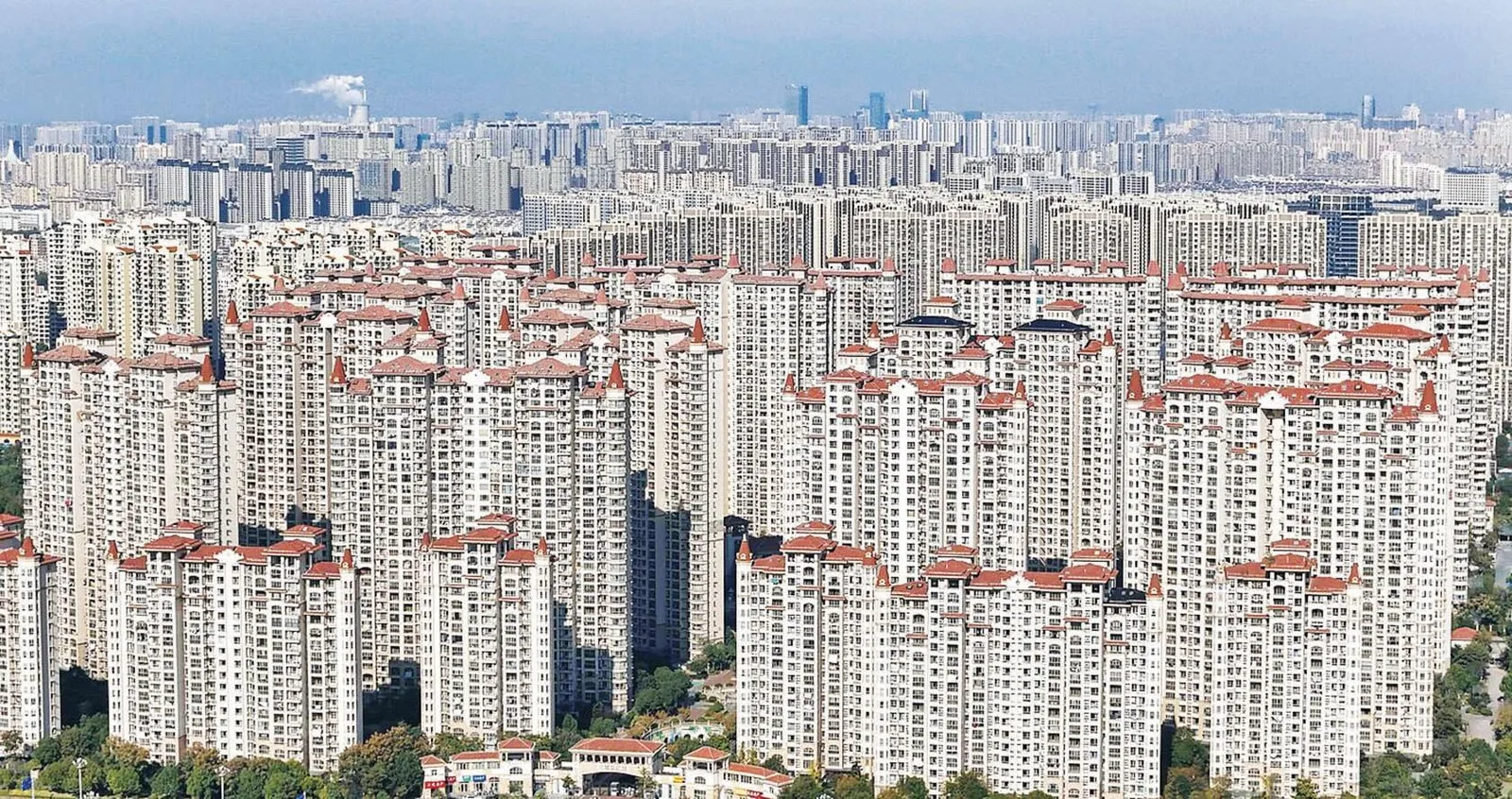
This shift comes as China’s property market remains trapped in a problem deeper than access to financing alone. Falling prices, housing inventories, developers’ financial difficulties and household caution have created a cycle in which available credit does not necessarily translate into a decision to buy.
Economic policy is therefore beginning to move from the supply of financing towards the demand for financing.
A stimulus that chooses its destinations
The housing measure, however, is only one half of the package.
The People’s Bank of China simultaneously cut the one-year rate on its Pledged Supplementary Lending facility, or PSL, by 25 basis points to 1.50%. The instrument provides low-cost funding to China’s policy banks and has previously been used to support large-scale urban redevelopment and public investment programmes.
Its scope is now being expanded to cover additional categories of infrastructure, including water, electricity, digital, logistics and urban projects.
At the same time, Beijing is increasing the refinancing quota for technological innovation and equipment upgrading by RMB 200 billion, bringing it to RMB 1.4 trillion. The quota supporting agriculture and small businesses rises by RMB 500 billion to RMB 4.85 trillion, while the facility dedicated to private enterprises increases by RMB 300 billion to RMB 1.3 trillion.
Together, the announced increases represent RMB 1 trillion in additional refinancing capacity, equivalent to roughly $149 billion.
That figure does not mean that RMB 1 trillion in new loans will immediately enter the economy. Between the existence of a quota, demand for borrowing, banks’ willingness to lend and the financing ultimately distributed, transmission may be substantial or limited.
But the intended destination of the capital is explicit.
Power grids, digital capacity, telecommunications, equipment, innovation, agriculture, small businesses and the private sector: Chinese monetary policy increasingly resembles more than the aggregate management of the cost of credit. It also operates as a mechanism for directing financing towards capabilities Beijing considers strategically important.
Two problems, one architecture
China is therefore attempting to address two very different imbalances simultaneously.
The first lies with households. After several years of property-market correction, making mortgages available is no longer necessarily enough to generate purchases. Households may be able to borrow and still decide not to.
The second lies with investment. Beijing continues to seek the expansion of energy and digital infrastructure, the modernisation of its industrial base and improved access to financing for private businesses.
The response is less about opening the monetary floodgates than about constructing several parallel channels.
Selected households receive assistance with part of their interest costs. Banks receive refinancing resources when they lend to designated activities. Policy banks gain cheaper PSL funding for specified categories of infrastructure.
Capital remains available, but its destination is increasingly organised.
In theory, this architecture allows Beijing to support economic activity without relying exclusively on broad interest-rate cuts. It may also reduce some of the side effects associated with much wider monetary easing: pressure on bank margins, indiscriminate growth in leverage, or additional pressure on capital flows and the currency.
The counterpart is an economy in which the boundary between monetary policy, fiscal policy and industrial policy becomes increasingly difficult to draw.
Lower-cost cities come first
The parameters of the mortgage subsidy also reveal the programme’s limitations.
A home must cost less than RMB 1.5 million to qualify. That ceiling mechanically limits the measure’s relevance in China’s most expensive metropolitan areas. Its impact is therefore likely to be greater in lower-tier cities, precisely where weak demand and excess housing inventories can be particularly difficult to resolve.
The targeting can be interpreted in two ways.
It limits the fiscal cost of the programme and avoids indiscriminately subsidising property purchases in the country’s most expensive markets. But it also concentrates assistance in places where weak demand may not primarily be caused by the cost of borrowing.
A slightly lower mortgage payment does not automatically change a city’s demographic outlook, households’ expectations of future property prices or their confidence in future income.
That is probably where the effectiveness of the programme will ultimately be tested.
China’s problem is no longer only the price of money
China’s economy expanded by 4.3% year on year in the second quarter of 2026, while several indicators of activity subsequently showed signs of weakening. The property downturn continues to weigh on a sector that for years served as a major engine of investment, household wealth and local-government revenue.
Against that backdrop, the September 29 package may reveal more through its design than through its headline size.
Beijing appears increasingly to believe that part of China’s economic problem can no longer be addressed simply by making money cheaper.
It must now persuade some households to use it and some banks to direct it towards specific sectors.
That does not guarantee a property recovery. A subsidy can improve housing affordability without changing expectations of falling prices. It can support transactions without absorbing enough excess inventory. And larger refinancing quotas can facilitate lending without automatically creating profitable projects or additional demand.
But the transformation of the instrument is significant.
China had already developed an industrial policy capable of directing capital towards technologies, infrastructure and productive capabilities considered strategically important. It is now beginning to apply a comparable logic to parts of domestic demand: identify the desired behaviour, select the beneficiaries and directly reduce its cost.
The question, then, is no longer simply how much money Beijing will inject into the economy.
It is how far the Chinese state is prepared to go in deciding where that money should flow — and, increasingly, in paying part of the price required to set it in motion.
Main sources
— People’s Bank of China (PBOC) — refinancing measures and monetary policy instruments — Ministry of Finance of the People’s Republic of China — interest subsidy programmes and measures supporting consumption — Reuters, September 29, 2026 — China unveils rate cut, mortgage subsidies to spur growth — Associated Press, September 29, 2026 — China’s measures supporting the property market and broader economy — Financial Times, September 29, 2026 — China unveils mortgage subsidies to boost economy — The Wall Street Journal, September 29, 2026 — China Offers Subsidies on Some Residential Mortgages
Atlas Limits Research Desk
Atlas Limits’ editorial and analytical desk.