China's decision to block SoftBank's acquisition of ABB's robotics division reveals a new frontier of industrial sovereignty. As robots become instruments of learning for artificial intelligence, their ownership is no longer merely a matter of corporate strategy. It increasingly involves control over data, manufacturing capabilities and the technologies that could shape tomorrow's industry.
On November 5, 2026, a financial transaction negotiated between a Japanese conglomerate and a Swiss industrial group encountered an obstacle in Beijing. China blocked the transfer of ABB's Chinese robotics operations to SoftBank, jeopardizing an international acquisition valued at $5.375 billion. The announcement unsettled investors, particularly because the transaction had already cleared China's competition review in February. Yet it remained subject to a second, considerably more political examination: the national security review of foreign investments.
At first glance, the transaction belongs to the familiar history of major industrial acquisitions. A Japanese conglomerate seeks to strengthen its technological portfolio, a Swiss company intends to divest a business, and national authorities assess the consequences of a change in ownership. But this interpretation no longer adequately explains China's decision. What Beijing seeks to preserve extends beyond factories and robots themselves. The question also concerns the industrial knowledge accumulated through these machines, the data they generate and the possibility that these resources could eventually support artificial intelligence systems developed outside China.
The SoftBank–ABB affair therefore marks a shift in the boundaries of sovereignty. After semiconductors, digital infrastructure and critical minerals, data generated by industrial machinery is becoming another matter of economic security.
An Acquisition Designed to Bring Artificial Intelligence into Industry
On October 8, 2025, SoftBank Group announced an agreement to acquire ABB's robotics division for $5.375 billion. The transaction was structured around a holding entity containing the relevant businesses, over which SoftBank would acquire full control. Completion was initially expected between mid-2026 and the end of that year, subject to regulatory approvals.
For ABB, the divestment formed part of a broader reorganization of its industrial portfolio. The Swiss group, active in electrification, automation and industrial technologies, intended to concentrate resources on its remaining businesses while generating substantial liquidity. Financial disclosures at the time indicated expected net cash proceeds of approximately $5.3 billion and a non-operating, pre-tax accounting gain of around $2.4 billion.
SoftBank approached the transaction from a different perspective. Masayoshi Son was seeking to transform a portfolio of technology investments into an industrial ecosystem capable of participating in the development and deployment of artificial intelligence. The Japanese group had already committed substantial resources to computing infrastructure, advanced AI models and robotics companies. Acquiring ABB Robotics would have added another dimension: an established manufacturing base, commercially deployed equipment, engineering expertise and longstanding relationships with major industrial customers.
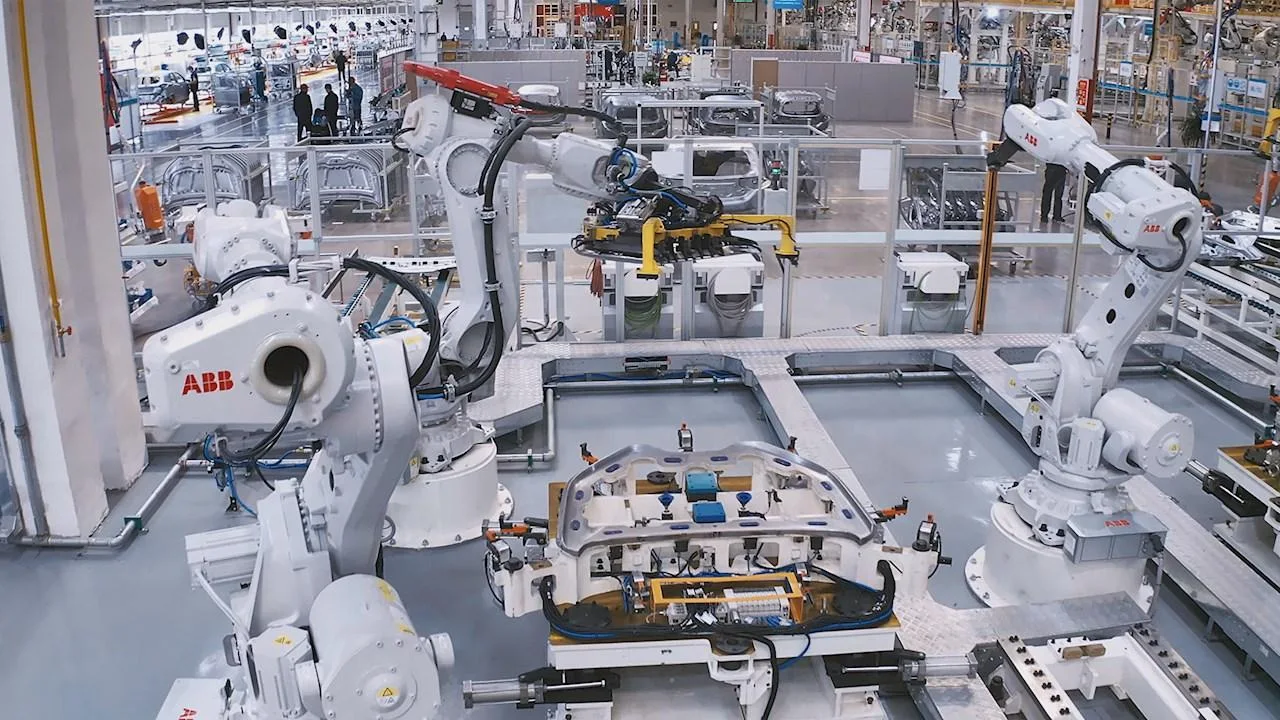
The business employed approximately 7,000 people and possessed extensive experience in industrial robotics. Its systems are used in welding, handling, assembly, painting and component manipulation. These activities may appear distant from large generative artificial intelligence models. Yet they represent environments in which AI could acquire particularly tangible economic value.
A model capable of generating text or interpreting images is not necessarily capable of controlling a robotic arm on a production line. It must understand physical constraints, anticipate movements, coordinate sensors and adapt decisions to changing conditions. Industrial robotics provides an environment in which these capabilities can be developed, tested and deployed.
SoftBank was therefore seeking more than a manufacturer of robots. It wanted a bridge between digital artificial intelligence and its application in the physical world.
Why China Became Central to the Transaction
China's ability to intervene stems first from the country's importance to ABB's robotics business. China accounts for approximately 30% of the division's activities, making it its largest national market. ABB has maintained a substantial industrial presence there for decades, reinforced by investments in manufacturing, research and development.
In Shanghai, ABB operates a major robotics manufacturing and development facility. A new robotics factory, representing an investment of approximately $150 million, began operations in 2022. According to reporting by the Financial Times, more than 90% of the robots ABB sells to Chinese customers are manufactured locally.
This presence is not simply a commercial platform for importing European equipment. It constitutes an integrated part of ABB's industrial system, with suppliers, engineers, production facilities and knowledge accumulated through years of operating in the Chinese market.
The distinction matters. When a foreign company develops operations in a country over several decades, it gradually builds assets that cannot all be transferred easily. Factories and machinery are identifiable. Supplier networks, technical expertise, manufacturing procedures and knowledge derived from production are more difficult to isolate.
SoftBank's acquisition would have transferred control of a global business incorporating these Chinese resources. Beijing therefore possessed considerable regulatory leverage, even though the buyer was Japanese and the seller Swiss.
China's foreign investment security review mechanism allowed authorities to intervene beyond the narrow question of market competition. The transaction had passed an initial regulatory examination, but that approval did not establish its acceptability from the perspective of national strategic interests.
This separation between competition policy and national security is one of the transaction's most important lessons. An acquisition may raise no decisive objection concerning market concentration while still being considered problematic because of its implications for sensitive technologies, industrial assets or data.
Industrial Data as a Strategic Asset
The most revealing concern involves the data generated by robots.
According to information published by the Financial Times and supplemented by Reuters, Chinese authorities feared that certain robotics data produced within the country could be transferred abroad and used to train artificial intelligence models. SoftBank's relationships with Western technology companies, particularly OpenAI, were reportedly among the concerns examined.
A distinction is necessary between an identified risk and an established event. Available reporting does not demonstrate that SoftBank or ABB had already organized an unlawful transfer of Chinese industrial data to foreign AI developers. It indicates that the possibility of such transfers became part of the regulatory assessment.
That distinction does not diminish the significance of the underlying reasoning.
Modern industrial robots generate or process different categories of information: positions and trajectories, movement speeds, mechanical forces, sensor signals, operating parameters, maintenance events, detected faults and production outcomes. Depending on the equipment, software architecture and access permissions, some of this information can be retained, analyzed or used to improve performance.
Not all such information is strategically sensitive. Nor is all of it necessarily accessible to the robot manufacturer, since contracts, technical configurations and confidentiality requirements can restrict collection. Nevertheless, sufficiently rich, contextualized and legally accessible datasets may contribute to the development of more advanced automation systems.
This is what changes the nature of the issue.
In generative artificial intelligence, the availability of text, images and digital content has long occupied a central position. In physical artificial intelligence, data describing interactions with the material world becomes particularly important. Under appropriate conditions, it can improve machine perception, planning and control.
Access to real industrial data may therefore offer advantages that simulated data cannot fully reproduce. Manufacturing environments impose requirements of precision, safety, repeatability and reliability that simulations do not always capture adequately.
The question is no longer simply who manufactures the robots. It is who can exploit the knowledge derived from their operation.
A machine may remain inside a factory while the insights generated through its activities circulate elsewhere. For a state that regards artificial intelligence as a strategic technology, this separation between the physical location of equipment and the destination of knowledge becomes a sovereignty concern.
SoftBank, OpenAI and the Question of Indirect Control
SoftBank's position within the global artificial intelligence ecosystem gives the transaction an additional dimension.
The Japanese conglomerate is a major investor in OpenAI and is pursuing a strategy intended to connect computing capacity, advanced models and industrial applications. Within this architecture, ABB Robotics could have become an important platform for developing physical artificial intelligence.
Such convergence does not imply that ABB's operational data would automatically have become available to OpenAI. Even a substantial financial investment does not, by itself, confer access rights to another company's information. Governance arrangements, contractual restrictions and regulatory obligations remain decisive.
National security authorities, however, frequently assess potential future capabilities, effective control and exposure to risk rather than limiting their analysis to transfers that have already occurred.
China's concern therefore appears to involve the possibility that an international industrial and financial ecosystem could gradually integrate technological resources originally developed on Chinese territory.
SoftBank's Japanese nationality adds another dimension. Reuters reported that tensions between Beijing and Tokyo also contributed to concerns surrounding the transaction. China does not necessarily assess changes in industrial ownership independently of the diplomatic environment in which they occur.
It would nevertheless be reductive to interpret the decision solely as retaliation against Japan. Available information points toward a combination of considerations involving data security, industrial capabilities, intellectual property and geopolitical relationships.
That combination helps explain why technology acquisitions are becoming increasingly difficult to assess. A transaction may be economically rational, financially attractive and industrially coherent without being politically acceptable to every state involved.
Intellectual Property and Supply Chains Under Scrutiny
China's examination extended beyond data.
According to information gathered by the Financial Times, authorities also examined the robotics division's supply chains and the possibility of maintaining certain manufacturing capabilities in China. Questions concerning intellectual property were reportedly considered, including potential arrangements under which some activities could be separated or transferred to Chinese owners to facilitate regulatory approval.
These possibilities should be understood as options examined or discussed during the review process, rather than as a definitive set of conditions formally imposed by Beijing.
They nevertheless reveal the underlying industrial logic.
Control over a technology does not depend exclusively on patent ownership. It also requires the ability to manufacture components, integrate equipment, maintain facilities and mobilize the expertise necessary for technological development.
When an international company changes ownership, its new shareholders and executives may alter investment locations, reorganize research activities, transfer functions or concentrate strategic decision-making in other jurisdictions. Such changes can occur gradually, long after the legal completion of an acquisition.
For Beijing, the potential risk was therefore not limited to an immediate transfer of data. It could also involve the subsequent reorganization of industrial value chains.
This consideration is particularly important in robotics. Competitiveness depends on accumulated expertise in precision mechanics, control systems, software, sensors, manufacturing processes and industrial integration. The loss of certain capabilities can weaken an industrial ecosystem even when factories remain physically present.
China is consequently seeking to prevent an international transaction from turning a local industrial presence into a mere operational extension of a technological strategy determined elsewhere.
A New Geography of Mergers and Acquisitions
The SoftBank–ABB affair forms part of a broader transformation in the regulation of international investment.
For much of modern corporate history, major acquisitions were primarily assessed through their effects on competition, market concentration and shareholder interests. These considerations remain essential, but they now coexist with reviews concerning national security, sensitive technologies, critical infrastructure and data flows.
The United States operates the Committee on Foreign Investment in the United States, or CFIUS, which examines certain transactions that may present national security risks. The European Union has developed a cooperation framework for screening foreign direct investment, while several member states maintain their own national mechanisms.
China also uses regulatory instruments to protect strategic interests connected to its territory.
These mechanisms are not identical. Their legal foundations, procedures, criteria and avenues for appeal differ considerably. Their proliferation nevertheless produces a common result: the final outcome of an international acquisition no longer depends exclusively on the companies involved and competition authorities.
The ABB transaction is particularly revealing because it concerns two non-Chinese companies. Chinese jurisdiction becomes decisive because strategically important industrial assets are located within the country.
This fundamentally changes acquisition calculations.
The value of an international business can no longer be assessed solely through revenue, margins, technology and growth prospects. Investors must also consider whether its assets can actually be transferred, what restrictions may apply to its data and whether particular states could oppose a change of control.
An activity may possess considerable economic value while facing limited strategic transferability. It may be profitable without being freely saleable to any prospective buyer.
Such constraints affect valuations, financing structures, contractual guarantees and transaction design.
In sensitive sectors, acquirers may increasingly need to consider data separation mechanisms, localization commitments, autonomous governance arrangements or partial divestments. These measures may mitigate certain risks without guaranteeing regulatory approval.
Sovereignty is becoming a financial variable.
The Manus Precedent and China's Expanding Strategic Perimeter
The SoftBank decision comes amid increasing Chinese scrutiny of acquisitions involving advanced technologies.
Reuters linked the case to the Manus transaction, involving an artificial intelligence company whose acquisition by Meta for more than $2 billion became subject to Chinese intervention in 2026.
The two transactions have different characteristics, but their comparison highlights a common development: Beijing intends to retain influence over certain technological resources connected to its economy, even when corporate structures or transactions involve international companies.
This development reflects a broader conception of economic security.
Critical technologies are no longer defined solely by their direct military applications. Computing capacity, software, data, automation platforms and artificial intelligence systems can also fall within the scope of national strategic concerns.
Industrial robotics sits at the intersection of several of these domains. It contributes to manufacturing competitiveness, production automation and the development of autonomous systems. It also has applications in logistics, infrastructure and certain defense-related industries.
The boundary between commercial technology and strategic resources is consequently becoming less distinct.
For companies, this uncertainty introduces another category of risk. An activity long regarded as commercially ordinary may become sensitive as its applications evolve. A transaction designed according to yesterday's regulatory assumptions may encounter tomorrow's strategic priorities.
The Corporate Cost of Sovereignty
China's decision carries consequences for both companies involved.
For SoftBank, it threatens an acquisition intended to accelerate its positioning in physical artificial intelligence. The group can continue investing in other robotics businesses, but quickly reproducing ABB Robotics' combination of industrial expertise, international presence and established customers would be difficult.
The intervention also comes against a financial backdrop characterized by investor questions about the cost of SoftBank's extensive artificial intelligence commitments. On November 5, its shares closed 6.8% lower in Tokyo, although the entire decline cannot be attributed exclusively to the Chinese announcement.
For ABB, the problem is different but equally significant. The Swiss group had organized part of its portfolio strategy around the divestment of its robotics division. A definitive failure could force it to seek another buyer, renegotiate the transaction or reconsider the business's future.
The acquisition should not, however, be regarded as definitively abandoned. As of November 5, ABB and SoftBank indicated that discussions were continuing and that they were working toward a solution. Available information does not establish whether an alternative regulatory arrangement will ultimately be accepted.
Possible scenarios include restructuring the Chinese perimeter, introducing specific commitments or modifying the ownership configuration. Their feasibility would depend on Chinese regulatory requirements, the positions of both companies and the economic attractiveness of the transaction after any changes.
An acquisition of this magnitude cannot be redesigned indefinitely without affecting its value.
If Chinese assets represent a substantial part of ABB Robotics' strategic appeal, excluding them could materially alter expected synergies. Conversely, retaining those assets under excessively restrictive conditions could limit the technological benefits SoftBank originally sought.
The case therefore raises a familiar corporate strategy question in a new form: to what extent does an acquisition remain value-creating when the control rights normally associated with ownership become incomplete?
Toward Sovereignty Over Industrial Systems
Beyond its immediate consequences, the transaction reveals a transformation in how states understand industrial assets.
For much of economic history, industrial sovereignty was associated with ownership of natural resources, infrastructure, factories and manufacturing technologies. Globalization progressively separated these elements: capital could originate in one country, machinery in another, components in several continents and finished products could be sold in distant markets.
Artificial intelligence introduces another separation. Equipment may operate within one jurisdiction while data useful for improving it is processed elsewhere. Knowledge extracted from its operation may subsequently be incorporated into models and redistributed through products developed in other countries.
Industrial value then circulates in forms that no longer correspond precisely to the physical boundaries of production facilities.
This development explains growing attention to data architectures, computing infrastructure and access rights. It may also encourage multinational companies to develop more regionalized systems, in which certain data, research functions or decision-making capabilities remain separated across jurisdictions.
Such arrangements could provide greater guarantees of local control, but they might also reduce economies of scale and global synergies. They could fragment the industrial datasets needed to develop increasingly capable artificial intelligence systems.
The paradox is considerable. Technologies promising to improve global productivity could reinforce economic boundaries precisely when their development requires international resources, expertise and investment.
China is not exempt from this tension. Its industrial economy has benefited for decades from technological exchanges, foreign investment and integration into global value chains. By seeking to protect strategic resources accumulated within its territory, it must also preserve the conditions that allow its industrial ecosystem to continue attracting capital and technology.
An excessively restrictive control regime can discourage investors or complicate corporate reorganizations necessary for competitiveness. Conversely, openness without safeguards may expose capabilities considered essential to decisions taken outside national jurisdiction.
The fundamental trade-off is therefore not simply between openness and protection. It concerns the benefits of international integration and the degree of control states wish to retain over technologies they regard as decisive.
Ownership Is No Longer Enough
The SoftBank–ABB affair could be interpreted as another episode in the tensions between China, Japan and the United States. That dimension exists, but it represents only part of the case's significance.
Beijing's decision demonstrates that a company may no longer be able to transfer freely all the economic and technological rights attached to an international business, even when it legally owns that business.
Control over machines, access to the data they generate, the location of industrial capabilities and the future use of accumulated knowledge are becoming separate questions. Each may fall under different authorities, contractual arrangements and strategic interests.
For investors, this fragmentation introduces lasting uncertainty into the valuation of technology companies. For industrial groups, it requires reconsideration of how international operations are organized. For states, it opens another field of intervention whose boundaries remain uncertain.
Industrial robotics is no longer merely an equipment market. It is becoming one of the arenas in which the relationship between artificial intelligence, manufacturing power and economic sovereignty is being defined.
For decades, owning a factory meant controlling its machines and organizing its production. Tomorrow, the more important question may be who owns the knowledge those machines help generate.
In this emerging industrial economy, ownership of robots no longer necessarily guarantees control over their intelligence.
Principal Sources
- SoftBank Group, Acquisition of ABB Ltd's Robotics Business, official announcement, October 8, 2025. Transaction value, acquisition structure and industrial objectives.
- ABB, third-quarter 2025 financial disclosures. Divestment terms, expected proceeds and portfolio reorganization.
- Financial Times, November 5, 2026. Reporting on China's intervention, national security review, robotics data, supply chains and intellectual property.
- Reuters, November 5, 2026. Confirmation of the regulatory block, corporate responses, geopolitical implications and market reaction.
- Reuters Breakingviews, November 5, 2026. Analysis of the implications of China's expanding scrutiny of international technology acquisitions.
Methodological note: Financial characteristics of the transaction are drawn from corporate disclosures. Concerns attributed to Chinese authorities are based on reporting citing sources familiar with the regulatory review. The discussion of data sovereignty, asset valuation and the evolution of industrial strategies represents Atlas Limits' editorial analysis.
Atlas Limits Research Desk
Atlas Limits’ editorial and analytical desk.