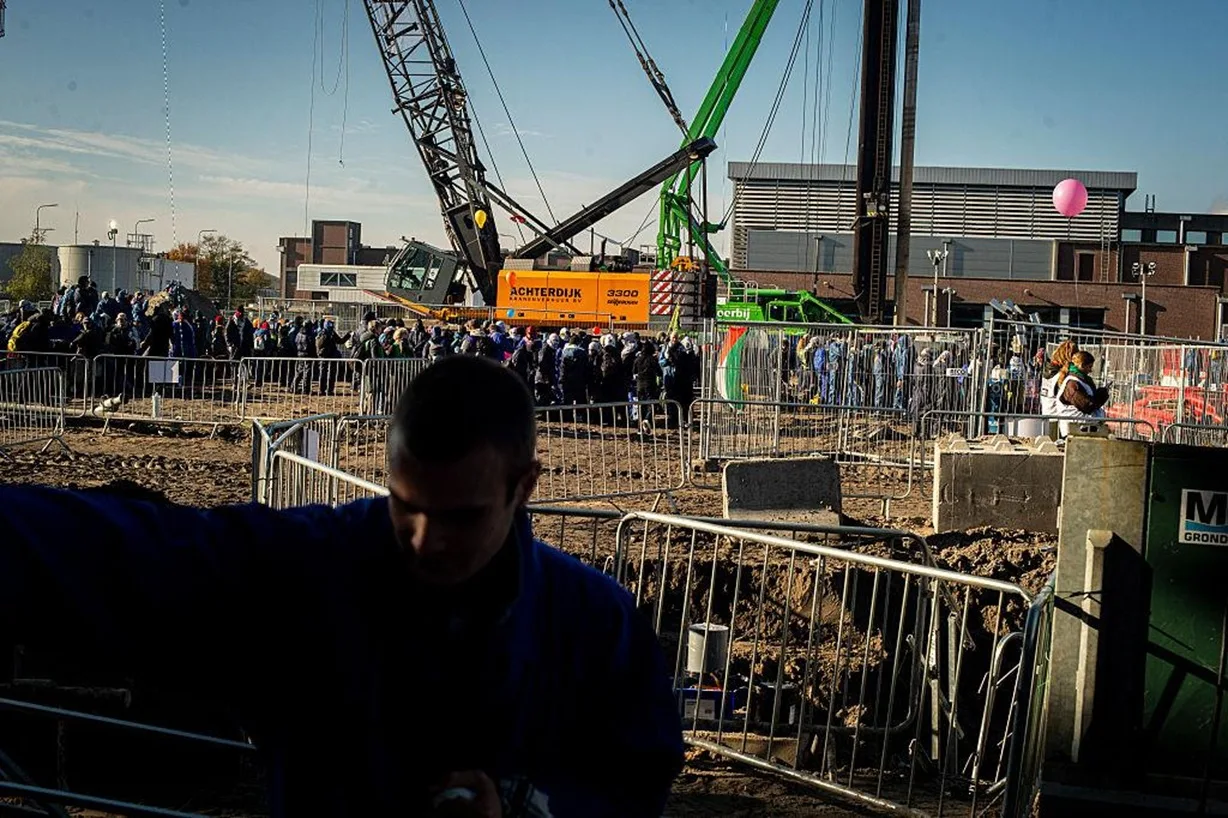
In Amsterdam, the occupation of a construction site intended for Microsoft reveals an opposition movement that now extends beyond environmental concerns. Behind the controversy surrounding data centers lie competing demands for energy, water and land, alongside questions of technological power and the legitimacy of public decisions. Artificial intelligence is discovering that its industrial expansion also depends on the consent of the territories where its infrastructure is built.
On November 6, 2026, protesters entered the construction site of a data center intended for Microsoft in Amsterdam's Westpoort district. Some climbed structures at the site, while others displayed banners and confronted police. Dutch authorities reported arresting between 150 and 200 people suspected of trespassing.
The incident could be regarded as another episode of environmental protest. Yet it reveals a more significant transformation. Data centers, long perceived as relatively discreet technical facilities, are becoming objects of political confrontation. Their development no longer raises only questions of urban planning or electricity consumption. It increasingly concerns the allocation of resources, economic sovereignty and the ability of local populations to influence industrial decisions that reshape their surroundings.
The Amsterdam protest formed part of a broader European campaign. The Stop Dirty Data Centres coalition announced actions across sixteen countries, bringing together environmental organizations and digital rights advocates. Not all participants pursued identical objectives. In the Netherlands, some organizations focused primarily on the project's ecological consequences, while others also challenged Microsoft's activities and the military or security applications of its technologies.
This diversity of demands is precisely what makes the movement significant. The data center has become a focal point for previously separate forms of opposition.
Infrastructure on a Different Scale
Data centers are not new. For decades, they have provided the physical foundation of computing, telecommunications and digital services. Their economic and energy requirements, however, have changed with the expansion of cloud computing and, more recently, generative artificial intelligence.
Training large AI models requires substantial computing capacity. Operating them at scale also mobilizes processors, networks, storage systems and cooling facilities. Growing demand is encouraging technology companies to invest in industrial complexes whose electricity requirements can reach tens or hundreds of megawatts.
The Amsterdam project, developed by Pure Data Centres for Microsoft, illustrates this evolution. Published reports describe an investment exceeding one billion dollars and an electrical capacity of approximately 78 megawatts.
This capacity should not be confused with constant actual consumption. For illustration, a facility operating continuously at 78 megawatts would consume approximately 683 gigawatt-hours annually. Actual electricity use would depend on utilization rates, energy efficiency and the technical characteristics of the installation.
The distinction matters because public debates frequently confuse contracted power capacity, estimated annual consumption and measured electricity use.
Even when these figures are interpreted correctly, however, the underlying issue remains substantial. A facility of this size must be powered, cooled, connected to electricity networks and integrated into a territory whose resources already serve other economic activities.
Electricity Becomes a Political Allocation Problem
The first conflict concerns access to energy.
A data center does not simply consume electricity. It requires a highly reliable supply capable of supporting equipment operating continuously and sensitive to interruptions. Its construction may demand substantial grid connections, network reinforcement and additional investment in generation or storage.
In regions where electrical capacity is constrained, these requirements can compete with those of industry, transportation, housing and other businesses.
This does not mean that every kilowatt-hour consumed by a data center is necessarily taken away from a household. Electricity networks are complex systems whose capacity varies by location and time. It does mean, however, that decisions about allocating available capacity become politically sensitive.
Who should receive priority access to new connections? Technology companies capable of rapidly financing large facilities, manufacturers seeking to electrify production, or communities facing growing residential demand?
The question becomes more difficult when digital infrastructure is presented as essential to national competitiveness. Governments may then be tempted to prioritize strategic projects whose local economic benefits remain difficult to quantify.
Data centers create employment during construction and may generate tax revenue. Their permanent operations, however, are generally much less labor-intensive than many traditional industrial activities. Comparing the resources mobilized with the benefits delivered to local communities therefore becomes essential.
Water, Land and Hidden Costs
Electricity is only part of the problem.
Depending on their design, data centers may use substantial quantities of water for cooling. Requirements vary considerably according to the technologies employed, local climatic conditions and heat-recovery systems.
It would therefore be misleading to assign a uniform water-consumption figure to the entire industry. Some facilities prioritize systems that limit withdrawals, while others rely more heavily on evaporative cooling.
The relevant question is the local impact. Consumption that appears modest at the national level may become problematic in a watershed already experiencing pressure.
Land creates another source of conflict. Data centers occupy sites that could otherwise accommodate housing, businesses or public facilities. Their development may also require technical easements and investment in surrounding infrastructure.
These costs are not necessarily borne entirely by the companies building the facilities. Depending on regulations and tariff structures, some network investments may be shared among electricity users.
This is where environmental opposition intersects with a distributional question: who benefits from the infrastructure, who bears its costs and who decides where it should be built?
Europe's Contradiction
Europe faces a particularly complex situation.
On one hand, European institutions want to strengthen the continent's digital capabilities. Dependence on American cloud providers, competition in artificial intelligence and economic security concerns encourage the development of local infrastructure.
On the other hand, European governments are pursuing decarbonization, energy efficiency and environmental protection objectives. They must also respond to social tensions surrounding housing, purchasing power and public services.
These ambitions are not necessarily incompatible. Achieving them simultaneously, however, requires explicit choices.
Building more data centers in Europe can improve the local availability of computing capacity. It does not automatically strengthen technological sovereignty when the facilities belong to foreign companies, operate through proprietary software and remain dependent on global supply chains.
The physical location of servers is not sufficient to determine who controls the data, software or operational decisions.
This distinction helps explain why digital investments can receive government support while generating growing distrust among local populations.
From Environmental Opposition to a Challenge to Power
The movement observed in Amsterdam cannot be reduced to the protection of natural resources.
Some protesters oppose the military and security applications of technologies supplied by major digital corporations. Others criticize the concentration of computing capacity among a small number of private companies or the social consequences of automation.
These claims do not all carry the same degree of factual verification. Allegations concerning particular uses of technology must be distinguished from established facts about contracts, infrastructure and corporate responsibilities.
Their convergence is nevertheless politically significant.
Data centers physically concentrate several dimensions of digital power. They house the infrastructure used to process information, operate platforms and develop artificial intelligence models. They have therefore become visible symbols of a technological transformation often perceived as being imposed from outside.
The debate no longer concerns only the environmental impact of an individual facility. It also concerns the purpose of the digital economy itself.
The Risk of a New Industrial Barrier
The multiplication of opposition movements could produce a paradoxical outcome.
Restrictions on new projects may slow the expansion of computing capacity. But they may also strengthen companies that already possess established infrastructure.
An operator with existing data centers, electricity connections and administrative authorizations owns assets that may become more valuable when new facilities are harder to build.
Emerging competitors, by contrast, could encounter greater obstacles in securing access to competitive infrastructure.
A policy intended to limit the environmental consequences of digital expansion could therefore, if poorly designed, consolidate the positions of dominant providers.
This mechanism is not unique to artificial intelligence. It appears in many industries when regulatory, land-use or energy constraints increase barriers to entry.
The challenge is to protect local communities without turning administrative scarcity into an economic advantage reserved for established companies.
Consent as an Industrial Requirement
The events in Amsterdam probably signal a new stage in the governance of digital infrastructure.
Companies will no longer be able to assume that obtaining a permit is sufficient to secure social acceptance. They will need to demonstrate the local benefits of their projects, explain their resource requirements and provide greater transparency about the consequences of their operations.
Public authorities, meanwhile, will need coherent criteria for allocating electricity, land and water among competing uses. Consultation cannot be limited to an administrative procedure initiated after the principal decisions have already been made.
This evolution does not necessarily imply an end to data center construction. It could encourage locations better suited to electricity-network capacity, more systematic heat recovery, less resource-intensive cooling technologies and clearer contractual commitments concerning infrastructure costs.
It could also lead some communities to reject projects whose benefits do not justify the resources required.
Artificial intelligence is frequently described as an immaterial revolution built on algorithms and data. Its expansion reveals, instead, a growing dependence on deeply material resources.
Models can be developed for global markets. The infrastructure that makes them work must still be built somewhere.
And that somewhere now has a political voice.
Main Sources
- Associated Press, November 6, 2026, reporting on demonstrations at Microsoft's Amsterdam data center construction site.
- Reuters, November 6, 2026, European mobilization against data centers.
- DutchNews.nl, November 6, 2026, characteristics of the Pure Data Centres project and local opposition.
- The Guardian, November 6, 2026, protest movements and environmental and political concerns.
- International Energy Agency (IEA), Energy and AI, analysis of data center electricity consumption.
- European Commission, policies concerning digital infrastructure, energy efficiency and technological sovereignty.
Atlas Limits Research Desk
Atlas Limits’ editorial and analytical desk.