Artificial intelligence was supposed to transform the economy without its infrastructure becoming a visible part of everyday life. It would circulate through networks, automate tasks, generate knowledge and accelerate growth. But as investment takes physical form, that promise is encountering a less abstract reality: power plants, high-voltage transmission lines, water reserves, industrial land and communities increasingly questioning how the costs are distributed.
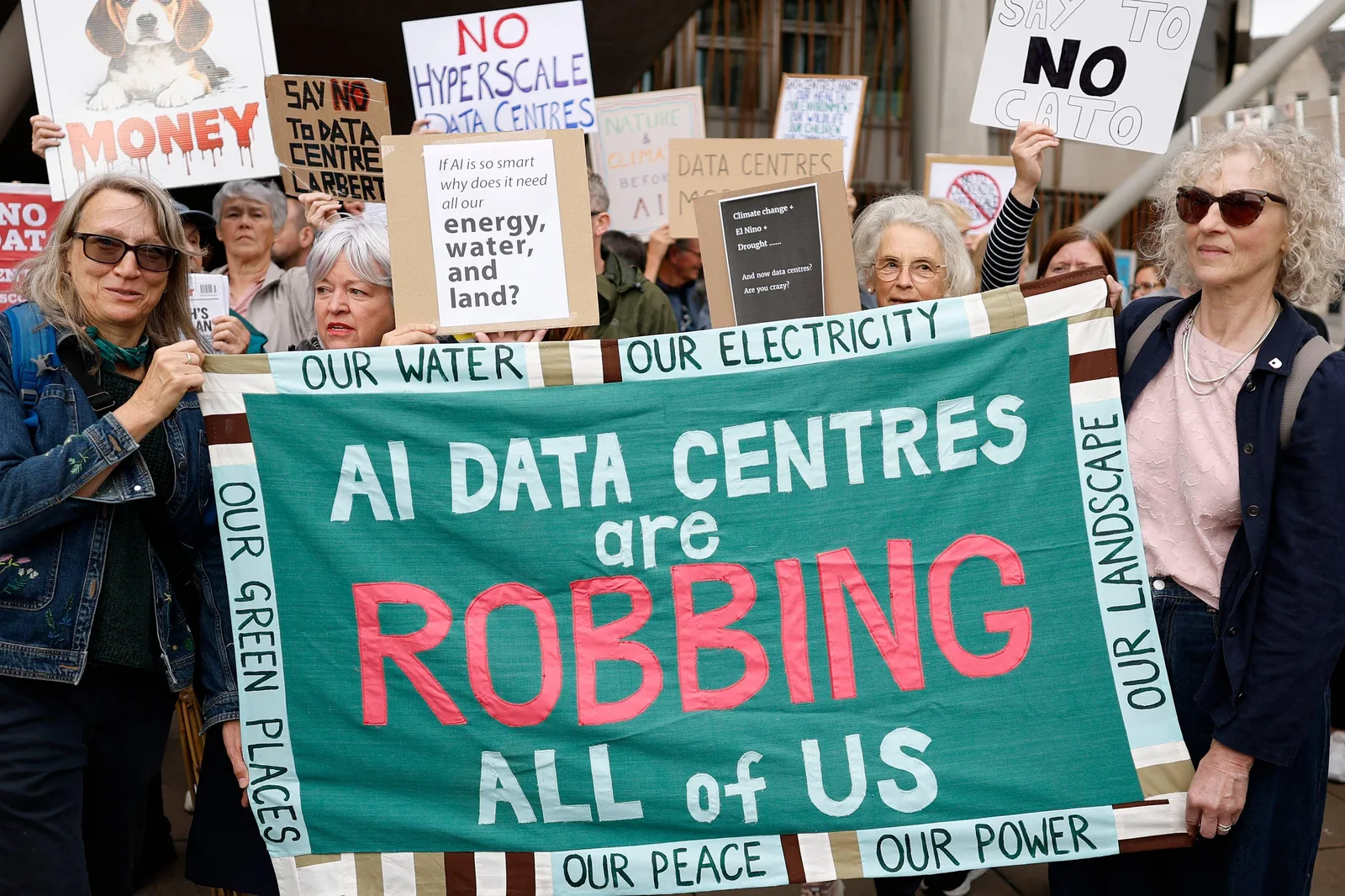
On November 6 and 7, 2026, civil society organizations coordinated a European mobilization against the expansion of large-scale data centers. More than one hundred organizations across fifteen countries had announced their participation. Their central demand was not necessarily to reject artificial intelligence, but to establish a moratorium on major new facilities until their environmental, economic and territorial consequences could be adequately regulated.
The movement represents an important shift. Opposition to AI, previously dominated by concerns about employment, surveillance, intellectual property and disinformation, is now extending to the material conditions of its production. Computing power is becoming a question of territorial planning.
The End of Invisible Infrastructure
Data center expansion depends on an extraordinary concentration of capital. Technology companies are building facilities capable of accommodating tens of thousands of specialized processors, alongside cooling systems, backup equipment and the electrical infrastructure required to operate them.
According to the International Energy Agency's Energy and AI report, global electricity consumption by data centers could exceed 1,000 terawatt-hours by 2030 under its original central scenario, compared with approximately 460 TWh in 2024. Subsequent updates have adjusted that trajectory without challenging the scale of the expected increase.
The difficulty is not simply the amount of electricity consumed. It is the geographical concentration of demand. A national electricity system may generate sufficient power over an entire year while remaining unable to supply several hundred additional megawatts to a particular location.
This distinction is essential. A data center can be built faster than transmission lines can be reinforced, transformers installed or new generating capacity developed. Technology investors operate on cycles of a few years, while energy infrastructure often follows considerably longer timelines.
Artificial intelligence is therefore creating a confrontation between two industrial timescales.
Who Pays for Digital Growth?
The most sensitive issue concerns the distribution of investment costs.
When an operator requests a high-capacity grid connection, the network may require extensions whose costs, depending on national tariff arrangements, can be distributed among several categories of consumers. Households and businesses may consequently fear that they are indirectly financing infrastructure primarily serving international technology companies.
It would nevertheless be inaccurate to suggest that every new data center automatically increases electricity bills. The effect depends on connection agreements, infrastructure financing, available capacity and regulatory arrangements. Some projects may even help finance equipment that benefits other consumers.
But the political debate arises precisely from this uncertainty: who bears the costs when the economic benefits are private, delayed or distributed globally?
Water consumption adds another dimension. Requirements vary considerably according to cooling technology, local climate and facility design. In regions experiencing water stress, even consumption that appears limited at the national level can become politically sensitive.
Local economic benefits are also disputed. Construction mobilizes contractors and substantial workforces, but highly automated facilities do not necessarily create many permanent jobs relative to their land and energy requirements.
Digital Sovereignty Meets Territorial Sovereignty
Europe faces a strategic contradiction.
Its institutions want to develop autonomous computing capabilities, reduce dependence on American and Chinese infrastructure and encourage the emergence of European artificial intelligence companies.
Yet achieving these objectives requires precisely the facilities whose construction is increasingly contested by local communities.
Digital sovereignty can therefore no longer be defined exclusively by server location or supplier nationality. It also depends on electricity access, water-use regulations, grid capacity and territorial acceptance.
A country may want to host its own computing infrastructure without possessing the energy systems required to power it. Conversely, a region with abundant electricity may refuse to dedicate that resource to facilities whose local benefits remain uncertain.
This tension could reshape Europe's digital geography. Regions capable of providing available electricity, robust networks and predictable connection procedures will enjoy a growing competitive advantage.
Toward a New Industrial Policy
The response cannot be reduced to approving or prohibiting projects.
A coherent strategy would integrate data centers into energy planning, distinguish between uses according to their economic and social value, require transparency about actual resource needs and clarify how associated infrastructure is financed.
Operators could be encouraged to locate certain computing workloads in regions with abundant electricity, improve the energy efficiency of their facilities or contribute directly to grid investment.
The issue ultimately becomes one of allocating a scarce resource.
For decades, digital growth was presented as a way to reduce the economy's dependence on physical constraints. Artificial intelligence reveals the opposite: the most advanced digital infrastructure can also be among the most demanding in material resources.
Opposition to data centers does not necessarily mean rejecting innovation. It reflects a demand for clarity about who benefits, who pays and which priorities should prevail.
AI will not develop only where capital and engineers are available. It will also require territories willing to provide the energy, space and resources on which it depends.
And those territories are beginning to negotiate.
Main Sources
- International Energy Agency, Energy and AI, April 2025, and Key Questions on Energy and AI, 2026.
- Euronews, reporting on European protests against energy-intensive data centers, November 5, 2026.
- European Commission, policy documents on digital infrastructure, energy efficiency and data centers.
Atlas Limits Research Desk
Atlas Limits’ editorial and analytical desk.