East Africa occupies a distinctive position in the restructuring of global economic and geopolitical balances. Located between the Red Sea, the Indian Ocean, the Ethiopian Highlands and the Great Lakes region, it constitutes one of the principal areas connecting the African interior to markets in Asia, the Middle East and Europe. Its ports, railway corridors, energy resources, agricultural land and expanding demographic markets give it growing strategic importance. Yet this accumulation of advantages does not automatically translate into the emergence of a coherent regional power. Infrastructure is advancing faster than some institutions, trade remains constrained by borders and political rivalries, while conflicts in the Horn of Africa directly threaten several of the routes that should support economic integration.
This contradiction distinguishes East Africa from many other regions of the continent. Its potential rests less on the concentration of a single dominant resource than on the possibility of connecting several complementary economies within a commercial space organized around the Indian Ocean. The ports of Kenya, Tanzania and Djibouti can serve substantial inland markets. The energy resources of Ethiopia, Uganda, Tanzania and Mozambique can support new industrial activities. The agricultural systems of the highlands and tropical regions supply international value chains. Digital services, particularly advanced in Kenya, create new possibilities for economic organization.
But these advantages will produce their full effects only if infrastructure, institutions and national policies can function as an integrated system.
Geography is the first element of this transformation.
East Africa is organized around two major territorial systems. The first corresponds to the maritime frontage of the Indian Ocean and the Red Sea, connecting African economies to the principal international trade routes. The second extends into the continental interior, across the highlands, the Great Lakes and landlocked territories whose access to global markets depends heavily on regional transport infrastructure.
These two spaces are interdependent.
Ports cannot fully develop their activities without efficient connections to inland markets. Landlocked economies cannot improve their competitiveness without reducing transport costs to maritime terminals. Industrial investment simultaneously requires electricity, logistics networks, financial services and commercial outlets.
East Africa's economic power therefore depends on its ability to organize this interdependence.
This logic explains the growing importance of corridors.
An economic corridor is more than a road or a railway. It is a system combining transport infrastructure, port facilities, border crossings, energy networks, logistics platforms and productive activities.
When it functions efficiently, it can reduce transaction costs, expand the markets accessible to businesses and encourage the emergence of regional value chains.
But a corridor can also reproduce a predominantly extractive economic structure, in which infrastructure serves to transport raw materials to ports without sufficiently developing the territories it crosses.
The distinction between these two models constitutes one of East Africa's principal challenges.
The corridor connecting Mombasa to Nairobi and then to inland economies illustrates this problem.
The port of Mombasa represents essential infrastructure for Kenya, but also for Uganda, Rwanda, Burundi and parts of the Democratic Republic of the Congo and South Sudan.
Its role extends beyond national borders.
Port performance, customs clearance times, road quality and railway capacity directly influence the supply and export costs of several economies.
Investment in the standard-gauge railway, roads and logistics platforms seeks to strengthen this regional function.
But its economic contribution depends on actual utilization.
An expensive railway becomes financially sustainable only when transported volumes, tariffs and revenues can cover a sufficient share of operating and financing costs over time.
When traffic forecasts prove excessively optimistic, governments may face substantial financial burdens.
Building infrastructure therefore does not guarantee its economic profitability.
It can nevertheless generate indirect benefits by reducing delays, improving transport reliability and encouraging businesses to establish operations.
These effects must be evaluated at the level of the wider economy, rather than solely through the operator's revenues.
Tanzania is pursuing a comparable strategy around the port of Dar es Salaam.
This port constitutes a major gateway to several landlocked economies, notably Zambia, Rwanda, Burundi and parts of the Democratic Republic of the Congo.
Investment in railway and port infrastructure aims to improve connections between the Indian Ocean and the continental interior.
Competition between Mombasa and Dar es Salaam can encourage improvements in services and reductions in costs.
But it can also produce redundant investment when projects are insufficiently coordinated.
The multiplication of infrastructure does not necessarily represent an improvement in regional integration.
The central question is one of complementarity.
Competing ports can strengthen supply-chain resilience by providing alternative routes.
They can also weaken their respective profitability if capacity expands much faster than commercial volumes.
The balance depends on actual demand, the quality of connections and the organization of trade.
Farther north, Djibouti occupies a different strategic position.
Located near the Bab el-Mandeb Strait, the country controls an important access point between the Red Sea and the Gulf of Aden.
Its economic function depends heavily on port services, logistics infrastructure and trade with Ethiopia.
Ethiopia, one of the continent's most populous economies, relies heavily on corridors through Djibouti for access to maritime trade.
This relationship illustrates both the advantages and vulnerabilities of regional interdependence.
For Djibouti, Ethiopian trade constitutes a major source of economic activity.
For Ethiopia, the concentration of much of its external trade along a limited number of routes represents a strategic dependency.
Ethiopia's efforts to diversify maritime access must be understood in this context.
But they face significant political constraints.
Questions of access to the sea, territorial sovereignty and diplomatic recognition remain particularly sensitive in the Horn of Africa.
The pursuit of logistical security can therefore become a source of geopolitical tension.
This situation reveals an essential characteristic of the region: commercial infrastructure is also an instrument of power.
Control over a port, railway or energy corridor can influence relations between states.
It can create interdependencies favorable to cooperation.
But it can also become an instrument of political pressure when diplomatic relations deteriorate.
East Africa is consequently a region in which economic geography and territorial geopolitics are closely intertwined.
This relationship is particularly intense in the Horn of Africa.
Proximity to Bab el-Mandeb gives the region global importance.
The strait connects the Red Sea to the Gulf of Aden and constitutes one of the principal access routes to the Suez Canal.
Goods moving between Europe and Asia can use this route, particularly manufactured products, hydrocarbons and intermediate goods.
But the strategic value of this passage should not be confused with a constant volume of trade.
Flows vary according to security conditions, energy prices, shipping companies' decisions and regional disruptions.
Attacks against commercial shipping in the Red Sea have demonstrated how localized conflicts can alter the routes of international trade.
When shipping companies divert vessels around Africa via the Cape of Good Hope, distances and transit times increase for many connections.
The consequences can affect transport costs, corporate inventories and the organization of supply chains.
East Africa's maritime security therefore becomes a component of global economic security.
This importance explains the presence of several foreign military powers in Djibouti and the surrounding maritime areas.
The United States, China, France, Japan and other partners maintain military or logistical facilities in this area.
Their presence serves different objectives: maritime surveillance, protection of commercial routes, military operations, security cooperation and power projection.
The concentration of these facilities reveals the region's strategic value.
But it also raises a fundamental question for host states.
Hosting foreign forces can generate revenues, investment and security guarantees.
It can also expose the countries concerned to rivalries between powers and restrict certain diplomatic options.
Geographical position is therefore a strategic advantage whose benefits depend on the political capacity to manage it.
This logic is also evident in port investments by Gulf states.
Infrastructure along the Red Sea, the Gulf of Aden and the Indian Ocean is of particular interest to Middle Eastern economies.
It can help secure trade routes, develop logistics platforms and strengthen connections between African and Asian markets.
Port investment can also form part of broader strategies involving agriculture, energy, infrastructure and food security.
But the interests of foreign investors do not necessarily coincide with the development priorities of local economies.
A port can be profitable as an international transit platform without generating substantial industrialization in its hinterland.
Governments' ability to negotiate operating conditions, complementary investment and economic benefits therefore becomes decisive.
This question extends beyond maritime corridors.
East Africa is also undergoing a major demographic transformation.
The regional population is increasing rapidly, although estimates vary considerably depending on the geographical perimeter used.
Eastern Africa under the United Nations statistical classification corresponds neither to the East African Community nor exclusively to the Horn of Africa.
These areas overlap partially, but they should not be confused.
This distinction is important when comparing populations, gross domestic products and growth rates.
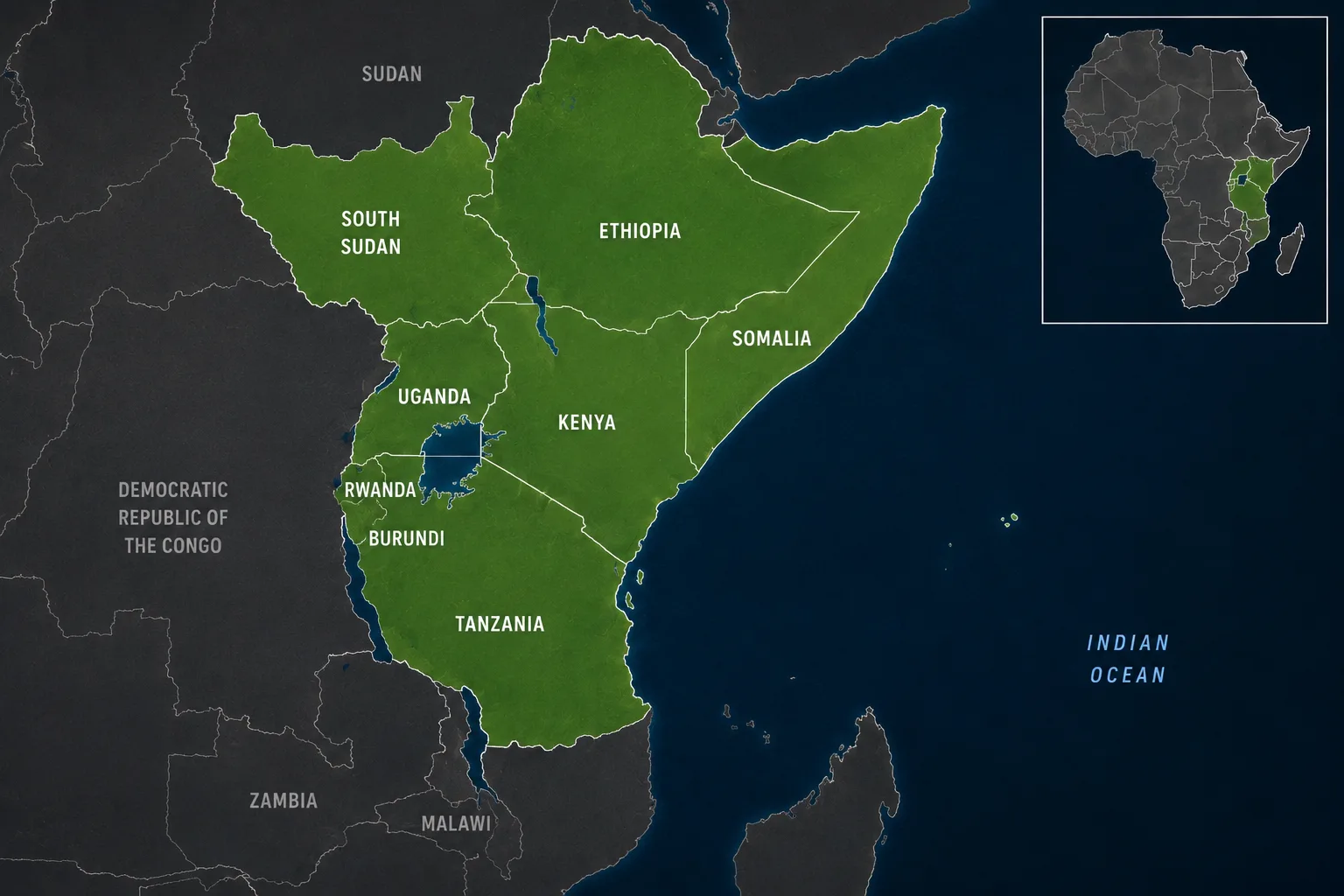
The East African Community comprises eight member states: Burundi, the Democratic Republic of the Congo, Kenya, Rwanda, Somalia, South Sudan, Tanzania and Uganda.
Its institutional boundaries extend beyond Eastern Africa in the strict geographical sense, particularly through the inclusion of the Democratic Republic of the Congo.
The organization represents a substantial demographic market.
But the size of this market does not guarantee effective economic integration.
Member economies display very different levels of development, productive structures and institutional capacities.
Kenya possesses a relatively diversified base of services, financial activities, commercial agriculture and manufacturing.
Tanzania combines agriculture, mineral resources, tourism, services and infrastructure investment.
Uganda has a substantial agricultural economy, expanding services and energy prospects linked to its petroleum resources.
Rwanda has developed investment, services and administrative modernization policies, but its domestic market remains relatively small.
Burundi and South Sudan face particularly significant economic and institutional constraints.
Somalia has an economy shaped by commerce, diaspora remittances, services and the consequences of prolonged instability.
The Democratic Republic of the Congo possesses considerable natural resources, but its eastern territories remain affected by conflicts that complicate regional economic integration.
This diversity can constitute an advantage if economies develop productive complementarities.
It can also complicate the harmonization of commercial, monetary and regulatory policies.
The East African Community seeks precisely to organize this integration.
Its project rests on several stages: customs union, common market, monetary union and, in the longer term, political integration.
This institutional architecture represents one of the continent's most ambitious experiments in regional integration.
But the different stages are not progressing at the same pace.
Reducing tariff barriers does not automatically eliminate administrative obstacles, border controls or sectoral restrictions.
The free movement of people, capital and services also depends on the effective implementation of national commitments.
Regulatory differences can maintain high costs even when customs duties have been reduced.
Commercial integration therefore requires continuous administrative coordination.
It also presupposes mechanisms for resolving disputes between member states.
This question becomes particularly sensitive when political or security tensions affect bilateral relations.
An economic union cannot function sustainably if commercial rules become instruments of diplomatic pressure.
Regional integration requires a minimum degree of predictability in commitments.
The monetary union project raises additional difficulties.
The region's economies differ significantly in inflation, fiscal policy, public debt and productive structure.
A common currency can reduce certain transaction costs and facilitate trade.
But it also limits states' ability to use monetary policy and exchange rates individually to respond to economic shocks.
Macroeconomic convergence is therefore an essential condition.
Without appropriate fiscal and institutional mechanisms, a monetary union can intensify certain divergences rather than reduce them.
The success of East African integration will consequently depend less on the ambition of its founding documents than on the capacity to build genuinely operational economic institutions.
This institutional development is taking place amid rapid demographic growth.
Ethiopia, Kenya, Tanzania and Uganda are among the region's principal demographic and economic centers.
Their young populations and expanding markets create significant opportunities for businesses.
But demographic growth does not automatically constitute an economic dividend.
It simultaneously increases demand for housing, schools, healthcare, electricity, transport and employment.
To become a productive advantage, it must be accompanied by improved skills and sufficient growth in investment.
The ability of economies to create formal, productive employment constitutes one of the region's principal challenges.
Growth concentrated in infrastructure, modern services or certain export sectors can generate substantial economic gains without absorbing everyone entering the labor market.
Agriculture therefore remains essential.
It continues to represent a major source of employment and income for many East African populations.
Agricultural production includes food crops, pastoral activities and several important export sectors.
Ethiopia occupies a major position in coffee production.
Kenya is an important exporter of tea and cut flowers.
Tanzania and Uganda possess diversified agricultural sectors, while the economies of the Great Lakes depend heavily on agriculture and regional food trade.
These activities play an essential role in rural incomes and food security.
But they continue to face several constraints.
Agricultural productivity depends on access to equipment, irrigation, inputs, financing and storage infrastructure.
Post-harvest losses can reduce producers' incomes.
Transport difficulties limit market access.
Fragmented landholdings can complicate mechanization and certain investments.
Agro-industrial processing could allow local economies to retain a larger share of added value.
But it requires processing capacity, appropriate logistics and reliable energy supplies.
Agricultural industrialization is therefore not simply a matter of increasing export volumes.
It requires the development of packaging, processing, preservation, transport and marketing activities.
These stages can create employment and strengthen connections between rural areas and urban centers.
They can also reduce certain vulnerabilities associated with fluctuations in international prices.
But they require investments that small producers cannot always finance individually.
The development of cooperatives, appropriate financial services and shared infrastructure can help reduce these constraints.
Agricultural transformation is particularly important because East Africa is among the regions heavily exposed to climate shocks.
Recurring droughts affect pastoral and agricultural territories in the Horn of Africa.
Episodes of extreme rainfall and flooding can destroy infrastructure, disrupt harvests and displace populations.
These phenomena are not isolated events in economic life.
They influence food prices, rural incomes, public finances and humanitarian assistance requirements.
They can also intensify tensions over access to water and grazing land.
But presenting regional conflicts as direct consequences of climate change would be reductive.
Resource-management mechanisms, land institutions, community relationships and political decisions play a decisive role in determining how environmental pressures translate into tensions.
Climate often acts as an aggravating factor rather than a single cause.
Climate resilience therefore becomes a matter of economic policy as much as environmental policy.
It requires investment in irrigation, water networks, early-warning systems, rural infrastructure and risk management.
It also presupposes financial mechanisms capable of helping households and businesses absorb shocks.
This question is directly connected to energy.
East Africa possesses diversified energy resources.
Kenya has developed substantial geothermal capacity, particularly in the Rift Valley.
This source of electricity has the advantage of providing relatively stable generation, unlike technologies whose output depends directly on weather conditions.
It contributes to diversifying the national electricity system and reducing certain energy dependencies.
But geothermal development requires high initial investment and involves risks associated with the exploration of underground resources.
Its competitiveness therefore depends on geological conditions, financing and the quality of electricity infrastructure.
Ethiopia possesses considerable hydroelectric potential.
The Grand Ethiopian Renaissance Dam represents one of the continent's most important energy projects.
Its development aims to increase electricity generation capacity and support domestic supply as well as regional exports.
But the project also has a major geopolitical dimension.
Located on the Blue Nile, it directly concerns relations between Ethiopia, Sudan and Egypt.
Questions of reservoir filling, operations, drought management and hydrological information-sharing have fueled prolonged diplomatic tensions.
The dam therefore illustrates a contradiction frequently encountered in regional infrastructure policies.
A facility can contribute to one country's energy development while generating strategic concerns among its neighbors.
Managing transboundary water resources consequently requires cooperation mechanisms capable of reconciling national needs.
Water becomes a factor of power when it simultaneously determines agriculture, electricity generation and population security.
But it can also become an instrument of cooperation when states succeed in establishing common management rules.
Uganda is seeking to develop its petroleum resources around Lake Albert.
Extraction and export projects require substantial investment, particularly in transport infrastructure.
The development of a pipeline toward the Tanzanian coast illustrates the possibilities for energy cooperation between states.
But it also raises environmental, social and financial questions.
Petroleum infrastructure can generate public revenues and foreign currency.
It can also create risks associated with international prices, financing costs and impacts on the territories crossed.
The contribution of these projects to development will depend on revenue management and their ability to support other economic sectors.
Tanzania also possesses natural gas resources that could contribute to its energy and industrial development.
Mozambique, situated farther south and outside the institutional boundaries of the East African Community, possesses substantial offshore natural gas resources.
Its participation in the economic dynamics of the Indian Ocean demonstrates that regional energy systems extend beyond the borders of political organizations.
But major gas projects face financial, commercial and security constraints.
They require long-term commitments, specialized infrastructure and sufficient stability to attract investors.
The security difficulties experienced in northern Mozambique illustrate the vulnerability of these projects to territorial conflicts.
An abundance of resources therefore does not guarantee their effective exploitation.
And exploitation does not automatically guarantee industrial diversification.
This distinction constitutes one of East Africa's principal energy challenges.
The region could become an important area for energy production and exports while maintaining electricity-access deficits in several territories.
An energy strategy oriented exclusively toward external markets would risk limiting domestic industrial benefits.
Conversely, the development of reliable electricity networks and regional interconnections could support manufacturing, services and agricultural processing.
The central question is therefore not only one of generation capacity.
It concerns the effective availability of competitively priced energy for businesses and populations.
This problem is closely connected to industrialization.
East Africa possesses several manufacturing centers, but their development remains uneven.
Ethiopia has sought to develop industrial zones and export-oriented manufacturing, particularly in textiles and clothing.
Kenya has agrifood, chemical, pharmaceutical and manufacturing activities.
Tanzania is seeking to strengthen its processing capabilities and resource-based industries.
Rwanda is pursuing strategies to develop services, processing and certain technological activities.
But these policies face common constraints.
Electricity access, financing costs, skills availability, logistical delays and market size directly influence competitiveness.
Industrial zones can facilitate business establishment by concentrating infrastructure and services.
But they do not automatically produce a diversified industrial base.
Their effectiveness depends on relationships between foreign companies and local suppliers, skills transfers and the ability to develop activities beyond assembly or subcontracting.
An economy can increase its manufactured exports while retaining relatively limited local added value.
Industrial transformation therefore requires progress through value chains.
It also requires national businesses capable of investing, innovating and participating in production.
This question is particularly apparent in the digital sector.
East Africa has distinguished itself through the development of financial solutions adapted to populations historically underserved by traditional banking networks.
Kenya occupies a central position in this evolution.
The development of M-Pesa profoundly changed financial practices by enabling money transfers, payments and several associated services through mobile phones.
This innovation helped expand access to financial services and reduce certain transaction costs.
It also encouraged the emergence of a digital services ecosystem.
Businesses can use mobile payments to facilitate transactions, pay suppliers and receive payments from customers.
Households can transfer funds and access certain financial products without having a bank branch nearby.
This transformation represents significant progress in the organization of economic exchanges.
But financial inclusion should not be confused with economic development as a whole.
Access to a payment method does not guarantee access to productive financing.
Small businesses may possess efficient digital solutions while continuing to face high interest rates, insufficient collateral or investment difficulties.
The spread of digital credit can also create overindebtedness risks when products are poorly adapted to borrowers' incomes.
The quality of financial regulation therefore becomes essential.
Authorities must reconcile innovation, competition, consumer protection and financial-system stability.
This question is becoming increasingly important with the expansion of technology companies.
Nairobi has established itself as one of Africa's principal centers of digital innovation.
Financial technology, logistics, digital health, agricultural services and software activities attract entrepreneurs and investors.
But the development of a technology ecosystem cannot be measured solely by the number of startups created or the amounts raised from investors.
It depends on companies' ability to achieve sustainable profitability, develop technologies and respond to the productive needs of the economy.
Digital services can improve the efficiency of agriculture, transport and public administration.
They can also facilitate cross-border trade.
But their contribution to structural transformation depends on their integration with other sectors.
A dynamic digital economy does not replace physical infrastructure.
It can improve its utilization.
Logistics platforms do not eliminate the need for roads. Digital financial services do not replace industrial investment. Agricultural technologies cannot compensate for the absence of irrigation or storage.
Economic power results from the combination of these capabilities.
This complementarity helps explain why East Africa attracts a growing number of international partners.
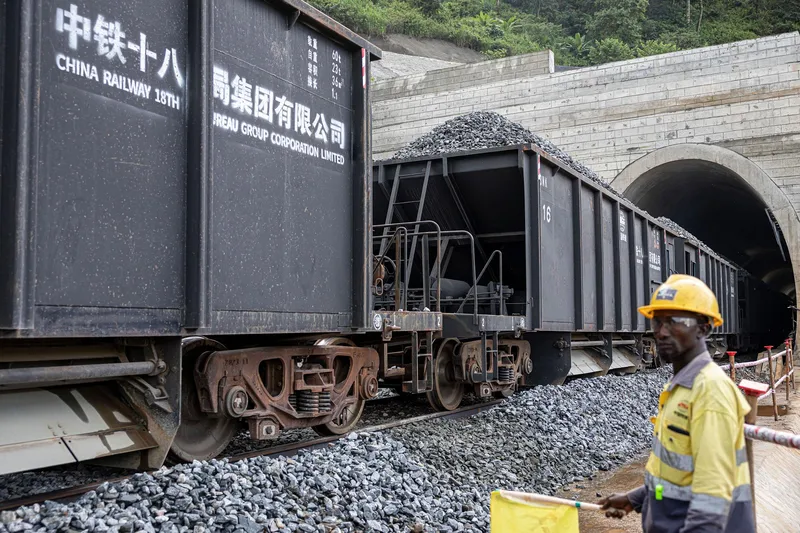
China has participated in financing and constructing numerous railway, road, port and energy infrastructure projects.
These investments form part of a broader strategy to develop commercial and industrial relationships.
They can help reduce infrastructure deficits.
But they also raise questions of financing, debt, profitability and local business participation.
The United States maintains significant interests in the region, particularly in security, technology, trade and diplomatic relations.
The European Union remains a major economic and institutional partner.
Turkey has strengthened its diplomatic, commercial and military presence, particularly in the Horn of Africa.
Gulf states invest in ports, logistics, energy, agriculture and several service sectors.
India, Japan and South Korea are also developing economic and technological partnerships.
This multiplication of actors can expand East African governments' negotiating options.
It can allow them to diversify financing, equipment suppliers and export markets.
But it does not automatically guarantee stronger strategic autonomy.
A state can reduce its dependence on one partner while developing financial or technological dependence on another.
Diplomatic diversification becomes a lasting advantage only when it strengthens national productive and institutional capabilities.
This distinction is essential in a region where strategic infrastructure requires considerable investment.
Port contracts, railway concessions, energy projects and mining agreements can commit public finances for several decades.
Negotiating them requires administrations capable of evaluating long-term costs, risks and benefits.
Infrastructure can possess significant geopolitical value without being financially sustainable.
Conversely, a project profitable for a private operator can generate limited benefits for the local economy if connections with national businesses remain weak.
Institutional quality therefore becomes a central factor of power.
This question is particularly important because several states in the region face fiscal constraints.
Infrastructure investment has contributed to increasing public financing requirements.
Exchange-rate fluctuations can increase the burden of debt denominated in foreign currencies.
Rising international interest rates increase the cost of new borrowing.
Climate and security shocks can reduce public revenues while increasing expenditure.
These mechanisms create particular vulnerabilities for economies whose domestic financial markets remain relatively shallow.
Development financing consequently becomes a question of economic sovereignty.
A country can possess considerable energy, agricultural or logistical potential without having the financial resources required to develop it.
It then depends on conditions imposed by markets, financial institutions and investors.
The ability to mobilize domestic savings, develop capital markets and improve public-finance management therefore constitutes an essential element of economic autonomy.
But financial constraints are not the only obstacles.
Armed conflicts represent one of the principal threats to regional transformation.
Somalia continues to face the Al-Shabaab insurgency and prolonged difficulties in institutional consolidation.
Sudan is experiencing a war with considerable human and economic consequences.
South Sudan remains affected by political tensions, institutional fragility and risks of violence.
Ethiopia has experienced several major internal crises whose consequences continue to weigh on its political and economic balances.
Eastern Democratic Republic of the Congo is also experiencing prolonged conflicts that directly affect relations among several members of the East African Community.
These crises have different causes.
They cannot be explained through a single mechanism.
But their economic consequences share several characteristics.
Conflicts destroy infrastructure, disrupt markets, displace populations and reduce investment.
They also weaken institutions necessary for resource management, tax collection and the provision of public services.
Forced displacement places additional pressure on host territories.
Commercial corridors can be interrupted or become more expensive.
Security expenditure can absorb an increasing share of public resources.
Political fragmentation can therefore neutralize some of the expected benefits of economic integration.
This contradiction is particularly visible in the Great Lakes region.
The Democratic Republic of the Congo's accession to the East African Community considerably expanded the organization's potential market.
It also increased its access to important natural resources.
But conflicts in eastern Congo and tensions between certain regional states complicate the construction of a stable economic space.
Institutional enlargement does not guarantee territorial integration.
A regional organization can increase its membership without possessing the political and security mechanisms necessary to make its market function fully.
The success of East African integration will therefore also depend on its ability to prevent and manage conflicts between member states or within their territories.
This requirement extends beyond military cooperation alone.
It concerns diplomacy, dispute-resolution mechanisms, judicial institutions and territorial development policies.
Infrastructure cannot generate its economic benefits when the territories it crosses remain persistently unstable.
This relationship between security and the economy constitutes one of the principal determinants of the region's future.
East Africa possesses several structural advantages capable of supporting significant economic transformation.
Its maritime position provides direct access to the major markets of the Indian Ocean.
Its inland economies offer substantial demographic markets.
Its energy resources can support industrialization.
Its agriculture possesses significant processing potential.
Its digital companies have demonstrated innovative capabilities in several fields.
Its institutional architecture includes ambitious regional integration projects.
But these advantages do not yet constitute a fully integrated economic system.
Corridors remain subject to logistical and political constraints.
Energy infrastructure does not guarantee universal access to competitively priced electricity.
Demographic markets remain fragmented by regulatory differences and transport costs.
Financial innovations do not eliminate difficulties in obtaining productive financing.
Foreign investment can develop physical capabilities without sufficiently strengthening local businesses.
Finally, territorial conflicts and diplomatic rivalries can undermine cooperation mechanisms.
East Africa's potential power therefore depends less on the existence of its advantages than on how they are connected.
The region could become one of the continent's principal economic areas if it succeeds in organizing efficient connections between its ports, domestic markets, energy resources and production centers.
This transformation requires coordination among national policies.
It demands complementary infrastructure, predictable commercial institutions, sustainable financing mechanisms and security cooperation sufficiently robust to preserve trade.
It also requires an increase in local added value.
Exporting more agricultural products, minerals or hydrocarbons can increase revenues without fundamentally transforming economies.
Developing processing industries, technical services, logistics companies and technological capabilities would allow a larger share of created value to remain within the region.
The difference lies in the ability to build regional production chains.
Indian Ocean ports could then become more than transit points.
They could serve as platforms for industrial areas connected to inland markets.
Electricity networks could support manufacturing activities across national borders.
Digital services could facilitate financing and the movement of goods.
Railway infrastructure could connect production centers rather than primarily serving the movement of imports and raw materials.
This evolution would be neither automatic nor uniform.
National trajectories will continue to differ.
Kenya must strengthen the competitiveness of its productive sector and preserve the sustainability of its investments.
Ethiopia must reconcile its industrial and energy ambitions with the requirements of political stability and commercial access.
Tanzania must convert its logistical and energy investments into more diversified productive activities.
Uganda must determine how to integrate its new petroleum resources into a broader economic strategy.
Rwanda will seek to develop its service and processing activities despite the limited size of its domestic market.
The most fragile economies must rebuild the institutional and security conditions necessary for investment.
These trajectories can become complementary.
But they can also compete when governments pursue similar industrial strategies without sufficient coordination.
Competition between ports, corridors and industrial zones can improve efficiency.
It can also produce dispersed investment and underutilized capacity.
Regional integration therefore does not mean eliminating national strategies.
It means creating conditions in which their complementarities generate more value than their mere coexistence.
This is precisely what makes East Africa a distinctive strategic region.
The region possesses a geography favorable to international trade, but its future economic power will depend primarily on the organization of its internal relationships.
Major powers can finance ports, railways, power plants and digital networks.
They can also contribute to maritime security and the development of trade.
But they cannot sustainably replace regional institutions and national productive capabilities.
East Africa's transformation will therefore depend on its ability to use external investment to strengthen its own economic connections.
It must also prevent geopolitical rivalries from turning its strategic infrastructure into instruments of fragmentation.
The region's international importance will probably continue to grow.
Indian Ocean routes, Red Sea security, demographic markets and energy resources will retain an important place in the economic and military strategies of external powers.
But this importance does not guarantee the emergence of an autonomous regional power.
The distinction between strategic position and economic capability remains fundamental.
A region can be indispensable to global trade without controlling the infrastructure, financing and productive activities that organize that trade.
It can host considerable investment without building a sufficiently integrated domestic market.
It can develop internationally recognized innovations while retaining structural deficits in energy, industry and public services.
East Africa faces precisely this choice.
Its corridors can become instruments of productive integration or remain primarily transit routes.
Its energy resources can support industrialization or remain oriented toward exports.
Its demographic growth can expand markets and strengthen the workforce or intensify pressures on employment and infrastructure.
Its international partnerships can increase its negotiating capacity or reproduce new dependencies.
Finally, its regional institutions can transform geographical proximity into economic cooperation or remain constrained by political rivalries and conflicts.
East Africa possesses the geographical, demographic and economic conditions necessary to become one of the continent's major growth centers. But its power will not emerge from the mere accumulation of ports, railways, energy resources and foreign investment. It will depend on its ability to transform these assets into a regional productive system, preserve territorial stability and organize complementarities among its economies. In this region oriented toward the Indian Ocean, the real challenge is not simply to connect Africa to the world. It is to establish lasting connections among African economies themselves.
Atlas Limits Research Desk
Atlas Limits’ editorial and analytical desk.