For a long time, much of the trade between China and Europe could be summarized by a geographical certainty: the sea carried most of the volume, while land offered speed. Container ships connected China’s major ports with Rotterdam, Hamburg or Antwerp through the Indian Ocean and Suez, while a far less visible infrastructure was expanding across the heart of the continent. Trains left Chongqing, Xi’an or Chengdu, crossed Kazakhstan or Russia, then Belarus and Poland before reaching Europe’s industrial centers.
This second geography appeared to have found its shape. Then the war in Ukraine turned a railway line into a strategic question.
Yet the corridor did not disappear. In 2025, China-Europe freight train services still made more than 20,000 journeys. By the first half of 2026, the network had exceeded 130,000 cumulative trips since its development and carried goods worth more than $520 billion. Some services between Xi’an and Duisburg can now complete the journey in eleven days. By July 2026, the network connected 129 Chinese cities with 235 cities in 26 European countries.
The war therefore did not destroy Eurasia’s overland routes. It put them in competition. And that difference changes almost everything.
The Russian Route Has Not Disappeared
When the first major regular rail services between China and Europe developed during the 2010s, their logic was primarily economic. Rail could not compete with maritime shipping for very large volumes, but it occupied a valuable middle ground: considerably cheaper than air freight and significantly faster than shipping by sea.
Geography naturally favored a northern axis. From China, trains could cross Kazakhstan or enter Russia directly, join the Russian railway network, continue through Belarus and then enter the European Union through Poland.
The infrastructure was already there. Russia possessed one of the world’s largest railway networks. Kazakhstan was connected to both the Russian and Chinese systems. Transshipment points were relatively limited, while operators had gradually standardized procedures.
Russia’s invasion of Ukraine in February 2022 introduced a factor that traditional logistics models had previously had much less reason to incorporate: the political risk attached to the route itself.
Western sanctions against Russia, controls on dual-use goods, financial restrictions and concerns among European companies that their cargo or intermediaries could become exposed to sanctions regimes altered the calculation. Crossing Russia is no longer simply a question of distance, price and delivery time. It is now also a compliance and risk decision.
But the northern axis continues to operate. The overall growth of the China-Europe Railway Express demonstrates this clearly: during the first seven months of 2026, nearly 13,000 China-Europe trains operated, an increase of 17.6% year on year.
The Eurasian reconfiguration therefore does not resemble a simple shift in which a new route replaces an old one. Something more complex is emerging: several routes are beginning to coexist because actors are no longer looking only for the most efficient path, but also for the dependency they are willing to accept. 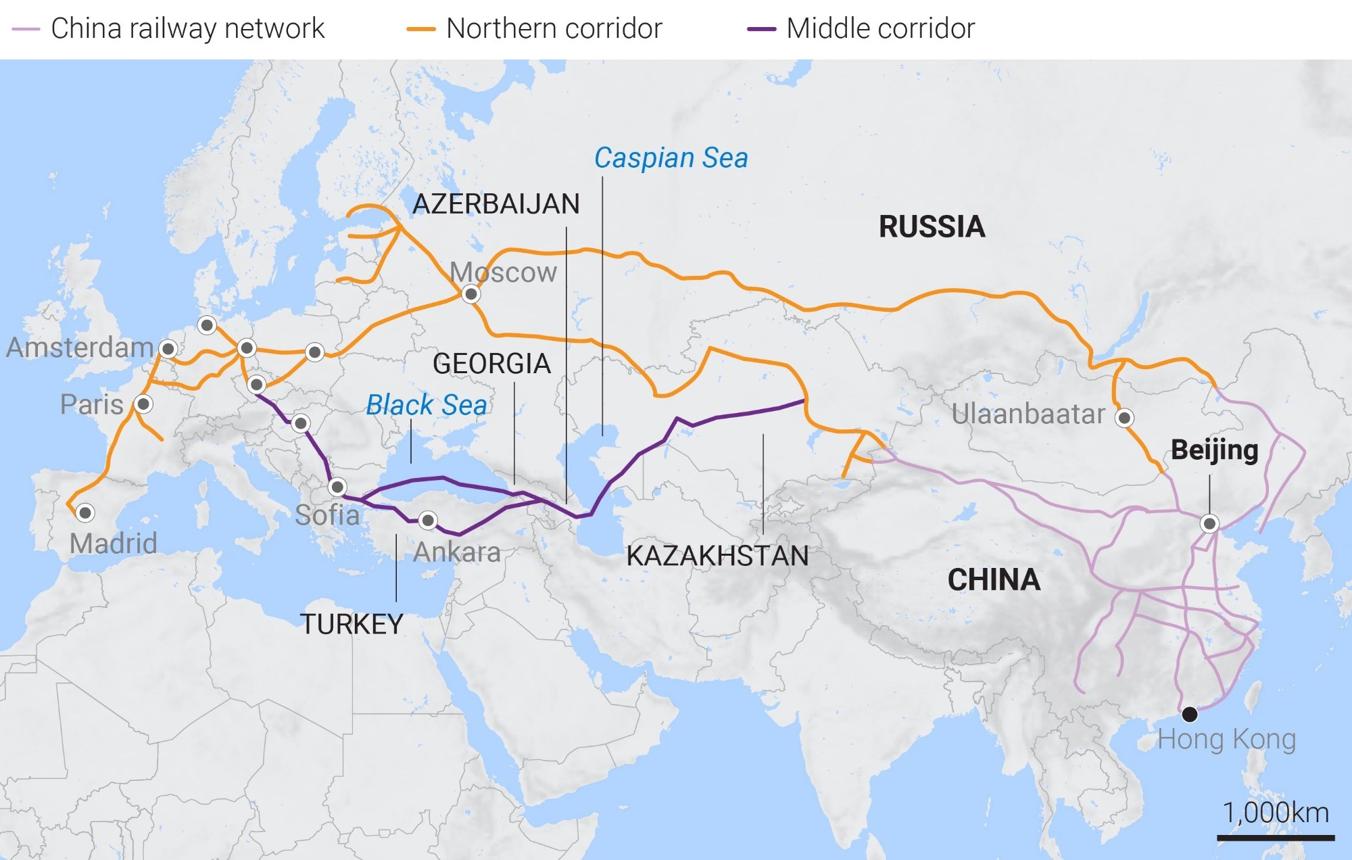
The Caspian Becomes Central Again
It is within this space that the Middle Corridor has acquired a new dimension.
Its principle is simple on a map and considerably more complicated on the ground. From China, goods cross Kazakhstan, reach ports on the Caspian Sea, cross the water to Azerbaijan, move through the Caucasus and then enter Georgia and Türkiye — or use maritime connections across the Black Sea — before continuing toward Europe.
Russia can therefore be bypassed.
That possibility existed long before 2022. What changed was its strategic value.
Kazakhstan sits at the center of the system. The country shares a border of almost 1,800 kilometers with China, possesses an immense railway network inherited from the Soviet space and has ports on the Caspian Sea. It can simultaneously trade with Russia, China, Central Asia, the Caucasus and Europe.
Astana is gradually turning that geography into economic policy. In 2025, freight transit through Kazakhstan reached 36.9 million tonnes, up from 34.6 million a year earlier.
In February 2026, the World Bank approved an $846 million guarantee designed to mobilize $1.41 billion in commercial financing to modernize part of Kazakhstan’s railway network linked to the Trans-Caspian corridor. The stated objective is considerable: helping triple volumes and halve transit times by 2030.
Kazakhstan is therefore gradually ceasing to be merely a territory located between larger powers. Its value increasingly derives precisely from that intermediate position.
But when an overland route encounters a sea, it temporarily ceases to be an overland route.
That is where the Middle Corridor’s main difficulty begins.
Geography Sends Its Bill
A train crossing Russia can travel thousands of kilometers over an almost continuous railway network. The Trans-Caspian corridor, by contrast, must operate as a multimodal chain.
Containers arrive by rail in Kazakhstan. They must be transferred to a port, loaded onto a vessel, carried across the Caspian, unloaded in Azerbaijan, reintroduced into the Caucasian railway system and then moved onward toward Georgia and Türkiye. Depending on the route selected, another maritime crossing of the Black Sea may follow.
Every interface is a vulnerability.
A congested port, insufficient vessel capacity, bad weather on the Caspian, a different customs procedure or poor coordination between railway operators can erase part of the time gained elsewhere.
The World Bank had already estimated that the appropriate investments and reforms could triple freight flows along the Middle Corridor and halve travel times by 2030. But it also emphasized the need to improve railways, ports, logistics, coordination and digitalization simultaneously.
A more recent study published in September 2026 expands the scale of the challenge. According to the World Bank, more than $25 billion in physical infrastructure investment could be required by 2040, with roughly another $30 billion needed for secondary connections, terminals, logistics equipment and systems allowing the corridor to function as an integrated whole. With those investments and corresponding reforms, volumes could more than triple and transport times could be halved; under a deeper integration scenario, volumes could even quadruple.
The question surrounding the Middle Corridor is therefore no longer whether it exists.
It is whether it can become a system.
Azerbaijan Turns Geography into Infrastructure
On the western shore of the Caspian, this transformation is particularly visible.
The Port of Alat, south of Baku, has become one of the corridor’s principal gateways. Its current capacity stands at around 15 million tonnes per year, while container capacity has been increased to 150,000 TEU. Planned expansion is intended to raise those figures to 25 million tonnes and 500,000 TEU.
But a port alone is not enough. Once the Caspian has been crossed, the Caucasus still has to be traversed.
That is the role of the Baku–Tbilisi–Kars railway.
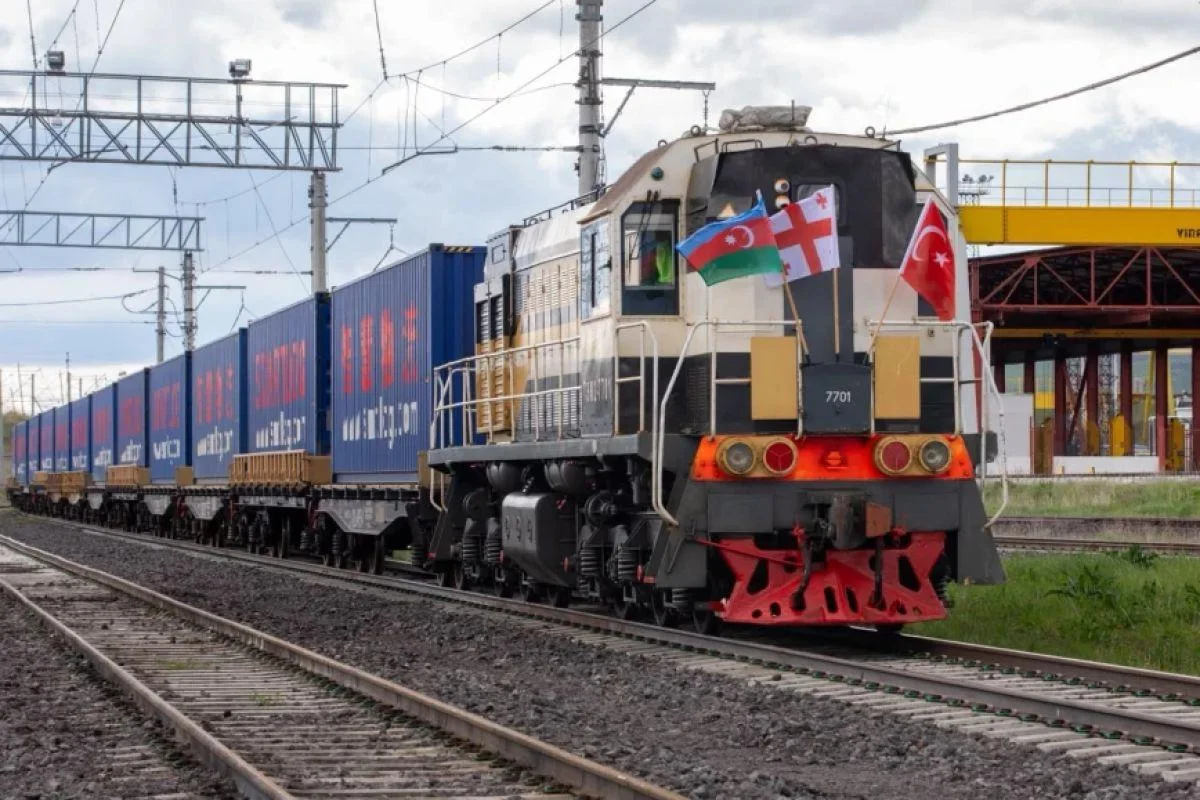
Opened in 2017 between Azerbaijan, Georgia and Türkiye, it gives the Caucasian railway system continuity toward Anatolia. Modernization work on its Georgian section increased annual capacity from roughly 1 million to 5 million tonnes in 2024.
An infrastructure that could still appear peripheral to the architecture of global trade a decade ago has thus become part of a much larger question: how to connect China with Europe without relying exclusively on Russia or the traditional maritime routes.
For Baku, the issue therefore extends far beyond transit fees.
Azerbaijan was already an energy corridor between the Caspian, Türkiye and Europe. It is now seeking to become a logistics corridor as well. Gas pipelines, oil pipelines, railways, highways, cables and port infrastructure are beginning to overlap across the same geography.
The power of a smaller state can sometimes derive less from what it produces than from what others need to move through it.
Türkiye Reconnects with the Continental Interior
At the other end of the Caucasus, Türkiye sees a similar possibility emerging.
Its geography already gave it control over the straits connecting the Black Sea and the Mediterranean, as well as an intermediate position between Europe, the Middle East and the Caucasus. The development of the Middle Corridor adds another dimension: Türkiye can become the western outlet of an overland route arriving directly from Central Asia and China.
The change is already measurable. According to data released by the Kazakh government, rail freight between Kazakhstan and Türkiye reached 6.4 million tonnes in 2025, up 35% year on year; more than 4 million tonnes reportedly traveled through the Trans-Caspian route. Authorities from both countries also indicate that delivery times have been reduced to around thirteen days for some corridor operations.
Türkiye is therefore becoming more than a terminal market.
It is becoming a junction.
From its territory, goods can enter the European network through the Balkans, Mediterranean ports or Black Sea connections. Ankara can simultaneously deepen its relations with the Turkic states of Central Asia and strengthen its position within the infrastructure linking Asia and Europe.
Physical geography intersects here with a longstanding political ambition: to make Anatolia not Europe’s eastern periphery, but the center of a space connecting several regions.
Europe Is Financing the Route It Wants to Be Able to Use
The European Union has also changed its perspective.
For decades, Eurasian infrastructure was largely considered through the prism of trade, regional development or the extension of trans-European networks. The war in Ukraine, Europe’s energy dependence on Russia and growing economic tensions with China have added a concept that has become central to the European vocabulary: resilience.
In January 2024, the European Union and its partners announced around €10 billion in commitments aimed at developing sustainable connectivity in Central Asia. The stated objective was to make a connection between Europe and Central Asia possible in approximately fifteen days.
The strategy has since become institutionalized. In June 2026, Brussels launched a connectivity platform linking Europe, the Black Sea, the South Caucasus and Central Asia. Letters of intent concluded with international financial institutions are expected to mobilize up to an additional €2 billion for transport infrastructure, border crossings and trade facilitation around the Black Sea and the Caucasus.
Europe is therefore not simply financing more railway lines.
It is financing options.
That distinction is essential.
Europe’s energy diversification after 2022 demonstrated the strategic cost of an extremely efficient infrastructure when it simultaneously concentrates political dependency. The same reasoning is beginning to enter logistics.
A slightly more expensive route can have considerable value if it allows trade to continue when the cheapest route becomes politically unusable.
Beijing Does Not Necessarily Have to Choose
China’s position is different.
For Beijing, multiplying corridors does not necessarily mean abandoning Russia in favor of Central Asia and the Caucasus. On the contrary, it increases the number of available options.
China already possesses the maritime option, which remains irreplaceable for massive volumes. It retains the northern railway axis through Russia. It is developing connections with Central Asia while simultaneously supporting Trans-Caspian routes.
This logic corresponds to a broader feature of China’s connectivity strategy: the objective is not always to select a single route, but to prevent any single route from becoming indispensable.
The 2026 figures show Beijing intensifying several networks at the same time. During the first seven months of the year, China-Europe freight trains made 12,988 journeys, while China-Central Asia services recorded 8,582.
The Belt and Road Initiative can therefore be understood less as a line drawn between China and Europe than as a network whose value increases with the number of possible branches.
That redundancy is expensive.
But redundancy is precisely what allows a network to survive disruption.
The Corridor Becomes an Instrument of Power
This transformation has a deeper consequence for Eurasia as a whole.
The states located between China, Russia and Europe are no longer merely territories crossed by the strategies of larger powers. They can increasingly exploit competition among them.
Kazakhstan can deepen its economic relations with Beijing without abandoning its links with Moscow, while welcoming European investment in the Middle Corridor. Azerbaijan can combine energy, transport and logistics. Georgia can monetize its position between the Caspian and Black seas. Türkiye can present itself as the western continuation of the system.
Even Central Asia is changing function.
For decades, its landlocked geography was primarily regarded as an economic handicap. In a world where several powers are searching for alternative routes, being located between them can become an asset.
Provided that the infrastructure exists to turn geographical position into actual flows.
That is why the Eurasian contest is increasingly being played out in places that rarely attract attention: railway terminals, Caspian ports, border crossings, ferries, bypass lines, logistics centers and digital customs systems.
Contemporary geopolitics can also depend on the width of a loading platform.
Globalization Learns to Pay for Redundancy
The Middle Corridor is unlikely to replace maritime shipping. Nor will it mechanically replace the Russian corridor.
The World Bank itself emphasizes that its importance does not derive solely from China-Europe transit. Expanding trade between Kazakhstan, Azerbaijan, Georgia, Türkiye and Europe could become an essential component of the corridor’s economic viability.
That may be the most important point.
Eurasia is not building a new route intended to succeed the old one. It is gradually constructing a network in which several routes must be capable of coexisting.
To the north remains Russia’s immense railway infrastructure. Across the center, the Kazakhstan–Caspian–Caucasus–Türkiye axis is expanding. Farther south, other possibilities run through Central Asia, Iran and the Middle East. Around the continent remains the maritime route, still dominant in terms of capacity and cost.
Each has its advantages. Each also has its vulnerabilities.
Russia brings geopolitical and sanctions exposure. The Caspian multiplies transshipment points. Southern routes cross other zones of tension. Maritime trade depends on straits, canals and passages whose vulnerability has been demonstrated successively by the blockage of Suez, attacks in the Red Sea and tensions around the world’s major shipping lanes.
There is no longer a perfectly secure route.
That is precisely why multiplying them becomes rational.
The globalization of previous decades sought to eliminate inventories, reduce detours and concentrate flows along the most efficient infrastructure. It turned logistics into a science of optimization.
The Eurasia emerging since 2022 is gradually operating according to a different logic.
It is willing to build multiple ports, multiple railways, multiple crossings and sometimes thousands of kilometers of redundancy so that a crisis along one route can no longer immobilize the entire system.
For thirty years, global trade searched for the cheapest path between two markets.
It is now also searching for the one that will remain open.
Main Sources
- World Bank — Integration: World-Class Trade Logistics Along the Trans-Caspian Transport Corridor, September 2026.
- World Bank — Trans-Caspian Transport Corridor Investments Could Spur Growth and Create Millions of Jobs Across Europe and Central Asia, September 28, 2026.
- World Bank — World Bank Support to Enhance Rail Connectivity and Logistics in Kazakhstan, February 19, 2026.
- World Bank — Middle Trade and Transport Corridor: Policies and Investments to Triple Freight Volumes and Halve Travel Time by 2030.
- European Commission — Sustainable Transport Connectivity in Central Asia and Global Gateway commitments for the Trans-Caspian corridor.
- European Commission — Connectivity Agenda Platform, June 23, 2026.
- Government of Kazakhstan — 2025–2026 data on freight transit and development of the Middle Corridor.
- Government of China / China State Railway Group — 2025–2026 China-Europe Railway Express data.
- Azerbaijan Transit Council — Baku–Tbilisi–Kars railway modernization and port infrastructure.
Atlas Limits Research Desk
Atlas Limits’ editorial and analytical desk.