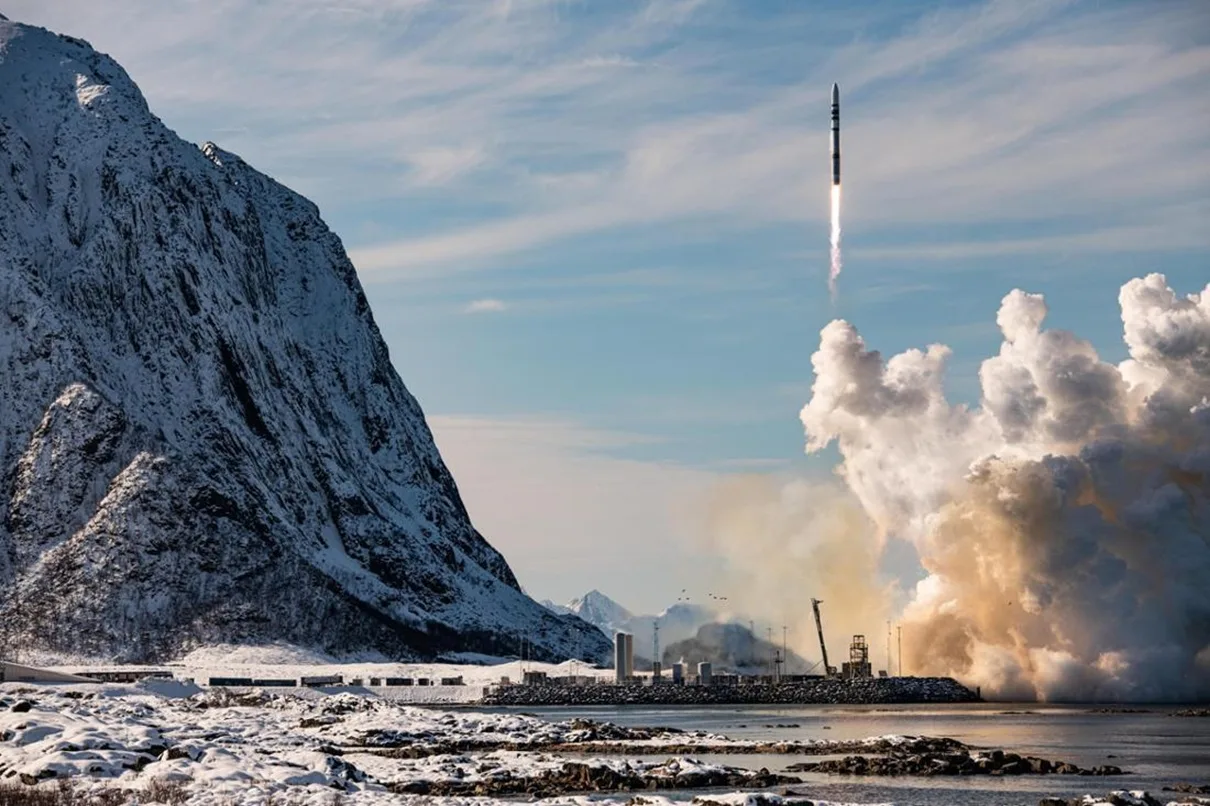
On September 5, 2026, a German rocket lifted off from Norway and reached orbit. The achievement was historic. It does not, however, mean quite what Europe would already like it to mean.
Spectrum, the launch vehicle developed by Isar Aerospace, completed its second flight from the Andøya Spaceport. For the first time, a private European company succeeded in placing its own rocket into orbit after launching from European soil. Hours later, Emmanuel Macron hailed “an achievement for Germany” and “a victory for all of Europe,” arguing that the continent was demonstrating its ability to “build a powerful Europe, independent even in space.”
The statement captures something real. It also gets considerably ahead of the story.
Reaching orbit is not the same as possessing autonomous space power. Between the two lie an industry, dozens of successful launches, supply chains, infrastructure, institutional orders, competitive costs and, above all, cadence. It is precisely in this space — far less spectacular than the trail of a rocket across the Norwegian sky — that Europe’s future in space will now be decided.
Isar Aerospace’s success therefore deserves something better than a triumphalist narrative. It reveals something more interesting: Europe may finally be beginning to change the system that caused it to lose part of its autonomous access to space in the first place.
A VICTORY THAT MATTERS
The scale of what has been achieved should first be acknowledged.
Founded in Munich in 2018 by Daniel Metzler, Josef Peter Fleischmann and Markus Brandl, Isar Aerospace belongs to a new generation of European companies seeking to apply a different industrial logic to space from that of the continent’s traditional institutional programmes.
Its Spectrum launcher is a two-stage rocket designed primarily for the small and medium satellite market. The company advertises a capacity of up to roughly one tonne to low Earth orbit. It also develops its own Aquila engines and seeks to control a substantial share of its industrial chain.
Spectrum’s first flight, in March 2025, was extremely short. The rocket lifted off from Andøya but lost control shortly afterwards before falling into the sea. What might once have been interpreted as an embarrassing failure was treated by Isar as a full-scale test from which to learn.
Eighteen months later, the second launch entered an entirely different category.
Spectrum reached orbit and deployed its payloads. Moving from a first test flight to a successful orbital mission represents a remarkable industrial progression. For Isar Aerospace, it turns a technological promise into a concrete demonstration. For Germany, it marks the emergence of a private launch capability the country did not previously possess. For Europe, above all, it adds another actor to a space landscape long organised around a limited number of institutions and prime contractors.
That is where the event becomes genuinely important.
EUROPE NEVER STOPPED BEING A SPACE POWER
Presenting Isar as the birth of a European space capability would nevertheless be historically wrong.
For decades, Europe has possessed world-class expertise in satellites, Earth observation, telecommunications, navigation, space science and launch vehicles. Ariane was one of the continent’s greatest industrial successes.
Ariane 4 and then Ariane 5 gave Europe independent access to space while making Arianespace a major force in the global commercial launch market. Ariane 5 completed 117 missions between 1996 and 2023 and, for part of its operational life, became one of the benchmarks of the heavy commercial launch industry.
Europe also built Galileo, one of the world’s few satellite navigation infrastructures independent of the American GPS system. Copernicus has become a major Earth observation programme. The European Space Agency brings together scientific and technological capabilities that few regions in the world can reproduce.
Europe’s problem, therefore, is not an absence of capability.
It is the difficulty of turning capability into durable industrial power.
WHEN THE MODEL BEGAN TO BREAK DOWN
While Europe perfected Ariane 5 and prepared Ariane 6, the global space market changed in nature.
SpaceX did not simply build a better rocket. The American company progressively changed the economics of launch.
The reuse of Falcon 9’s first stage, the dramatic increase in launch cadence, the vertical integration of much of its production and, above all, the combination of launch services with the Starlink constellation created an industrial system whose advantages reinforce one another.
Every launch generates experience. Every reuse amortises infrastructure further. Starlink creates enormous internal demand. That demand justifies a high launch cadence. That cadence reduces costs and accelerates learning.
The rocket is no longer merely a product. It becomes one component of an industrial machine.
In Europe, the logic remained far more fragmented.
Space programmes must accommodate multiple states, multiple companies, multiple industrial sites and a geographical distribution of contracts that also serves the political necessity of maintaining cohesion among participating countries.
This architecture has an institutional rationale. It allows Europe to finance collectively capabilities that no individual country would necessarily wish to support alone.
But it also carries an industrial cost.
When global competition increasingly depends on speed, iteration and cadence, the permanent search for institutional compromise itself becomes a factor of production.
EUROPE’S ACCESS-TO-SPACE CRISIS
That fragility became particularly visible in the early 2020s.
Ariane 5 completed its final flight in July 2023. Ariane 6 was not yet operational. Vega C had been grounded following a mission failure in December 2022. And Russia’s invasion of Ukraine had ended Europe’s use of Soyuz launchers from Kourou.
For a time, Europe found itself in a remarkable position: one of the world’s leading space powers no longer possessed regular autonomous access to orbit.
The paradox extended to important European missions being launched by SpaceX.
Ariane 6’s maiden flight in July 2024 began to close that gap. The launcher’s gradual ramp-up and Vega C’s return restored part of Europe’s capability.
But the episode left behind a much deeper question.
Does space autonomy simply mean possessing a European rocket?
Or does it require being able to manufacture it quickly enough, launch it frequently enough and operate it competitively enough that its existence does not continually depend on political decisions to sustain it?
ARIANE 6 AND ISAR ARE NOT DOING THE SAME JOB
It would nevertheless be a mistake to frame Spectrum as an alternative to Ariane 6.
The two launchers belong neither to the same category nor to the same economic model.
Ariane 6 is a heavy launch vehicle designed to carry substantial payloads to different orbits and, critically, to perform strategic institutional missions. Spectrum targets a much smaller segment and aims to provide greater flexibility to operators of smaller satellites.
Europe does not necessarily have to choose between them.
It may need both.
Ariane 6 represents strategic infrastructure: the guarantee that a major European institutional mission can be launched without depending on an outside power.
Private microlaunchers serve another purpose: increasing the number of actors, experimenting with different industrial models, shortening development cycles and creating a more competitive market.
The real transformation would therefore be less about replacing the Ariane system than about allowing an ecosystem to emerge around it.
EUROPEAN NEW SPACE LEAVES THE POWERPOINT
Isar Aerospace is not alone.
Rocket Factory Augsburg in Germany, Orbex in the United Kingdom and several other European companies are developing or have developed their own launch projects. Some will succeed. Others will probably disappear.
That is not necessarily a problem.
An innovative industry does not require every company to survive. It requires several architectures to be tested, capital to move between them and technologies that work to be allowed gradually to prevail.
This is perhaps where Spectrum’s success carries its greatest significance.
For years, European “New Space” was primarily an ambition: incubators, financing programmes, demonstrators, public initiatives, funding rounds and presentations promising the imminent emergence of European challengers to American companies.
A rocket that actually reaches orbit changes the nature of the discussion.
The industry leaves the PowerPoint.
It has not yet entered mass production.
THE REAL ADVERSARY IS CADENCE
The comparison with SpaceX reveals the scale of the remaining challenge.
The problem is not simply technological. Europe knows how to build rockets.
The problem is industrial.
A modern space capability depends on how many launches a system can perform, how quickly missions can follow one another, the marginal cost of each launch, the availability of launch infrastructure and the ability of the entire logistics chain to operate reliably.
SpaceX has progressively pushed Falcon 9 to a launch cadence that would have seemed extraordinary only a few years earlier. That frequency produces an advantage rarely captured by static comparisons between rockets: industrial learning.
A company that launches constantly learns constantly.
Teams accumulate experience. Procedures are repeated. Suppliers produce more. Defects emerge faster. Improvements can be incorporated into the next cycle.
Cadence becomes a technology in itself.
That is probably one of the central limitations of the political comparison between a successful launch and space independence.
A rocket can reach orbit in minutes.
Building a system capable of doing it fifty or a hundred times is another matter entirely.
THE STATE NEVER DISAPPEARED
It would also be misleading to portray Isar as a spontaneous victory of private enterprise over the old public model.
American New Space itself never developed independently of the state.
SpaceX benefited from major contracts with NASA, the US Department of Defense and other federal institutions. Public procurement provided revenue, missions and visibility that allowed the company to develop its capabilities progressively.
Europe is beginning to apply a comparable logic.
Isar Aerospace has benefited from European and German programmes, including the European Space Agency’s Boost! initiative and Germany’s microlauncher competition.
The relevant dividing line, therefore, is not between public and private.
It is between two ways of using public money.
In one model, the state largely defines the industrial architecture, allocates responsibilities and finances the development of the system.
In the other, several companies develop their own solutions while public authorities rely more heavily on procurement, contracts and competition to progressively select those that work.
The distinction may sound administrative.
It can become strategic.
BUY EUROPEAN TO CREATE A EUROPEAN MARKET
Europe’s challenge will now be to avoid two symmetrical mistakes.
The first would be to protect every European player artificially, recreating under private labels the rigidities of the previous institutional system.
The second would be to assume that the market alone will decide, while American, Chinese, Russian and Indian competitors themselves operate within environments in which public power plays a considerable role.
A sovereign space industry almost never emerges from a perfectly neutral market.
It emerges from an interaction between private innovation, patient capital, institutional demand and national strategy.
European states, the European Union and the ESA possess precisely such demand.
Military satellites, observation systems, meteorology, navigation, secure telecommunications, scientific missions and future European constellations all represent payloads that will need to reach orbit.
How those contracts are awarded will shape part of the industry’s future.
Buying European can generate the cadence that eventually allows European companies to become competitive.
But buying European without simultaneously demanding cost discipline, performance and reliability could simply subsidise inefficiency.
The entire difficulty lies in that distinction.
SPACE HAS BECOME A QUESTION OF POWER AGAIN
This transformation is taking place as the nature of space itself changes.
Satellites are no longer merely scientific or commercial infrastructure. They have become central components of contemporary power.
Navigation, military communications, intelligence, observation, targeting, weather forecasting, financial-network synchronisation, agriculture, logistics and telecommunications increasingly depend on orbital infrastructure.
The war in Ukraine made that dependence particularly visible.
In such an environment, relying permanently on a foreign actor for access to space creates a vulnerability that extends far beyond the price of a launch.
Europe already understood this with Galileo. Building an independent constellation prevents complete dependence on the American GPS system.
The same logic increasingly applies to launchers.
A sovereign constellation whose satellites can reach orbit only with the availability or permission of an external power possesses a rather peculiar form of sovereignty.
EUROPE’S PROBLEM IS BIGGER THAN A ROCKET
This is why Isar Aerospace’s success must be understood as part of a much broader transformation.
Europe does not lack engineers, capital, universities, industrial groups or even institutional demand.
Its deeper weakness lies in turning those resources into industrial systems capable of reaching enormous scale quickly.
Space is only a particularly visible manifestation of a problem that also appears in semiconductors, digital technology, artificial intelligence, defence and some energy technologies.
Europe knows how to fund research.
It knows how to regulate markets.
It knows how to construct large institutional partnerships.
It has considerably more difficulty allowing a company born on its territory to become enormous very quickly.
Isar Aerospace therefore matters beyond the space industry.
The question is no longer simply whether Spectrum can fly.
It is whether the European environment can allow a company like Isar to multiply factories, engines, launch vehicles and missions until it reaches genuine industrial scale.
INDEPENDENCE CANNOT BE DECLARED
The September 5 launch deserves the congratulations it received.
A European company founded less than a decade ago developed an orbital rocket, built its engines, conducted an initial test, learned from failure and reached orbit on its second flight.
That is no small achievement.
But precisely because the event matters, it does not need to be turned into something it is not yet.
Europe has not just conquered its independence in space.
It has demonstrated that a new path towards building it may exist.
The distinction is essential.
European autonomy will not be measured by the number of declarations celebrating each launch, but by the day when such launches cease to be exceptional. When several European companies can regularly place satellites into orbit, when Ariane 6 operates at a robust cadence, when European institutions can choose between several domestic solutions and when launching from Europe becomes an ordinary industrial operation rather than a political event, the word power will acquire a different substance.
On September 5, Spectrum crossed the Kármán line and continued into orbit.
For Europe, the trajectory is longer.
The rocket has lifted off. The system still has to prove that it can follow.
Main sources
Isar Aerospace — communications regarding Spectrum’s second flight and successful orbital mission, September 2026.
European Space Agency (ESA) — Boost! programme, European space transportation, Ariane 6 and support for commercial European launch services.
Arianespace / ArianeGroup — Ariane 5 flight history and the development and operation of Ariane 6.
European Commission — European space programmes, Galileo, Copernicus and strategic autonomy policy.
DLR / German Federal Government — German microlauncher support programme and development of the commercial space ecosystem.
NASA — Commercial Orbital Transportation Services, Commercial Resupply Services and the institutional contracts that supported SpaceX’s development.
SpaceX — operational data on Falcon 9 and first-stage reuse.
Atlas Limits Research Desk
Atlas Limits’ editorial and analytical desk.