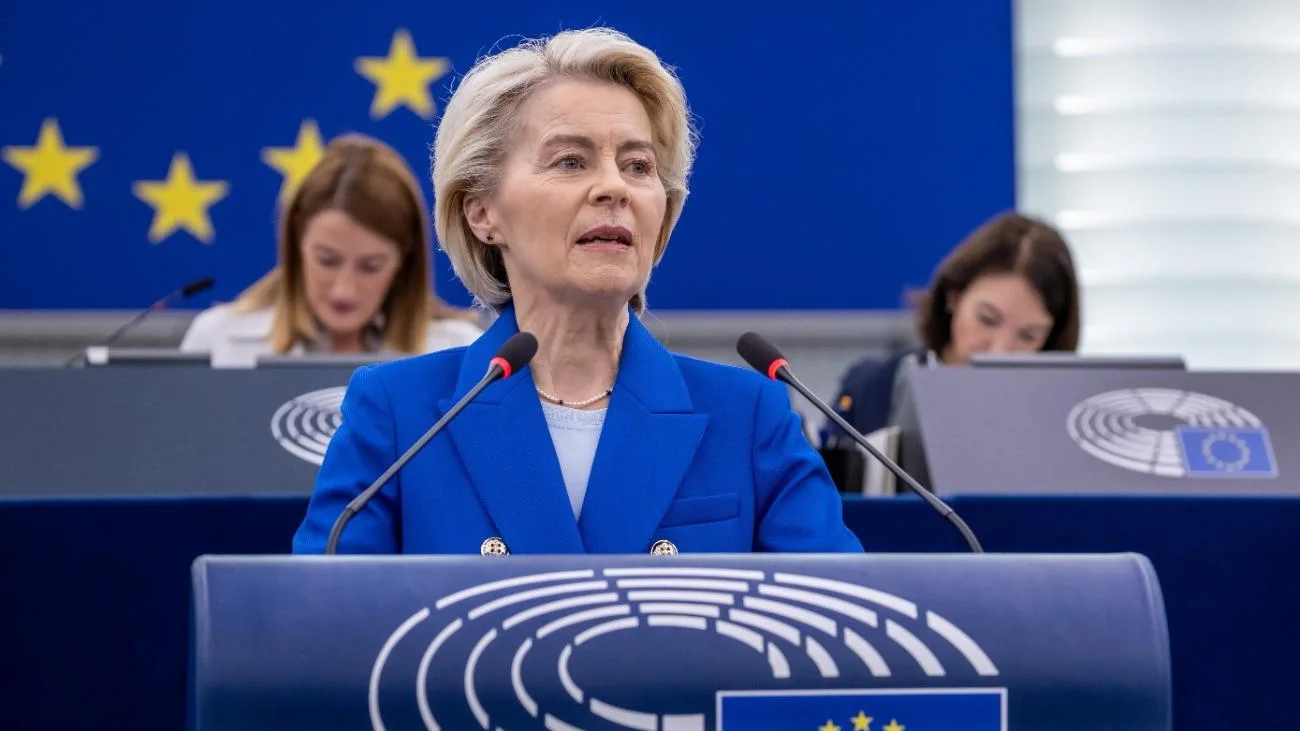
At the European Parliament, Sarah Knafo gave the European taxpayer a name. His name is Nicolas. His work, she told Ursula von der Leyen, is worth €4,000; he receives €2,000. Then come the fuel tank, heating, electricity and, eventually, European debt. At every stage of the story, Brussels supposedly takes another share of his income.
The scene is effective because it turns the European Union’s financial architecture into a succession of bills. It is also effective because it places mechanisms that actually belong to several different levels of government under a single responsibility.
But behind the political shortcut lies a more interesting question than the confrontation between an MEP and the President of the European Commission: how much does a European actually pay for Europe?
The difficulty begins precisely here. There is almost never a simple answer.
Nicolas’s salary provides the first demonstration. The gap between what an employee costs an employer and the amount that reaches the employee’s bank account depends primarily on social contributions, taxation and welfare systems determined at national level. The Union intervenes in many areas of economic policy, but it does not set French social contribution rates or French income tax.
Directly attributing to Brussels the €2,000 separating, in the example used in Parliament, the supposed value of Nicolas’s work from his net salary therefore conflates two different levels of public authority.
Yet that confusion cannot be reproduced everywhere. A few kilometres later, when Nicolas stops at a petrol station, the boundary between national taxation and European policy becomes considerably less clear.
The Union has created a second carbon market, ETS2, covering, among other things, fuels used in road transport and the heating of buildings. The system is due to become fully operational in 2028. Households will not themselves purchase CO₂ allowances: the obligation will fall on suppliers placing fuels on the market. But those suppliers will have to acquire and surrender allowances corresponding to the emissions generated by the products they sell. The cost of carbon may therefore be passed on, in whole or in part, through the prices ultimately paid by consumers.
Brussels will not send Nicolas a carbon bill. That does not mean Nicolas will not bear part of its cost.
This distinction matters because it reveals a quiet transformation in the way the Union exercises economic power. For a long time, Europe’s financial contribution was primarily visible in national budgets. It increasingly also operates through standards, regulated markets and pricing mechanisms whose effects can reach everyday expenditure without ever appearing as an identifiable European levy.
Electricity tells a comparable, though different, story.
The 2022 energy crisis demonstrated how strongly European wholesale electricity prices could be driven by soaring gas prices. This resulted partly from the functioning of marginal pricing: to balance supply and demand, the most expensive plants required at a given moment could determine the market price, and gas-fired power stations frequently occupied that position.
To say that every European simply pays for “electricity at the price of gas”, however, reduces this system to a formula that describes neither the full range of contracts nor national taxes and tariffs, hedging mechanisms or public interventions separating wholesale markets from final household bills.
More importantly, the Union itself began changing this model after the crisis.
Since 17 July 2026, new European electricity market rules have strengthened the use of fixed-price contracts and long-term mechanisms designed to reduce consumers’ exposure to episodes of extreme fossil-fuel price volatility. The Commission explicitly presents the reform as a response to the lessons of 2022.
The Europe criticised by Knafo is therefore already correcting some of the mechanisms she attacks. At the same time, however, it is constructing others.
It is when the story moves away from energy bills and towards debt that the transformation becomes deeper.
For decades, the European Union had a common budget but not a genuine borrowing capacity comparable to that of a state. The pandemic shifted that boundary.
With NextGenerationEU, the member states authorised the Commission to borrow up to €806.9 billion at current prices — the often-cited €750 billion figure expressed in 2018 prices — on financial markets on behalf of the Union. The Commission now estimates that it will have raised up to €634 billion by the end of 2026.
That change is considerable.
Part of the money is distributed as loans, whose repayment falls to the member states that borrowed it. Another part finances grants and various European programmes. For that portion, repayment will pass through future EU budgets and is due to extend from 2028 until 2058.
In other words, a decision taken in the early 2020s will still have a budgetary existence when Europeans who were children during the pandemic are approaching retirement.
Once again, Nicolas will receive no repayment notice from Brussels.
He will contribute indirectly.
The European budget is currently financed primarily through customs duties, a VAT-based resource, national contributions calculated notably on the basis of gross national income, and a contribution linked to non-recycled plastic packaging waste. Member states therefore finance the European budget with resources that ultimately derive, directly or indirectly, from their economies and taxpayers.
Common debt adds a new dimension: future European budgets must also absorb its repayment.
This is where the debate extends far beyond the personality of Ursula von der Leyen.
The European Union has gradually become a structure through which considerable financial flows circulate without anything equivalent to a European tax statement allowing every citizen to see immediately what they contribute and what they receive.
This opacity is not necessarily intentional. It stems first from the nature of the Union itself.
Brussels collects relatively little directly. Member states collect much more, then finance the Union. The Union subsequently redistributes part of those resources to states, regions, farmers, companies, universities and infrastructure. It now borrows on financial markets. It regulates carbon. It organises certain markets whose rules influence prices. National governments then intervene once again between those mechanisms and consumers.
At every stage, the origin of the money becomes a little less visible.
The same problem also works in the opposite direction. It would be equally misleading to add together national contributions and every cost associated with European regulation without counting what subsequently flows back into the economies concerned.
NextGenerationEU finances investment and reforms across the member states. The Recovery and Resilience Facility initially amounted to €723.8 billion in loans and grants. Other resources have supported Horizon Europe, the Just Transition Fund, InvestEU and rural development.
A taxpayer may therefore contribute to financing a European policy through his or her national government and, several years later, benefit from infrastructure partly financed by that same policy, without the two transactions ever appearing on the same document.
That is probably the system’s real singularity.
Within a state, taxation establishes a relatively identifiable relationship between an administration and the taxpayer. Within the European Union, that relationship is fragmented across several institutions and several levels of sovereignty. National governments can attribute to Brussels the cost of a decision they themselves negotiated in the Council. European institutions can present an investment as European even though part of its funding ultimately comes from member-state contributions. The citizen sits at the end of the chain with a bill whose institutional origin can sometimes be almost impossible to reconstruct.
For a long time, this ambiguity was manageable because the European budget remained limited and the overwhelming majority of fiscal and budgetary capacity remained clearly national.
That world is beginning to change.
Carbon is gradually giving the Union an instrument that acts on prices. Common borrowing has given it access to capital markets on a previously exceptional scale. Discussions over new own resources directly raise the question of how this debt will be financed. And successive crises — pandemic, energy, defence, competitiveness — regularly push member states to seek financial capacity at European level that they hesitate to mobilise individually.
This movement does not turn the Union into a federal state. Member states retain the overwhelming majority of taxation, social expenditure and public budgets in Europe. But the boundary is less clear than it was when European integration rested primarily on the single market, competition and free movement.
Europe is gradually acquiring some of the economic instruments of a public authority without yet having built the transparent fiscal relationship that normally accompanies them.
That is why Nicolas ultimately remains a useful character, even if the political narrative constructed around him conflates several different responsibilities.
The question is not simply whether Brussels takes too much or too little from him. It is whether an architecture capable of borrowing hundreds of billions of euros, putting a price on carbon, redistributing resources between territories and influencing some of the continent’s most important markets can remain so difficult to read for those who finance it.
Nicolas can know his net salary. He can know the price of a litre of fuel and the amount of his electricity bill.
What he still cannot easily know is the exact price of Europe.
MAIN SOURCES
European Parliament / European Commission Audiovisual Service — 2026 State of the Union debate and Sarah Knafo’s intervention.
Council of the European Union — ETS2 and full operation scheduled for 2028.
European Commission — NextGenerationEU, financing structure and debt repayment through 2058.
European Commission — reform of the European electricity market applicable from July 2026.
European Commission — resources and financing of the EU budget.
Atlas Limits Research Desk
Atlas Limits’ editorial and analytical desk.