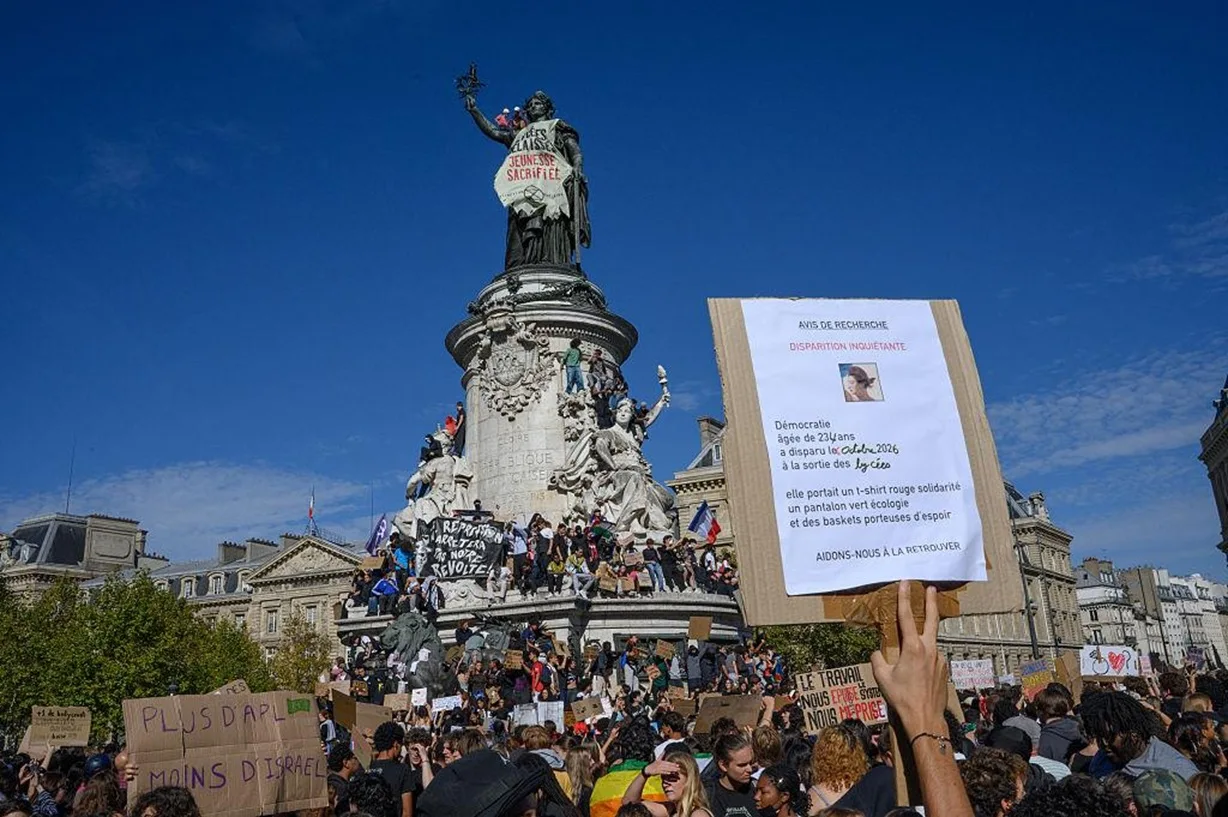
In Paris, clouds of tear gas obscure Place de la République. A few streets away, thousands of demonstrators continue marching peacefully, while smaller groups confront police officers and fires break out. In Lyon, the tourist information office on Place Bellecour is engulfed in flames. In Marseille, protesters force their way into City Hall. On Saturday, October 17, 2026, France experiences another day of nationwide demonstrations, marked by peaceful processions, property destruction and violent confrontations. Yet beyond these dramatic scenes, a deeper transformation is emerging: a protest movement initially driven by young people is converging with longstanding economic and social grievances, once again raising questions about the French political system's ability to manage its internal tensions.
The Interior Ministry reports at least 272 arrests during the day, while the CGT trade union estimates nationwide participation at 800,000. These figures come from different sources and remain subject to revision. Nevertheless, they illustrate the scale of a movement whose demands now extend far beyond educational institutions. Demonstrations bring together secondary-school pupils, university students, employees, trade union activists and participants identifying with the Yellow Vest movement. This convergence remains heterogeneous, without a single leadership structure or shared political programme, but it reveals concerns that increasingly transcend generational boundaries.
The current crisis partly originated in the education system. Since September, protests have multiplied over teacher shortages, deteriorating school buildings, difficulties accessing higher education and the functioning of Parcoursup, France's centralised university admissions platform. In some areas, these demands carry a particularly strong social dimension. At Lycée Paul-Éluard in Saint-Denis, which has become one of the movement's symbols, students denounce inadequate facilities and renovation work that has been repeatedly delayed. The mobilisation is therefore not simply about securing additional resources. It expresses a broader concern about genuine equality in public services and the ability of schools to provide comparable opportunities to young French citizens, regardless of their social or geographical background.
This educational dimension partly explains how quickly the movement has attracted support beyond younger generations. Schools occupy a distinctive position within the French republican model. They are not merely administrative services; they are among the principal institutions through which the state promises social mobility, equal opportunity and national integration. When those who depend on them believe that this promise is weakening, protests can acquire a political significance far greater than the material problems that initially triggered them. An overcrowded classroom, an absent teacher or a disputed admissions procedure becomes a tangible expression of a broader sense of declining opportunity.
The education system's difficulties are embedded in wider financial constraints. In an analysis published on October 17, economist Thomas Piketty estimates that real resources allocated per student in higher education have declined by approximately 20% since 2017, reflecting the combined effects of inflation and rising enrolment. This estimate is based on spending per student and must be distinguished from changes in the nominal higher education budget. It nevertheless illustrates an essential phenomenon: an apparent increase in public expenditure does not necessarily translate into better resources for individual users.
The educational protests have encountered a second source of discontent: purchasing power. Rising energy, fuel and food prices, alongside concerns surrounding the national budget, have helped broaden calls for demonstrations. The difficulties cannot be reduced to the headline inflation rate. For households whose incomes are growing slowly, the cost of essential expenditure remains decisive. Transport, heating, housing and food absorb a share of income that restricts opportunities for saving and discretionary consumption. This daily pressure can persist even when certain macroeconomic indicators suggest that conditions are stabilising.
France is consequently returning to a configuration reminiscent of the Yellow Vest movement, which emerged in November 2018 in opposition to fuel taxation. At the time, an initially specific demand rapidly exposed deeper divisions between territories, social groups and political institutions. Roundabouts became gathering places for a France dependent on cars, distant from major urban centres and convinced that its everyday constraints were insufficiently recognised. Eight years later, concerns about purchasing power and political representation remain, but they are now intersecting with a mobilisation whose initial momentum came from schools.
The distinction matters. The Yellow Vests largely organised outside traditional institutions, developing a strong territorial presence and displaying considerable distrust of established intermediaries. The current movement brings together autonomous activist networks, student organisations, trade unions and social groups with different demands. This diversity may facilitate its expansion, but it also complicates the formulation of common objectives. The ability to unite around dissatisfaction does not necessarily imply the ability to negotiate a political settlement.
This contradiction lies at the heart of the government's difficulties. Faced with a sector-specific protest, the executive can identify representatives, negotiate a budget or propose administrative measures. Faced with a composite movement, the available responses become less straightforward. Announcing additional teacher recruitment does not address rising energy prices. A tax measure does not resolve difficulties accessing university. Negotiations with trade unions do not guarantee the support of groups that reject institutional representation. As demands accumulate, the government must increasingly arbitrate between different, sometimes conflicting expectations.
These difficulties are compounded by France's fiscal position. Public debt, persistent deficits and the state's financing requirements restrict the resources available for new commitments. Expenditure on education, healthcare, security, infrastructure and social protection competes within a financial environment in which public borrowing conditions have become more sensitive. The debate therefore concerns not only how much money can be mobilised, but also how resources should be distributed and which collective priorities should prevail. Demonstrators may argue that public services have been inadequately funded, while the government may emphasise the need to preserve fiscal sustainability. These concerns are not necessarily incompatible, but reconciling them requires political choices whose costs must be made explicit.
An additional source of tension is the policing of demonstrations. Student protests in recent weeks have been accompanied by numerous arrests, injuries and allegations of police violence. Authorities also report hundreds of injured officers and emphasise the presence of violent groups attacking security personnel, damaging buildings or using demonstrations as cover. Investigations into certain police interventions must establish individual responsibilities and determine whether misconduct occurred. It remains essential to distinguish peaceful demonstrators, perpetrators of violence and the specific circumstances in which police officers intervene.
Yet maintaining these distinctions becomes increasingly difficult when public debate is dominated by images of confrontation. In Paris on October 17, authorised marches proceeded peacefully while violence erupted nearby. In Lyon, several groups dispersed and regrouped across different neighbourhoods, prompting successive police interventions. These situations produce competing narratives: some emphasise destruction and attacks, while others focus on policing methods and the risks faced by demonstrators. When physical confrontation becomes the central subject of public debate, the original grievances can gradually disappear behind a wider security controversy.
The institutional danger does not lie solely in the violence itself. It emerges when each new confrontation further weakens trust between citizens and the authorities responsible for protecting their rights. In a democracy, the state must simultaneously guarantee freedom of assembly, personal safety and the protection of property. These obligations may come into tension during episodes of disorder, but none disappears in favour of the others. The legitimacy of public action consequently depends as much on the ability to restore security as on the proportionality of the methods employed and the existence of credible oversight mechanisms. 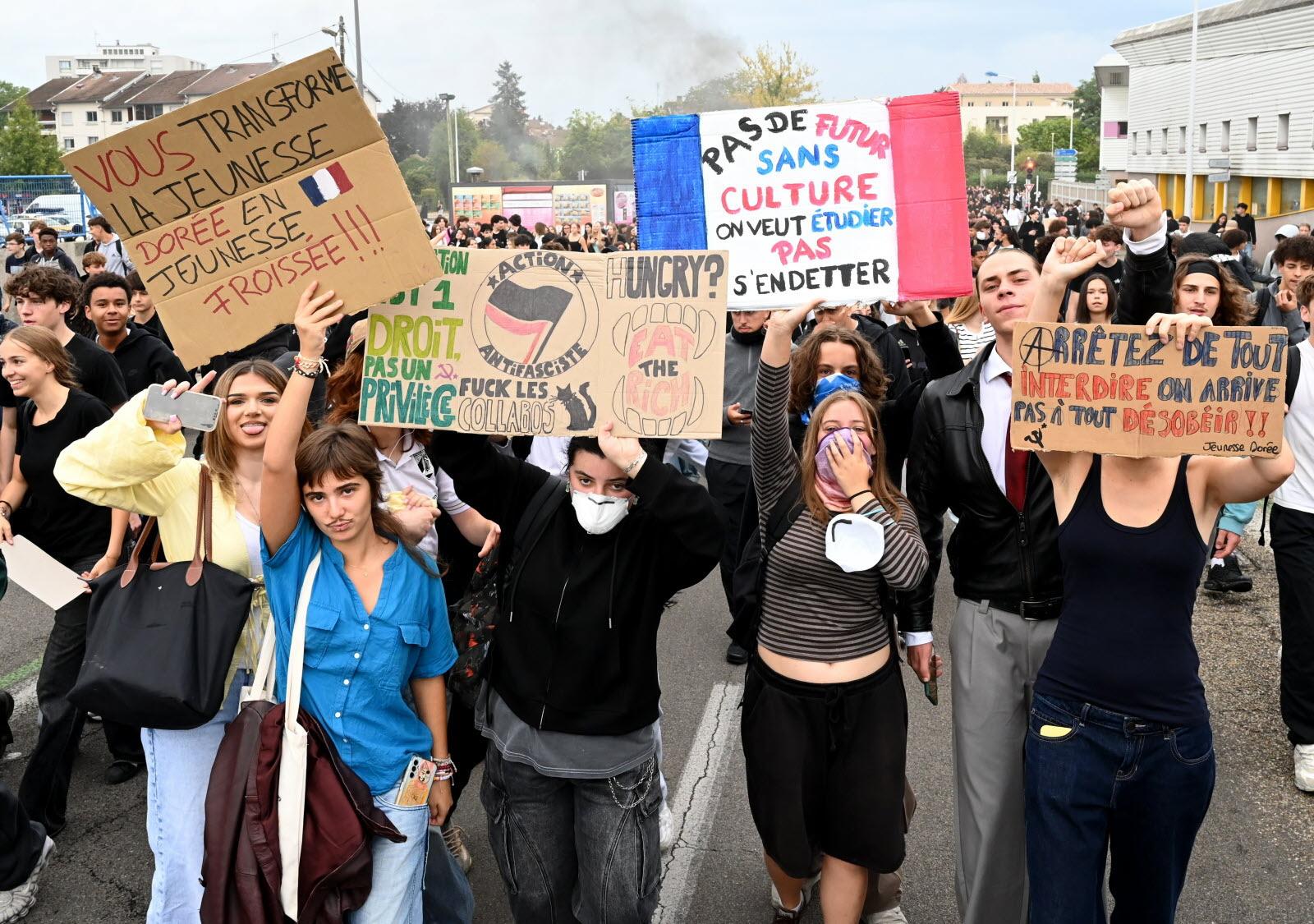 The French crisis also has a generational dimension. Young people mobilising in 2026 have grown up in an environment shaped by the consequences of the financial crisis, terrorist attacks, the pandemic, geopolitical tensions and rising living costs. They have experienced successive economic and institutional disruptions that may influence their perception of the future. Concerns about housing affordability, employment stability and the quality of public services add to difficulties within the education system. For part of this generation, the issue is not merely obtaining better study conditions, but determining whether educational achievement will continue to offer a credible path towards improved living standards.
This question intersects with the concerns of older generations. Workers facing stagnant purchasing power, households in peripheral areas dependent on fuel and users of public services may share the perception that the sacrifices demanded of them are increasing faster than the protections they receive. It would be excessive to infer the existence of a unified political consciousness from these overlapping concerns. Interests, experiences and electoral preferences remain highly diverse. Nevertheless, this proximity of grievances creates favourable conditions for simultaneous mobilisation, even when participants disagree about possible solutions.
France is not alone in experiencing these pressures. Demonstrations have also taken place in Belgium, particularly in Brussels, where student groups are protesting against education costs and certain reforms. Solidarity actions and protests over economic conditions have been reported in several other European countries. It would be premature to describe these developments as a unified continental movement. Political circumstances, education systems and national demands differ considerably. Nevertheless, these episodes suggest that tensions surrounding living costs, public services and opportunities for younger generations extend beyond France.
This European dimension highlights the economic constraints facing governments across the continent. Slower growth, defence expenditure, industrial investment requirements and energy transitions impose increasingly complex budgetary trade-offs. European societies simultaneously expect extensive social protection, effective public services, an affordable energy transition and resilience against external shocks. Financing these objectives depends on limited resources, making their allocation a central political issue.
In France, these tensions acquire particular significance as the 2027 presidential election approaches. Emmanuel Macron is nearing the end of his second term in a fragmented political landscape shaped by the institutional and social crises of previous years. Prime Minister Sébastien Lecornu faces a protest movement that no longer concerns only his government's decisions, but increasingly touches on confidence in political institutions themselves. Political parties are attempting to interpret the grievances and translate them into electoral proposals, although there is no basis for treating the demonstrators as collectively aligned with any particular political formation or ideology.
The electoral calendar may alter the behaviour of political actors without necessarily resolving the underlying tensions. For political organisations, demonstrations provide opportunities to gain visibility and articulate competing programmes. For the government, they require a balance between social responses, fiscal discipline and public order. For participants, they offer a means of drawing attention to difficulties that do not always find adequate expression through representative institutions. These dynamics intersect, but they do not pursue identical objectives.
French social history nevertheless encourages caution when interpreting immediate events. Major protest movements do not systematically produce institutional transformations. Some lead to concessions, others gradually lose momentum, while a smaller number permanently alter relations between the state and society. The demonstrations against pension reform in 2023 demonstrated that substantial and sustained mobilisation could coexist with the implementation of a contested government decision. The Yellow Vests, meanwhile, secured several fiscal and social responses without establishing unified political representation. The scale of a protest is therefore insufficient to determine its eventual consequences.
The essential questions now concern the movement's duration and organisational capacity. Can student mobilisation maintain its momentum during school holidays? Will trade unions succeed in integrating economic grievances into a common protest calendar? Can groups associated with the Yellow Vests rebuild a lasting territorial presence? Will the government be able to initiate negotiations that address certain demands without intensifying budgetary pressures? The answers will shape the crisis more profoundly than the images of October 17 alone.
Another question concerns the nature of political representation itself. For several years, France has experienced protest movements in which some participants express distrust towards the organisations traditionally responsible for transmitting social demands to political institutions. This distrust does not necessarily indicate a rejection of democracy. It may also reflect demands for more direct participation, dissatisfaction with existing negotiation mechanisms or a conviction that public decisions are made too far from everyday realities. Yet when no interlocutor is recognised as legitimate, transforming protest into policy becomes particularly difficult.
The events of October 17 do not, by themselves, justify concluding that France has entered an irreversible institutional crisis. Demonstrations remain diverse, demands are not unified and public institutions continue to function. Nevertheless, successive waves of protest since 2018 indicate that certain economic, territorial and social divisions have not found lasting resolution. The current movement does not simply reproduce earlier crises. It connects with them through new generations, different actors and grievances that have accumulated over time.
On French streets, confrontations command immediate attention. Fires, property destruction and police interventions are serious developments requiring specific responses. But the deeper issue lies elsewhere, in the widening distance that some citizens perceive between the promises of the French social model and their daily experience. Education, employment, public services and purchasing power are not independent questions. Together, they constitute the principal elements of a social contract whose credibility depends on the possibility of improving one's circumstances and passing on at least comparable opportunities to the next generation.
France does not lack institutions, traditions of social mobilisation or mechanisms of social protection. It faces a more complex challenge: maintaining confidence in those institutions at a time when resources are constrained, expectations remain high and political compromises are increasingly costly. October 17, 2026, may therefore prove significant not simply because of the intensity of its confrontations, but because grievances that had previously been expressed separately have begun to meet in the same streets.
Whether this convergence produces negotiations, a sustained movement or another succession of confrontations without a common resolution remains uncertain. Beyond the marches and barricades, however, the question increasingly confronting French society is whether its institutions can transform discontent into collective decisions before distrust itself becomes a defining force in political life.
Main Sources
- Reuters, October 17, 2026 — Reporting on clashes between police and protesters, nationwide mobilisation and government responses.
- Associated Press, October 17, 2026 — Coverage of demonstrations, fires and the participation of student groups.
- Le Monde, October 17, 2026 — Reporting on demonstrations in Paris, Lyon and other major French cities.
- Le Monde, October 14, 2026 — Coverage of the student movement, its demands and calls for broader mobilisation.
- Le Monde, October 14, 2026 — Reporting from Lycée Paul-Éluard in Saint-Denis on educational inequalities.
- Le Monde, October 17, 2026 — Thomas Piketty's analysis of higher education financing.
- The Guardian, October 17, 2026 — Reporting on policing practices during student demonstrations.
- Euronews, October 16–17, 2026 — Coverage of protests over living costs and the nationwide demonstrations.
Atlas Limits Research Desk
Atlas Limits’ editorial and analytical desk.