Sometimes a single word is enough to reveal that a debate has changed in nature. On October 6, Elon Musk was not talking about migration quotas, visas, asylum law, external borders or labour shortages. Responding on X to a post by Tommy Robinson concerning France, he used a different vocabulary: that of an “invasion”. Those who supported it were then described in his message as “traitors”.
This vocabulary no longer belongs solely to immigration policy.
It belongs to a representation of the world.
Because there is a conceptual, not merely quantitative, difference between saying that a country receives too many immigrants and saying that it is being invaded. In the first case, immigration is a flow that the state can increase, reduce, select or interrupt. In the second, it becomes a relationship of power between populations. The border no longer merely separates two territories. It increasingly separates an “us” from a “them”.
It is this shift that is now reshaping part of the Western debate.
From the United States to the United Kingdom, from Germany and France to the Netherlands and Italy, the same words and arguments are circulating with new speed: mass migration, replacement, remigration, civilisation, identity, demography, invasion. They do not necessarily form a coherent doctrine, and those who use them do not all advocate the same policies. But together they reveal an important transformation: for some political actors and commentators, immigration is gradually ceasing to be merely an administrative, economic or humanitarian issue and becoming a general theory about the future of nations.
And that theory is encountering a reality that has itself changed.
The Border Is No Longer Enough
For decades, the European immigration debate could be formulated through a relatively stable vocabulary.
How many people enter? For what reasons? How many work? How many obtain asylum? How many leave? How many become citizens? What are the effects on wages, public finances, housing, schools or demographics?
Those questions remain.
But they increasingly coexist with another: what becomes of a nation when its demographic composition changes permanently?
The distinction is fundamental.
Immigration policy can be adjusted every year. Demographic transformation unfolds over decades.
It is precisely this longer horizon that is driving the current politicisation.
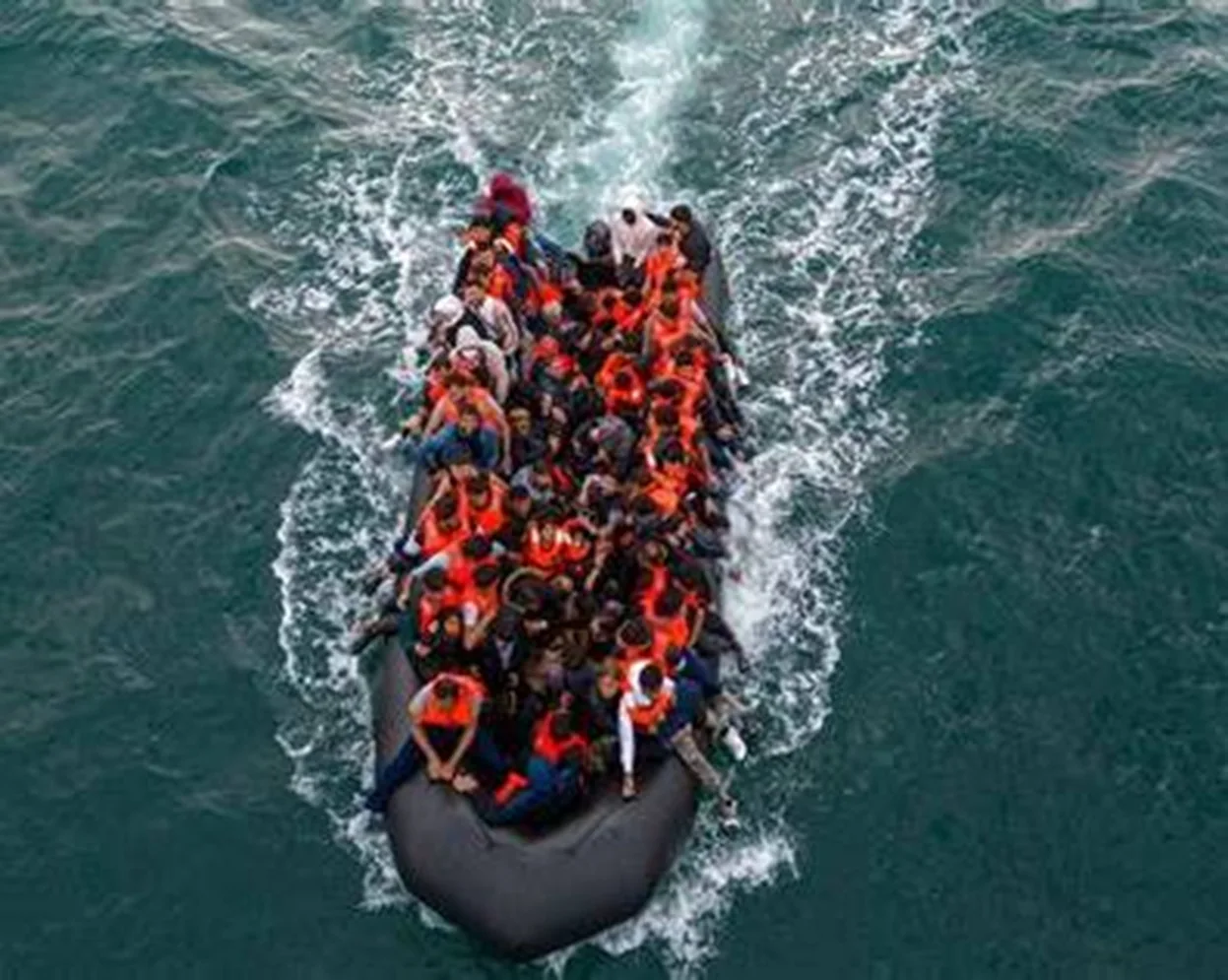
In 2024, 4.2 million people immigrated into an EU country from outside the European Union. Another 1.5 million people moved between EU countries. Relative to the European population, external immigration amounted to approximately 9.2 immigrants per 1,000 inhabitants. National differences were considerable: 60 per 1,000 in Malta, 42 in Cyprus and 38 in Luxembourg, but only 6 in France.
The first difficulty in the debate already appears here.
There is no single European immigration.
There are dozens of overlapping migration systems.
Romanian workers in Luxembourg, Indian engineers in Germany, Moroccan students in France, Ukrainian refugees in Poland, seasonal workers in Spain, Sudanese asylum seekers in Italy: statistics combine trajectories that political debate often turns into a single phenomenon.
The word “immigration” gives unity to something that remains administratively, economically and humanly fragmented.
Demography Is Changing Nonetheless
It would be an equal mistake, however, to reduce the entire debate to ideological construction.
Demographic transformation is real.
Almost 8 million immigrants were living in France in 2025, representing 11.6% of the population. Around 2.6 million of them had acquired French nationality. The foreign population — a different statistical category — stood at 6.3 million, or 9.1% of the population. Altogether, 9.6 million inhabitants had been born abroad, including those who were French citizens from birth.
The movement is historical.
Immigrants represented 5% of France's population in 1946, 7.4% in 1975 and 7.3% in 1999. Their share has now reached 11.6%. The French statistical institute, Insee, notes a methodological break in 2024 that means the latest figures cannot simply be compared mechanically with previous years. The longer-term trend, however, is clear: since the beginning of the 2000s, the immigrant population has grown faster than the population as a whole.
Its composition matters just as much.
In 2025, 49.2% of immigrants living in France had been born in Africa, 30.3% in Europe, 14.3% in Asia and 6.2% in the Americas or Oceania. More than half were aged between 25 and 54.
These figures prove neither an “invasion” nor its opposite.
They show something more precise: France has indeed become more of an immigration country than it was at the end of the twentieth century.
The debate begins when society decides what that development means.
From Numbers to Identity
A number has no ideology.
Its interpretation can.
For an economist confronting demographic ageing, the arrival of young adults can represent an expansion of the working-age population.
For a company facing labour shortages, it can represent a resource.
For a mayor whose schools, transport networks or social housing are under pressure, it can create an additional constraint.
For a humanitarian organisation, it can mean protecting people fleeing war or persecution.
For a nationalist, finally, it can be interpreted as a transformation of the country's historical and cultural continuity.
The same person crossing a border can therefore appear successively as a worker, taxpayer, refugee, competitor, neighbour, foreigner or future member of the nation.
The political battle begins with the choice of noun.
And “invasion” is perhaps the most powerful noun of all.
An invasion presupposes territory. It presupposes a group entering and another group subjected to that entry. It implies direction, a balance of power and, almost inevitably, the legitimacy of resistance.
When applied to civilian migration composed of very different individual trajectories, the word therefore performs considerable ideological work: it transforms a collection of movements into a collective actor.
Migrants become “immigration”.
Immigration becomes a population.
The population becomes a force.
And the force becomes a threat.
The Return of Demographic Politics
This reasoning draws its power from a much older anxiety: numbers.
States have always counted their populations.
But contemporary European societies had largely moved demographic questions away from the centre of political debate. Citizenship, law and the individual appeared gradually to have displaced broad ethnic or religious readings of population.
European ageing, declining fertility and immigration are bringing demography back into politics.
The foreign population of the European Union is significantly younger than the national population. In 2024, people aged 20 to 49 represented a substantially larger proportion of non-nationals than nationals, while people over 50 were under-represented.
This difference generates two almost opposite interpretations.
The first is economic: an ageing Europe needs workers.
The second is identitarian: an ageing Europe becomes mechanically more dependent on populations originating elsewhere.
Both can use the same statistical table.
This is where immigration becomes extraordinarily difficult to depoliticise. The disagreement no longer concerns facts alone. It concerns the time horizon through which those facts are interpreted.
A company thinks about the next five years.
A pension system thinks about the next twenty.
Demography thinks about the next fifty.
National identity sometimes thinks in centuries.
From Integration to Replacement
For a long time, the implicit European compromise rested on integration.
People arrived. They worked. Their children attended national schools. Some became citizens. Across generations, the distinction between immigrant and national populations was expected gradually to become less relevant.
That model continues to operate for millions of people.
But it is increasingly challenged by two phenomena.
The first is quantitative: when migration flows continue over time, the integration of earlier generations occurs simultaneously with the arrival of new populations. Immigration therefore never becomes a completed process.
The second is cultural: in some societies, part of the descendants of immigrants retain or assert visible religious, cultural or transnational identities.
It is within this space that the idea of “replacement” has developed.
The argument no longer asks whether an immigrant integrates.
It asks whether, on a sufficiently large scale, the accumulation of migration changes the population itself.
That question can be studied demographically.
But it becomes ideological when it presupposes that populations are fixed, hereditary and antagonistic blocs.
A child born in France to immigrant parents can be classified as French by law, as a descendant of immigrants statistically, as Muslim by religion, as North African by family origin and as European geographically.
None of these categories exhausts that person's identity.
Politics, however, often chooses the one it needs.
Islam as an Accelerator
In Western Europe, the immigration question has another distinctive characteristic: it regularly merges with the question of Islam.
Statistically, this is an imperfect shortcut.
A substantial share of European immigration originates in European countries or among non-Muslim populations. Immigrants living in France themselves constitute neither a homogeneous origin nor a homogeneous religion. Almost a third were born in Europe or in regions other than Africa and Asia.
Politically, however, Islam has particular visibility.
Religion, dietary practices, clothing, places of worship, calendars, family norms and debates surrounding secularism make some differences immediately perceptible.
Migration then becomes cultural.
Culture becomes religious.
And religion can subsequently be interpreted as a political project.
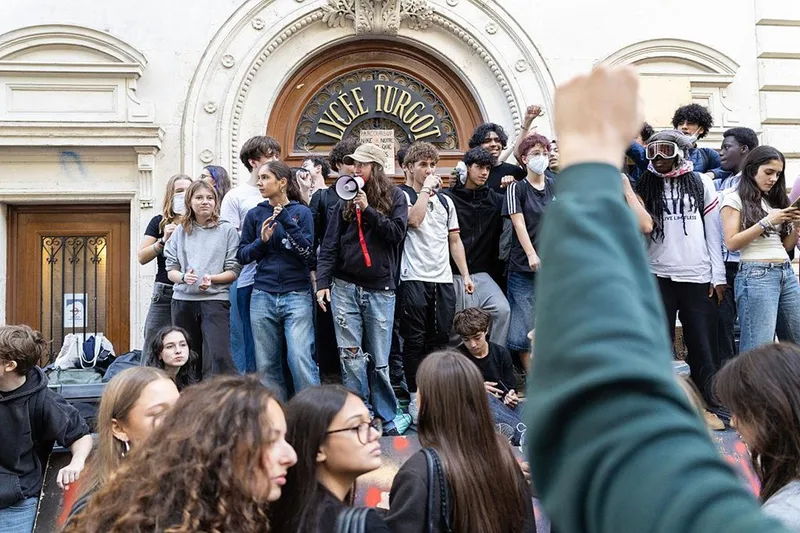
That is precisely the conceptual leap contained in the image shared by Tommy Robinson to which Elon Musk was responding: a French mobilisation initially concerning schools is reinterpreted through immigration and then through Islam.
At that point, immigration no longer merely explains immigration.
It begins to explain society itself.
That is one of the most characteristic features of an ideology: its ability to absorb different phenomena into the same causal framework.
X and the Birth of a Transnational Language
Something new is also happening in the way these ideas circulate.
Immigration debates were once overwhelmingly national.
France debated secularism and integration. Britain debated multiculturalism. The United States debated its Mexican border. Germany debated labour needs and the legacy of 2015. Italy debated Mediterranean arrivals.
Social networks have connected these debates.
A video filmed in Paris can now be interpreted by a British activist, amplified by an American entrepreneur, commented on by a German user and fed back into French political debate within hours.
Context disappears faster than images.
And the vocabulary converges.
“Mass migration.”
“Invasion.”
“Remigration.”
“Replacement.”
“Traitors.”
The international circulation of these terms is creating something that extends beyond national political parties: a transnational political imaginary of the border.
It is a remarkable paradox.
Movements that place national sovereignty at the centre of their politics are themselves constructing a globalised political conversation.
Musk Is Not a Political Party
This is where Elon Musk becomes a distinctive actor.
He does not lead a European political party. He is not running in a French or British election. He does not offer a detailed migration programme for the European Union.
His power is different.
He possesses an exceptional ability to move words, images and narratives between political spaces.
When the owner of a platform with a global audience adopts the vocabulary of “invasion”, the significance lies not only in his personal opinion. It lies in that opinion's capacity to connect communities that previously operated within separate national arenas.
Tommy Robinson speaks from Britain.
The post he shares concerns France.
Musk responds from the United States.
The political object becomes Western.
This does not mean that all anti-immigration movements belong to a common organisation. They differ substantially over economics, the state, religion, Russia, Israel, the United States and social protection.
But they increasingly share a diagnosis.
And sometimes a vocabulary.
The Numbers Resist the Narrative
The paradox is that this rhetorical escalation is occurring while some European migration indicators are declining.
In June 2026, the European Union recorded 37,075 first-time asylum applications, 29% fewer than a year earlier. In May, the number had already fallen by 22% year on year.
This obviously does not mean that migration pressure has disappeared.
Asylum applications represent only one component of migration. Population stocks reflect decades of accumulated flows. National situations differ considerably. And a recent decline does not reverse transformations accumulated over years.
But the divergence reveals something important.
Political perceptions of immigration no longer necessarily move at the same speed as migration flows.
Once an issue becomes identitarian, the stock can matter more than the flow.
Presence more than arrival.
Visibility more than numbers.
And projections of the future more than present conditions.
That is why closing a border does not necessarily close the debate.
Remigration: The Logical Shift
If immigration is understood as an excessive flow, the logical response is to reduce entries.
If it is understood as an invasion that has already occurred, that response is no longer sufficient.
It is precisely at this point that the concept of “remigration” appears.
The term covers very different proposals depending on who uses it: deporting undocumented foreign nationals, withdrawing residence rights from some foreigners convicted of crimes, encouraging voluntary return, but sometimes also reconsidering the long-term residence of legally established populations.
The distinctions are considerable.
They determine precisely the boundary between a restrictive immigration policy and a policy intended to alter the composition of an already resident population.
But the intellectual progression is coherent.
Open border: prevent entry.
Established immigration: organise departure.
Demographic transformation: restore an earlier composition.
As the diagnosis moves from flows towards populations, the political instruments move with it.
Economics Complicates Everything
This logic encounters another reality: Europe is ageing.
Its companies need workers. Its healthcare systems need staff. Some industries face skills shortages. Agriculture, logistics, construction, hospitality and care work already depend heavily on foreign labour in several countries.
The immigrant population is also concentrated in working ages. In France, 51.5% of immigrants were between 25 and 54 years old in 2025.
Immigration is therefore caught in a structural contradiction.
Part of the European economy demands it.
Part of European society contests its consequences.
Governments consequently attempt to construct a politically attractive distinction: chosen rather than uncontrolled immigration, skilled workers rather than irregular entries, economic needs rather than family reunification or asylum.
In practice, however, the categories interact.
A worker settles.
A family is formed.
Children become citizens.
A decision that initially appears economic therefore produces demographic consequences over time.
Europe is discovering that immigration is never entirely temporary when some of those who arrive build their lives in the receiving country.
The External Border Becomes Internal
This is perhaps the ultimate point in the ideological transformation.
As long as immigration is understood as movement, the border is geographically located outside the country.
When immigration is understood as demographic transformation, the border moves.
It begins to run between citizens.
Who really belongs to the nation?
Is citizenship enough?
Birth?
Language?
Religion?
Adherence to institutions?
The origin of one's parents?
How many generations does it take before someone ceases to be perceived as having an immigrant background?
Liberal democracies had developed a relatively straightforward legal answer: the citizen belongs to the political community.
Demographic identity politics reintroduces a much more complicated answer: belonging can be legal without being regarded as historical, cultural or civilisational.
It is at this point that the immigration debate can become considerably more conflictual.
Because it no longer concerns those who are arriving.
It concerns those who are already there.
A Battle Over the Definition of “Us”
It would be tempting to resolve the question simply by choosing between two narratives.
Immigration is either an opportunity that needs to be better managed, or an invasion that must be stopped.
European societies are unlikely to have that luxury.
They will have to hold several realities at once.
Yes, immigration changes their demographics.
Yes, when rapid or geographically concentrated, that transformation can generate genuine pressures on housing, schools, public services, integration and social cohesion.
Yes, an ageing Europe also has economic needs to which migration can contribute.
Yes, immigrant populations do not constitute a single bloc.
Yes, integration works for a considerable share of their descendants.
And yes, some cultural and political divides persist beyond the first generation.
Serious immigration policy begins precisely where slogans end: with the ability to hold several truths simultaneously.
But the Western debate is increasingly moving in another direction.
It is gradually transforming a public-policy question into an existential one.
Numbers become identity.
Identity becomes territory.
Territory becomes civilisation.
And civilisation ultimately produces two competing conceptions: those who understand the nation as a community capable of integrating new members, and those who understand it as a demographic continuity that excessive immigration could irreversibly transform.
That is why the word used by Elon Musk deserves more attention than its immediate brutality.
“Invasion” does not merely describe a border being crossed.
It describes a nation under siege.
And when those who reject that interpretation are themselves described as “traitors”, the border has completed its movement.
It no longer runs between two countries.
It runs through society itself.
Main Sources
Eurostat — data on immigration into the European Union in 2024; foreign-born and foreign-national populations; population structure by age; asylum applications in 2026.
Insee — Population immigrée et étrangère en France, 1921–2025 data; L’essentiel sur les immigrés et les étrangers, June 2026; immigrant population by origin, age and nationality.
Public posts on X by Elon Musk and Tommy Robinson, October 6, 2026 — used solely to analyse political vocabulary and its circulation, independently of the authenticity of the Donald Trump message depicted in the image shared by Robinson.
Atlas Limits Research Desk
Atlas Limits’ editorial and analytical desk.